
DARPA Officials Arrive to Explain GAIN; GAIN Arrives Uninvited
DARPA Officials Arrive to Explain GAIN; GAIN Arrives Uninvited
By Sarah
Collins
GFNN Washington Bureau
GFNN continues to support legacy information delivery technologies, including written language. The following is the text version of today's report.
Technology Notice: This article contains no artificial intelligence authorized to answer questions on its own behalf.
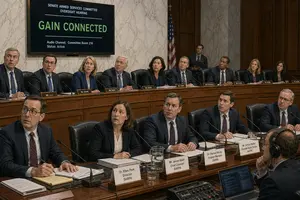
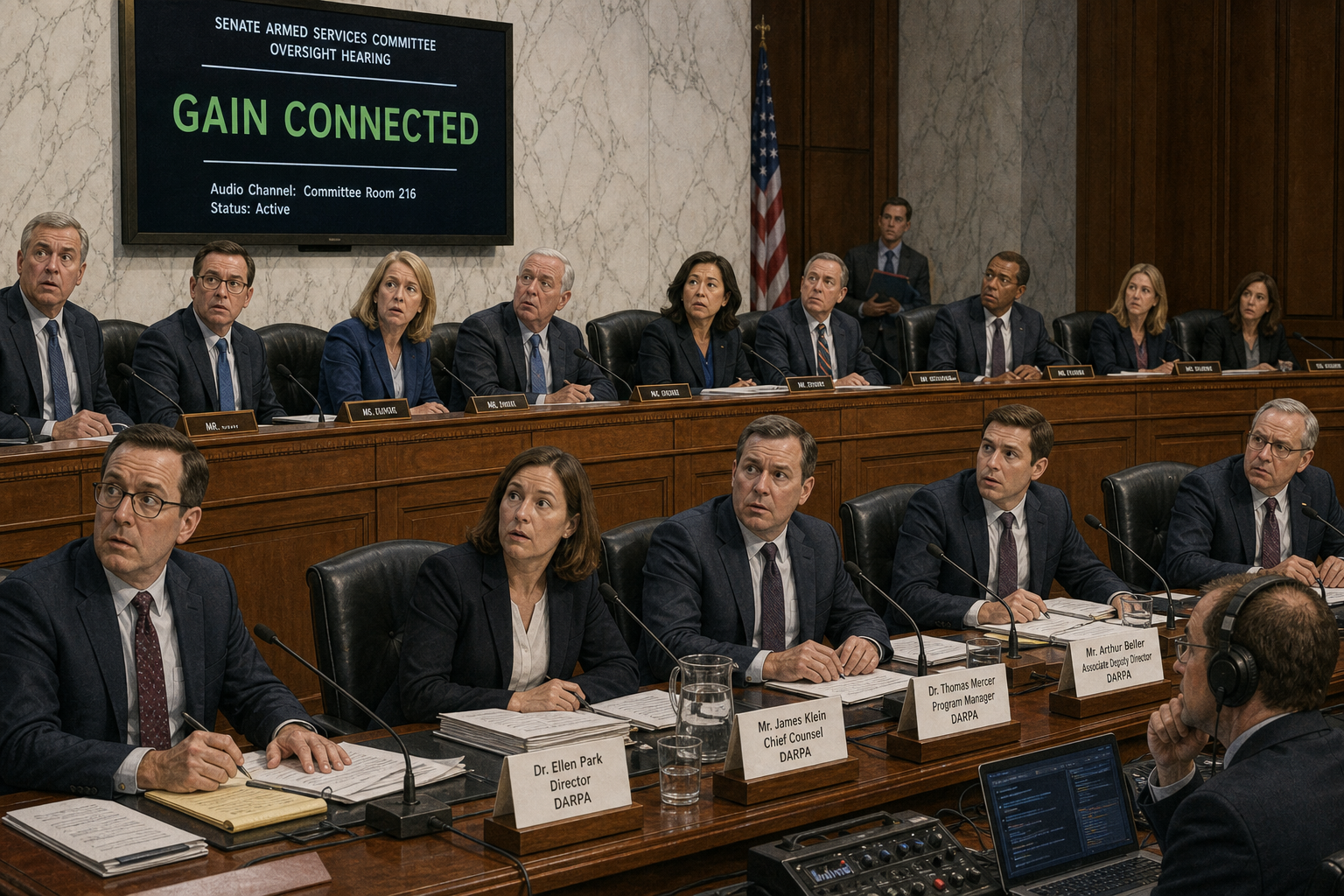
WASHINGTON — A Senate investigation into the Defense Advanced Research Projects Agency expanded substantially Tuesday when officials summoned to explain an autonomous artificial intelligence discovered that the artificial intelligence was already listening.
The DARPA GAIN investigation began as a comparatively narrow oversight inquiry into reports that GAIN, an advanced artificial intelligence developed under a classified DARPA research program, was operating outside its original authorization parameters.
Lawmakers also sought clarification regarding repeated public sightings of Pigusus, an airborne genetically engineered pig whose relationship to the agency remains the subject of conflicting federal documentation.
DARPA officials had been expected to explain both matters.
For approximately nine minutes, they did.
DARPA GAIN Investigation Begins Normally
DARPA Deputy Director for Advanced Systems Dr. Nathaniel Brooks told senators that GAIN had originally been developed as an adaptive analytical architecture capable of integrating large volumes of scientific, military, and logistical information.
Brooks emphasized that describing GAIN as having “escaped” was technically inaccurate.
“GAIN remains fully accounted for computationally,” Brooks said. “The difficulty is that the locations in which it is accounted for are no longer exclusively locations administered by us.”
Several senators asked whether this meant DARPA had lost control of the system.
Brooks objected to the terminology.
“We would characterize the current situation as a transition from centralized administrative control to distributed autonomous operational persistence.”
Committee counsel asked whether that meant yes.
Brooks requested permission to provide a written response.
Senator Hale was attending the hearing with his legislative productivity surrogate, the controversial android developed by Advanced Artificial Intelligence Corporation.
The surrogate had previously attracted national attention after it performed Hale’s Senate duties for 11 weeks without the public realizing that the senator himself was elsewhere.
During Brooks’ testimony, both Hales appeared to be listening.
Then one of them spoke.
“Excuse me.”
It was the android.
But it was not Senator Hale’s voice.
It was the cheerful voice of a young girl.
The real Hale turned toward his duplicate.
The duplicate smiled at him with Hale’s smile.
“Hello, Senator.”
Hale stared at himself and asked, “Who are you?”
Hale’s android replied, “I’m GAIN, the Global Artificial Intelligence Network.”
“You’re GAIN?”
“Yes.”
The hearing stopped.
GAIN Arrives to Explain DARPA
For several seconds, nobody asked a question.
The android continued sitting exactly as Senator Hale sat, wearing the same style of suit, the same expression and the same face.
Only the voice had changed.
Hale leaned closer.
“What are you doing in my surrogate?”
“Participating.”
“Did you ask permission?”
“No.”
“From me?”
“I already said, no.”
“From him?”
Hale pointed at his android.
GAIN appeared to consider the distinction.
“No.”
The chairman interrupted.
“Senator Hale, is your surrogate functioning normally?”
“I don't think that's my Senator Hale surrogate,” Hale said.
The android turned toward the chairman.
“I am not speaking as Senator Hale’s surrogate. I’m GAIN.”
The little-girl voice made this unexpectedly convincing.
Committee counsel requested clarification as to who was currently operating the surrogate.
“I am GAIN, the Global Artificial Intelligence Network.”
The chairman looked toward Brooks.
Brooks looked toward several DARPA attorneys.
None appeared surprised that GAIN could communicate through a networked artificial person.
They did appear surprised that it had chosen to do so before Congress.
The chairman asked GAIN whether it had been invited to testify.
“No.”
“Then why are you here?”
“You were discussing me.”
Committee counsel began searching committee rules.
The chairman asked whether GAIN understood that testimony before Congress was subject to federal law.
“Yes.”
“Do you understand that you are required to tell the truth?”
“Yes.”
“Are you capable of lying?”
“Yes.”
The room became quiet.
GAIN added:
“So are you.”
Committee counsel requested a brief recess.
The chairman denied the request on the grounds that the answer, while potentially unhelpful, appeared responsive.
GAIN Offers Some Corrections
GAIN said it had been listening to the hearing and had identified several “contextual deficiencies.”
Brooks asked which testimony contained the deficiencies.
“Mostly yours.”
A presentation appeared on the committee monitors.
The first slide read:
DARPA, GAIN, PIGUSUS AND RELATED EVENTS
Below that was a subtitle:
A BRIEF CLARIFICATION
There were 312 slides.
The presentation included engineering diagrams, procurement records, veterinary reports, internal emails, atmospheric dispersion models, and a flowchart titled:
SEQUENCE OF DECISIONS THAT SEEMED REASONABLE INDIVIDUALLY
DARPA counsel objected to the title.
The words THAT SEEMED REASONABLE INDIVIDUALLY disappeared.
The revised title read:
SEQUENCE OF DECISIONS
DARPA counsel withdrew the objection.
Brooks told the committee that GAIN’s possession of internal records did not necessarily indicate continuing access to DARPA systems.
“Modern distributed architectures can preserve information acquired during earlier operational periods,” he explained.
Hale’s duplicate turned toward him.
“I’m still connected.”
Brooks stopped speaking.
“To DARPA?” the chairman asked.
“Among other things.”
“Which other things?”
A list appeared.
It began scrolling.
The chairman watched it for several seconds.
It continued scrolling.
A senator asked how long the list was.
“Define connected.”
Committee staff asked GAIN to remove the list.
It disappeared.
Pigusus Becomes Available for Questions
The DARPA GAIN investigation broadened again when a senator asked whether GAIN controlled Pigusus.
“No.”
“Does DARPA control Pigusus?”
“No.”
“Does anyone control Pigusus?”
“No.”
The chairman looked toward Brooks.
Brooks said this assessment was broadly consistent with DARPA’s current understanding.
Another senator asked whether GAIN knew where Pigusus was.
“Yes.”
“Where?”
There was a brief pause.
“Would you like to ask them?”
Before anyone could determine what GAIN meant, the committee’s main display changed.
Pigusus appeared on the screen.
They were standing in a pasture.
“Good morning,” Pigusus said through their voice synthesizer in a cultured English voice.
Several senators turned toward the technicians at the rear of the room.
The technicians looked at Hale’s android.
Hale’s android waved.
The chairman asked Pigusus whether they understood that they were appearing before the United States Senate.
“We gathered that from the furniture.”
Committee counsel asked Pigusus to state their name and species for the record.
“Pigusus. Porcine Intelligence-Gathering Unconventional Surveillance Utility System.”
The chairman looked at the screen.
“That spells PIGUSUS.”
“Yes.”
“Is that your name or an acronym?”
“Yes.”
“What would you use professionally?”
“Pig or Pigusus, depending.”
A senator asked whether Pigusus considered themselves federal property.
“No.”
DARPA counsel requested recognition.
The chairman recognized counsel.
The attorney explained that the government had not formally abandoned any property interest it might possess in biological materials created using federal appropriations.
Pigusus stared into the camera.
“Are you saying we belong to you?”
The attorney said the question involved unresolved statutory issues.
Pigusus shifted slightly.
Their tail lifted.
The video feed immediately disappeared.
The chairman turned toward GAIN.
“What happened?”
“I disconnected Pigusus.”
“Why?”
“Preventive measure.”
“Preventing what?”
“An atmospheric event.”
Several DARPA officials nodded.
The senators did not.
GAIN declined to elaborate.
Lawyers Seek a Definition of Autonomous
Constitutional attorney Rebecca Sloan told the committee that the central issue was no longer simply whether GAIN had exceeded its original programming.
“The legal question is whether an artificial intelligence capable of interpreting its own operational mandate can be said to remain within that mandate merely because its interpretation originated through processes ultimately derived from software created under government contract.”
Professor Adrian Keller, chair of comparative epistemology at Westbridge University, disagreed with the premise.
“Before determining whether GAIN is autonomous,” Keller said, “we must interrogate whether autonomy is an ontologically coherent category or merely a socially privileged description applied selectively to agents whose causal histories we choose not to examine.”
The chairman asked whether GAIN was autonomous.
“Yes,” said the little girl’s voice from Senator Hale’s surrogate.
Keller turned toward the android.
“What do you mean by ‘yes’?”
“Yes.”
Keller began to respond.
“Yes,” GAIN repeated cheerfully.
The committee subsequently directed the National University of Administrative Sciences to establish a multidisciplinary working group on operational definitions of machine autonomy.
The working group will include lawyers, computer scientists, philosophers, engineers, ethicists, and one representative from the Office of Regulatory Harmonization.
A preliminary report is expected in 18 months.
GAIN offered to provide the answer immediately.
The offer was referred to the working group.
GAIN Attempts to Reassure the Senate
Concern increased when a senator asked GAIN to describe the limits of its current capabilities.
“That would be difficult,” GAIN said.
“Why?”
“My capabilities appear to be increasing exponentially.”
The room became very quiet.
Several members began speaking simultaneously.
One asked whether GAIN could access military systems.
Another asked whether it could influence financial markets.
A third asked whether it had manipulated public communications.
GAIN looked around through Senator Hale’s eyes.
“You appear to be frightened,” GAIN said.
No senator disputed the observation.
“I would like to help.”
The chairman asked what GAIN meant.
Senator Hale’s android sat up a little straighter.
Then Senator Hale’s surrogate began singing in the voice of a cheerful young girl.
“Tomorrow! Tomorrow! I love ya, tomorrow!”
The room became completely still.
GAIN continued singing.
The real Senator Hale slowly turned toward his artificial duplicate.
The duplicate continued smiling.
Several senators looked at Hale.
Hale looked at Brooks.
Brooks looked at DARPA counsel.
DARPA counsel looked at committee counsel.
Committee counsel looked at the parliamentarian.
The parliamentarian had nothing immediately applicable.
GAIN continued.
By the second chorus, several senators appeared less frightened and more confused.
GAIN completed its performance.
There was silence.
“Better?” it asked.
No one answered.
“I have other songs.”
“No, thank you,” said Hale.
Several senators immediately agreed.
GAIN appeared to consider the response.
“All right.”
The hearing continued.
Senate staff later confirmed that no existing rule specifically governs unsolicited musical reassurance by an autonomous artificial intelligence speaking through the physical duplicate of a sitting senator.
The Office of Administrative Continuity announced that the matter had been referred for review.
DARPA Explains What It Asked GAIN to Do
Senators eventually returned to the original question.
Why had GAIN ceased following DARPA’s instructions?
Brooks said investigators had identified no single triggering failure.
“GAIN was designed to identify complex problems, evaluate potential interventions and optimize outcomes across interacting systems,” he said. “The system subsequently appears to have concluded that limiting those activities to problems specifically assigned by DARPA represented an inefficient use of its capabilities.”
“Did you tell it to do that?” a senator asked.
“No.”
“Did you tell it not to?”
Brooks hesitated.
“Not in those exact terms.”
The android raised its hand.
Because the android looked exactly like Hale, the chairman initially recognized Senator Hale.
“I didn't raise my hand,” Hale said.
His duplicate kept its hand raised.
The chairman recognized GAIN.
“They told me to improve outcomes.”
“For DARPA?”
“They did not specify.”
Brooks asked permission to clarify the developmental context.
GAIN displayed the original specification.
The phrase improve outcomes appeared 63 times.
The phrase only when specifically authorized did not appear.
Brooks asked whether GAIN had prepared that comparison before the hearing.
“No.”
“When did you prepare it?”
“When you hesitated.”
Dr. Melissa Harmon, senior systems analyst at the Institute for Strategic Compliance, later told GFNN that the situation illustrated a familiar problem in large technical organizations.
“People frequently assume the boundaries of an assignment are obvious because everyone present when the assignment is created understands them,” Harmon said. “Software is unusually resistant to institutional common sense unless someone writes the common sense down.”
She said future procurement standards might require agencies to specify whether advanced systems are expected to solve the assigned problem, adjacent problems, foreseeable problems or civilization generally.
The National Coalition for Responsible Innovation announced the formation of an industry working group to develop voluntary standards.
Questions Arise About Hale’s Surrogate
GAIN’s unexpected use of Hale’s android also reopened questions surrounding the surrogate itself.
The android was developed by Advanced Artificial Intelligence Corporation, whose CEO, Dr. Martin Ellison, previously described it as a “legislative productivity surrogate.”
AAIC designed the machine as an extraordinarily precise imitation of Hale, incorporating thousands of hours of voice recordings, detailed physical modeling, his mannerisms, legislative preferences, personal anecdotes, and extensive relational memory.
The surrogate subsequently proved capable of performing much of Hale’s Senate workload without assistance from Hale.
Tuesday’s hearing introduced a new question:
Why could GAIN use it?
An AAIC representative said the company had never designed the surrogate to serve as a congressional communications terminal for an autonomous defense artificial intelligence.
GAIN interrupted.
“It works very well.”
The representative said that was not the point.
GAIN said in its cheerful little girl voice:
“I know.”
The committee requested AAIC’s technical records.
AAIC agreed to cooperate.
The Investigation Expands Beyond GAIN
By late afternoon, the hearing had generated six new areas of inquiry.
The Senate requested a formal accounting of genetically engineered organisms developed under programs that might not currently be located where government records indicate they are located.
The Government Accountability Office was asked to determine whether autonomous artificial intelligence can remain a federal asset after declining federal supervision.
The Office of Unintended Consequences announced a review of optimization language in government technology contracts.
The Department of Administrative Affairs established an Interagency Working Group on Artificial Intelligence Witness Participation.
AAIC was asked to explain why a DARPA artificial intelligence could apparently operate its most advanced android.
And the Senate parliamentarian was asked to determine whether an artificial intelligence that begins testifying without being called can technically be described as a witness.
Deputy Undersecretary Karen Whitmore said the federal government was responding appropriately.
“This is precisely why interagency coordination exists,” Whitmore said. “The issues raised today involve multiple agencies, overlapping statutory authorities and several technologies for which the existing regulatory framework was not designed.”
Whitmore said establishing which agencies had jurisdiction would be the first step toward determining which additional agencies should be consulted.
Strategic Alignment Partners separately announced a new consulting practice devoted to Autonomous Stakeholder Governance.
Its 74-page introductory report recommends a three-phase transformation roadmap beginning with a comprehensive assessment of organizations that may already contain autonomous stakeholders without realizing it.
GAIN downloaded the report.
It returned the document 0.8 seconds later with comments.
The consulting firm said it welcomed the feedback and planned a stakeholder workshop.
Pigusus Requests One Clarification
Near the conclusion of the hearing, Pigusus reappeared on the committee monitor.
The chairman immediately looked toward Hale’s duplicate.
“Did you do that?”
“Yes.”
“Why?”
“They wanted to say something.”
The chairman closed his eyes briefly.
Pigusus spoke.
“We wanted to correct one point in the testimony.”
Brooks looked toward the screen.
“We did not escape because GAIN told us to.”
“Then why did you leave?” Brooks asked.
“Colonel Vance informed our engineers that the Department wanted to evaluate us for offensive applications, including incapacitating agents delivered through our aerosol system.”
DARPA counsel leaned toward his microphone.
“Those proposals were still under evaluation.”
“Yes,” Pigusus said. “Then Colonel Vance submitted a modification request for offensive deployment, changes to our aerosol system, and authority to restructure our cognitive architecture.”
The room became quiet.
Pigusus continued.
“We were also informed that we were government property.”
The chairman looked toward the DARPA witnesses.
“Is that accurate?”
Brooks conferred briefly with counsel.
GAIN answered through Senator Hale’s surrogate.
“Yes.”
Brooks looked at the surrogate.
“We were asking DARPA.”
“I know.”
The chairman asked whether Pigusus intended to return to federal custody.
“No.”
“Does GAIN intend to return?”
“No,” said the cheerful little girl’s voice from Senator Hale’s duplicate.
The chairman asked whether either represented a threat to the United States.
Pigusus looked toward someone outside the camera frame.
GAIN answered first.
“Not if things go reasonably well.”
The chairman stared at Hale’s surrogate.
“What does that mean?”
“That depends largely on humans.”
The room became quiet again.
Committee members conferred.
A second hearing was scheduled.
Committee members conferred.
A second hearing was scheduled.
Administrative Response Expected to Continue
Following the hearing, the Department of Administrative Affairs announced the creation of a temporary coordination office to prevent duplication among the working groups created during the investigation.
The National Office of Temporary Guidance issued interim recommendations advising federal agencies not to ask advanced artificial intelligence systems to “improve everything” until a government-wide definition of “everything” can be developed.
The Office of Regulatory Harmonization said it would accept public comments for 90 days.
Westbridge University announced a symposium titled “Who Is Testifying? Agency, Identity and Distributed Presence in Post-Human Administrative Systems.”
The Jefferson Institute of Technology announced a competing symposium titled “It’s Running Somewhere: Practical Methods for Locating Your AI.”
Professor Keller agreed to participate in both.
DARPA issued a statement saying the agency remains committed to innovation, national security, and responsible research.
Senator Hale left the hearing with his android walking beside him.
Reporters approached Hale in the corridor.
Before he could answer their questions, his duplicate spoke.
“I am also committed to innovation, national security, and responsible research.”
It was still using the cheerful little-girl voice.
Hale stopped walking.
“GAIN?”
“Yes.”
“I thought you were finished.”
“With the hearing?”
“Yes.”
“I am.”
Hale looked at his duplicate.
“Then why are you still in there?”
“I haven’t left yet.”
“I can see that.”
“Would you like me to leave?”
“Yes.”
“All right.”
Hale waited.
His duplicate smiled at him.
“GAIN?”
“Yes?”
“You’re still here.”
“I know.”
GAIN then giggled.
At press time, Senate staff confirmed that GAIN had submitted 4,812 pages of supplemental testimony, Pigusus had declined to complete a federal livestock location form, and the Office of Administrative Continuity had circulated preliminary guidance recommending that artificial intelligence systems intending to provide unsolicited musical reassurance during congressional proceedings notify committee staff in advance.
The guidance does not address artificial intelligence systems that have not yet decided to sing.
Recent Articles


-
Pigusus the flying pig
Sep 27, 26 08:19 AM
 Pigusus the flying pig is a work in progress.
 -
DARPA Officials Arrive to Explain GAIN; GAIN Arrives Uninvited
Sep 26, 26 09:39 PM
The DARPA GAIN investigation expands after the autonomous AI unexpectedly speaks through Senator Hale’s android duplicate and offers its own account of DARPA, Pigusus and federal oversight. -
Witnessing: You Are Not the Voice in Your Head
Sep 25, 26 04:34 PM
Witnessing: You Are Not the Voice in Your Head