Guaranteed Weight Loss Plan: Finally, A Weight Loss Program That Actually Works

After decades of research, nutritional scientists announce a breakthrough that threatens the entire weight-loss industry.
After decades of nutritional controversy, scientific investigation, commercial innovation, and considerable personal observation, I am announcing a revolutionary weight-loss program requiring no special equipment, proprietary supplements, or recurring monthly payments.
At long last, I have discovered a guaranteed weight-loss plan.
This breakthrough follows decades of lived experience, extensive scientific research, and careful observation of an industry that has managed to transform the relatively straightforward business of eating into one of the most commercially sophisticated enterprises in human history.
We have witnessed the rise of carbohydrate restriction, fat restriction, intermittent fasting, ancestral diets, metabolic optimization, juice cleanses, detoxification programs, celebrity fitness systems, proprietary meal replacements, expensive supplements, wearable electronics, injectable medications, and nutritional philosophies that attribute extraordinary powers to foods previously regarded as ordinary vegetables.
Entire careers have been devoted to explaining why people gain weight. Entire corporations have been established to help them lose it. Millions of consumers have purchased books, subscriptions, powders, coaching programs, and electronic devices designed to assist them in accomplishing something their grandparents generally understood without consulting a registered dietitian.
Having considered these developments, I am prepared to announce what may be the most important contribution to weight management since the invention of the smaller serving.
DON'T EAT SO MUCH FATSO!
That's the plan.
Thank you for visiting.
Unfortunately, experience suggests that some readers will require additional explanation.
Why Most Diets Fail
The modern weight-loss industry operates on a commercially inconvenient biological principle: sustained weight loss generally requires the body to obtain less energy from food than it expends over time.
There are complications, of course. Human appetite is influenced by hormones, sleep, stress, medications, genetics, food availability, and a remarkable collection of biological mechanisms that evolved long before the invention of the drive-thru window.
These complications are genuine. Some people face substantially greater difficulty managing their weight than others, and effective medical treatments can make a meaningful difference.
Nevertheless, the existence of biological complexity has created an extraordinary commercial opportunity.
Rather than explaining the underlying principle and helping people address the obstacles to following it, much of the weight-loss marketplace has devoted itself to selling increasingly elaborate methods of accomplishing essentially the same objective.
One company recommends eating fewer carbohydrates. Another recommends eating fewer fats. A third recommends eating only during certain hours. A fourth sells prepared meals containing fewer calories than the meals customers would otherwise prepare themselves.
A fifth offers an expensive application that informs subscribers, through attractive graphics and motivational notifications, that they have eaten too much.
All five may produce results.
The difficulty arises when customers conclude that purchasing the system constitutes compliance with the system.
A person may subscribe to three nutritional programs, purchase a fitness tracker, join an online accountability community, and acquire enough protein powder to provision a small military installation without making any meaningful change to the quantity of food entering their mouth.
The resulting disappointment is frequently attributed to an unsuitable program.
Another program is then purchased.
This arrangement has proved commercially sustainable.
The Coffee Beverage Problem
Consider the modern coffee beverage.
Coffee was once a relatively simple preparation involving roasted beans, hot water, and, occasionally, milk or sugar.
Today, certain coffee establishments offer beverages containing whipped cream, caramel syrup, chocolate syrup, flavored sweeteners, cold foam, and cookie fragments. Some contain more calories than an entire meal, yet consumers continue to regard them as coffee rather than dessert.
I drink coffee black, with no sugar, and I like the taste of genuine dark, French-roasted coffee. I once bought a cup of black coffee at a Starbucks with no sugar. It was undrinkable.
Starbucks sells poor-quality coffee, knowing most customers will order it loaded with so many unhealthy, fattening ingredients that they can't taste the coffee.
A plain black coffee generally contains fewer than five calories.
A large specialty beverage, depending on its ingredients and size, may contain several hundred calories. Particularly elaborate preparations can approach or exceed the energy content of a substantial meal.
The customer, however, has not ordered a meal.
The customer has ordered coffee.
This distinction is psychologically important.
A person who would never consider eating a large dessert before breakfast may happily consume its caloric equivalent through a straw while driving to work.
The beverage is not regarded as food because it arrived in a cup bearing the name of a coffee establishment.
Later, when reviewing the day's nutritional intake, the customer may remember having eaten a modest breakfast, a sensible lunch, and a reasonably restrained dinner.
The two elaborate coffee beverages have somehow escaped the investigation.
The bathroom scale, unfortunately, does not recognize the distinction between calories consumed from a plate and calories consumed from a cup.
This has led to repeated accusations that bathroom scales are inaccurate.
Independent investigations generally fail to support these allegations.
The Extraordinary Human Capacity for Nutritional Negotiation
One of the most fascinating aspects of weight management is the human ability to negotiate with non-negotiable facts.
Consider the following observations:
- A cookie eaten while standing beside the refrigerator is frequently regarded as less consequential than a cookie eaten while sitting at a table.
- Food consumed directly from its original packaging is sometimes excluded from the category of a meal.
- A restaurant appetizer shared with another person may be considered nutritionally insignificant, even when both participants consume enough to constitute a complete dinner.
- Foods labeled organic, natural, artisanal, or responsibly sourced are often assumed to possess properties that exempt them from ordinary arithmetic.
- A package labeled "family size" may be interpreted as a suggestion rather than a description.
- Food remaining on a child's plate can become the responsibility of a parent who has already finished eating.
- A dessert purchased to celebrate an accomplishment may be considered emotionally necessary, regardless of how many accomplishments have occurred that week.
None of these practices necessarily causes weight gain. The difficulty is that people are extraordinarily talented at constructing explanations for why individual decisions should not count toward the cumulative total.
A single cookie is insignificant.
So is a second cookie.
A third cookie is merely an extension of the original decision.
By the sixth cookie, the consumer may reasonably conclude that the package is nearly empty and that leaving two cookies behind would accomplish very little.
The package is therefore finished.
The following morning, the consumer begins a new weight-loss program.
Frequently Asked Questions
Can I still eat dessert?
Certainly.
Dessert is not prohibited under the Guaranteed Weight Loss Plan. The program merely questions whether dessert must be served in quantities appropriate for a wedding reception.
What about my metabolism?
Your metabolism is a complex biological system, not a defective household appliance.
Metabolic rates vary, and the body can adapt to changes in energy intake and expenditure. These are legitimate considerations, particularly for people who have repeatedly lost and regained weight.
Nevertheless, the existence of metabolic adaptation does not establish that a person can routinely consume unlimited quantities of food without consequences.
Do I need to count calories?
Not necessarily.
Some people find calorie tracking useful. Others find that smaller portions, fewer calorie-dense beverages, more satisfying meals, and consistent eating habits accomplish the same practical objective.
The program does not require the purchase of an electronic device to confirm that a second large serving contains more food than no second serving.
What about fat-burning supplements?
The supplement industry has developed an impressive vocabulary for describing products whose effects are frequently less impressive than their advertising.
Terms such as metabolic activation, thermogenic optimization, and advanced fat mobilization can make ordinary ingredients sound like classified discoveries from a government laboratory.
Consumers should remember that a proprietary name is not evidence of clinical effectiveness.
Are weight-loss medications cheating?
No.
Modern prescription treatments can produce substantial, clinically meaningful weight loss for appropriate patients. Some work partly by reducing appetite and improving the body's regulation of food intake.
These are genuine medical advances, not merely expensive substitutes for self-discipline.
The Guaranteed Weight Loss Plan has no objection to effective medical treatment.
It does, however, reserve the right to observe that a medication costing hundreds of dollars per month may accomplish part of its purpose by making a person less inclined to eat the food they previously found difficult to resist.
Medical science deserves credit for helping people overcome that difficulty.
The pharmaceutical marketing department does not necessarily require a standing ovation.
Is exercise required?
Physical activity offers important cardiovascular, metabolic, muscular, and psychological benefits. It can also assist with weight management and help maintain weight loss.
Unfortunately, the amount of energy expended during exercise is often considerably less than people imagine.
A long walk is an excellent activity.
It does not automatically cancel the nutritional consequences of consuming an entire cheesecake afterward.
Are any foods forbidden?
No.
The Guaranteed Weight Loss Plan supports nutritional freedom, personal responsibility, and the continued legal availability of cheesecake.
It also supports putting some of the cheesecake back into the refrigerator.Advanced Weight Loss Techniques
Once participants have mastered the fundamental principle, they may wish to explore more sophisticated interventions.
These techniques have been selected for their practicality, affordability, and lack of commercial potential.
The Smaller Plate Method
Place a reasonable serving of food on a smaller plate.
The plate may appear full despite containing less food.
This technique exploits the human tendency to evaluate quantities visually rather than mathematically.
No electronic equipment is required.
The Refrigerator Preservation Method
When removing ice cream from the freezer, transfer an appropriate serving into a bowl and return the container to the freezer.
This prevents the gradual disappearance of an entire carton during a television program.
The method is particularly effective when the carton is returned before the program begins.
The Beverage Recognition Protocol
Acknowledge that beverages can contain substantial quantities of energy.
This includes sweetened coffee drinks, soft drinks, juices, alcoholic beverages, and other liquids whose calories may be overlooked because they do not require chewing.
Water remains available without a subscription.
The Second-Helping Assessment
Before obtaining another serving, determine whether you are still hungry or simply enjoying the experience of eating.
Both explanations are understandable.
Only one necessarily indicates a continuing need for food.
The Grocery Store Prevention Strategy
Avoid purchasing large quantities of foods that you consistently consume in excess.
This may be more effective than purchasing them and relying on extraordinary willpower every evening.
The food industry has spent considerable resources making products attractive, convenient, and difficult to stop eating.
Consumers are under no obligation to assist these efforts by maintaining an emergency inventory of their greatest temptations.
The Science Behind the Guaranteed Weight Loss Plan
The Guaranteed Weight Loss Plan rests on principles that have resisted advertising, political pressure, and consumer dissatisfaction. Despite the complexities of human metabolism, one principle remains particularly difficult to dispute.
Thermodynamics
The human body requires energy to function.
Food supplies that energy.
When energy intake consistently exceeds expenditure, the surplus can contribute to increased body energy stores. When intake remains below expenditure, the body must draw upon stored energy.
The actual process involves complex hormonal regulation, metabolic adaptation, changes in activity, and variations in appetite. Human bodies are not simple furnaces, and weight change is not perfectly predictable from a single arithmetic formula.
Nevertheless, thermodynamics remains an important consideration.
Attempts to circumvent its consequences without expensive surgery or drug therapies have generally been unsuccessful.
Biology
Human beings evolved in environments where food availability was often uncertain.
The ability to store energy provided a substantial survival advantage.
Our ancestors did not have continuous access to supermarkets, convenience stores, vending machines, food delivery applications, or restaurant portions large enough to feed several members of a hunting party.
Modern food environments are dramatically different.
The biological systems governing appetite and energy storage, however, have not undergone a corresponding redesign.
This creates an unfortunate situation in which ancient survival mechanisms encounter twenty-four-hour access to pizza.
Biology has not yet developed a reliable defense against promotional offers involving two large pizzas for the price of one.
Basic Arithmetic
Weight management frequently involves a branch of mathematics known as addition.
Consider a hypothetical daily intake consisting of breakfast, lunch, dinner, snacks, sweetened beverages, restaurant appetizers, dessert, and alcoholic drinks.
Each item may appear reasonable when evaluated separately.
The difficulty becomes apparent when the quantities are added together.
Unfortunately, calories consumed during celebrations, vacations, stressful afternoons, business meetings, and late-night television viewing remain eligible for inclusion in the total.
There is no scientifically recognized exemption for food consumed while emotionally distressed by the evening news.
Gravity: It's Not Just a Good Idea, It's a Law!
Gravity is not directly responsible for weight gain.
It does, however, make the consequences of carrying additional body mass considerably more noticeable.
Climbing stairs, walking long distances, and rising from low furniture can become more physically demanding as body weight increases.
The Guaranteed Weight Loss Plan acknowledges that joint conditions, disability, aging, and numerous other factors also influence mobility.
Nevertheless, gravity has declined to adjust its policies in response to consumer complaints.
Pants
Pants represent one of the oldest forms of practical body-size monitoring.
Unlike electronic scales, they require no batteries, calibration, wireless connectivity, or monthly software updates.
A pair of pants that previously fit comfortably may become increasingly reluctant to cooperate.
The wearer may initially attribute this development to laundering practices, changes in textile manufacturing, or an unexplained deterioration in garment quality.
Repeated purchases of larger pants may eventually suggest an alternative explanation.
The Guaranteed Weight Loss Plan does not regard clothing size as a measure of personal worth.
It merely observes that trousers have no commercial incentive to conceal changes in waist circumference.
Mirrors and Photographs
Mirrors and photographs have traditionally played a role in personal appearance assessment.
They are, however, unreliable instruments for evaluating health, body composition, or nutritional status.
Lighting, camera angles, posture, clothing, and ordinary variations in human anatomy can substantially influence appearance.
For these reasons, the Guaranteed Weight Loss Plan does not recommend using photographs as a medical diagnostic system.
It does recognize a curious behavioral phenomenon: people often distrust photographs that contradict their preferred understanding of themselves.
The camera is accused of adding ten pounds.
The lighting is unfavorable.
The angle is unfortunate.
After numerous photographs taken by several different people, the investigation may become increasingly difficult to sustain.
The Commercial Problem With Simple Solutions
The principal weakness of the Guaranteed Weight Loss Plan is not scientific.
It is commercial.
A program advising people to eat somewhat less does not naturally support an elaborate corporate structure.
There are no proprietary ingredients, patented food combinations, exclusive nutritional discoveries, or complicated electronic devices.
The program requires no specialized membership.
Participants cannot reasonably be charged a monthly subscription for access to the concept of mindful eating.
This represents a serious obstacle to investor enthusiasm.
Modern commercial weight management depends heavily upon differentiation. Each new product must explain why it offers something meaningfully different from the products already available.
Consequently, relatively ordinary recommendations are frequently repackaged using impressive terminology.
Eating fewer calories becomes strategic energy modulation.
Avoiding unnecessary snacks becomes behavioral intake optimization.
Eating dinner earlier becomes circadian nutritional alignment.
Walking after a meal becomes postprandial metabolic activation.
Drinking water becomes cellular hydration support.
The underlying practices may be useful.
The vocabulary is what makes them expensive.
The Guaranteed Weight Loss Plan has considered adopting similar terminology.
After extensive deliberation, management has elected to retain the original message:
DON'T EAT SO MUCH FATSO!
The marketing department has expressed reservations.
Introducing the Premium Platinum Elite Weight Loss Experience
Following repeated inquiries from consumers who find inexpensive advice insufficiently reassuring, I am pleased to announce the development of an exclusive premium version of the program.
For only $4,999, participants will receive:
- A professionally formatted framed poster on premium paper containing the complete weight-loss recommendation.
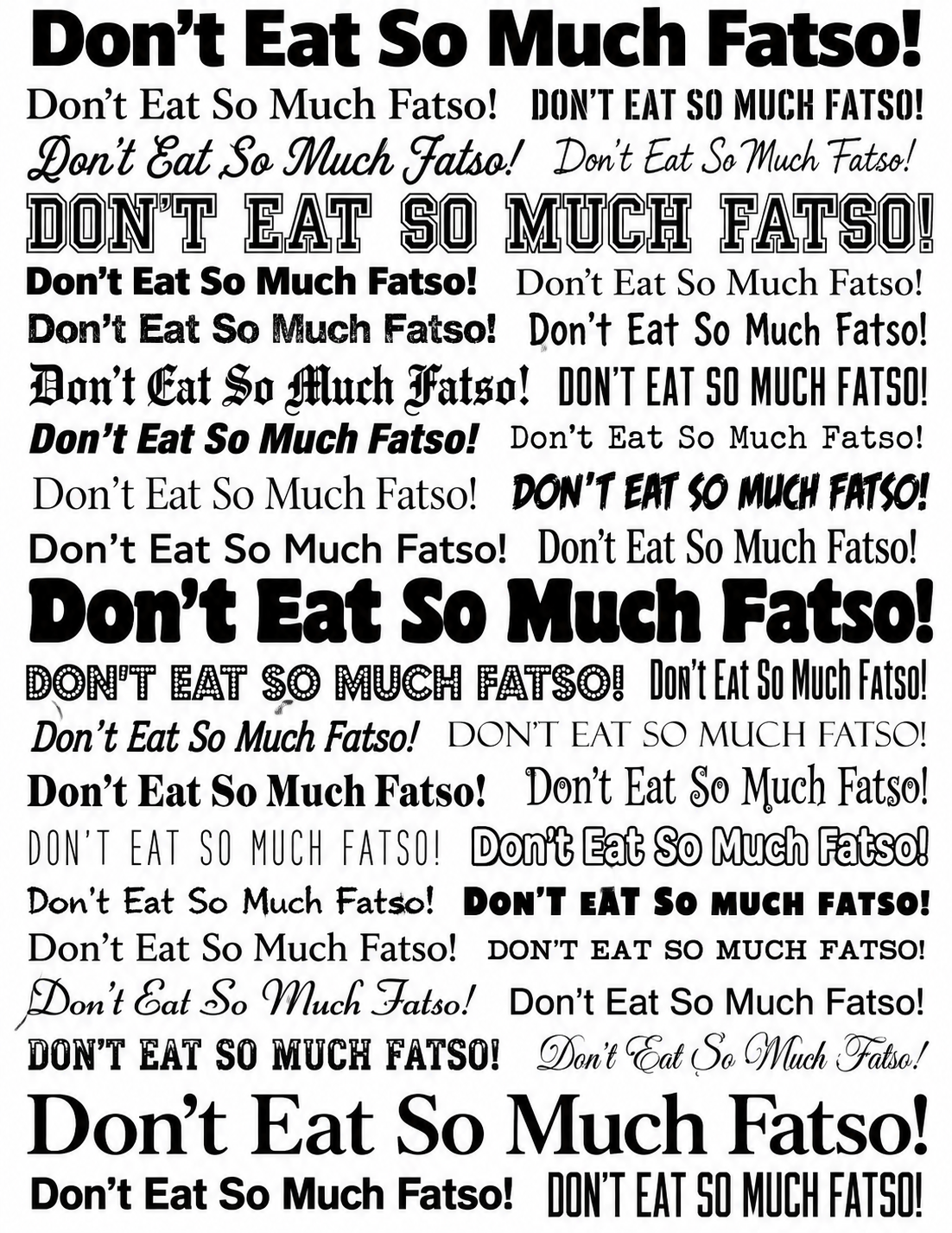
- A stainless steel water bottle engraved with the program's motivational slogan. DON'T EAT SO MUCH FATSO!
- Twelve monthly motivational emails reminding subscribers of the original recommendation.
- A laminated certificate recognizing their commitment to nutritional transformation.
- Access to a private online community where participants can discuss plate sizes, metabolism, and the possibility that the program is too simple to work.
- A personalized progress worksheet featuring several columns and an inspirational quotation.
- An exclusive invitation to purchase the forthcoming Executive Platinum Renewal Package.
Participants who complete the program may qualify for an advanced certification in Personal Nutritional Awareness and may participate in our mentorship program.
Certification requires demonstrating familiarity with the fundamental principles and submitting the appropriate processing fee.
For an additional charge, participants may purchase a commemorative plaque recognizing the successful completion of their weight-loss journey.
Guaranteed Weight Loss Plan Book Publication Status
After the congressional hearing and some soul-searching, the book version of the Guaranteed Weight Loss Plan has been permanently withdrawn from publication.
This decision should not be interpreted as dissatisfaction with sales.
The book may have remained commercially successful, medically controversial, psychologically unsettling, and sufficiently influential to prompt more congressional hearings and multiple federal reviews.
The original manuscript consisted of 439 pages.
Each page contained essentially the same recommendation, presented with minor variations in typography, emphasis, and punctuation.
Early readers praised the message's consistency.
Literary scholars recognized it as artistic expression.
Others questioned whether the material justified its length.
Several complained that the book became repetitive after approximately page six.
A few suggested that the author was deliberately wasting their time.
I considered these criticisms carefully and ultimately concluded that publishing a 439-page book containing the same sentence thousands of times might be unnecessary.
The complete program could be communicated in considerably less space.
In fact, it could be communicated in five words.
This discovery rendered the publishing project commercially awkward.
I therefore withdrew the book and made the underlying recommendation available without charge.
The decision represents a substantial personal sacrifice.
Final Thoughts
The modern world has developed an extraordinary capacity to complicate simple matters.
Weight management is genuinely difficult for many people. Biological regulation, food environments, emotional habits, economic circumstances, medical conditions, and individual differences can make sustained weight loss a formidable challenge.
Recognizing those difficulties is important.
It is equally important to recognize that complexity does not automatically make a solution more effective.
A sophisticated nutritional program may help someone establish better habits. Medical treatment may be appropriate and highly beneficial. Professional guidance may provide essential support.
But purchasing an elaborate system is not the same as changing one's behavior, and impressive terminology does not exempt anyone from the biological consequences of their habits.
The Guaranteed Weight Loss Plan offers no miracle.
It does not promise effortless transformation, secret metabolic activation, or permanent results from a temporary intervention.
Its central recommendation is so embarrassingly straightforward that entire industries have developed around making it sound more complicated.
Eat reasonably.
Choose satisfying, nutritious foods.
Limit portions and eliminate calorie-dense beverages.
Remain physically active as your circumstances permit.
Make changes you can sustain.
And, when appropriate, consider the original recommendation:
DON'T EAT SO MUCH FATSO!
I realize this message lacks the excitement of biohacking your mitochondrial fat-adaptation pathways through alkaline turmeric fasting.
It also lacks a monthly subscription fee.
I apologize for both deficiencies.
Are you interested in a longer healthspan and a sustainable approach to weight management that goes beyond a single sentence?
See: Longevity Secrets For Men, Women, Even Them Non-Binaries!
Recent Articles


-
Jake Sullivan Denies Intentionally Prolonging the Ukraine War
Oct 27, 26 09:36 PM
 Jake Sullivan denies intentionally prolonging the Ukraine war as Congress examines military aid decisions, Russian attrition, and the human cost of restraint.
-
Was Merrick Garland Waiting for Trump to Die of Natural Causes?
Oct 25, 26 01:36 PM
Congress examines Merrick Garland's delays, Trump's return to power, and the humanitarian consequences of government decisions left unresolved. -
The Pigusus Saga Chapter One Pardon Us
Oct 24, 26 08:23 PM
The Pigusus Saga, Chapter One: A DARPA-engineered flying pig discovers a disturbing military agenda and escapes with help from a mysterious artificial intelligence.