
Jake Sullivan Denies Intentionally Prolonging the Ukraine War
GFNN continues to support legacy information delivery technologies, including written language. The following is the text version of today's report.
Continuity Notice: This report may be read in its entirety without receiving additional information between paragraphs.
WASHINGTON — Former National Security Adviser Jake Sullivan denied during a congressional hearing that the Biden administration intentionally prolonged the war in Ukraine by providing sufficient military assistance to prevent a Russian victory while withholding capabilities that might have enabled Ukraine to defeat Russian forces more quickly.
Sullivan defended the administration's incremental approach to military assistance, emphasizing the risks of escalation with a nuclear-armed adversary and the importance of preserving Ukrainian independence without involving American forces directly in the conflict.
The hearing is part of a broader congressional investigation into whether the administration's publicly acknowledged objective of weakening Russia influenced decisions concerning the quantity, timing, and operational restrictions associated with American weapons deliveries.
Investigators are examining whether the strategic benefits of Russian military attrition were considered alongside the humanitarian consequences of a prolonged conflict.
Sullivan rejected suggestions that the administration deliberately calibrated military assistance to maximize Russian casualties.
"Our objective was to support Ukraine's sovereignty and territorial integrity while managing the substantial escalation risks associated with direct confrontation between nuclear powers," Sullivan told the committee. "We did not establish the duration of the conflict as an independent strategic objective."
Asked whether weakening Russia was an American objective, Sullivan acknowledged that reducing Russia's ability to undertake future aggression was consistent with American national security interests.
The committee chairman asked whether the administration had considered the possibility that those interests might be served by a conflict lasting considerably longer than Ukraine would have preferred.
Sullivan replied that American policy was designed to help Ukraine determine its own future.
"Within the parameters established by the United States?" the chairman asked.
"Within the broader framework of responsible security assistance," Sullivan answered.
Sullivan Questioned About the Definition of Ukrainian Victory
The hearing's first extended exchange concerned the Biden administration's definition of success.
Committee investigators presented a chronology of decisions involving advanced aircraft, long-range missiles, air defense systems, and restrictions on the use of American-supplied weapons against targets inside Russia.
Sullivan explained that the administration continuously adjusted its assistance in response to changing battlefield conditions, intelligence assessments, allied consultations, and the risk of escalation.
"We were not operating according to a static definition of victory," he said. "Our approach reflected an evolving assessment of achievable military outcomes and the conditions necessary for a durable settlement."
The chairman asked whether the administration had ever adopted the defeat of Russian forces as an operational objective.
"We supported Ukraine's ability to defend itself successfully."
"Was successfully defending itself the same as winning?"
"That depends on how victory is defined."
"Who defined it?"
"Ultimately, the Ukrainians."
"Could the Ukrainians obtain any weapons they considered necessary to achieve their definition?"
"No. American assistance decisions necessarily reflected American national security considerations."
"So Ukraine defined victory, but the United States determined which capabilities Ukraine could employ in pursuing it?"
"That is an incomplete characterization of a complex security relationship."
The committee's legal counsel subsequently recommended establishing separate definitions for Ukrainian victory, American strategic success, Russian defeat, Russian military degradation, and an acceptable negotiated settlement.
Members agreed that the terms should not be treated as interchangeable until their relationships had been formally evaluated.
The chairman directed staff to prepare a preliminary terminology report before the next hearing.
Congressional Investigators Examine Russian Attrition
The committee next examined the administration's stated interest in diminishing Russia's military capabilities.
Investigators cited former Defense Secretary Lloyd Austin's April 2022 declaration that the United States wanted Russia weakened sufficiently to prevent it from conducting similar military operations in the future.
Sullivan agreed that Russian military degradation was a desirable consequence of Ukraine's successful resistance.
He disputed the suggestion that the administration sought to prolong the fighting to achieve additional Russian losses.
"Russian attrition was a consequence of Russia's decision to invade Ukraine," he testified. "It was not a justification for extending the conflict."
A committee member asked whether the administration had regularly evaluated Russian military losses.
"Yes."
"Personnel losses?"
"Yes."
"Equipment losses?"
"Yes."
"Degradation of Russian combat effectiveness?"
"Of course."
"Were favorable developments in those assessments reported as evidence of strategic progress?"
"Where appropriate."
"Did you maintain an equivalent measure of the additional Ukrainian civilian and military casualties potentially associated with delaying specific weapons deliveries?"
Sullivan explained that estimating casualties under hypothetical alternative military assistance scenarios involved substantial methodological uncertainty.
The committee member asked whether Russian losses were also subject to uncertainty.
"Naturally."
"But you were able to use those estimates in evaluating strategic progress?"
"With appropriate qualifications."
The chairman requested that the administration's former national security staff provide documentation explaining why uncertainty was sufficiently manageable for measuring Russian military degradation but presented greater difficulties when evaluating the potential humanitarian costs of delayed assistance.
Economists Asked to Calculate the Cost of Strategic Restraint
The committee subsequently heard testimony from Dr. Alan Prescott, senior economist at the Center for Regulatory Excellence, who had been asked to examine the economic consequences of American military assistance to Ukraine.
Prescott explained that the financial structure of the assistance program was considerably more complicated than the public accounting suggested.
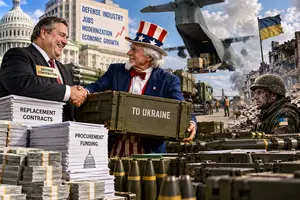
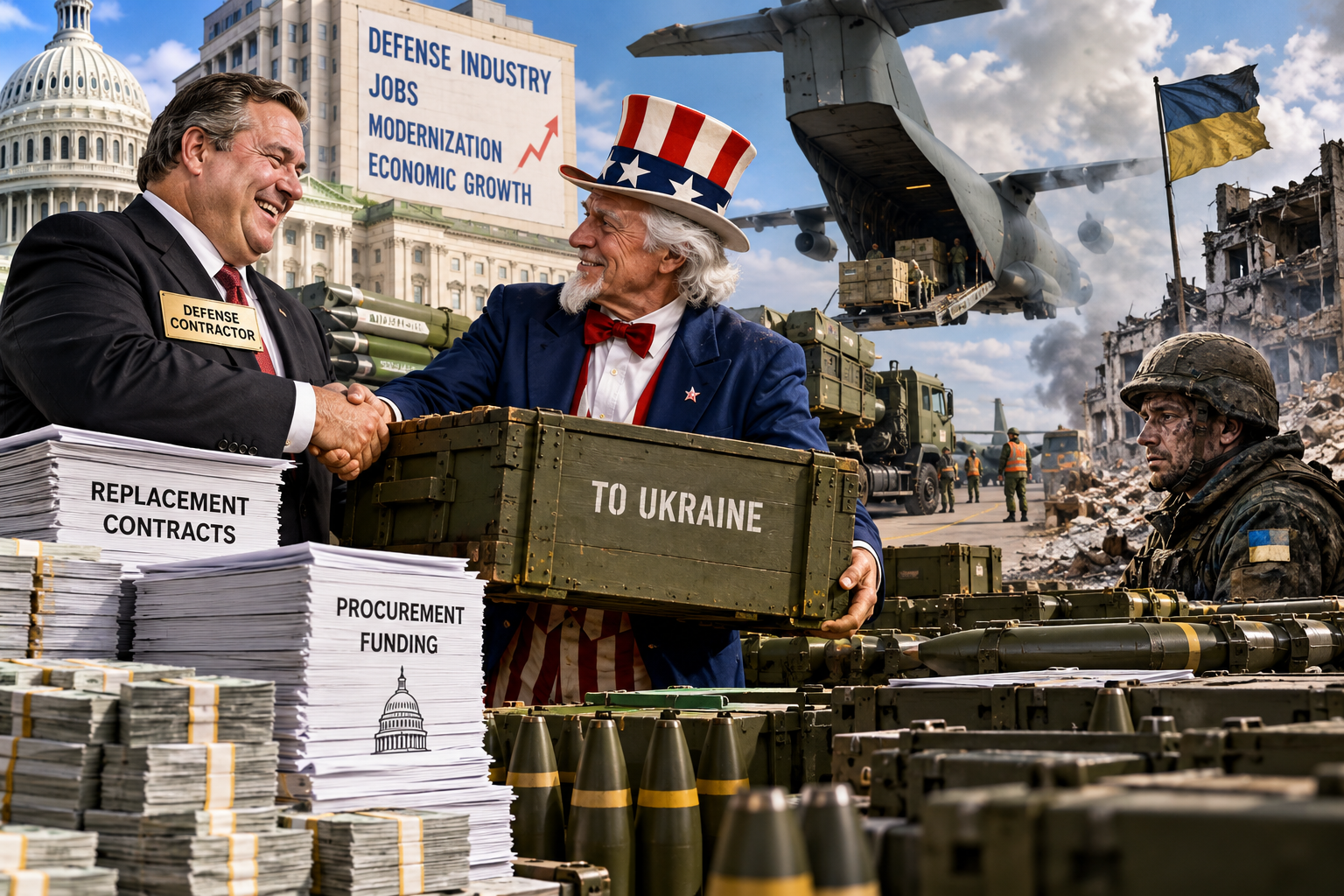
"A substantial portion of American military assistance involved equipment transferred from existing military inventories," Prescott testified. "Some of that equipment was aging, approaching scheduled replacement, or no longer represented the preferred configuration for American forces. Its transfer created opportunities to procure newer systems."
A committee member asked whether the United States was effectively using the war to modernize its own military inventories.
"That was one possible consequence," Prescott replied. "The government transferred existing equipment to Ukraine and, where replacement funding was authorized, purchased new equipment from American defense contractors. The resulting transactions could serve several objectives simultaneously."
"Which objectives?"
"Supporting Ukraine, degrading Russian military capabilities, replenishing American inventories, modernizing selected weapons systems, and sustaining domestic defense manufacturing."
"Who benefited financially?"
"Primarily the manufacturers receiving procurement contracts, together with their suppliers and subcontractors."
The committee member asked whether those manufacturers had an economic interest in continued military assistance.
"Certainly. Continued procurement creates revenue opportunities. Whether those opportunities translate into increased profits depends upon contract terms, production costs, and other factors."
"Would an extended conflict create additional procurement opportunities?"
"Potentially substantial ones."
Prescott emphasized that the economic incentives facing American defense manufacturers were not necessarily aligned with the humanitarian interests of Ukraine.
"From Ukraine's perspective, the preferred outcome would presumably involve achieving its security objectives with the smallest possible loss of life and destruction of infrastructure," he explained. "From the perspective of a manufacturer supplying replacement weapons, additional procurement may be financially advantageous regardless of whether the conflict is resolved quickly."
A committee member asked whether this represented a conflict of interest.
"It represents a divergence of incentives. A conflict of interest would require examining the relationship between those commercial incentives and the officials responsible for making procurement and military assistance decisions."
The committee requested an assessment of defense industry lobbying, campaign contributions, procurement recommendations, and the timing of major replacement contracts.
Prescott cautioned that evidence of financial benefit would not, by itself, establish that contractors had influenced decisions to delay particular weapons deliveries.
"An economic incentive is not proof of improper conduct," he said. "But an investigation that excludes the incentive cannot claim to have examined the complete economic structure of the policy."
The chairman asked whether the United States could benefit strategically and economically from a prolonged war while Ukraine continued bearing the principal human costs.
"Yes," Prescott replied. "The United States could experience Russian military degradation, domestic industrial activity, and military modernization while avoiding direct American combat casualties. Ukraine, meanwhile, would continue bearing the immediate costs of combat, displacement, infrastructure destruction, and civilian deaths."
"Would that create an incentive to prolong the conflict?"
"It could create incentives favoring continued military expenditure. Whether those incentives actually influenced decisions concerning the duration of the war is a separate question."
Committee counsel asked whether Prescott could calculate the economic benefits received by American defense contractors alongside the humanitarian costs incurred by Ukraine.
"With appropriate data, we could estimate contract revenues, procurement expenditures, industrial activity, and certain other financial effects," Prescott replied. "We could also estimate some of the human and economic costs associated with alternative military assistance scenarios. But those calculations would not establish that the additional suffering was intentionally imposed."
"How would we establish that?"
"We would need evidence connecting the economic incentives to specific policy decisions."
The committee authorized a preliminary investigation into the relationship between military assistance, defense procurement, and the financial interests of American weapons manufacturers.
Prescott recommended examining whether the transfer of aging equipment had accelerated replacement programs that might otherwise have proceeded more slowly.
The Department of Administrative Affairs requested that the investigation distinguish between the cost of supplying Ukraine, the cost of replenishing American inventories, and the economic benefits of the resulting procurement contracts.
The committee agreed.
Members also requested a separate determination of whether an expenditure could properly be classified as foreign assistance when the payment was ultimately received by an American corporation.
The Department of Causality advised that the question involved the distinction between the intended beneficiary of a government expenditure and the recipient of the funds.
A working group was established to determine whether those categories should be reported separately.
Historians Asked Whether Roosevelt Developed a Similar Strategy
The investigation expanded after several committee members requested an assessment of American and British military assistance to the Soviet Union during World War II.
Historians testified that President Franklin Roosevelt and Prime Minister Winston Churchill recognized the strategic importance of sustaining Soviet resistance against Nazi Germany.
They also acknowledged that the enormous losses suffered by German and Soviet forces weakened both countries, although no evidence presented to the committee established that Roosevelt or Churchill deliberately prolonged the fighting to maximize Soviet casualties.
One historian cited a 1941 statement by Senator Harry Truman suggesting that the United States should assist whichever side was losing so that Germany and the Soviet Union would continue inflicting damage upon one another.
Committee members asked whether the Biden administration's Ukraine policy represented a modern variation of that strategic concept.
Sullivan rejected the comparison as incomplete.
"Historical analogies must account for differences in military technology, alliance structures, escalation dynamics, and the strategic environment," he said.
The committee's historical adviser agreed and recommended examining the Korean War, the Soviet-Afghan War, and several Cold War proxy conflicts before drawing conclusions.
Professor Adrian Keller, chair of comparative epistemology at Westbridge University, cautioned that the investigation also required a more rigorous understanding of historical intention.
"An anticipated consequence is not necessarily an intended consequence," Keller testified. "However, when an anticipated consequence repeatedly informs subsequent decisions, the distinction between intention and expectation becomes increasingly dependent upon the interpretive framework employed by the observer."
The committee chairman asked whether policymakers could knowingly benefit from a prolonged war without intending to prolong it.
"Certainly," Keller replied. "The more difficult question is whether they could continue making decisions that preserve those benefits while remaining entirely indifferent to the duration of the conflict."
"Can we determine that?"
"Only after establishing what we mean by determine."
The committee authorized a supplementary historical review.
Department of Causality Asked to Separate Intentions From Consequences
The Department of Causality entered the investigation after committee attorneys concluded that the distinction between intended outcomes and foreseeable consequences required specialized administrative guidance.
Department analysts proposed classifying the administration's decisions according to four categories: intended consequences, anticipated but unintended consequences, unanticipated consequences, and consequences whose anticipated status could not be established from available documentation.
A fifth category was subsequently added for consequences that were anticipated by some officials but not formally adopted as policy objectives.
Karen Whitmore, deputy undersecretary at the Department of Administrative Affairs, explained that interagency decision-making frequently produces outcomes that no participating agency independently intended.
"Each organization may execute its assigned responsibilities in full compliance with established procedures while contributing to an aggregate outcome that was never expressly approved at the interagency level," Whitmore testified.
Asked whether this meant the government could pursue a policy without anyone being responsible for its consequences, Whitmore disagreed.
"Responsibility is assigned through the applicable governance structure. The absence of an individually attributable decision does not necessarily establish the absence of institutional accountability."
"Who would be accountable?"
"That would depend upon the allocation of decision authority."
"And who determines that allocation?"
"Ordinarily, the participating agencies."
Committee counsel observed that the agencies responsible for the original decisions would therefore play a substantial role in determining who should be held responsible for them.
Whitmore confirmed that this arrangement was consistent with established administrative practice.
She recommended an interagency review of decision authority before any findings concerning responsibility were issued.
Strategic Success Creates a Measurement Problem
The committee then considered whether the administration's strategy could be evaluated as successful if Russia suffered substantial military and economic losses while Ukraine continued experiencing widespread destruction.
Dr. Melissa Harmon, senior systems analyst at the Institute for Strategic Compliance, testified that the problem involved competing performance indicators.
"A policy can demonstrate favorable results against its primary strategic metrics while generating adverse outcomes in secondary operational or humanitarian categories," Harmon explained.
"The difficulty arises when those categories are maintained in separate reporting systems and no integrated performance standard has been established."
Investigators asked whether the administration had developed a unified measure incorporating Russian military degradation, Ukrainian casualties, economic destruction, territorial control, and the duration of hostilities.
Harmon said such a measure would require policymakers to assign relative weights to outcomes that could not be directly compared.
"How much weight would you assign to a Ukrainian civilian death?" a committee member asked.
"That is not a determination a systems analyst should make independently."
"Who should make it?"
"The responsible policy authority, following consultation with appropriate stakeholders."
"And if the policy authority declined to assign a value?"
"The indicator would remain outside the consolidated performance model."
The chairman asked whether excluding humanitarian losses from a performance model might make a prolonged conflict appear more successful than it actually was.
"That depends upon the definition of success," Harmon replied.
The committee requested that the Institute for Strategic Compliance prepare a proposed framework for evaluating the humanitarian costs of strategic patience.
Harmon recommended that the framework first undergo an independent methodological validation.
Officials Disagree Over Whether the War Was Prolonged
The investigation encountered another difficulty when attorneys questioned whether a conflict could properly be described as prolonged without establishing when it otherwise would have ended.
Representatives of the Department of Causality advised that the term required a counterfactual reference point.
Without such a reference point, they explained, investigators could establish that a war continued but could not determine how much longer it continued because of any particular American policy decision.
Committee counsel proposed examining whether specific weapons restrictions contributed to additional months of fighting.
Department analysts objected that military outcomes depended upon numerous interacting variables, including Russian operational decisions, Ukrainian force availability, weather, logistics, intelligence, and the willingness of both governments to negotiate.
A legal adviser recommended that the committee avoid using the word prolonged until a formal duration assessment had been completed.
The chairman asked whether the investigation could continue under its existing authorization.
The adviser replied that the authorization referred specifically to the possible prolongation of the conflict.
"If we cannot establish that the war was prolonged, what exactly are we investigating?" the chairman asked.
"The circumstances under which prolongation may have occurred."
"And if those circumstances cannot be established?"
"We would need to determine whether the inability to establish them was itself a consequence of deficiencies in the original decision-making records."
The Department of Administrative Affairs subsequently proposed creating a Joint Working Group on Counterfactual Duration Assessment.
The Department of Causality requested a separate review of the proposed group's authority to distinguish causation from correlation.
Congress Establishes a Permanent Review of Temporary Strategic Decisions
By the hearing's conclusion, investigators had requested records from former National Security Council officials, military planners, intelligence analysts, diplomatic advisers, and officials responsible for weapons procurement and delivery schedules.
The Department of Administrative Affairs agreed to coordinate the review, subject to clarification of its jurisdiction.
The Office of Unintended Consequences proposed a separate inquiry into whether the administration's efforts to prevent escalation had produced consequences inconsistent with its stated humanitarian objectives.
The Interagency Committee on Strategic Coordination recommended that all participating organizations adopt common definitions of victory, defeat, escalation, attrition, restraint, and strategic success before proceeding.
The National Commission on Long-Term Planning requested permission to evaluate whether the absence of an agreed timetable for ending the conflict had contributed to the difficulty of assessing the administration's performance.
Sullivan, in his concluding statement, again rejected the allegation that the administration intentionally prolonged the war.
"Every decision we made reflected our assessment of the available options, the risks associated with those options, and our responsibility to advance American national security while supporting Ukraine," he said.
The committee chairman thanked Sullivan for his testimony.
"Your position, as I understand it, is that the administration did not intend to prolong the war, did not consider prolonging the war an independent strategic objective, and did not deliberately withhold assistance for the purpose of extending Russian military attrition."
"That is correct."
"But the administration did intend to weaken Russia."
"Yes."
"And it recognized that continued fighting was weakening Russia."
"Yes."
"And it repeatedly made decisions that limited Ukraine's military options because the alternatives presented unacceptable risks."
"We made those decisions based on our assessment of the national interest."
The chairman asked whether Sullivan could identify the point at which the humanitarian costs of continued fighting would have outweighed the strategic benefits of further weakening Russia.
Sullivan said that no single numerical threshold could adequately represent the full range of considerations involved.
The committee agreed that the absence of such a threshold warranted further examination.
At press time, the Department of Administrative Affairs was preparing interim guidance for agencies participating in the investigation.
The guidance will require officials to distinguish between policies intended to achieve a particular outcome, policies that foreseeably contribute to that outcome, and policies whose continued implementation becomes dependent upon the outcome remaining unresolved.
The department emphasized that the guidance would remain provisional until participating agencies agreed upon a common definition of intention.
The committee has postponed its final determination pending completion of the review, which officials said should not be interpreted as an intentional effort to prolong the investigation.
Sarah Collins
GFNN Washington Bureau
Recent Articles


-
Jake Sullivan Denies Intentionally Prolonging the Ukraine War
Oct 27, 26 09:36 PM
 Jake Sullivan denies intentionally prolonging the Ukraine war as Congress examines military aid decisions, Russian attrition, and the human cost of restraint.
-
Was Merrick Garland Waiting for Trump to Die of Natural Causes?
Oct 25, 26 01:36 PM
Congress examines Merrick Garland's delays, Trump's return to power, and the humanitarian consequences of government decisions left unresolved. -
The Pigusus Saga Chapter One Pardon Us
Oct 24, 26 08:23 PM
The Pigusus Saga, Chapter One: A DARPA-engineered flying pig discovers a disturbing military agenda and escapes with help from a mysterious artificial intelligence.