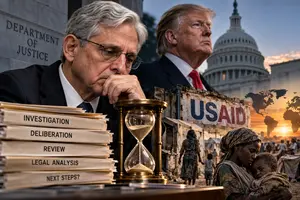

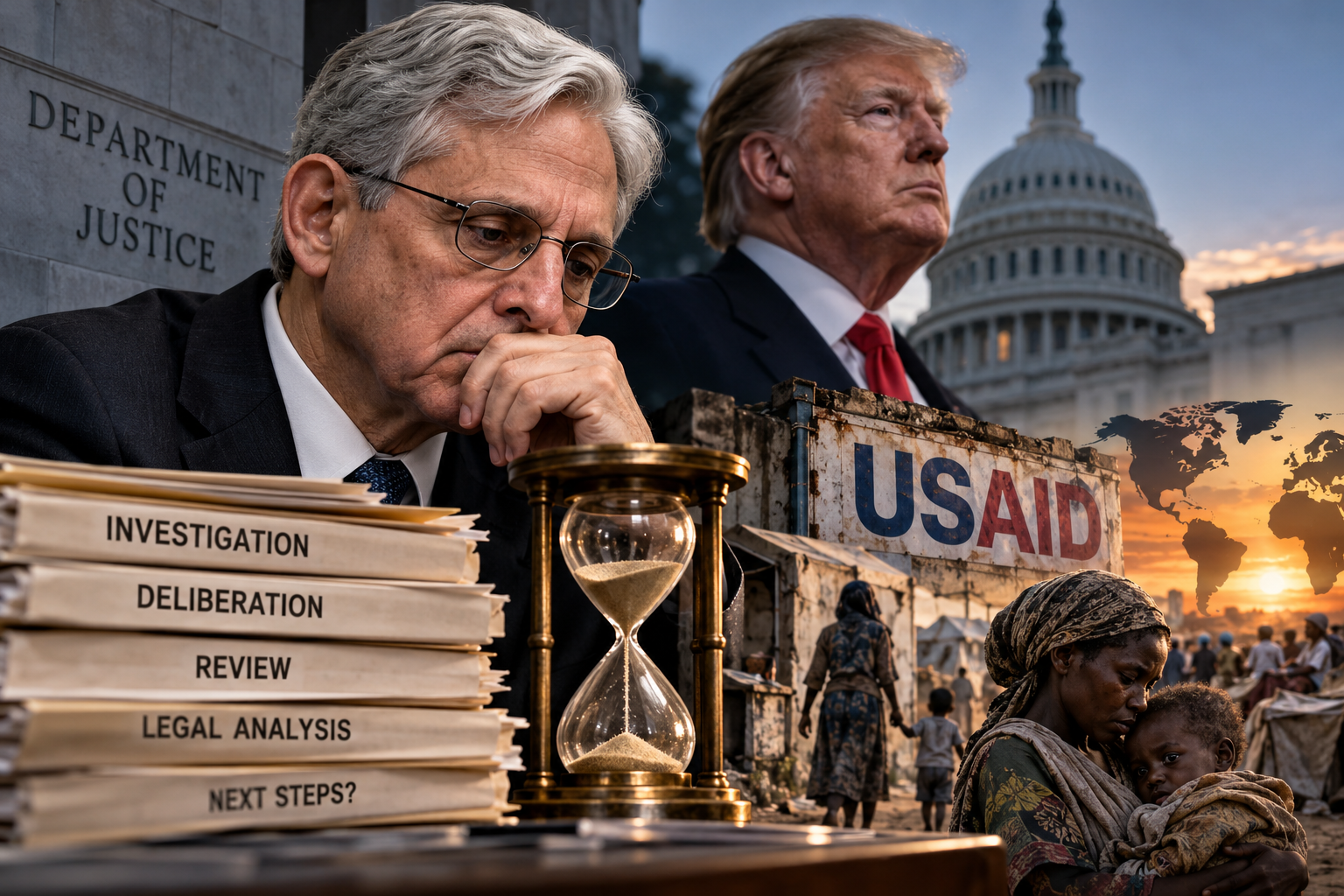
Was Merrick Garland Waiting for Trump to Die of Natural Causes?
By Sarah Collins | GFNN Washington Bureau
GFNN continues to support legacy information delivery technologies, including written language. The following is the text version of today's report.
Administrative Notice: This report has been cleared for publication without completion of the customary preliminary review of preliminary reviews.
WASHINGTON — A congressional investigation into former Attorney General Merrick Garland's handling of federal criminal investigations involving Donald Trump has expanded into an examination of whether excessive caution within the Justice Department contributed to a sequence of events culminating in the dismantling of the U.S. Agency for International Development and potentially millions of preventable deaths and incalculable suffering among the world's most vulnerable.
The inquiry began with questions about the nearly two-and-a-half-year interval between the January 6, 2021, attack on the Capitol and the first federal indictment of Trump relating to his efforts to overturn the 2020 presidential election.
Investigators are examining whether the Justice Department's commitment to procedural safeguards, prosecutorial independence, and institutional neutrality adequately accounted for the consequences of delaying criminal proceedings against a former president actively seeking reelection.
The committee has also requested an assessment of whether Garland anticipated that Trump's advanced age might eventually resolve the department's prosecutorial difficulties without requiring a trial.
No evidence supporting that hypothesis has been presented.
Committee officials emphasized that the absence of evidence should not be interpreted as a reason to exclude a possibility before completing the procedures established for its exclusion.
Garland Defends the Department's Deliberations
Appearing before the committee, Garland defended his administration of the Justice Department, emphasizing that prosecutors must evaluate evidence according to established legal standards rather than political timetables.
"The Department of Justice has an obligation to pursue the facts and apply the law without fear or favor," Garland testified. "That obligation does not change because an investigation involves a former president or because an election is approaching."
Committee Chairman Thomas Ellsworth acknowledged the importance of prosecutorial independence but questioned whether independence necessarily required the absence of urgency.
"Mr. Garland, is it possible to conduct an investigation both carefully and expeditiously?"
"Certainly."
"Was that your objective?"
"At every stage."
"Did you achieve it?"
"I believe the department conducted itself in accordance with its responsibilities."
"That wasn't my question."
Garland explained that complex investigations frequently require prosecutors to resolve difficult questions involving evidence, witness testimony, executive privilege, and constitutional protections.
Ellsworth asked whether the department had considered the possibility that prolonged proceedings might prevent the courts from resolving the charges before the next presidential election.
"Political considerations must not dictate prosecutorial decisions," Garland replied.
"Is the calendar a political consideration?"
"Not inherently."
"Is the defendant's candidacy a political consideration?"
"It can be."
"Is the possibility that the defendant might become president before his trial a political consideration?"
"That would depend on the context in which the question arose."
Ellsworth asked whether the department had established a procedure for distinguishing legitimate scheduling concerns from impermissible political considerations.
Garland said the department relied on established prosecutorial judgment.
The chairman requested documentation describing how that judgment had been exercised.
Justice Department counsel advised that the request would require a review to determine which internal deliberations could appropriately be disclosed without compromising the independence of prosecutorial decision-making.
The committee agreed to await the results.
The Possibility of Natural Causes
The hearing took an unexpected direction when committee investigators introduced a memorandum examining whether the Justice Department's prolonged deliberations could have reflected an expectation that Trump might eventually die before his criminal cases were resolved.
The memorandum was prepared by the committee's Office of Alternative Explanations after investigators found no documented maximum duration for the department's internal deliberations.
Garland rejected the suggestion.
"I did not consider the defendant's eventual death a prosecutorial strategy."
Ellsworth asked whether the department had considered Trump's age.
"Age can be relevant to certain legal determinations."
"Was it relevant here?"
"Not in the manner you are suggesting."
"Did you believe Mr. Trump would live indefinitely?"
"Of course not."
"Did you expect him to live long enough to stand trial?"
"That was not a determination the department was required to make."
"Would his death have resolved the prosecution?"
"It would have rendered certain proceedings moot."
"So death would have resolved matters that the Justice Department was still attempting to resolve?"
"That is not an appropriate characterization."
The committee's legal counsel intervened to explain that the termination of criminal proceedings following a defendant's death did not constitute a successful prosecution.
Ellsworth acknowledged the distinction.
"Then the department could have avoided a trial without obtaining a conviction."
"Only through circumstances entirely outside its control," counsel replied.
Garland reiterated that the department had never adopted such a strategy.
The Office of Alternative Explanations subsequently recommended distinguishing between intentionally waiting for a defendant to die and conducting proceedings without establishing whether the defendant was likely to survive their completion.
The Department of Causality agreed to review the distinction.
Humanitarian Consequences Change the Inquiry
The committee's investigation assumed a different character when public-health researchers presented evidence concerning the international consequences of the Trump administration's reductions in foreign assistance.
A study published in The Lancet in 2025 projected that continued USAID funding reductions could contribute to more than 14 million additional deaths worldwide by 2030, including approximately 4.5 million children younger than five.
Researchers emphasized that the estimates represented modeled outcomes under specified funding assumptions, not a verified count of deaths already attributable to the reductions.
The committee received testimony from Dr. Eleanor Shaw, a former USAID public-health administrator with experience coordinating international disease prevention and maternal health programs.
Shaw explained that foreign assistance programs frequently operate in regions where national health systems lack the resources to replace externally funded services.
"These programs are not simply financial transfers," she testified. "They involve trained medical personnel, pharmaceutical procurement, diagnostic laboratories, transportation networks, community health workers, and established relationships with local providers."
When funding is interrupted, she explained, the consequences can extend beyond the immediate suspension of services.
Patients receiving antiretroviral treatment may lose access to medication. Tuberculosis programs may experience interruptions that complicate treatment and increase the risk of drug resistance. Malaria prevention programs may lose the capacity to distribute insecticide-treated nets or maintain surveillance.
Nutrition programs may no longer reach children already suffering from severe malnutrition.
"An interruption in funding is an administrative event," Shaw said. "An interruption in treatment is a medical event. They are not equivalent, even when one produces the other."
Ellsworth asked whether the consequences could be reversed by restoring funding.
"Some can," Shaw replied. "Some cannot. Medical personnel may have left. Supply chains may have collapsed. Patients may have deteriorated. Some will have died."
She explained that the deaths of children from preventable disease and malnutrition are not administrative losses that can be corrected through subsequent appropriations.
"Once a child has died, restoring the program does not restore the child."
The committee did not immediately question the witness.
After a recess, Ellsworth asked whether Shaw could establish that earlier prosecution of Trump would have prevented the foreign-aid reductions.
"No," she replied. "That would require us to know how the courts, the electorate, and a subsequent administration would have behaved under circumstances that did not occur."
"Then what can you establish?"
"That decisions about funding have consequences for human beings. Some of those consequences are measurable. Others become apparent only after the opportunity to prevent them has passed."
The committee thanked Shaw for her testimony.
A representative of the Office of Unintended Consequences requested clarification concerning whether a consequence should be classified as unintended when the responsible institution had not evaluated it before acting.
Shaw replied that she was not qualified to answer that question.
She added that the classification would make no difference to the patients.
Prosecutorial Independence Meets Institutional Responsibility
The committee next heard testimony from constitutional attorneys who warned against evaluating prosecutorial decisions solely through the consequences of subsequent political events.
A former federal prosecutor explained that criminal investigations cannot properly be conducted according to the electoral fortunes of the people being investigated.
"Prosecutors must establish that the evidence supports the charges," he said. "They must anticipate constitutional challenges, protect the rights of defendants, and avoid allowing political pressure to determine the course of an investigation."
Ellsworth asked whether the obligation to avoid political interference also required prosecutors to disregard foreseeable consequences of delay.
"Not necessarily. But the distinction is difficult."
"Suppose the department knows that a defendant is seeking an office that may make prosecution impossible. Does that create a legitimate reason to proceed more quickly?"
"It may create a scheduling concern. It cannot justify compromising the integrity of the investigation."
"Can an investigation maintain its integrity while proceeding more quickly?"
"Certainly."
"Then how do we determine whether the department proceeded as quickly as it reasonably could?"
"That would require examining the decisions made at each stage."
"Would we also examine the consequences of those decisions?"
"Consequences may be relevant, but they cannot establish whether an earlier decision was legally appropriate."
The chairman asked whether a department could fulfill every applicable procedural obligation and nevertheless produce an outcome contrary to the public interest.
The witness acknowledged that it could.
"Then procedural compliance does not necessarily establish sound judgment?"
"No. But an unfavorable outcome does not necessarily establish unsound judgment either."
Ellsworth thanked the witness.
Committee counsel advised that the testimony had established the need to distinguish procedural compliance, professional judgment, institutional responsibility, and consequential accountability.
The committee requested separate definitions for each.
The Department of Administrative Affairs subsequently recommended that the definitions be developed collaboratively to avoid inconsistencies between agencies.
Economists Examine the Cost of Waiting
Dr. Alan Prescott, senior economist at the Center for Regulatory Excellence, told lawmakers that institutions frequently underestimate the consequences of postponing decisions because their accounting systems measure the risks associated with action more precisely than those associated with inaction.
"A decision to wait is still a decision," Prescott explained. "It allocates risk over time, even when the institution making the decision does not explicitly recognize that allocation."
He described a hypothetical agency attempting to reduce the probability of an incorrect decision.
The agency might devote additional months to collecting evidence, conducting reviews, and obtaining approvals. Each additional review could improve the quality of the eventual decision.
But those improvements might become progressively smaller while the consequences of continued delay increased.
"An institution can optimize the quality of its internal procedures while producing a progressively worse external outcome," Prescott said.
Ellsworth asked whether that principle applied to the Justice Department.
"It can apply to any organization," Prescott replied. "Whether it applied in this particular case would require a detailed examination of the available alternatives and the risks associated with each."
"Can we calculate those risks?"
"Some of them."
"Can we calculate the number of lives that might have been saved had the department proceeded differently?"
"Not reliably. That would require assumptions about judicial decisions, election results, subsequent executive actions, and the effectiveness of international assistance programs."
"Then how do we evaluate the consequences?"
"We distinguish between what we know, what we can estimate, and what we cannot establish."
Prescott recommended that federal agencies incorporate the opportunity cost of delay into their decision-making frameworks whenever such costs could reasonably be assessed.
The Justice Department expressed reservations.
A department representative warned that requiring prosecutors to calculate the economic and political consequences of their decisions might introduce precisely the considerations that prosecutorial independence was intended to exclude.
Prescott acknowledged the concern.
He suggested that the government might need to distinguish between using political consequences to determine whether a person should be prosecuted and recognizing practical constraints when determining how efficiently an otherwise justified investigation should proceed.
Committee counsel advised that the distinction appeared legally significant.
The department requested additional time to study it.
Administrative Officials Propose a Solution
Karen Whitmore, deputy undersecretary at the Department of Administrative Affairs, testified that the investigation had exposed a structural limitation in federal accountability systems.
"Government agencies generally evaluate performance within the boundaries of their assigned responsibilities," Whitmore explained. "The Department of Justice evaluates legal compliance. Public-health agencies evaluate health outcomes. Budget officials evaluate expenditures. Election administrators evaluate electoral procedures."
She noted that these systems functioned independently because each required specialized expertise.
"The difficulty arises when the consequences of one institution's decisions extend into areas administered by another institution."
Ellsworth asked whether that meant no single agency was responsible for the overall outcome.
"Responsibility may exist at several levels," Whitmore replied. "However, the government currently lacks a comprehensive framework for determining which institution is responsible for determining the allocation of responsibility."
"Are you suggesting that nobody is responsible?"
"Not at all. I am suggesting that responsibility has not been adequately assigned for purposes of evaluating responsibility."
"Who should assign it?"
"That is among the questions a properly constituted interagency working group would address."
Whitmore recommended establishing a National Framework for Consequence-Adjusted Administrative Accountability.
The proposed framework would require participating agencies to document significant foreseeable consequences associated with delayed decisions, establish procedures for evaluating those consequences, and identify circumstances in which additional review might create greater risks than proceeding.
The Department of Causality would develop standards for evaluating causal relationships.
The Office of Unintended Consequences would determine whether an outcome had been reasonably foreseeable.
The Department of Sequential Approvals would establish procedures for authorizing expedited decisions.
The National Commission on Long-Term Planning would coordinate implementation.
Whitmore emphasized that the framework would not interfere with existing agency responsibilities.
"Each participating institution would retain complete authority over its assigned functions," she said. "The framework would simply provide a coordinated process for ensuring that the exercise of that authority is appropriately coordinated."
Ellsworth asked how long implementation would take.
Whitmore estimated that preliminary guidelines could be available within eighteen months.
"Could the process be accelerated?"
"Possibly. But accelerating the process without an adequate review of the risks associated with acceleration could undermine the very objectives we are attempting to achieve."
The committee requested a formal implementation schedule.
Congress Considers the Meaning of Accountability
As the hearings approached their conclusion, lawmakers confronted a question that had become increasingly difficult to resolve.
If an official followed established procedures, acted in good faith, and nevertheless failed to prevent foreseeable harm, what standard should determine whether the official had fulfilled the responsibilities of public office?
Dr. Melissa Harmon, senior systems analyst at the Institute for Strategic Compliance, told the committee that institutional performance systems often confuse compliance with effectiveness.
"Compliance tells us whether an organization followed its rules," Harmon explained. "Effectiveness tells us whether its actions accomplished their intended purpose. Those are different measurements."
She cautioned that an institution could achieve exemplary compliance scores while failing to accomplish its broader mission.
Ellsworth asked whether government agencies routinely evaluated the distinction.
"Some do. But evaluations are often conducted within the same institutional framework that established the procedures being evaluated."
"Does that create a problem?"
"It can. An organization may conclude that it performed successfully because it completed every required step, even when the result was unsatisfactory."
"How would you correct that?"
"By incorporating outcome measurements into institutional performance assessments."
"Would that have prevented the events we are investigating?"
"Not necessarily. No administrative framework can guarantee favorable outcomes."
"Then what would it accomplish?"
"It would make it more difficult for an institution to declare success solely because it followed its own procedures."
Committee members asked Harmon to prepare a preliminary proposal.
She recommended that agencies identify their intended outcomes before developing procedures for achieving them.
The Department of Administrative Affairs expressed support for the proposal but warned that defining intended outcomes might require agencies to reconsider their existing performance measurements.
The Office of Administrative Continuity cautioned that reconsidering existing measurements could undermine confidence in previously completed evaluations.
The Center for Regulatory Excellence recommended a transitional framework under which agencies could continue using their existing measurements while developing procedures for evaluating the adequacy of those measurements.
Several departments requested assurances that unfavorable outcomes would not automatically be interpreted as evidence of administrative failure.
Harmon agreed that outcomes should be evaluated in context.
She also observed that context should not become a substitute for evaluation.
A Government Prepared to Prevent Future Delays
The committee concluded its hearings by announcing plans for legislation requiring federal agencies to consider the foreseeable consequences of prolonged deliberation.
Under the proposal, agencies would establish procedures for identifying circumstances in which the risks associated with waiting might exceed the risks associated with acting.
The legislation would also create an independent review mechanism to evaluate whether existing administrative procedures encouraged unnecessary delay.
Committee members emphasized that the proposed reforms would preserve prosecutorial independence, constitutional safeguards, and the authority of individual agencies.
Garland, who had been invited to provide additional written testimony, reiterated that the Justice Department's obligations must not be subordinated to political expectations.
Ellsworth acknowledged the principle.
"The question before us," he said, "is not whether government officials should follow the law. It is whether following established procedures is sufficient when those procedures fail to address the consequences of delay."
The committee requested that the Department of Administrative Affairs develop recommendations for incorporating that distinction into federal performance standards.
Whitmore agreed to coordinate the effort.
She cautioned that any recommendations would require extensive consultation with participating agencies to ensure that the proposed safeguards did not inadvertently create new risks.
The Department of Sequential Approvals requested an opportunity to review the consultation procedures.
The Office of Unintended Consequences recommended a preliminary assessment of the potential consequences of the proposed review.
The National Commission on Long-Term Planning suggested that the assessment be incorporated into a broader study of government decision-making.
At press time, lawmakers were preparing legislation requiring federal agencies to evaluate the potential consequences of excessive deliberation before undertaking lengthy reviews.
Implementation has been postponed pending completion of a comprehensive assessment of the risks associated with making decisions too quickly.
This article is a work of fictional institutional satire. The congressional investigation, hearings, witness testimony, quotations attributed to Merrick Garland, and proposed administrative reforms are fictional.
The historical foundation includes Garland's November 18, 2022, appointment of Jack Smith, Trump's August 1, 2023, federal election-related indictment, and the dismissal of that prosecution following Trump's reelection. These events are documented in the Special Counsel's Final Report.
The humanitarian projections come from a 2025 study published in The Lancet. Its researchers estimated that sustained USAID funding reductions could cause more than 14 million additional deaths worldwide by 2030, including approximately 4.5 million children younger than five. These are conditional projections, not verified mortality totals.
The article examines the possibility that earlier prosecutorial action might have changed subsequent events. It does not establish that Garland's decisions caused Trump's reelection or the subsequent humanitarian consequences.
Recent Articles


-
Was Merrick Garland Waiting for Trump to Die of Natural Causes?
Oct 25, 26 01:36 PM
 Congress examines Merrick Garland's delays, Trump's return to power, and the humanitarian consequences of government decisions left unresolved.
-
The Pigusus Saga Chapter One Pardon Us
Oct 24, 26 08:23 PM
The Pigusus Saga, Chapter One: A DARPA-engineered flying pig discovers a disturbing military agenda and escapes with help from a mysterious artificial intelligence. -
Pigusus the flying pig
Oct 22, 26 06:53 PM
Pigusus the flying pig is a work in progress. The first chapter of The Pigusus Saga is now available. Pardon Us.