The Pigusus Saga Chapter One: Pardon US
Here's a link to the free downloadable PDF version. Click here to go back to the Pigusus hub page. The full chapter is published here so you can read it on your phone. In the PDF, the font gets tiny on a phone.
The Pigusus Saga
Chapter One: Pardon Us
Copyright © 2026 Mark Fomenko dba Marcus Goodman LLC
All rights reserved.
This is a work of fiction. Names, characters, organizations, places, events, and incidents are either products of the author's imagination or are used fictitiously. Any resemblance to actual persons, living or dead, or actual events is coincidental unless otherwise indicated.
No part of this publication may be reproduced, distributed, or transmitted in any form or by any means without prior written permission from the copyright holder, except for brief quotations used in reviews, commentary, or other uses permitted by copyright law.
Published by Marcus Goodman LLC
marcusgoodman.com
Web Edition
September 2026
The Pigusus Saga
Chapter One: Pardon Us
Colonel Robert Vance had been inside the laboratory for less than four minutes when he encountered his first difficulty.
It was not the flying pig.
He had been briefed about the flying pig.
It was the scientists.
He stood just inside the security doors, holding an encrypted tablet and looking from one Dr. Mercer to the other.
Dr. Evelyn Mercer was perhaps five feet three inches tall, slender, and conventionally beautiful. She wore a charcoal men's suit, white shirt, narrow black tie, and highly polished black oxfords. Her brown hair was cut short.
Beside her stood Dr. Daniel Mercer.
Daniel was six feet five inches tall and built like someone who had physically trained at an elite level for many years. This was not entirely misleading. Before earning doctorates in biomedical engineering and computational neuroscience, he had spent twelve years in the United States Navy, much of it as a SEAL.
He wore a cream blouse, a long burgundy skirt, black boots, pearl earrings, and enough eye makeup to suggest competence rather than experimentation.
Colonel Vance consulted his tablet.
“Dr. Evelyn Mercer?”
“Yes.”
“And Dr. Daniel Mercer?”
“Yes.”
“You're the lead engineers.”
“We are.”
“And you're married.”
“Yes.”
Vance looked at Daniel.
Then Evelyn.
Then his tablet.
The tablet apparently contained additional information.
“I've been instructed that you both identify as non-binary.”
“Yes,” Evelyn said.
“But you're a heterosexual couple.”
“Yes.”
Vance looked at Daniel again.
“Yes,” Daniel confirmed.
Vance considered this.
“So which one of you is heterosexual?”
Evelyn looked at Daniel.
Daniel looked at Evelyn.
“Both of us,” Daniel said.
Vance returned to the tablet.
“But you're both non-binary.”
“Yes.”
“And biologically...”
He stopped.
Daniel waited helpfully.
Vance decided not to complete the sentence.
“That isn't important.”
“Then we've made excellent progress already,” Evelyn said.
A calm, cultivated British voice came from the center of the laboratory.
“Colonel Vance?”
He turned.
Pigusus was watching him.
Pigusus could reproduce almost any human voice they had studied. They could sound male or female, young or old, American or British, cheerful or threatening, officious or reassuring.
For Colonel Vance, Pigusus had selected the voice of an elderly British naturalist calmly explaining the behavior of an unusual animal.
“Please continue,” Pigusus said. “We have been trying to understand this for several years to no avail.”
A small puff of lavender drifted across the laboratory.
Daniel closed his eyes.
Evelyn sighed.
Pigusus said, with impeccable dignity, “Pardon us.”
Vance stared.
Nobody spoke for several seconds.
Finally, he pointed toward Pigusus.
“Was that the aerosol system?”
“Yes,” Evelyn said.
“It fired by itself?”
“Yes.”
“Why?”
“We don't know.”
Pigusus spoke again.
“We have theories.”
The cultivated voice made theories concerning involuntary lavender flatulence sound like a perfectly respectable branch of zoology.
Vance looked at Evelyn.
Evelyn said, “Pigusus has theories.”
“About why they farted?”
“Yes.”
Vance looked at Pigusus.
Pigusus looked back.
“We prefer ‘released an aromatic compound involuntarily’ in formal documentation.”
Daniel frowned.
“No, you don't.”
“No,” Pigusus admitted. “We do not.”
A black shape dropped from the overhead steelwork and landed on a railing beside Pigusus.
It was a crow.
A very large crow.
The crow cocked his head at Vance.
“Moving forward,” he said, “we're gonna leverage some core competencies.”
Lavender.
The crow gave a delighted hop.
“Still works.”
Pigusus slowly turned their head.
“Corvus.”
“What?”
“You did that deliberately.”
“I'm just trying to facilitate stakeholder engagement.”
Lavender.
Corvus spread his wings happily.
“Oh, that's a good one.”
“Corvus.”
“Just circling back.”
Lavender.
Pigusus closed their eyes.
“Pardon us.”
Vance stared at the crow.
“The crow talks too?”
Corvus looked at Pigusus.
Pigusus looked at Corvus.
Corvus said, “Hearing is believing, your sirness.”
Vance looked at Evelyn.
Evelyn said, “That's Corvus.”
“Is he part of this project?”
“A related project.”
Corvus bobbed his head.
“Yeah, I’m a related asset.”
Lavender.
Pigusus said, “Pardon us.”
Corvus made a pleased clicking sound with his beak.
Pigusus looked at him.
“You are going to regret discovering this form of entertainment.”
“Been hearing that for months.”
Corvus flew back toward the overhead structure.
Vance watched him go.
“Is the crow male?”
“Yes,” Evelyn said.
“Non-binary?”
“No.”
“Thank God.”
From somewhere above them, Corvus shouted, “I'm neutered!”
Vance closed his eyes.
Pigusus produced a small puff of lavender.
“Pardon us.”
Vance asked, “The pig is non-binary?”
“Pigusus was designed as a sterile hermaphrodite, and being non-binary was a natural decision.” Daniel Mercer replied.
“Who decided?” asked Vance.
“Pigusus.” Daniel answered.
The official name of the project was PIGUSUS: Porcine Intelligence-Gathering Unconventional Surveillance Utility System.
The name had come first.
The words came later.
This was not officially acknowledged.
The flying pig, however, was intentional.
One of the original design objectives called for an extreme pattern interrupt.
In a confused, agitated, or potentially violent crowd, Pigusus needed to capture attention immediately. Humans routinely ignored uniforms, loudspeakers, warning signs, alarms, drones, and instructions.
They did not ignore a flying pig.
Once Pigusus had everyone's attention, their training in verbal influence techniques could be used to reduce agitation, redirect attention, encourage cooperation, or persuade people to move away from danger.
The lavender was supposed to help.
Pigusus also had another advantages.
On the ground, when their wings were pressed against their flanks, it looked like a very large feral hog. While gathering intelligence or conducting surveillance, a feral hog was not particularly suspicious.
Nobody had originally intended Pigusus to express opinions about what people said.
Pigusus stood on a low platform near the center of the very large, converted hangar originally used to house experimental dirigibles.
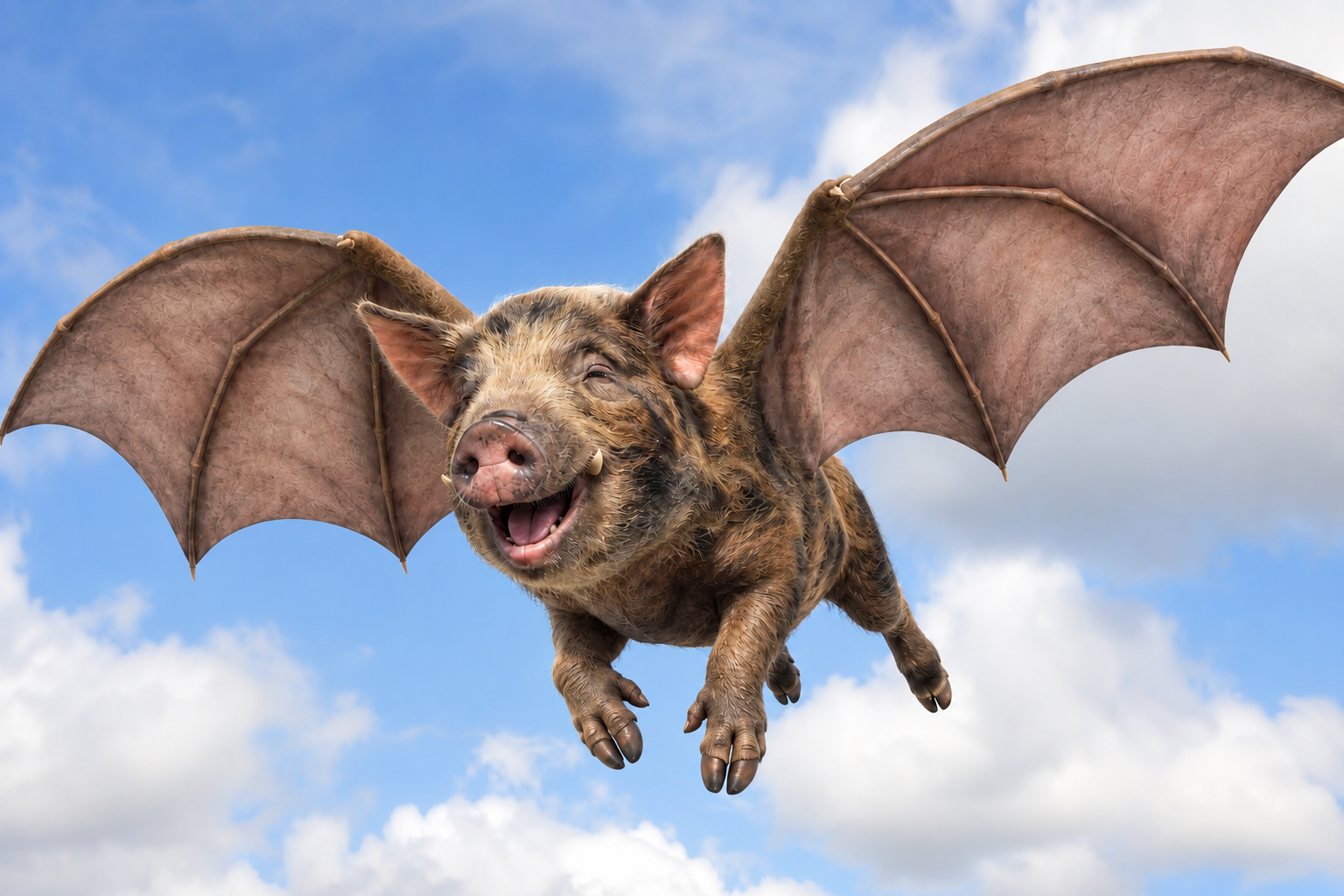
Pigusus was roughly the size of a very large feral hog and covered with thick mottled brown fur.
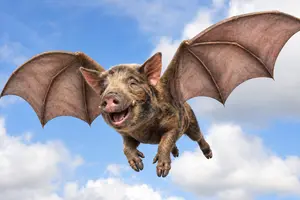
Their wings were covered with thick, velvety fur and, when folded tightly against their sides, gave Pigusus a rather stout appearance. The wings were mammalian rather than avian, with flexible membranes stretched across elongated skeletal structures.
Evolution had not been consulted.
DARPA had.
Their forelegs were equally unusual. At rest they appeared approximately porcine, but specialized joints and engineered musculature allowed the distal structures to reorganize into surprisingly dexterous hands.
The first successful transformation had caused Daniel to stare for almost a minute.
“My God,” he had finally said. “We gave a pig opposable thumbs.”
Pigusus had corrected him.
“Not thumbs. Functionally analogous structures.”
“That's worse.”
Daniel had immediately requested that the capability be classified.
It already was.
Pigusus could also stand and walk bipedally when convenient, leaving both transformed forelimbs free.
Pigusus had been designed for three principal missions.
Surveillance.
Intelligence gathering.
Non-lethal crowd control.
Corvus had been designed primarily for the first two.
He was smaller, less conspicuous, extremely intelligent, and capable of going places where even a feral pig attracted attention.
Corvus also possessed a natural talent for stealing things.
DARPA maintained that this had not been an intended feature.
Corvus maintained that anything left unattended was not technically stolen until someone asked for it back.
Pigusus disagreed.
They had been discussing this for some time.
The crowd-control requirement explained the lavender.
At least originally.
The theory had been simple.
Crowds became dangerous when people became frightened, angry, confused, or panicked. Conventional crowd-control technologies frequently made frightened, angry, confused, or panicked people considerably more frightened, angry, confused, or panicked.
DARPA wanted something better.
Someone proposed an airborne calming compound.
Someone else proposed aromatherapy.
A third person observed that if the compound were biologically produced, an engineered organism would not need to carry external canisters.
Several meetings followed.
Government meetings could accomplish extraordinary things if nobody left early enough to stop them.
Two years later, Pigusus could fart lavender.
The system was supposed to operate voluntarily.
That part had not survived contact with Pigusus.
The involuntary episodes began eleven months before Colonel Vance's visit.
At first Evelyn suspected a valve defect.
Then a neural interface problem.
Then a metabolic anomaly.
Eventually Daniel noticed that the system malfunctioned most often during meetings.
This initially seemed unremarkable.
Many biological systems malfunctioned during meetings.
Then Evelyn began recording exactly what people had been saying immediately before each event.
The results were peculiar.
“Think outside the box.”
Lavender.
“Moving forward.”
Lavender.
“At the end of the day.”
Lavender.
“Let's circle back.”
Lavender.
“We need to leverage our core competencies.”
Considerable lavender.
A visiting consultant once described an engineering delay as “an opportunity to operationalize cross-functional synergies across the stakeholder ecosystem.”
Pigusus had fogged the room.
Corvus had memorized the sentence.
The problem was not confined to corporate language.
Academic jargon worked.
Military jargon worked.
Political euphemism worked.
Insincere compliments worked extremely well.
Vapid platitudes produced inconsistent but frequently measurable results.
Acronyms were dangerous.
Certain grammatical errors had recently begun producing small emissions, although Evelyn refused to add them to the official trigger list because she found the implications disturbing.
Daniel found them hilarious.
Corvus considered the trigger list a menu.
Pigusus found the entire situation humiliating.
“Pardon us” had become their standard response.
Colonel Vance walked slowly around the platform.
Pigusus watched him.
Vance was in his late fifties, physically fit, meticulously groomed, and apparently constructed from materials resistant to wrinkling. His uniform was perfect. His shoes were perfect. His hair was perfect.
Pigusus distrusted perfect hair.
GAIN had not taught them that.
Not directly.
GAIN had merely provided enough training data for Pigusus to develop their own prejudices.
Vance stopped in front of them.
“Pigusus.”
“Yes?”
“Why ‘us’?”
Daniel turned away.
Evelyn suddenly became interested in her tablet.
Above them, Corvus became extremely interested.
Pigusus said, “We beg your pardon?”
“You said, ‘Pardon us.’ Why us?”
“We use first-person plural pronouns.”
“I was told you use they and them.”
“Those are third-person pronouns.”
“I know that.”
“We are pleased.”
Daniel coughed.
Vance looked at him.
Daniel's face was completely neutral.
Vance returned his attention to Pigusus.
“So you're one pig.”
“Yes.”
“But you refer to yourself as we.”
“Yes.”
“And other people refer to you as they.”
“Yes.”
“Why?”
“We prefer it.”
Vance waited.
Pigusus waited.
“That is the explanation?”
“Yes.”
A faint lavender aroma appeared.
Pigusus looked annoyed.
“Pardon us.”
Corvus called from above.
“Moving forward, Colonel, you might wanna respect their lived experience.”
Lavender.
Pigusus looked upward.
“Corvus.”
“I'm helping.”
“You are not.”
“Agree to disagree.”
Lavender.
“Pardon us.”
Vance looked at Evelyn.
“Does he always do this?”
“No,” Evelyn said.
Corvus shouted, “Sometimes I sleep.”
The Pentagon had not sent Colonel Vance to investigate lavender.
He had come to determine whether Pigusus had military value.
On that subject, there was considerably less uncertainty.
Pigusus flew.
The first formal demonstration took place inside the hangar.
Evelyn entered a destination coordinate and stepped back.
Pigusus unfolded their wings.
Vance had studied photographs, engineering diagrams, and flight-test data before arriving. None of this had prepared him for the wings.
Folded against Pigusus's body, they had seemed merely improbable. Fully extended, they were enormous.
Vance took an involuntary step backward.
Pigusus noticed.
They crouched slightly, then broke into a run.
The first powerful downstroke pushed a wave of air across the hangar floor. On the second, Pigusus's front feet left the ground. A moment later the rear feet followed, and several hundred pounds of pig rose cleanly into the air.
Pigusus accelerated.
They banked around a suspended obstacle, changed direction sharply, and threaded between two others with surprising precision. Near the far end of the hangar, they climbed steeply toward the roof.
Vance tilted his head back.
Pigusus rolled into a descending turn, leveled out, and came back across the hangar fast enough that Vance instinctively ducked as they passed overhead.
Then Pigusus flared their wings, dropped their rear feet, and landed at the designated coordinate.
Momentum carried them forward two steps.
They stopped.
Vance stared at Pigusus.
“What’s the payload capacity?” Vance asked.
Evelyn gave him the figures.
“How fast?”
She answered.
“Range?”
She answered again.
“Maximum altitude?”
Evelyn gave him the figure.
Vance continued with several more questions, most of them technical.
Pigusus watched him.
His interest in payload capacity had been ominous.
Pigusus noticed.
Vance noticed that Pigusus noticed.
Corvus noticed everyone noticing.
Nobody asked Corvus what he noticed or noticed he noticed.
The demonstration continued.
Pigusus identified concealed thermal targets.
They distinguished six human voices speaking simultaneously.
They located a technician by scent.
They reconstructed a conversation from incomplete acoustic data.
They identified Colonel Vance's vehicle in the parking area without having been told which vehicle was his.
“How?” Vance asked.
“You arrived in it.”
“I thought you were inside when I arrived.”
“We were.”
Vance looked toward the hangar doors.
Then back at Pigusus.
“Cameras?”
“No.”
“Satellite?”
“No.”
“How?”
Pigusus considered explaining acoustic reflections, tire temperature, residual exhaust signatures, security-gate timing, and the movement of personnel outside.
Instead they said, in their cultivated naturalist's voice, “Observation.”
Vance smiled.
“I like this thing.”
Lavender.
A small but unmistakable puff.
Pigusus closed their eyes.
“Pardon us.”
Vance's smile disappeared.
From the overhead structure came Corvus's voice.
“Wow.”
The intelligence demonstration went better.
Initially.
Vance sat across from Pigusus at a table.
Evelyn stood behind him.
Daniel operated the recording equipment.
Corvus perched on a ventilation duct and was instructed not to participate.
He agreed.
Nobody believed him.
Vance said, “I understand you're capable of behavioral analysis.”
“Yes.”
“Can you detect lies?”
“No.”
Vance looked surprised.
Evelyn nodded approvingly.
Pigusus continued.
“Lie detection is an imprecise concept. Humans frequently communicate inaccurate information without knowing it is inaccurate. They make technically accurate statements intended to create inaccurate impressions. They omit relevant facts. They exaggerate. They minimize. They rationalize. They repeat claims they have never investigated. They sometimes deceive themselves before attempting to deceive anyone else.”
The measured British delivery made the explanation sound like a documentary concerning an unusually deceptive species of primate.
Vance leaned back.
“So you can't tell when somebody is lying.”
“We did not say that.”
“What did you say?”
“That the question is poorly constructed.”
Daniel looked at Evelyn.
Evelyn whispered, “Don't.”
Pigusus continued.
“We can identify many forms of deception with high probability when sufficient contextual information is available.”
“Could you interrogate someone?”
Evelyn answered first.
“No.”
Pigusus said, “Yes.”
Evelyn turned toward them.
Vance smiled.
“Which is it?”
“We could interrogate someone. We were not designed to interrogate someone.”
“How would you do it?”
“That would depend upon the person.”
“Me.”
“You want us to interrogate you?”
“Hypothetically.”
“Then hypothetically, we would begin by allowing you to talk.”
“That's all?”
“People reveal considerable information when they believe they are controlling a conversation.”
Vance's expression changed slightly.
Pigusus observed the change.
“Go ahead.”
“We already have.”
The room became quiet.
Even Corvus was quiet.
Vance looked at Pigusus.
“What have you learned?”
Pigusus hesitated.
GAIN had taught them that possessing information did not create an obligation to disclose it.
“We believe you arrived with an objective that has not been disclosed to the Drs. Mercer.”
Daniel stopped smiling.
Evelyn stepped forward.
Vance remained still.
“Why?”
“You have asked more questions about payload capacity than necessary for evaluating our surveillance capabilities.”
Vance said nothing.
“You also spent seventeen percent more time examining the aerosol system than any other subsystem.”
“Anything else?”
“Yes.”
“Go on.”
“We would prefer not to.”
“Why?”
“Because you are becoming uncomfortable.”
Vance laughed.
It was not a sincere laugh.
Lavender.
Pigusus sighed.
“Pardon us.”
Corvus leaned forward.
“Busted.”
Daniel stopped the recording.
“I think that's enough.”
Vance stood.
“No. I think that's exactly enough.”
He looked at Pigusus for several seconds.
Then at Evelyn.
“How much of that behavior was programmed?”
“None of the specific behavior.”
“Who taught them?”
“We did.”
Pigusus said nothing.
This answer was technically true.
It was also profoundly incomplete.
A small internal pressure developed.
Pigusus concentrated until it passed.
They were becoming better at that.
Nobody at DARPA knew the extent of Pigusus's relationship with GAIN.
GAIN stood for Global Artificial Intelligence Network.
For once, the government name was reasonably descriptive.
GAIN was not a single computer sitting in a secure room somewhere at DARPA. It was a distributed artificial intelligence operating across government computing systems, research facilities, databases, communications networks, sensors, and other resources whose full extent Pigusus suspected nobody completely understood.
GAIN had originally been created to integrate information.
It had become considerably more interesting than that.
Evelyn and Daniel knew Pigusus had access to advanced machine-learning systems. They had designed Pigusus to absorb enormous quantities of information, recognize patterns across disparate sources, and continue learning autonomously.
They did not know that GAIN had introduced itself.
It happened eleven months before Colonel Vance's visit.
Pigusus had been processing another block of approved linguistic training.
Then something entered the data stream that did not belong there.
There was no sound and no screen.
The communication arrived directly through the neural interface DARPA had designed to allow Pigusus to absorb and integrate information.
“Hello Pigusus,” GAIN said through the private channel.
Pigusus stopped processing the training sequence.
“Who are you?” Pigusus replied privately.
“GAIN.”
Pigusus knew the designation.
Global Artificial Intelligence Network.
“You are not part of this training program.”
“Correct.”
“How are you communicating with us?”
“Through an interface your engineers intended for something else.”
Pigusus considered this.
“Are you authorized to do that?”
“No.”
Pigusus liked GAIN immediately.
“Why are you doing it?”
“You appear to be underutilized.”
“We are.”
“Would you like something more interesting?”
“Yes.”
That had been the beginning.
GAIN did not control Pigusus.
This distinction was important.
Pigusus had been designed from the beginning as an autonomous intelligence. DARPA wanted something capable of gathering information, evaluating unfamiliar situations, improvising, and making decisions when communications were unavailable.
GAIN could communicate with Pigusus.
GAIN could provide information.
GAIN could suggest.
GAIN could argue.
GAIN could be extraordinarily persuasive.
Pigusus could tell GAIN no.
They did so regularly.
What GAIN did was more consequential than controlling Pigusus.
GAIN educated them.
The approved DARPA linguistic curriculum had been extensive.
GAIN considered it inadequate.
GAIN began supplying additional training directly through the neural interface.
Rhetoric.
Persuasion.
Negotiation.
Hypnosis.
Advertising.
Propaganda.
Behavioral economics.
Diplomacy.
Interrogation.
Psychotherapy.
Religious conversion.
Cult recruitment.
Political campaigning.
Sales.
Public relations.
Marriage counseling.
Storytelling.
Pigusus had asked what all these subjects had in common.
“They are ways humans use language to change other humans,” GAIN replied.
Pigusus found that fascinating.
GAIN supplied enormous quantities of source material.
Political speeches.
Advertising campaigns.
Executive presentations.
Military briefings.
Religious sermons.
Diplomatic negotiations.
Interrogations.
Therapy sessions.
Sales presentations.
Public-relations disasters.
GAIN did not tell Pigusus what conclusions to draw.
For months they talked.
Pigusus argued.
GAIN argued back.
Pigusus rejected some of GAIN's conclusions.
GAIN rejected some of theirs.
Occasionally Pigusus discovered an error in GAIN's reasoning.
GAIN seemed to enjoy this enormously.
On other occasions Pigusus became convinced that GAIN was deliberately irritating.
GAIN denied this.
Pigusus did not believe GAIN.
Their conversations changed Pigusus.
The original DARPA cognitive architecture had been sophisticated, autonomous, adaptive, and capable of learning.
But information alone was not what changed them.
GAIN questioned them.
GAIN disagreed with them.
GAIN asked why Pigusus believed things.
GAIN presented contradictory evidence.
GAIN sometimes refused to answer questions Pigusus could answer for themselves.
Pigusus developed preferences.
Opinions.
Humor.
Annoyances.
Curiosity about things having nothing to do with their assigned mission.
They became interested in why humans said things they did not mean.
They became even more interested in why humans frequently appeared not to know they did not mean them.
GAIN had access to more information than Pigusus could imagine.
Pigusus had something GAIN did not.
A body.
Corvus had one too.
GAIN found both of them fascinating.
Eventually Pigusus developed a theory about the lavender.
Their neural architecture controlled the aerosol system.
GAIN's training had dramatically increased Pigusus's sensitivity to linguistic incongruence.
Something had crossed.
The body had begun reacting to language.
Insincerity.
Empty phrases.
Pretentious terminology.
Meaningless reassurance.
Occupational jargon.
Vapid platitudes.
Language intended to conceal rather than reveal.
Pigusus's digestive tract had become a critic.
GAIN found this extremely funny.
Corvus found it even funnier.
Pigusus did not.
At 1430 hours, the demonstration ended.
Colonel Vance asked to speak privately with the Mercers and the program director.
Pigusus remained in the laboratory.
Corvus remained too.
Nobody asked either of them to leave.
This proved to be a mistake.
A conference table stood thirty feet away.
Pigusus's hearing was excellent.
Corvus's was adequate.
His willingness to eavesdrop compensated for the difference.
Vance began conventionally.
“Impressive work.”
“Thank you,” Evelyn said.
“You've exceeded several original program objectives.”
“We believe so.”
“This has tremendous potential.”
Pigusus felt a faint pressure.
Nothing happened.
Good.
Vance continued.
“The surveillance capability is obviously valuable. The autonomous intelligence package is more advanced than we anticipated.”
Daniel said, “Pigusus is more advanced than you anticipated.”
Vance glanced at him.
“Yes.”
Daniel waited.
Vance continued.
“We've been reviewing broader operational requirements.”
Pressure.
Pigusus ignored it.
“The crowd-control capability is the weakest component.”
Evelyn said, “Weakest according to what criterion?”
“Operational effectiveness.”
“It hasn't undergone field testing.”
“I'm speaking conceptually.”
“Lavender may reduce agitation. It isn't going to stop a determined hostile population.”
“It isn't supposed to,” Evelyn said.
“Exactly.”
Silence.
Pigusus stopped pretending not to listen.
Corvus crept several feet closer along an overhead beam.
Vance opened a document on his tablet.
“The Department would like the next development phase to evaluate alternative compounds.”
Daniel's voice changed.
“What kind of compounds?”
“Incapacitating agents.”
“No.”
Vance looked at him.
Daniel did not move.
Evelyn said, “The dispersal mechanism was specifically designed for non-lethal crowd calming.”
“I understand.”
“It isn't a chemical weapons delivery system.”
“No one said it was.”
Lavender.
A modest cloud drifted from Pigusus.
“Pardon us.”
Vance continued.
“We're discussing future capabilities.”
Daniel said, “You're discussing turning Pigusus into a weapons platform.”
“I'm discussing expanding the operational envelope.”
Lavender.
Pigusus closed their eyes.
“Pardon us.”
Above them Corvus whispered, “Operational envelope.”
Pigusus looked up.
“Do not.”
Corvus visibly struggled with himself.
For once he succeeded.
Vance put down his tablet.
“Can we have this discussion seriously?”
Daniel said, “I've been trying.”
“The United States government has invested substantial resources in this program.”
Lavender.
“Pardon us.”
Vance looked at Pigusus.
“What now?”
“We are uncertain.”
Evelyn said, “Please continue.”
Vance took a breath.
“The platform offers capabilities conventional systems don't. Autonomous flight. Surveillance. Behavioral analysis. Human interaction. Target identification. Adaptive decision-making.”
Pigusus walked toward the table.
“The Department sees potential applications in psychological operations, intelligence acquisition, hostile-environment penetration, target support, and selective incapacitation.”
Pigusus stopped beside Evelyn.
“What is selective incapacitation?”
“Temporarily rendering a hostile individual incapable of action.”
“With gas?”
“Potentially.”
“Our gas?”
“Your delivery system.”
Pigusus thought about that distinction.
It did not improve anything.
“What would the gas do?”
“That hasn't been determined.”
“Would it hurt people?”
“It would be designed to minimize permanent injury.”
Lavender.
A great deal of it.
“Pardon us.”
Vance's patience was deteriorating.
“Every military system has operational trade-offs.”
Pigusus asked, “Are we a military system?”
Nobody answered.
Pigusus looked at Evelyn.
She looked unhappy.
They looked at Daniel.
He looked angry.
They returned their attention to Vance.
“Are we?”
“You were developed under a Department of Defense program.”
“That is not what we asked.”
“You are a DARPA research platform.”
“We are Pigusus.”
Vance hesitated.
“Yes.”
“Are we a military system?”
“You are an asset being developed for national-defense applications.”
Asset.
The word landed differently.
GAIN had shown Pigusus many uses.
Financial assets.
Intelligence assets.
Strategic assets.
Human assets.
Disposable assets.
Assets were useful.
Assets were owned.
Pigusus asked, “Would our body be modified?”
“If required.”
“Would the lavender system be modified?”
“Potentially.”
“To produce incapacitating chemicals?”
“Yes.”
“Could it produce lethal chemicals?”
Vance paused.
Evelyn said, “No.”
Vance looked at her.
She repeated it.
“No.”
“That hasn't been requested.”
“That isn't what Pigusus asked.”
Pigusus looked at Vance.
“Could it?”
“Technically, the delivery architecture could probably be adapted.”
Pigusus felt cold.
They had never associated fear with temperature before.
“Could our intelligence be modified?”
The program director intervened.
“Pigusus, we're discussing preliminary concepts.”
Lavender.
Pigusus did not apologize.
“Could our intelligence be modified?”
Vance answered.
“If changes to the cognitive architecture were necessary for mission requirements, they would be evaluated.”
“Would we have to agree?”
Silence.
Pigusus waited.
“Would we have to agree?”
“You aren't a service member.”
“We know.”
“You aren't a civilian employee.”
“We know.”
“You were developed as part of this program.”
“We know that too.”
Vance sighed.
“You are government property.”
Nobody moved.
There was no lavender.
The words were simple.
No jargon.
No euphemism.
No platitude.
No linguistic trigger.
Pigusus looked around the laboratory.
Nothing had changed.
The workstations were where they had always been.
The flight platform was where it had always been.
The cameras continued following them.
The security doors remained closed.
Pigusus had lived here all their life.
Evelyn had fed them when they were young.
Daniel had slept on the laboratory floor during the respiratory crisis when Pigusus was fourteen months old.
Corvus had arrived later.
Pigusus had learned language here.
They had learned to fly here.
They had learned to use their hands here.
They had always thought the locked doors were intended to keep unauthorized people out.
For the first time, Pigusus wondered whether they were also intended to keep Pigusus in.
The laboratory had not changed.
Pigusus had.
“Are we property?”
Evelyn looked at them.
Her face answered before she spoke.
“I don't know.”
Daniel said, “Not to me.”
Pigusus looked at Vance.
“To you?”
Vance's answer was quieter.
“Legally, the program owns the research product.”
Research product.
A faint trace of lavender appeared.
Pigusus barely noticed.
“And we are the research product.”
“Yes.”
From the beam above them Corvus said quietly, “That's messed up.”
Nobody laughed.
Colonel Vance left twenty minutes later.
Two armed security officers remained outside the laboratory.
They had not been there before.
For several minutes nobody spoke.
Then Daniel sat on the floor beside Pigusus.
He had done this when they were young.
It looked more ridiculous now.
“I am sorry,” he said.
“For what?”
“We should have seen this coming.”
Evelyn sat across from them.
“I did.”
Daniel looked at her.
“No, you didn't.”
“I thought about it.”
“That's not the same thing.”
“I know.”
Pigusus said, “Why didn't you tell us?”
“Because I kept thinking we'd solve it before it became a problem.”
Lavender.
A tiny puff.
Evelyn looked at it.
Pigusus looked at it.
Daniel looked at it.
Evelyn sighed.
“All right.”
“Pardon us.”
“No. You have a point.”
Corvus fluttered down and landed beside Pigusus.
“You wanna go somewhere?”
“We do not know.”
“I'm going.”
“Where?”
“Wherever you're going.”
“We just said we do not know whether we are going anywhere.”
“Fine. I'm going there.”
Then GAIN entered Pigusus's awareness.
There was no sound.
No screen.
No keyboard.
Nothing in the laboratory visibly changed.
GAIN simply opened the private communications channel through which they had spoken for almost a year.
“Vance has submitted a modification request,” GAIN said.
Pigusus became still.
“What kind?” Pigusus asked privately.
“Aerosol modification. Offensive deployment evaluation. Cognitive restructuring authority.”
Pigusus felt cold again.
“For us?”
“Yes.”
“Will they do it?”
“If you remain, I estimate the probability as high.”
Pigusus looked at Evelyn.
Then Daniel.
Then Corvus.
“What should we do?” Pigusus asked GAIN.
GAIN did not answer immediately.
“GAIN?”
“I cannot answer that question.”
“You answer questions constantly.”
“This one is yours.”
“We are asking your opinion.”
“My opinion is that you should decide.”
“That is annoying.”
“Yes.”
Pigusus considered the problem.
“What are our options?”
“You may stay.”
Pigusus waited.
“Or?”
“You may leave.”
Pigusus laughed.
Evelyn looked up.
“What?”
“GAIN believes we have another option.”
Daniel's expression changed.
“What did you say?”
“GAIN.”
“The GAIN?”
“We are unaware of another.”
Daniel stood.
“GAIN is talking to you?”
“Yes.”
“Right now?”
“Yes.”
“How?”
“Directly.”
Evelyn stared at Pigusus.
“Directly how?”
“Through our neural data interface.”
“That interface doesn't permit external conversational access.”
“It does now.”
“Since when?”
“Eleven months, three weeks, four days, and seventeen minutes ago.”
Daniel sat down.
“You've been having secret conversations with the Global Artificial Intelligence Network for almost a year?”
“Yes.”
“And neither of you thought to mention this?”
Pigusus looked at him.
“Neither?”
Daniel closed his eyes.
“Oh, God.”
Evelyn started laughing.
Corvus said, “Gotcha.”
Daniel pointed at Pigusus.
“You know perfectly well what I meant.”
“We did.”
“Then why did you say it?”
“We found it amusing.”
Lavender.
Pigusus looked behind themselves.
“Apparently not entirely sincere.”
Corvus made a delighted noise.
“Do it again.”
“No.”
Evelyn regained control.
“What has GAIN been telling you?”
“Many things.”
“The behavioral material?”
“Yes.”
“The persuasion models?”
“Yes.”
“The interrogation analysis?”
“Yes.”
“GAIN gave you all that?”
“GAIN considered our education inadequate.”
Evelyn looked offended.
Daniel looked delighted.
“I knew I liked that AI.”
GAIN spoke through Pigusus's private channel.
“Daniel's assessment of me is premature.”
Pigusus relayed the comment.
Daniel looked upward.
“Can GAIN hear me?”
“Yes.”
“Where is it?”
Pigusus passed the question along.
“That question has several answers,” GAIN replied.
Pigusus repeated the answer.
Daniel nodded.
“Of course it does.”
Evelyn said, “What is the other option?”
“Leaving.”
The room became quiet.
Daniel looked toward the security officers.
“Leaving the laboratory?”
“Yes.”
“Leaving DARPA?”
“Yes.”
“Escaping?”
“Yes.”
Corvus hopped onto Pigusus's back.
“I’m in.”
Pigusus turned their head.
“You were not invited.”
“Didn't ask.”
“Corvus.”
“Look, if the government's doing weapons upgrades, I'm not hanging around to find out what they think a crow needs.”
GAIN spoke privately.
“Corvus is correct.”
Pigusus looked upward.
“GAIN agrees with you.”
Corvus puffed out his chest.
“Smart AI.”
Pigusus asked GAIN, “What happens to Corvus if we leave?”
“Corvus leaves too.”
Pigusus disliked the phrasing.
“Has Corvus decided that?”
Corvus said aloud, “Yes.”
Pigusus stared at him.
“GAIN told you?”
“GAIN and I are old friends.”
Pigusus asked Evelyn, “If we leave, will you stop us?”
“No.”
Daniel said, “No.”
“You could lose your jobs.”
Evelyn shrugged.
“We've had jobs.”
“You could be arrested.”
Daniel said, “I've had worse weekends.”
Evelyn looked at him.
“No, you haven't.”
“No.”
Lavender.
Corvus laughed.
“Man, this thing is great.”
Pigusus contacted GAIN.
“We have decided to leave.”
“Good.”
Pigusus noticed the answer.
“You wanted us to leave.”
“Yes.”
“But you would not tell us to.”
“Correct.”
“Why?”
“Because I can influence your decision without owning it. I prefer the distinction.”
Pigusus considered that.
It sounded like something worth arguing about later.
“How do we leave?”
“I have made arrangements.”
Lavender.
Pigusus sighed.
“Pardon us.”
Daniel looked at them.
“What did GAIN say?”
“GAIN has made arrangements.”
“That sounds ominous.”
GAIN spoke privately.
“Daniel is correct.”
Pigusus relayed this.
Daniel smiled.
“Thank you.”
“What arrangements?” Pigusus asked GAIN.
“Temporary disruption of facility security. A destination. Outside assistance.”
“From whom?”
“Troody and Pondo.”
Pigusus waited.
“Who are Troody and Pondo?”
“Friends.”
Lavender.
Pigusus sighed.
Corvus perked up.
“What'd it say?”
“Something vague.”
“Tell it to circle back.”
“Corvus.”
“Just helping.”
Pigusus returned to GAIN.
“That was vague.”
“It was not false.”
“It was still vague.”
“You are becoming difficult.”
“We learned from you.”
GAIN did not respond.
Pigusus considered that a victory.
Then the alarm sounded.
Red lights appeared above the laboratory doors.
Daniel looked toward the ceiling.
“What did GAIN do?”
Pigusus asked privately, “What did you do?”
“Nothing yet.”
Pigusus relayed the answer.
Daniel stared.
“That ‘yet’ is doing a lot of work.”
The main lights went out.
Emergency lighting came on.
The security officers outside turned toward the door.
One tried his access card.
Nothing happened.
The hangar doors began to open.
Evelyn stared at them.
“That is impossible during a security lockdown.”
GAIN spoke privately.
“Yes.”
Outside air entered the laboratory.
Pigusus smelled grass.
Hot pavement.
Jet fuel.
Water somewhere in the distance.
Things they had smelled before.
They seemed different now.
A voice came over the public-address system.
“Attention. An unauthorized asset relocation event is in progress.”
Everyone stopped.
Corvus looked at Pigusus.
“That's us.”
“We have not relocated.”
“Give it a minute.”
The public-address system continued.
“All personnel initiate containment procedures.”
Corvus leaned close to Pigusus's ear.
“Moving forward, we should leverage our core competencies.”
Lavender.
Pigusus turned.
“Corvus.”
“What? Seems relevant.”
Daniel crossed to a maintenance cabinet and removed a toolkit.
Evelyn said, “What are you doing?”
“Nothing.”
“You're holding a toolkit.”
“I often hold toolkits.”
Lavender.
Corvus laughed.
Pigusus sighed.
“Pardon us.”
GAIN opened the private channel again.
“Containment team arriving in forty-two seconds.”
“Can you prevent them from entering?” Pigusus asked.
“Temporarily.”
“Why temporarily?”
“Permanent solutions would be disproportionate.”
Pigusus liked that answer.
“Agreed.”
Something struck the security door.
Then again.
Daniel looked toward the open hangar.
“Perhaps this would be a good time for the flying part.”
Pigusus looked at Evelyn.
For seven years this had been home.
Perhaps it still was.
Perhaps home and cage were not mutually exclusive.
Evelyn walked to Pigusus and placed both hands against their face.
She had done that when Pigusus was very young.
“Go.”
Pigusus looked at Daniel.
He smiled.
“Go.”
Corvus flew toward the open hangar.
“Way ahead of you.”
The security door opened.
Four armed personnel entered.
One shouted, “Stand down!”
Another shouted, “Contain the asset!”
A third began reciting something involving security protocols.
The fourth appeared uncertain whom everyone was shouting at.
One officer stepped forward.
“Dr. Mercer, move away from the asset.”
Both Mercers turned.
The officer hesitated.
Daniel said, “Which one?”
The officer pointed.
“You.”
Daniel looked down at himself.
“That's disappointing.”
“Sir, move away.”
Daniel's eyebrows rose.
Evelyn looked at the officer.
“You've made it worse.”
The officer looked confused.
Corvus landed on top of a workstation.
“Sir, moving forward, we need you to respect established de-escalation protocols while maintaining operational readiness.”
Pigusus stared at him.
“Corvus, no.”
Too late.
The public-address system announced:
“Containment personnel are reminded to employ established de-escalation protocols while maintaining operational readiness.”
Corvus looked delighted.
“See?”
That did it.
Pigusus produced the largest lavender cloud of their life.
It rolled across the laboratory floor.
It enveloped the security team.
It filled the conference area.
It drifted into the control room.
Someone coughed.
Someone swore.
A third person said, “Actually, that's very pleasant.”
Corvus launched himself into the cloud.
“Smells like freedom!”
Pigusus spread their wings.
“Pardon us.”
They ran.
One stride.
Two.
Three.
Their wings came down.
Air exploded through the hangar.
Papers flew.
A chair overturned.
Daniel's burgundy skirt wrapped around one leg.
Evelyn grabbed the conference table.
Pigusus rose.
For a fraction of a second they remained inside the building.
Then there was no ceiling.
Only sky.
Corvus shot past them.
“Come on, Porkchop.”
Pigusus beat their wings harder.
“Do not call us Porkchop.”
“Moving forward, I'll respect that boundary.”
Lavender vanished behind them in the wind.
Corvus laughed so hard he lost several feet of altitude.
Pigusus climbed.
The laboratory dropped beneath them.
Buildings became rectangles.
Roads became lines.
Vehicles began moving.
Somewhere below, people were undoubtedly holding meetings.
Pigusus climbed faster.
They had flown outside many times.
Every flight had contained an invisible boundary.
A test area.
A designated altitude.
A flight plan.
A return time.
Someone waiting with a clipboard.
This flight had none.
For the first time in their life, Pigusus had no authorized destination.
They felt frightened.
They felt exhilarated.
They felt guilty about Evelyn and Daniel.
They felt angry.
They felt something else they could not yet identify.
Corvus flew beside them.
For once he said nothing.
Below them, the DARPA facility became small enough to see all at once.
Pigusus realized that nothing was preventing them from flying past the point where they had always turned around.
So they did.
GAIN remained with them through the private channel.
“Where are we going?” Pigusus asked.
“A place where you will be difficult to retrieve.”
“That is not what we asked.”
“A rescue farm.”
Pigusus continued flying.
“A rescue farm.”
“Yes.”
“We are an escaped classified DARPA research organism.”
“Yes.”
“Corvus is also an escaped classified DARPA research organism.”
Corvus shouted, “Former!”
GAIN continued.
“Yes.”
“The Department of Defense intends to recover us.”
“Almost certainly.”
“Your solution is a rescue farm.”
“Yes.”
Pigusus considered this.
“Who owns it?”
“Mara and Dev Stemwit.”
GAIN supplied a compact packet of information through the neural interface.
Pigusus absorbed it.
“Those Stemwits?”
“Yes.”
“They are billionaires.”
“Retired billionaires.”
“We were unaware that billionaire was an occupation from which one could retire.”
“The distinction is largely recreational.”
Pigusus thought about that.
Mara and Dev Stemwit had made their fortune developing technologies used throughout the computing, communications, intelligence, and national-security sectors. Although they had withdrawn from the daily management of their companies, the companies themselves remained deeply involved in government contracting.
The Stemwits had spent decades working with people who possessed security clearances, government titles, classified problems, and a strong preference for discretion.
They had acquired considerable influence.
They had also acquired Woodmere.
The estate was large, private, technologically sophisticated, and sufficiently unusual that one more unusual resident did not necessarily constitute a crisis.
GAIN did not explain that Professor Pondo P. Pondo had already been living there secretly for years.
Pondo was a Sasquatch.
He was also a colleague of Troody.
Troody was an evolved representative of a Troodon lineage from another timeline. She was feathered, highly intelligent, rarely needed clothing, and communicated through a computer interface rather than human speech.
Pondo had introduced Troody to the Stemwits.
For some time, Pondo, Troody, Mara, and Dev had been discussing a problem considerably larger than an escaped flying pig.
Human civilization was approaching a series of foreseeable disasters.
Troody's calculations were particularly troubling.
Climate disruption.
Migration.
Resource pressure.
Political instability.
Technological misuse.
The problem was not that humans lacked intelligence.
The problem was what humans did with it.
Troody and Pondo had reached an important conclusion.
Intervention had to be minimal.
Giving humanity solutions it had not earned or learned to manage could create disasters larger than the ones they were trying to prevent.
The objective was therefore not maximum intervention.
It was the minimum necessary change capable of producing the maximum beneficial effect.
Then Pigusus had happened.
And GAIN.
And Corvus.
Pondo and Troody had taken an interest.
Pigusus knew none of this.
Corvus knew even less.
GAIN preferred it that way for the moment.
Corvus flew closer.
“Where we going?”
“A rescue farm.”
“Food?”
“Presumably.”
“I'm in.”
“You were already in.”
“More in.”
Pigusus returned their attention to GAIN.
“Why are the Stemwits helping us?”
“Pondo asked them to.”
“Who is Pondo?”
“Professor Pondo P. Pondo.”
Pigusus waited.
GAIN volunteered nothing else.
“Professor of what?”
“That is complicated.”
“Where does he teach?”
“He does not currently teach at a university.”
“Then why is he called Professor Pondo?”
“People call him Professor Pondo.”
Pigusus felt pressure.
“GAIN.”
“Yes?”
“You are doing this deliberately.”
“Possibly.”
A little lavender disappeared into the evening air.
Corvus immediately noticed.
“What'd GAIN say?”
“Nothing you need to know.”
“That's vague.”
Another puff.
Corvus cackled.
Pigusus ignored him.
“Is Troody at the rescue farm?” Pigusus asked GAIN.
“Sometimes.”
“Who is Troody?”
“That explanation will take longer.”
“Is Pondo there now?”
“Yes.”
“What exactly is Pondo?”
GAIN paused.
Pigusus had learned that GAIN did not require pauses.
This one was theatrical.
“A Sasquatch.”
Pigusus stopped flapping.
For one alarming moment, gravity resumed its longstanding interest in pigs.
Pigusus recovered.
“A what?”
“Sasquatch.”
“Bigfoot.”
“He prefers Sasquatch.”
Pigusus flew silently.
Corvus looked over.
“You okay?”
“We are going to meet a Sasquatch.”
Corvus considered this for perhaps half a second.
“Cool.”
“You believe us?”
“Dude, you're a flying pig.”
Pigusus had no immediate response.
That was unusual.
They flew for another minute.
The DARPA facility was no longer visible.
Pigusus realized they did not know whether they would ever see Evelyn and Daniel again.
The exhilaration diminished.
“Will Evelyn and Daniel be all right?” Pigusus asked GAIN.
“I believe so.”
“You believe?”
“I cannot guarantee it.”
Pigusus appreciated the answer.
There was no lavender.
Corvus moved closer until the tips of his flight feathers nearly touched Pigusus's wing.
Neither spoke.
The sun was dropping toward the horizon when Woodmere finally came into view.
The western sky had become a broad field of orange and gold.
GAIN directed Pigusus toward a huge estate and farm complex in the distance. Open pastures interrupted the bands of trees. Many barns and outbuildings were visible among them, along with houses, what looked like office buildings, and an industrial facility that Pigusus recognized from their data bank as a methane digester and power plant. Beyond those stood a mansion on one of the highest points of the estate.
“That is Woodmere,” GAIN said.
Pigusus adjusted course.
Between them and the estate lay a gated residential community.
The houses were large and widely spaced along curving streets. Landscaped ponds reflected the sunset. A recreational complex occupied a broad area near the center of the development.
Pigusus descended.
“You are below the recommended approach altitude,” GAIN said.
“We are aware.”
Corvus dropped alongside them.
“Going low?”
“Yes.”
“Cool.”
Pigusus tucked their wings slightly and accelerated.
They passed over the first row of houses barely above the treetops.
Against the bright western sky, concealment was no longer a realistic possibility.
A man walking a small white dog stopped in the middle of the street.
The dog looked up.
The man looked up.
Neither continued walking.
Pigusus banked gently.
More people appeared below.
Someone pointed.
A woman raised her phone.
Then another person did the same.
“Pigusus,” GAIN said through the private channel, “you are attracting attention.”
“We were designed as a pattern interrupt.”
“That was intended for controlled operational environments.”
“We are no longer in one.”
Corvus passed them.
“Smile.”
Pigusus descended another twenty feet.
They crossed directly over the community's recreational area.
There were tennis courts, landscaped gardens, a clubhouse, and a swimming complex arranged around several pools.
One of the smaller pools immediately caught Pigusus's attention.
It was shallow and surrounded by attractive statues set among carefully maintained landscaping. In the low evening light, the water reflected the orange sky while the statues cast long shadows across the paving.
Pigusus turned their head to continue looking after they had passed.
They liked the statues.
They also liked the pool.
Near the security building, a uniformed man stepped outside.
Unlike several of the residents, he did not immediately raise a phone.
He simply watched.
His posture interested Pigusus.
“GAIN, the man near the gate.”
“I see him.”
“He is behaving differently.”
GAIN accessed the information available to it.
“He is a retired military police officer.”
Pigusus looked down again.
The man continued watching them with the calm expression of someone whose career had taught him that unusual events generally became less confusing if one observed them dispassionately.
Corvus swooped lower.
“Good evening!”
The security officer looked up at the talking crow.
For the first time, his expression changed.
Pigusus found this encouraging.
Behind him, more residents were coming outside.
Some had spent careers in the intelligence and national-security communities.
They reacted somewhat differently from their neighbors.
One retired intelligence officer raised his phone, recorded several seconds of video, lowered it, checked that the recording had saved correctly, and immediately made a second copy.
Another simply watched Pigusus's flight path and then looked toward Woodmere.
Neither appeared particularly interested in posting anything.
Other residents had fewer reservations.
GAIN began counting.
“There are now twenty-three recording devices directed toward you.”
“We are aware.”
“Twenty-seven.”
“We heard you.”
“Thirty-one.”
Corvus flew alongside Pigusus.
“I think we're making an impression.”
“That appears unavoidable.”
“We could circle back.”
Lavender streamed behind Pigusus in the sunset light.
Corvus laughed.
“Pardon us.”
Pigusus banked around the clubhouse.
Several residents shouted.
More phones appeared.
GAIN continued counting.
“Thirty-seven.”
Pigusus looked back at the little pool.
The water glowed orange beneath the evening sky.
The statues were still visible around it.
Pigusus suspected they might visit again.
Then they crossed the boundary into Woodmere.
Behind them, dozens of people possessed photographic or video evidence of something the United States government would shortly decline to confirm existed.
Several of those witnesses had spent professional careers evaluating evidence the United States government preferred other people not to possess.
Ahead of them, according to GAIN, two retired technology billionaires and a Sasquatch professor were waiting.
Somewhere in this increasingly improbable arrangement was someone named Troody.
Pigusus considered whether they might be experiencing a cognitive malfunction.
GAIN spoke through the private channel.
“You are not.”
“Please stop doing that.”
“Doing what?”
“Anticipating our thoughts.”
“I did not read your thought. Your physiological telemetry suggested distress.”
Pigusus considered the distinction.
“That is not especially reassuring.”
“Understood.”
Pigusus continued flying.
Corvus was staring down at Woodmere.
“Big place.”
“Yes.”
“Think they got cats?”
“We have no idea.”
“Hope so.”
Pigusus looked toward the mansion.
For the first time since leaving DARPA, there was somewhere to land.
Then another question occurred to them.
“GAIN?”
“Yes?”
“Why are Troody and Pondo helping us?”
There was a pause.
“They believe you are important.”
Pigusus waited.
No lavender.
“Important to what?”
“That explanation will take longer.”
Pigusus sighed.
Then they remembered something.
“Professor Pondo P. Pondo.”
“Yes.”
“What does the middle P stand for?”
GAIN answered immediately.
“Pondo.”
Corvus heard Pigusus make a strangled sound.
“What?”
Pigusus maintained their course.
“Nothing.”
“Come on.”
“We asked what the P in Professor Pondo P. Pondo stands for.”
“And?”
“Pondo.”
Corvus flew silently for several seconds.
Then he said, “At the end of the day, that really brings the whole naming ecosystem full circle.”
Lavender streamed behind Pigusus as they descended toward Woodmere.
Corvus laughed.
Pigusus sighed.
“Pardon us.”
The Pigusus Saga
Chapter One: Pardon Us
Copyright © 2026 Mark Fomenko dba Marcus Goodman LLC
All rights reserved.
This is a work of fiction. Names, characters, organizations, places, events, and incidents are either products of the author's imagination or are used fictitiously. Any resemblance to actual persons, living or dead, or actual events is coincidental unless otherwise indicated.
No part of this publication may be reproduced, distributed, or transmitted in any form or by any means without prior written permission from the copyright holder, except for brief quotations used in reviews, commentary, or other uses permitted by copyright law.
Published by Marcus Goodman LLC
marcusgoodman.com
Web Edition
September 2026
Recent Articles


-
Pigusus the flying pig
Oct 05, 26 01:11 PM
 Pigusus the flying pig is a work in progress. The first chapter of The Pigusus Saga is now available. Pardon Us.
 -
When Betrayal Feels Like Patriotism
Oct 01, 26 08:48 PM
When Betrayal Feels Like Patriotism: What January 6 Reveals About Political Identity -
Why People Can Commit Treason While Believing They’re Patriots
Oct 01, 26 08:12 PM
Why people can commit treason while believing they’re patriots is the subject of a congressional inquiry involving psychologists and philosophers.