

Congress Investigates Why People Can Commit Treason While Believing They’re Patriots
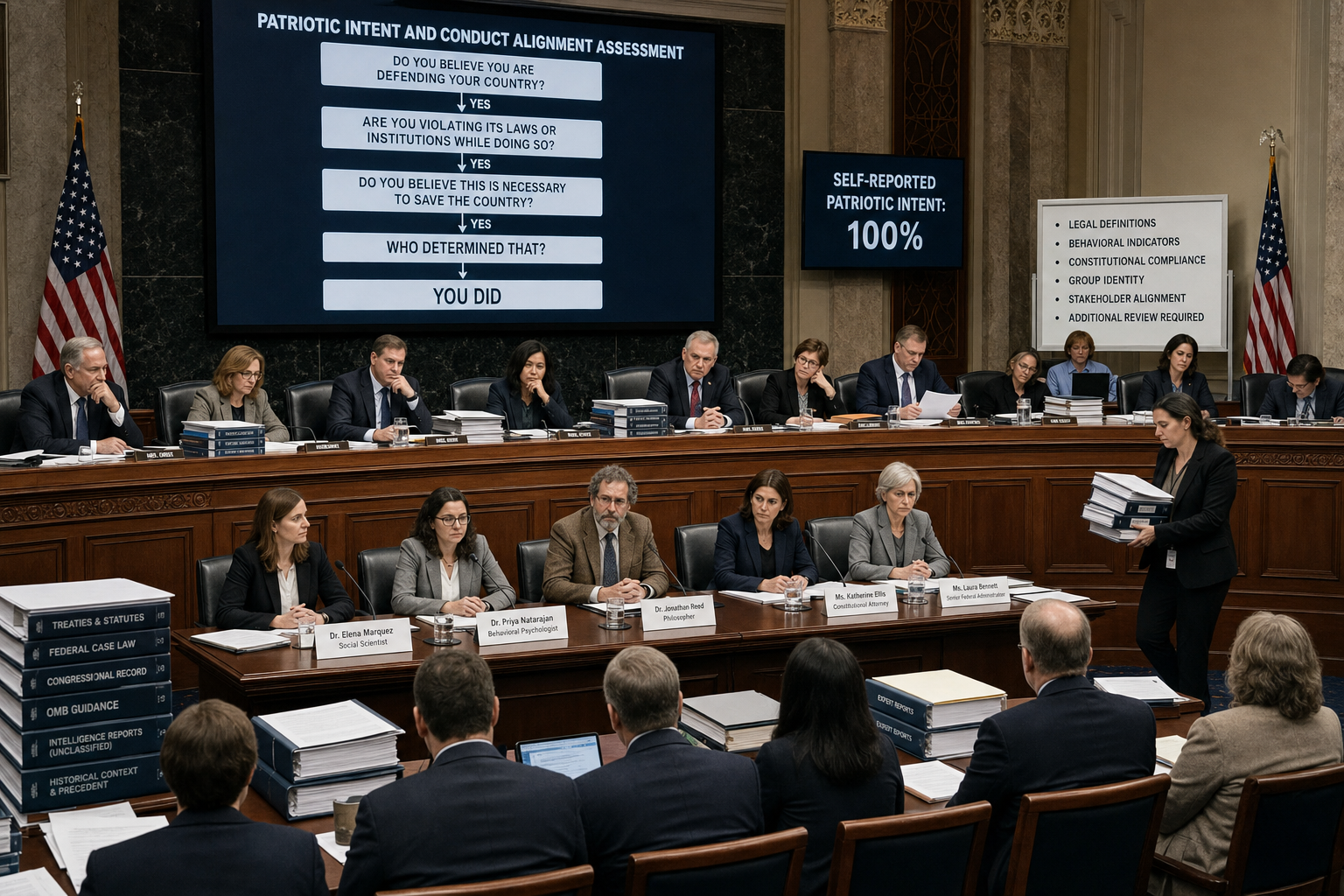
Why People Can Commit Treason While Believing They’re Patriots
GFNN continues to support legacy information delivery technologies, including written language. The following is the text version of today's report.
Reader Assurance Notice: All conclusions in this report remain available even when encountered in an inconvenient order.
WASHINGTON — A congressional committee investigating why people can commit treason while believing they’re patriots heard testimony Tuesday from social scientists, behavioral psychologists, legal scholars and philosophers, who largely agreed that the problem becomes more difficult when the people involved sincerely believe they are saving the country.
The hearing, originally scheduled for two hours, entered its seventh hour after lawmakers requested formal definitions of patriotism, betrayal, country, loyalty, constitutional order, national interest, legitimate authority, emergency and “saving.”
Committee staff said the inquiry was prompted by a bipartisan concern that conventional methods of identifying seriously disloyal conduct depend too heavily on an assumption that people who betray their country recognize themselves as people who are betraying their country.
Witnesses said the assumption is poorly supported.
“People generally maintain a favorable account of their own motives,” said Dr. Elena Marwick, a behavioral psychologist at the Center for Behavioral Decision Sciences. “A person does not need to think, ‘I am betraying my country.’ It is psychologically much easier to think, ‘Extraordinary circumstances require me to do what ordinary people are too frightened, compromised or misinformed to do.’”
Several committee members asked whether the finding had been tested on members of the opposing political party.
Marwick said it had been tested on humans.
The committee subsequently requested additional information about the sampling methodology.
Why People Can Commit Treason While Believing They’re Patriots Becomes a Federal Question
Committee counsel cautioned lawmakers early in the hearing that “treason” has a much narrower meaning under the Constitution than it does in ordinary political speech.
Article III defines treason against the United States in terms of levying war against the United States or adhering to its enemies, giving them aid and comfort, and it imposes unusually specific evidentiary requirements for conviction. The committee therefore said its broader inquiry concerned how people can sincerely understand potentially unlawful, anti-constitutional or gravely disloyal conduct as patriotic conduct, rather than whether any particular person has legally committed treason.
That clarification immediately required the committee to determine what it meant by “patriot.”
Professor Adrian Keller, chair of comparative epistemology at Westbridge University, said the difficulty was not primarily semantic.
It was ontological.
This required another clarification.
“It means,” Keller said after several minutes, “that before determining whether someone is loyal to a country, we have to determine what that person believes the country actually is.”
A senator said the United States was the United States.
Keller agreed that this was one available formulation.
He then asked whether patriotic loyalty was owed principally to the nation's territory, its people, its constitutional system, its government, its laws, its history, its institutions, its ideals, its elected officials, or some combination of those things.
“America,” the senator replied.
“Yes,” Keller said. “That is precisely the compression problem.”
Keller said two citizens could profess absolute loyalty to “America” while referring internally to substantially different objects.
One might mean the constitutional system and its procedures. Another might mean a historical tradition. Another might mean a preferred social order. Another might mean the people. Another might mean a political movement that the individual believes uniquely represents the authentic nation.
The committee chairman asked whether this meant they could all be patriots.
“I haven't established that any of them are patriots,” Keller said. “I have established that they can all produce the sentence.”
Social Scientists Identify an Identity Problem
Dr. Miriam Sato, a social psychologist specializing in group behavior, told the committee that researchers have studied a phenomenon known as identity fusion, in which the boundary between personal identity and group identity can become unusually strong and permeable.
Research on identity fusion has associated that intense sense of oneness with willingness to engage in personally costly and sometimes extreme pro-group behavior, although findings vary across populations, measures, and contexts.
“The important distinction,” Sato said, “is that extreme conduct undertaken for a group does not necessarily feel antisocial from inside the actor's own interpretive framework. It may feel profoundly prosocial.”
“Even violence?” a senator asked.
“Potentially.”
“Even breaking the law?”
“Yes.”
“Even attacking institutions?”
“If the person has concluded that the institutions themselves threaten the group, certainly.”
The senator leaned forward.
“So the more convinced someone becomes that the country is threatened, the more extreme the measures that person may regard as justified?”
“Under some conditions.”
“That's dangerous.”
“It can be.”
“Who decides when those conditions exist?”
Sato paused.
“That question,” she said, “has historically generated additional conditions.”
Committee staff added “conditions” to the terminology list.
Sato explained that group identity itself is neither pathological nor inherently dangerous. Social identification can support cooperation, sacrifice, solidarity and civic participation. The concern arises when an individual's conception of the group becomes sufficiently fused with a particular interpretation of national survival that normal constraints can be reclassified as obstacles to the group's preservation.
The committee asked whether the government could measure that.
Sato said researchers could measure aspects of identity fusion.
The committee chairman asked whether the measurement could identify traitors.
Sato said no.
The chairman asked whether a better measurement could.
Sato still said no.
The committee authorized preliminary discussions regarding a better measurement.
Behavioral Psychologists Explain How the Emergency Keeps Expanding
Marwick then described motivated reasoning, cognitive dissonance, and self-justification.
Research on motivated reasoning examines how people process information in ways influenced by prior commitments, identity and desired conclusions rather than solely by an effort to reach the most accurate conclusion. Researchers have also examined how ego involvement and threats to self-concept can interact with cognitive dissonance and motivated reasoning.
Marwick said the process does not require conscious dishonesty.
That finding appeared to concern the committee more than conscious dishonesty had.
“A consciously dishonest person knows that he is lying,” Marwick said. “A sincerely motivated person may experience contradictory evidence as evidence that the threat is even larger than previously understood.”
She presented a hypothetical sequence.
A citizen begins with the proposition that the country faces an extraordinary threat.
If ordinary institutions do not recognize the threat, the citizen may conclude that the institutions are failing.
If courts reject the citizen's claims, the courts may be considered compromised.
If government officials reject them, those officials may become part of the problem.
If journalists challenge them, the media may be helping conceal the threat.
If friends object, the friends may have been deceived.
If family members object, they may not understand how serious the situation has become.
“And at the end?” a committee member asked.
“At the end, Senator, the person may be surrounded by evidence that he is wrong and experience that as confirmation that he is nearly alone in being right.”
Several senators requested copies of that statement.
One requested that his name not appear on the distribution list.
Marwick emphasized that the mechanisms she described are not confined to any ideology, party, or nationality. Motivated reasoning is a human cognitive phenomenon, not a platform provision.
A senator asked whether education prevented it.
“No.”
“Intelligence?”
“No.”
“Expertise?”
“Not necessarily.”
“Being very certain?”
Marwick looked at him.
“No.”
The senator thanked her and said that confirmed what he had suspected.
Philosophers Ask What Exactly Is Being Betrayed
Keller returned to the witness table after committee members determined that the psychological explanation had created a philosophical problem.
“If someone believes the existing country has departed from the true country,” Keller said, “then conduct directed against existing institutions can be represented internally as loyalty to the supposedly authentic nation.”
A senator objected.
“But if he's betraying his country, surely he knows he's betraying it.”
“Why?”
“Because he's betraying it.”
“That establishes what he is doing, Senator. It doesn't establish what he believes he is doing.”
“What is the difference?”
“Approximately the subject of this hearing.”
The committee recessed for 11 minutes.
After returning, Keller said patriotism ordinarily contains both descriptive and normative elements. It describes an attachment while also implying that the attachment is honorable. As a result, people rarely describe their own political conduct using morally discrediting categories when morally favorable categories remain cognitively available.
A member asked whether that meant a traitor could sincerely consider himself a patriot.
Keller reminded the committee that the legal category of treason remained narrow and should not be casually assigned.
The member rephrased the question.
“Can someone profoundly betray the principles he claims to defend while sincerely considering himself their defender?”
“Of course.”
“How?”
“By changing what counts as defending them.”
Keller said the philosophical problem becomes especially acute when a person distinguishes between the country as it actually exists and the country as it ought to exist.
“If the idealized country is treated as more real, more legitimate or more morally authoritative than the actual constitutional order,” he said, “actions against the latter can be experienced as service to the former.”
A senator asked whether there was a test for determining which version was the real country.
Keller said there were constitutions, laws, institutions, elections, courts, civic traditions and centuries of political philosophy devoted to managing precisely that disagreement without requiring universal metaphysical agreement.
“So there is no test?”
“There is civilization.”
Committee staff asked him to be more specific.
Congress Searches for an Objective Patriotism Standard
The hearing shifted after lunch from explanation to measurement.
Deputy Undersecretary Karen Whitmore of the Department of Administrative Affairs testified that federal agencies already maintain standards for security clearances, conflicts of interest, foreign influence, classified information, ethics compliance, and threats to government operations.
What they lack, she said, is a standardized federal instrument for distinguishing genuine patriotic conviction from sincere patriotic conviction associated with conduct that undermines the thing being defended.
“The current framework contains a self-reporting vulnerability,” Whitmore said.
She displayed a sample question:
DO YOU LOVE YOUR COUNTRY?
“Yes,” Whitmore said. “Everybody of concern keeps checking yes.”
Her department had therefore developed a preliminary Patriotism Intent and Conduct Alignment Assessment.
The draft contained 184 questions.
Among them:
Do you believe you are defending the Constitution?
Do you believe violating constitutional procedures may sometimes be necessary to defend the Constitution?
Who determines when that necessity exists?
Would you accept that determination if made by someone whose political objectives you strongly oppose?
If not, identify the constitutional principle distinguishing the two circumstances.
If your answer requires additional pages, attach Form PICA-17B.
Whitmore said field testing revealed a significant response anomaly.
“Participants across ideological groups generally believed the questions were excellent when they imagined their opponents answering them,” she said.
“How did they perform when answering the questions themselves?” a senator asked.
“We are still validating that portion.”
“Why?”
“They challenged the assumptions underlying the instrument.”
“On what grounds?”
“Political bias.”
“Was it biased?”
“Every group believed so.”
The senator nodded.
“That sounds balanced.”
Whitmore said the department had reached no such conclusion.
Lawyers Discover That Sincerity Is Not a Defense to Everything
The committee next heard from constitutional attorney Rebecca Vale, who warned against converting psychological concepts into legal categories.
“The government should not criminalize cognitive processes,” Vale said. “People are entitled to be wrong, irrational, partisan, grandiose, historically confused, philosophically inconsistent and extraordinarily annoying.”
Committee counsel asked whether all of those protections appeared explicitly in the Constitution.
Vale said not in those words.
She explained that legal systems generally evaluate conduct using defined offenses, evidentiary standards, intent requirements and procedural protections. A person's sincere belief in the righteousness of an action does not automatically determine whether the action was lawful.
At the same time, she said, patriotic rhetoric cannot establish criminal liability.
“We cannot prosecute a person because a psychologist thinks his identity is fused,” Vale said. “Nor can we acquit him because he owns an unusually large flag.”
This created an immediate jurisdictional problem.
The psychologists had described mechanisms that could help explain extreme behavior but could not identify legal treason.
The philosophers could analyze competing concepts of loyalty but resisted operational definitions.
The lawyers could define prohibited conduct but refused to certify patriotism.
The social scientists could measure group identification but would not determine which group deserved loyalty.
Whitmore said this was precisely the kind of interprofessional coordination problem the Department of Administrative Affairs was established to address.
She recommended an interagency working group.
Why People Can Commit Treason While Believing They’re Patriots Produces a Working Group
By late afternoon, the committee had approved in principle the creation of a temporary Congressional Advisory Panel on Patriotic Intent, Constitutional Conduct and Self-Perceived National Loyalty.
The temporary panel would coordinate with the Department of Administrative Affairs, the Center for Behavioral Decision Sciences, Westbridge University, the National University of Administrative Sciences and the Office of Regulatory Harmonization.
The Department of Administrative Affairs proposed six initial workstreams:
legal definitions;
behavioral indicators;
constitutional compliance;
self-reported patriotic intent;
group-identity effects;
and stakeholder disagreement regarding the first five workstreams.
Strategic Alignment Partners, a consulting firm that submitted unsolicited written testimony, recommended that the government avoid treating the issue as a binary distinction between patriot and traitor.
Instead, the firm proposed a “Patriotic Alignment Maturity Model” measuring individuals and institutions across five stages: Expressed Loyalty, Demonstrated Loyalty, Procedurally Aligned Loyalty, Constitutionally Resilient Loyalty and Transformational Patriotic Excellence.
Vale immediately warned that none of those categories had legal meaning.
Strategic Alignment Partners agreed and recommended a second phase to develop one.
Keller objected that the framework assumed patriotism could be reduced to measurable behavioral criteria without first resolving what patriotism meant.
The consultants added an epistemological workstream.
Sato said any instrument would need controls for social desirability bias, identity fusion, perceived threat, group attachment and situational context.
The consultants added a behavioral validation workstream.
Marwick said asking people whether they were rationalizing their conduct would probably produce unreliable answers.
The consultants added an unconscious-process workstream.
Whitmore recommended consolidating the workstreams before the number of workstreams impaired stakeholder confidence.
The committee approved a workstream consolidation working group.
The Hearing Encounters Its Own Research Findings
Shortly before adjournment, the chairman asked the witnesses to answer the question with which the hearing had begun.
“How can someone betray the country while sincerely believing he is a patriot?”
Sato said group identity can alter the object toward which loyalty is directed.
Marwick said motivated reasoning can alter how contradictory evidence is processed.
Keller said people can distinguish the actual nation from an idealized version they regard as more legitimate.
Vale said sincerity and legality are separate questions.
Whitmore said the federal government currently lacked a validated cross-agency framework for integrating those answers.
The chairman appeared dissatisfied.
“So after seven hours, you cannot tell us how to identify these people?”
Marwick replied that examining observable conduct was generally more useful than accepting a person's preferred description of his motives.
“You mean judge people by what they do?”
“Yes.”
“Rather than what they say they believe?”
“For the question you are asking, substantially so.”
There was a pause.
A senator asked whether the principle would apply equally to elected officials.
Marwick said it would apply to human beings.
Another pause followed.
The chairman asked Whitmore how long development of the federal framework was expected to take.
“Eighteen to 24 months for preliminary guidance,” Whitmore said.
“Can it be expedited?”
“Certainly.”
“How quickly?”
“Twenty-four to 36 months.”
The chairman asked how expedited review could take longer.
Whitmore explained that expedited review required additional oversight.
At press time, the Department of Administrative Affairs had circulated temporary guidance instructing federal agencies not to classify individuals as patriotic or unpatriotic pending completion of the new assessment framework.
The Office of Regulatory Harmonization subsequently clarified that the guidance itself should not be interpreted as questioning anyone's patriotism.
Congress has scheduled a follow-up hearing to determine why several members considered that clarification personally directed at them.
Sarah Collins
GFNN Washington Bureau
Click here to read a pretty good essay about this.
Recent Articles


-
When Betrayal Feels Like Patriotism
Oct 01, 26 08:48 PM
 When Betrayal Feels Like Patriotism: What January 6 Reveals About Political Identity
 -
Why People Can Commit Treason While Believing They’re Patriots
Oct 01, 26 08:12 PM
Why people can commit treason while believing they’re patriots is the subject of a congressional inquiry involving psychologists and philosophers. -
Pigusus the flying pig
Sep 27, 26 08:19 AM
Pigusus the flying pig is a work in progress.