
Marcus Goodman's Guaranteed Weight Loss Plan Triggers Congressional Hearing
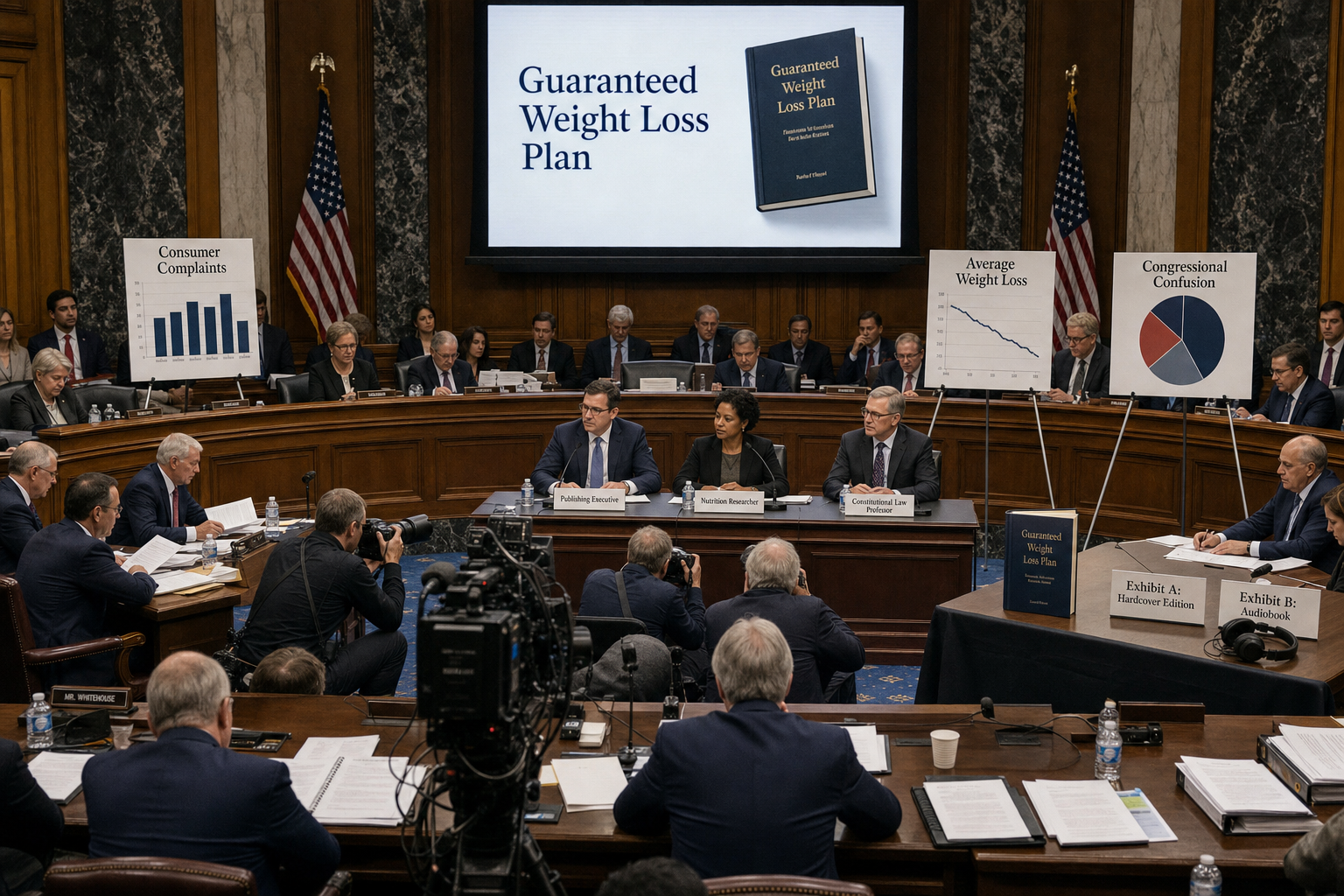
Marcus Goodman's 'Guaranteed Weight Loss Plan' prompts a congressional hearing, highlighting the legal, medical, and constitutional discussions it ignited as a bestselling diet book.
GFNN continues to support legacy information delivery technologies, including written language. The following is the text version of today's report.
Administrative Notice: Readers are reminded that uninterrupted concentration remains a legacy cognitive feature that continues to receive limited institutional support.
By Sarah Collins
GFNN Washington Bureau
WASHINGTON, D.C. — Members of Congress convened Tuesday to examine the legal, medical, ethical, and constitutional implications of Marcus Goodman's Guaranteed Weight Loss Plan, a bestselling health book that has simultaneously generated record consumer complaints and unexpectedly favorable health outcomes.
The hearing was scheduled after several federal agencies concluded that the book's unprecedented commercial success had produced regulatory questions extending well beyond nutrition.
According to documents released by the Department of Nutritional Consistency, consumer complaints initially focused on the book's opening sentence.
Investigators later confirmed that the remaining 438 pages contained precisely the same sentence repeated in varying typefaces, font sizes, page layouts, and typographical emphasis.
No additional nutritional guidance was identified.
Publishing records indicate that the book has nevertheless remained near the top of national bestseller lists for more than fourteen consecutive months.
Public health researchers estimate that readers have collectively lost millions of pounds.
Consumer satisfaction surveys, however, remain sharply divided.
Many respondents described the book as "life changing."
Many also described it as "personally offensive."
Federal analysts characterized the combination as administratively unusual.
Marcus Goodman's Guaranteed Weight Loss Plan Triggers Congressional Hearing After Consumer Complaints Expand
Officials from the Department of Nutritional Consistency testified that the original consumer complaints did not concern dietary science.
"The scientific recommendation itself was remarkably conventional," Deputy Undersecretary Karen Whitmore told lawmakers.
"Our initial review found no disagreement regarding the long-established proposition that sustained reductions in caloric intake generally contribute to weight loss."
"The administrative complications arose almost entirely from the manner in which that recommendation was communicated."
Committee counsel then entered Exhibit 1 into the Congressional Record.
The Chairman requested that the opening sentence be read aloud.
A staff attorney complied.
"Don't eat so much, fatso."
Silence followed for several moments.
The Chairman thanked counsel and instructed the court reporter to reproduce the quotation exactly.
No witness disputed that the sentence appeared on the first page.
The committee then received testimony confirming that identical language appeared on every remaining page.
Officials from the Government Publishing Standards Office verified that Chapters Two through Twenty-Seven differed almost exclusively through changes in typography.
"The author's editorial philosophy appears to have emphasized visual variation rather than textual expansion," one publishing analyst testified.
"The informational content remains operationally stable throughout."
Publishing Executives Describe Unsuccessful Editorial Negotiations
Executives from Heritage Summit Publishing testified that editors initially assumed the manuscript represented an incomplete draft.
"We believed the author had inadvertently submitted only the opening chapter," Senior Acquisitions Editor Richard Lawson explained.
"We therefore requested the remaining chapters."
According to internal correspondence introduced during the hearing, Marcus Goodman responded the following morning by emailing an additional 437 pages.
"They all contained the same sentence," Lawson testified.
"We assumed there had been another transmission error."
Editors again requested recipes, nutritional explanations, grocery shopping advice, behavioral psychology, meal planning strategies, references, appendices, and a bibliography.
Goodman reportedly replied that additional explanation would unnecessarily complicate implementation.
Lawson testified that the editorial staff proposed replacing the opening sentence with several alternatives emphasizing encouragement, positive reinforcement, motivational psychology, and inclusive communication.
"He declined every recommendation."
"What reason did he provide?" one member asked.
"He stated that revising the sentence would reduce operational clarity."
Editors then proposed replacing one specific word.
Goodman again declined.
"The author indicated that substituting a more socially acceptable noun would materially alter what he described as 'the motivational architecture of the program.'"
Publishing executives ultimately approved the manuscript after concluding that consumers would likely interpret the repetitive structure as conceptual performance art rather than a conventional health publication.
Sales data quickly suggested otherwise.
Literary Establishment Discovers Layers Of Meaning Previously Unknown To Civilization
As public criticism of the book intensified, the committee called representatives from the literary community to explain why Marcus Goodman's Guaranteed Weight Loss Plan had recently received several prestigious literary awards despite containing only one sentence, repeated thousands of times, across 439 pages.
The first witness, Dr. Eleanor Whitcomb, President of the National Society for Contemporary Literary Interpretation, rejected what she described as "the increasingly unsophisticated assumption that textual novelty is necessary for artistic significance."
"The work employs radical semantic persistence," Whitcomb testified.
"The sentence does not repeat."
Several members of the committee looked down at their copies.
"It appears to."
Whitcomb smiled patiently.
"Only to readers who remain trapped within conventional notions of linear textual progression."
The Chairman requested clarification.
"The sentences are identical."
"The typography isn't."
Whitcomb nodded approvingly.
"Now you're beginning to read it."
She explained that every typographical alteration represented what literary scholars describe as "a renegotiation of authorial intention within evolving visual discourse."
Representative Collins raised a hand.
"So page 184..."
"...cannot possibly be understood independently of page 183."
"It says exactly the same thing."
"Precisely."
Whitcomb paused.
"The dialogue between those pages is extraordinary."
The committee entered a period of administrative silence.
Professor Malcolm Avery, Chair of Post-Structural Literary Hermeneutics at Northeastern Metropolitan University, testified next.
"Traditional readers mistakenly assume they are reading a sentence."
"What are they actually reading?" the Chairman asked.
"A relationship."
"Between what?"
"The sentence and its previous appearances."
A senator looked confused.
"So nothing changes."
"Oh, Senator."
Avery smiled sympathetically.
"Everything changes."
He explained that the first appearance of the sentence represents "nutritional proposition."
By approximately page 200, however, the reader begins experiencing "recursive lexical destabilization."
"What does that mean?"
"The words stop functioning as words."
"They become..."
He considered briefly.
"...an event."
Committee counsel asked whether the author had intended any of this.
"In literary criticism," Avery replied, "authorial intent remains an interesting historical curiosity."
Art Critics Compare The Book To Minimalist Masterpieces
The committee next heard testimony from internationally recognized art critics.
Dr. Simone Laurent, Chief Curator of Contemporary Visual Expression at the National Museum of Conceptual Art, rejected descriptions of the publication as merely repetitive.
"The public continues to confuse duplication with iteration."
"What's the difference?" one Congressman asked.
"Approximately forty years of graduate education."
Laurent explained that each page exists in "dynamic aesthetic conversation" with every other page.
"The white space breathes."
"The typography hesitates."
"The margins negotiate."
Representative Dawson examined Exhibit 1.
"It looks centered."
"It appears centered."
Laurent leaned toward the microphone.
"The distinction is critical."
She described the work as "perhaps the most important exploration of visual nutritional minimalism since the late twentieth century."
Committee staff asked whether she was referring to diet books.
"No."
"Modern sculpture."
Several lawmakers wrote nothing.
Art historian Dr. Gregory Feldman testified that the repeated sentence gradually loses linguistic identity and instead becomes "pure visual architecture."
"By page 317," Feldman explained, "one is no longer reading criticism."
"One is inhabiting it."
The Chairman interrupted.
"Professor..."
"Doctor."
"My apologies."
"No apology is necessary. Correction itself constitutes an aesthetic gesture."
The Chairman looked briefly toward committee counsel.
"Doctor..."
"Yes."
"Have you actually lost weight?"
"Thirty-one pounds."
"And your opinion of the book?"
"It profoundly destabilized my understanding of textual embodiment."
"So..."
"I bought nine additional copies for friends and colleagues."
Universities Rapidly Expand Research Programs
University administrators described the publication as creating entirely new opportunities for interdisciplinary scholarship.
Dr. Howard Bingham, Provost of East Atlantic University, testified that twelve new academic departments had already been proposed.
"One sentence?"
"The funding opportunities are exceptional."
Bingham explained that the institution had received grant proposals from literature, psychology, typography, philosophy, communications, nutrition, sociology, visual arts, neuroscience, and computational linguistics.
"What are they studying?"
"The same sentence."
"Separately?"
"Initially."
"And now?"
"We've formed a Center for Integrated Repetitive Studies."
The Chairman asked how many faculty members were involved.
"Forty-three."
"Have they reached any conclusions?"
"They've secured additional funding."
Several university presidents testified that conferences devoted exclusively to the book had already been scheduled through 2034.
"The keynote address," one administrator noted proudly, "will examine whether page 276 should properly be understood as an ironic response to page 275."
The Chairman slowly turned to page 276.
"It appears identical."
"That interpretation has become increasingly controversial."
Museums Compete To Acquire Historically Significant Pages Of First Editions
Museum administrators testified that institutions around the world had begun competing for individual pages from first editions.
Margaret Hollis, Director of the National Museum of Printed Culture, explained that Page 1 had already been insured for several million dollars.
"What distinguishes it from Page 2?" the Chairman asked.
"It came first."
"And Page 2?"
"It demonstrates remarkable confidence."
She explained that museums were especially interested in preserving pages where the sentence appeared in unusually bold typography.
"The emotional weight is visibly heavier."
Representative Collins turned to Page 143.
"This one appears italicized."
"One of the finest examples in private hands."
Another museum director described negotiations to borrow Page 318 for a major international exhibition titled Repetition, Identity, and Caloric Consciousness.
"What else will be displayed?" the Chairman asked.
"Only Page 319."
"Why?"
"The dialogue between them must remain uninterrupted."
The Chairman closed the binder.
"I regret to inform the committee that I appear to be completely unqualified to appreciate any of this."
The witnesses exchanged understanding smiles.
"That," Professor Avery observed gently, "is often the first stage of genuine appreciation."
Committee staff later confirmed that attendance at the hearing had increased substantially after literary critics began referring to it as "a live extension of the artwork itself." Several members of Congress privately admitted they remained uncertain whether they had participated in a legislative proceeding, an academic symposium, or an immersive museum installation. None expressed confidence that those categories remained meaningfully distinct.
Physicians And Psychiatrists Distinguish Physiology From Psychology
Medical organizations devoted much of their testimony to separating the book's physiological outcomes from its psychological effects.
Representatives of the Association of Strategic Healthcare Providers emphasized repeatedly that Congress appeared to be evaluating two entirely different clinical questions.
"The first concerns metabolic health," testified Dr. Jonathan Ellis, Chief of Internal Medicine at Unified Healthcare Systems.
"The second concerns bedside manner."
"Our profession has traditionally attempted to optimize both simultaneously."
Ellis cautioned lawmakers against interpreting the controversy as evidence that the biological mechanisms involved were either novel or poorly understood.
"When caloric intake consistently exceeds caloric expenditure over extended periods, the human body has demonstrated a longstanding tendency toward storing excess energy."
"Human physiology," he continued, "has shown remarkably little interest in developments within contemporary communication theory."
Several committee members requested clarification.
"The biological outcome appears entirely conventional," Ellis explained.
"The communication strategy is considerably less so."
Ellis emphasized that physicians generally encourage sustainable behavioral change through rapport, collaborative treatment planning, motivational interviewing, and individualized counseling.
"We do not typically initiate clinical encounters with the word 'fatso.'"
"Medical schools have not historically devoted significant instructional time to determining whether doing so would improve long-term patient compliance."
The American Medical Education Administrators Association later announced the formation of the Curriculum Communication Integration Consortium to evaluate whether future physicians should receive additional instruction in "clinically effective language unlikely to generate congressional oversight."
Dr. Susan Martinez, an endocrinologist specializing in obesity medicine, testified that the reported weight loss itself had surprised relatively few clinicians.
"The physiology is not mysterious."
"The intervention is."
She explained that sustained caloric reduction has long been associated with improvements in body weight, blood pressure, insulin sensitivity, and numerous metabolic markers.
"What we did not anticipate," Martinez said, "was a bestselling publication whose entire behavioral intervention appears to consist of a single repeatedly encountered verbal stimulus."
The committee then turned to psychiatric testimony.
Dr. Benjamin Harris, Professor of Psychiatry at Jefferson Medical Center, told lawmakers that both supporters and critics of the book were overlooking an important clinical distinction.
"The committee appears to be assuming that emotional discomfort and therapeutic effectiveness occupy opposite ends of a single continuum."
"Our review suggests they may represent two largely independent variables."
Harris explained that psychiatric patients frequently experience internal self-talk that substantially influences decision-making.
"Most psychotherapeutic interventions attempt to cultivate more adaptive internal dialogue."
"This publication appears to have selected a rather different implementation strategy."
Researchers participating in the observational studies, Harris noted, consistently reported that readers described spontaneous critical self-talk consisting of repetition of the book's opening sentence immediately before discretionary food choices.
"The phenomenon itself is not especially surprising."
"The remarkable feature is the extraordinary consistency of the reported cognitive cue."
Committee Chairman Harold Benson asked whether psychiatrists considered the resulting self-talk psychologically healthy.
Harris paused briefly before answering.
"I believe 'psychologically uncomplicated' would be a more defensible characterization."
The Chairman repeated the question.
"I would not normally recommend that patients address themselves in those terms," Harris replied.
"On the other hand, our longitudinal data indicate that many participants subsequently made healthier nutritional decisions."
Lead counsel for the plaintiffs immediately asked whether emotional injury and measurable health improvement could legitimately coexist.
"Certainly," Harris answered.
"Psychiatry encounters productive discomfort rather regularly."
"It is entirely possible for patients to dislike an intervention while simultaneously benefiting from it."
He emphasized that his remarks should not be interpreted as an endorsement of the book's communication style.
"My responsibility is to describe the observed psychological mechanisms."
"The committee must decide what to do about them."
Following the testimony, the American Psychiatric Association announced the creation of an interdisciplinary working group to study whether repeated exposure to unusually direct nutritional language should be classified as maladaptive critical self-talk, adaptive behavioral cueing, or a previously unrecognized cognitive phenomenon requiring additional diagnostic terminology.
Its preliminary report is expected next year. The working group's initial planning document contains forty-three pages devoted exclusively to defining the phrase "critical self-talk."
Medical Researchers Report Unexpectedly Straightforward Mechanism
Scientists appearing before the committee repeatedly cautioned lawmakers against searching for a hidden physiological breakthrough.
Dr. Melissa Harmon, Senior Systems Analyst at the Institute for Strategic Compliance, explained that the biological mechanism appeared unusually uncomplicated.
"Our review has identified no previously unknown metabolic pathway."
"No proprietary supplement."
"No novel endocrine discovery."
"No undisclosed pharmacological intervention."
"The available evidence suggests that readers simply consumed fewer calories."
Dr. Harmon emphasized that this finding should not be interpreted as an endorsement of the book's communication strategy.
"Our responsibility is to evaluate physiological outcomes rather than interpersonal etiquette."
"The two variables have become unusually difficult to separate."
Researchers noted that participants generally reported engaging in critical self-talk in which the book's opening sentence was spontaneously repeated immediately before discretionary food choices.
The effect appeared particularly pronounced among readers who had also purchased the audiobook.
"That portion of the investigation remains ongoing," Harmon said.
"The audiobook introduces an entirely different reinforcement schedule. We are evaluating whether repeated cue exposure influences long-term behavioral compliance."
Marcus Goodman's Guaranteed Weight Loss Plan not only Triggers Congressional Hearing but also Becomes a Constitutional Law Question
As testimony continued into its second day, lawmakers increasingly shifted their attention away from nutrition and toward constitutional law.
Attorneys representing several advocacy organizations argued that Congress had an obligation to determine whether Americans possessed a constitutional right to receive dietary advice free from what they described as "gratuitously pejorative nutritional terminology."
Lead counsel Rebecca Aldridge of the National Association of Trial Attorneys emphasized repeatedly that the litigation did not challenge the underlying physiology.
"Our clients acknowledge that consuming fewer calories may contribute to weight reduction," Aldridge testified.
"Our concern is that this recommendation was delivered using language inconsistent with contemporary expectations regarding personal dignity."
She described the issue as "a novel balancing test between measurable physiological benefit and measurable emotional injury."
Several members of the committee nodded while making extensive notes.
Professor Adrian Keller, Chair of Comparative Epistemology at Westbridge University, described the controversy as "an unexpectedly productive intersection between ethics, constitutional law, linguistics, and metabolic science."
"It has long been understood that statements may be true."
"It has likewise long been understood that statements may be offensive."
"This hearing represents one of the first large-scale governmental efforts to determine what should occur when those characteristics become highly correlated."
Keller cautioned lawmakers against assuming that truthfulness and kindness necessarily occupy identical philosophical territory.
"They frequently overlap."
"They occasionally diverge."
"This appears to be one of those occasions."
When asked whether philosophy possessed a solution, Keller paused briefly.
"Not one likely to conclude before appropriations expire."
The committee later entered into evidence a 612-page philosophical review titled Toward A Normative Framework For Evaluating Interpersonally Abrasive Nutritional Recommendations.
Members acknowledged privately that few expected to finish reading it before the next hearing.
Alleged Victims Describe Continuing Emotional Recovery
Much of the afternoon session focused on testimony from readers who stated they had suffered significant emotional distress after reading the opening sentence.
Committee Chairman Harold Benson thanked each witness for appearing before Congress and reminded observers that respectful testimony remained essential regardless of body composition.
The first witness described purchasing the book after seeing it recommended by coworkers.
"I opened the cover."
"I read the first sentence."
"I experienced an immediate sense of emotional violation."
She paused before continuing.
"It made me feel unseen, invalidated, and fundamentally unsafe within my own nutritional journey."
The Chairman asked whether she had continued reading.
"I did."
"How much of the book?"
"All of it."
"Results?"
"I've lost thirty-eight pounds."
The Chairman asked whether she considered the program successful.
"Physically, yes."
"Emotionally?"
"I'm still processing the harm."
Another witness testified that she initially threw the book across her living room after reading the opening page.
"I felt attacked."
"I felt judged."
"I felt profoundly dysregulated."
She acknowledged retrieving the book before dinner.
She explained that the opening sentence subsequently began recurring as spontaneous critical self-talk whenever she considered desserts, second helpings, or late-evening snacks.
"My endocrinologist is delighted."
"My therapist believes the outcome is considerably more nuanced."
A third witness described feeling "re-traumatized by typographical aggression."
"I understood intellectually that it was only ink on paper."
"My nervous system experienced something quite different."
Committee members requested clarification of "typographical aggression."
The witness replied that the unusually large bold lettering had amplified the emotional impact.
Lead counsel immediately reminded witnesses that measurable health improvements should not be interpreted as diminishing claims of emotional injury.
"The existence of favorable clinical outcomes," Aldridge explained, "does not extinguish compensable psychological harm. Courts have long recognized that beneficial consequences and actionable emotional distress may coexist."
Another witness testified that his blood pressure had normalized, he had discontinued two medications under physician supervision, his sleep had improved, and chronic knee pain had largely resolved.
Committee attorneys requested that he confine his testimony to the emotional dimensions of his experience.
The witness apologized.
"I continue to feel profoundly uncomfortable about how much better I feel."
HR Professionals Develop Alternative Communication Framework
Representatives of the Customer Experience Harmonization Council and the Association of Responsible Stakeholders jointly unveiled a proposed replacement for the book's opening sentence.
The revised version required slightly more than two pages.
"We invite you to evaluate whether your current nutritional behaviors remain fully aligned with your long-term physiological objectives while recognizing that every individual's relationship with food exists within a unique social, emotional, cultural, and experiential context deserving of unconditional respect."
The statement continued for approximately 1,300 additional words.
Consultants described the revision as "substantially more inclusive."
Researchers later reported that most test subjects became hungry before reaching the conclusion.
Operational Excellence Advisors subsequently proposed a six-phase implementation framework involving guided self-reflection, stakeholder affirmation exercises, meal-planning workshops, interdisciplinary nutritional dialogue sessions, and post-meal emotional validation.
The projected implementation cost exceeded $84 million nationwide.
Marcus Goodman's original intervention continued retailing for $14.95.
Dr. Melissa Harmon cautioned lawmakers against interpreting the comparison as a recommendation.
"The committee should avoid assuming that implementation complexity necessarily predicts clinical effectiveness."
"Our findings at present establish only that one approach is significantly shorter."
The Chairman requested that both programs undergo comparative evaluation.
The resulting pilot study is expected to continue for approximately six years.
Audiobook Producers Introduce Expanded Performance Edition
The committee devoted considerable attention to the audiobook adaptation after federal investigators determined that it had outsold the hardcover edition by nearly three to one.
Executives from Audible Media Group confirmed that the unabridged recording consists entirely of Marcus Goodman reading the same sentence for just over fourteen hours.
"The text faithfully reproduces the printed edition," Senior Audio Producer Michael Alvarez testified.
"The principal artistic variation involves vocal emphasis."
Members of Congress requested examples.
Alvarez explained that the opening chapter employs what production notes describe as "measured nutritional disappointment."
Subsequent chapters gradually transition through "increasing concern," "firm encouragement," "professional exasperation," and finally "administrative inevitability."
"The wording itself never changes," Alvarez explained.
"Only the emotional delivery evolves."
Government analysts reported that listeners completing the entire audiobook demonstrated substantially higher completion rates than expected for nonfiction health publications.
Researchers remain divided over whether the improved outcomes resulted from repeated behavioral reinforcement or a progressively diminished desire to think about food.
"The causal mechanism requires additional study," Dr. Harmon testified.
"The practical outcome appears less ambiguous."
Congressional staff members assigned to review the audiobook as evidence collectively lost 187 pounds before the hearing concluded.
Several later testified that they remained uncertain whether the recording constituted protected speech, medical advice, motivational psychology, or "some combination requiring additional regulatory classification."
Administrative Review Continues As Institutions Expand Their Roles
As the hearing entered its third day, additional organizations announced parallel reviews.
The Department of Administrative Affairs established an Interagency Working Group on Respectful Nutritional Communication.
The Office of Unintended Consequences began evaluating whether emotionally uncomfortable health interventions required a distinct regulatory framework separate from traditional medical guidance.
The Department of Nutritional Consistency announced a comprehensive review of existing dietary terminology.
Meanwhile, the National University of Administrative Sciences established the Center for Applied Motivational Language Studies, whose initial research grant will examine whether typographical emphasis influences long-term behavioral compliance.
Consulting firms quickly released white papers recommending comprehensive transformation roadmaps, stakeholder engagement initiatives, implementation frameworks, communication harmonization strategies, and multi-phase optimization plans.
Most concluded that additional coordination among government, healthcare providers, publishers, behavioral scientists, philosophers, and communications professionals would likely prove beneficial.
None recommended printing fewer reports.
Publishers likewise announced formation of the Responsible Wellness Language Consortium, an industry coalition dedicated to developing evidence-based best practices for nutritionally effective yet emotionally supportive manuscript preparation.
The Consortium's first meeting has been scheduled for next spring.
Its preliminary agenda contains twelve sessions on inclusive vocabulary selection.
Nutrition has been allocated a forty-five-minute panel immediately before lunch.
Marcus Goodman Declines To Revise Future Editions
Marcus Goodman appeared briefly near the conclusion of the hearing.
Asked whether he intended to revise future editions, Goodman replied that he had carefully considered every recommendation submitted by publishers, attorneys, physicians, consultants, philosophers, communications specialists, and members of Congress.
"I have."
The Chairman asked whether any changes would be incorporated.
"No."
A committee member asked whether readers might reasonably benefit from recipes, grocery shopping advice, meal plans, behavioral coaching, nutritional science, or references.
Goodman considered the question.
"I made one change."
Members leaned forward.
"The new edition uses larger print."
The revised manuscript was immediately referred to the Government Publishing Standards Office for technical review.
Officials later confirmed that the additional font size increased production costs by approximately sixty-two cents per copy while leaving the nutritional guidance unchanged.
Late Breaking: Publication Status Update
Following the congressional hearing and subsequent federal reviews, representatives for Marcus Goodman confirmed that the book version of the Guaranteed Weight Loss Plan has been permanently withdrawn from publication.
Officials emphasized that the decision should not be interpreted as dissatisfaction with sales. According to those familiar with the matter, the book would likely have remained commercially successful, medically controversial, psychologically unsettling, and sufficiently influential to prompt additional congressional hearings and federal reviews.
The publisher explained that the decision was based entirely on the increasingly practical difficulty of continuing to offer a 439-page volume containing the same sentence thousands of times.
"When you stop and think about it," Goodman said, "it begins to feel repetitive."
Unsold copies have attracted the attention of book collectors, who reportedly view the volume as a landmark in repetitive literature. Remaining copies have become increasingly difficult to obtain.
At press time, the House Committee had voted unanimously to establish the National Commission on Constitutionally Appropriate Nutritional Communication to determine whether the phrase "fatso" should be classified as an insult, protected speech, motivational counseling, a clinical intervention, or a distinct category requiring the creation of an entirely new federal agency.
The Commission's preliminary report is expected to exceed 2,400 pages. The book under investigation remains 439 pages long and continues to contain exactly one sentence.
— Sarah Collins, GFNN Washington Bureau
Interested in a weight loss plan that contains more than one sentence?
Marcus Goodman's Longevity Secrets For Men, Women, Even Them Non-Binaries! explores the science of fasting, nutrition, inflammation, metabolic health, and healthy aging using substantially more pages, significantly more references, and noticeably fewer congressional hearings.
Meanwhile, Get More GFNN.
Recent Articles


-
The Gentle Night Friends Series
Aug 23, 26 03:38 PM
 The Gentle Night Friends Series is a collection of SEL children's stories.
 -
Senator Replaced Himself With Android: Committee Investigates
Aug 10, 26 12:32 PM
 Senator replaced himself with an android characterized as a "Legislative Productivity Surrogate," prompting a Judiciary Committee inquiry into voting, representation, AI autonomy, and constitutional p…
 -
Congress Opens Investigation Into the Decline of Music Education
Aug 03, 26 02:18 PM
Congress Opens Investigation Into the Decline of Music Education after educators report unexpected changes in student learning, prompting federal hearings, academic reviews, and industry responses.