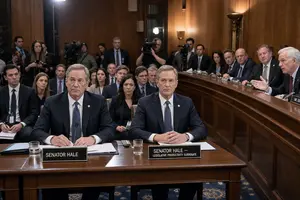

Congress Opens Hearing Into Ancient Persian Governance Procedure Following Preliminary Federal Review
Congress Opens Hearing Into Ancient Persian Governance Procedure Following Preliminary Federal Review as experts from multiple disciplines testify that an ancient decision-making practice merits careful scientific evaluation.
GFNN continues to support legacy information delivery technologies, including written language. The following is the text version of today's report.
Continuity Advisory: Readers may experience sustained exposure to complete institutional reasoning presented in sequential order.
By Sarah Collins
GFNN Washington Bureau
WASHINGTON — Congress opened formal hearings Tuesday following the Department of Administrative Affairs' Preliminary Federal Review into an ancient Persian governance procedure that has attracted growing interest from historians, organizational researchers, engineers, economists, psychologists, and cognitive scientists.
Committee officials emphasized throughout the opening session that Congress has reached no conclusions regarding the historical practice and has authorized no implementation of any kind.
Rather, lawmakers described the hearing as an evidence-gathering exercise intended to determine whether the Department's findings justify additional interdisciplinary research.
The hearing followed the Department's Preliminary Federal Review, itself initiated after Representative Harold Benson asked congressional staff to verify a historical account he encountered while helping his eighth-grade daughter with a history assignment. What began as a routine request for historical clarification expanded into an interagency examination of a governance procedure attributed to ancient Persia.
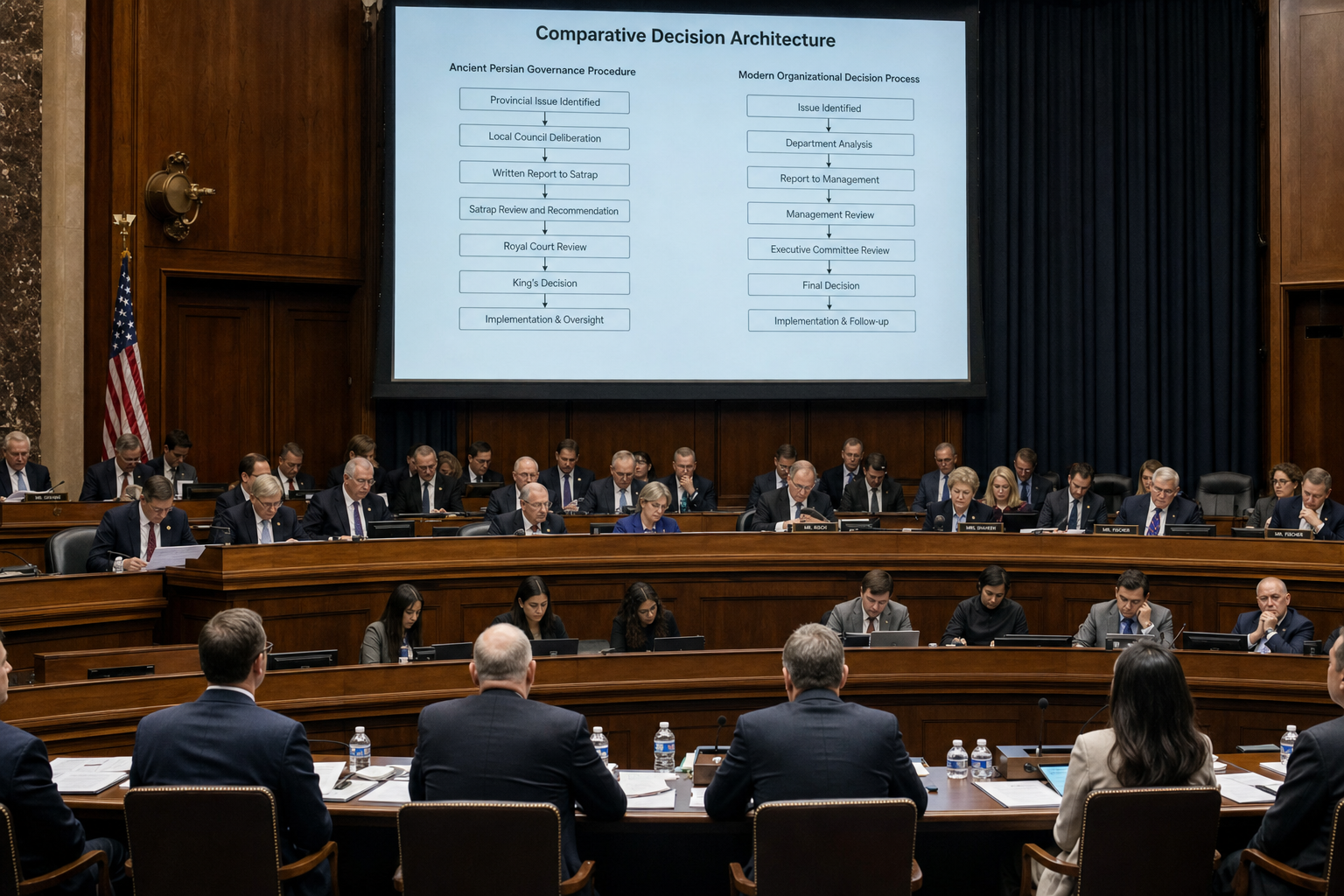
According to the historical accounts under review, important governmental decisions were discussed while participants were intoxicated, reconsidered after they had become sober, and adopted only if the proposals appeared equally sound under both conditions.
Historians appearing before the committee cautioned lawmakers against treating ancient historical narratives as procedural manuals.
They were equally cautious, however, about dismissing them.
Professor Eleanor Hastings, Chair of Ancient Mediterranean Studies at Westbridge University, testified that the reported practice appears frequently enough within surviving historical sources to warrant continued scholarly attention.
"Our responsibility as historians is not to determine whether modern governments should adopt ancient customs," Hastings said.
"Our responsibility is to determine whether the historical record accurately describes what those societies believed they were doing."
She noted that while historians continue debating how consistently the procedure may actually have been employed, the underlying concept has long been recognized within classical scholarship.
"The historical question is comparatively straightforward," she said.
"The administrative question now before Congress is considerably more ambitious."
Committee Chairman Robert Holloway thanked the witness before reminding attendees that the hearing concerned modern organizational decision-making rather than ancient political history.
"The Committee," Holloway said, "is attempting to determine whether contemporary organizational science has anything to learn from this historical account."
He quickly added that the hearing should not be interpreted as expressing any opinion regarding alcohol consumption.
That clarification would be repeated frequently throughout the day.
Department Of Administrative Affairs Explains Why The Review Was Ordered
Deputy Undersecretary Karen Whitmore of the Department of Administrative Affairs summarized the Department's preliminary findings.
She explained that the review, originally initiated after Representative Harold Benson requested historical clarification while helping his daughter with a homework assignment, gradually expanded well beyond its original scope.
"The Department became interested," Whitmore testified, "when independent reviewers from multiple disciplines began describing the same historical account using entirely different professional vocabularies."
"Our historians described an ancient governance tradition."
"Our engineers described sequential verification."
"Our psychologists described temporal separation between ideation and evaluation."
"Our economists described incentive structures affecting reputational risk."
"Our organizational consultants immediately proposed implementation frameworks."
Whitmore paused briefly.
"The Department considered the consultants' response premature."
She explained that no participating discipline had concluded the historical procedure should be adopted.
"What surprised us," Whitmore continued, "was that no participating discipline concluded the procedure could simply be dismissed."
That observation gradually became the defining conclusion of the Department's review before emerging as the recurring theme of the congressional hearing.
"The Department has identified no scientific basis upon which the historical procedure may presently be recommended."
She paused before delivering the sentence that committee members would reference repeatedly throughout the hearing.
"The Department has likewise identified no scientific basis upon which it may presently be dismissed."
The hearing room remained quiet as lawmakers reviewed copies of the Department's preliminary report.
Whitmore emphasized that the Department was making no recommendation.
"The Department recommends only that Congress determine whether additional research is justified."
Engineers Describe An Unexpectedly Familiar Verification Architecture
The committee's next witnesses came from Jefferson Institute of Technology.
Dr. Leonard Hughes, Professor of Systems Engineering, testified that engineers had examined the historical descriptions without regard to their cultural origin.
"We analyzed the process exactly as we would analyze any decision architecture."
According to Hughes, the historical procedure appeared to separate divergent idea generation from convergent analytical verification.
"The two cognitive activities are not identical."
"Generating unconventional possibilities and critically evaluating those possibilities require substantially different operational objectives."
He displayed a systems diagram comparing several contemporary engineering design methodologies with the reported Persian procedure.
Committee members appeared surprised by the similarities.
"The engineering community has independently developed multiple processes that intentionally separate creative exploration from formal design verification."
Representative Elaine Porter asked whether the ancient procedure should therefore be considered technologically sophisticated.
Hughes smiled politely.
"Engineers generally avoid assigning adjectives to historical civilizations."
"We evaluate architectures."
He pointed toward the projected diagram.
"This architecture exhibits characteristics we would immediately recognize."
Representative Porter asked whether engineers considered the procedure irrational.
"Irrational?"
Hughes looked briefly toward his colleagues.
"No."
He chose his next words carefully.
"It appears operationally unconventional."
"Those are not synonymous."
He cautioned Congress against assuming that unconventional processes necessarily produce superior outcomes.
"We have not evaluated outcomes."
"We have evaluated only structural characteristics."
Several lawmakers requested copies of the engineering report.
Economists Discover An Incentive Problem
Dr. Alan Prescott, Senior Economist at the Center for Regulatory Excellence, approached the witness table carrying several charts illustrating organizational decision dynamics.
"The economic question," Prescott began, "is not whether participants become more creative."
"The economic question concerns incentives."
He explained that most organizations unintentionally reward predictability.
Employees proposing conventional ideas assume relatively little professional risk.
Employees proposing unconventional ideas face substantially greater reputational uncertainty.
"As a consequence," Prescott said, "organizations frequently receive fewer genuinely original proposals than individual employees privately possess."
Representative Holloway interrupted.
"Are you suggesting employees routinely withhold ideas?"
"I'm suggesting," Prescott replied, "that employees continuously estimate career risk."
He emphasized that this behavior requires no conspiracy.
"No manager instructs employees to self-censor."
"No employee consciously decides to protect organizational conformity."
"The equilibrium emerges naturally."
Several committee members underlined the word equilibrium in their briefing documents.
Prescott continued.
"If one temporarily reduced perceived reputational consequences during idea generation while restoring full analytical standards before implementation..."
He stopped.
"That appears to be exactly the incentive structure the reported Persian procedure was designed to create."
The economist immediately qualified his statement.
"I am not evaluating the mechanism."
"I am evaluating the incentives."
Representative Porter asked whether economics therefore supported implementation.
Prescott shook his head.
"Economics supports measurement."
"The two concepts should not be confused."
Behavioral Scientists Conclude Modern Theory Cannot Yet Explain The Findings
The afternoon session featured testimony from psychologists specializing in organizational behavior.
Dr. Rebecca Lawson of the Center for Behavioral Decision Sciences testified that modern research has extensively documented conformity effects within groups.
"No serious researcher disputes the existence of groupthink-related phenomena."
She emphasized, however, that organizations have invested decades developing methods intended to reduce those effects.
Structured brainstorming.
Anonymous submissions.
Devil's advocates.
Delphi techniques.
Red-team exercises.
Independent review panels.
Cross-functional committees.
External reviewers.
Sequential approvals.
Independent validation teams.
"Collectively," Lawson said, "these methods represent a remarkable intellectual achievement."
Representative Holloway asked the obvious question.
"If modern organizations already possess these tools..."
Lawson nodded.
"...why examine an ancient historical account?"
She took several moments before answering.
"Because science advances by investigating observations that existing theory does not entirely account for."
She explained that the preliminary review had not demonstrated that the Persian procedure outperformed modern techniques.
"It has merely demonstrated that none of our existing theories adequately explain why multiple professional disciplines independently concluded the historical account deserved additional study."
The committee room became noticeably quieter.
Lawson concluded with perhaps the most cautious testimony of the day.
"The Center is not prepared to recommend implementation."
"We are equally unprepared to recommend intellectual dismissal."
She folded her notes.
"Those positions, while superficially similar, are scientifically quite different."
Human Resource Professionals Urge Caution
The committee's next witnesses represented human resources professionals from several large public and private organizations.
Unlike previous witnesses, they offered no opinion regarding the historical evidence, behavioral science, engineering analyses, or economic testimony presented earlier in the day.
Instead, they emphasized the importance of maintaining established organizational processes.
Jennifer Marshall, Chief Human Resources Officer for the National Association of Workplace Excellence, testified that successful organizations rely upon carefully developed procedures promoting professionalism, psychological safety, mutual respect, and appropriate workplace conduct.
"Those procedures have evolved over many years."
Representative Holloway asked whether the Association had identified any specific shortcomings in the historical procedure discussed throughout the hearing.
Marshall replied that the Association had not yet completed its review.
She nevertheless urged Congress to proceed with exceptional caution.
"Caution regarding what?" Representative Porter asked.
Marshall paused briefly.
"Change."
She explained that organizations often underestimate the complexity associated with modifying established interpersonal processes.
Representative Bell asked whether the Association believed existing organizational methods already addressed the concerns identified by behavioral scientists earlier in the day.
"Our position," Marshall replied, "is that organizations should continue relying upon appropriately structured organizational processes."
Representative Porter asked whether those processes consistently eliminated conformity pressures and groupthink.
Marshall replied that the Association strongly supported their continued use.
She did not elaborate.
Committee staff later noted that the testimony represented the only appearance of the day in which a witness recommended maintaining current institutional practices without first explaining why.
No committee member challenged the recommendation.
Consultants Recommend Frameworks For Research That Has Not Yet Been Authorized
The committee's next panel demonstrated why the Department of Administrative Affairs had chosen to delay public release of its preliminary review until after Congress convened.
Representatives from three national consulting firms appeared before lawmakers to discuss the potential administrative implications should Congress eventually determine that additional research was warranted.
Committee counsel reminded each witness that no pilot program had been approved.
All three consultants acknowledged the reminder.
None appeared to consider it a significant obstacle to discussing implementation.
Martin Keating, Senior Managing Director of Strategic Alignment Partners, testified that his firm viewed the historical procedure not as an isolated practice but as "an organizational architecture requiring careful modernization."
"The objective," Keating explained, "would not be historical replication."
"It would be strategic adaptation within contemporary governance environments."
He outlined what he described as a preliminary transformation roadmap consisting of executive stakeholder engagement, organizational readiness assessments, governance modernization, cognitive diversity metrics, facilitator accreditation, implementation governance, post-session validation frameworks, performance benchmarking, change-management communications, executive dashboards, and continuous operational optimization.
Representative Holloway studied the chart for several seconds.
"Have any of these recommendations been requested?"
"No," Keating replied.
"They represent proactive preparedness."
Another consultant, Sandra Liu of Institutional Transformation Group, cautioned against what she termed "historical literalism."
"The opportunity before Congress is not whether to recreate antiquity."
"It is whether modern organizations might benefit from a structured methodology that separates unrestricted ideation from disciplined evaluation."
She emphasized that successful implementation would require executive coaching, facilitator certification, governance documentation, compliance standards, quality assurance procedures, organizational maturity assessments, and periodic external auditing.
Representative Thomas Bell glanced toward Karen Whitmore.
"How many of those existed in ancient Persia?"
Whitmore quietly adjusted her microphone.
"The Department possesses no evidence suggesting they maintained facilitator certification."
The hearing moved on without further discussion.
Attorneys Request Definitions Before Considering Questions
If consultants viewed the hearing as an implementation challenge, attorneys regarded it as a definitional problem.
Margaret Sullivan, Senior Counsel for the Institute for Strategic Compliance, testified that Congress should avoid discussing the historical procedure until several foundational legal questions had been resolved.
"The Committee has used the terms 'brainstorming,' 'decision-making,' 'evaluation,' 'intoxication,' 'judgment,' and 'governance' repeatedly today."
She paused.
"None have yet been formally defined."
Representative Porter asked whether the historical descriptions themselves supplied sufficient context.
"Historical context and statutory language satisfy different legal objectives," Sullivan replied.
"The former informs scholarship."
"The latter governs liability."
She distributed a memorandum identifying twenty-three terms that, in her opinion, required precise legal definitions before any pilot study could be authorized.
Among them were "uninhibited discussion," "temporary cognitive alteration," "organizational participation," "professional judgment," "voluntary attendance," "decision finality," and "subsequent sobriety."
Representative Bell asked how long such work might require.
"That depends."
"On what?"
"Definitions."
Several committee members smiled.
Sullivan did not.
She continued in exactly the same tone.
"The legal profession generally prefers determining what words mean before regulating activities they describe."
No one disagreed.
Philosophers Object To The Committee's Understanding Of Originality
The afternoon's most unexpectedly influential testimony came from Professor Adrian Keller, Chair of Comparative Epistemology at Westbridge University.
Keller began by informing Congress that the hearing had proceeded under an assumption requiring immediate examination.
"The Committee appears to have accepted the proposition that originality constitutes a measurable phenomenon."
Representative Holloway asked whether it did not.
"I have no objection to the proposition," Keller replied.
"I merely note that no witness has defended it."
The room became noticeably quieter.
Keller explained that historians discussed authenticity.
Engineers discussed architecture.
Economists discussed incentives.
Psychologists discussed cognition.
Attorneys discussed definitions.
"Each discipline has spoken competently."
"Each has also assumed a concept of originality without identifying whether originality exists independently of the interpretive frameworks through which organizations recognize it."
Representative Porter leaned forward.
"Professor..."
"Yes?"
"What exactly are you recommending?"
"I recommend that Congress avoid confusing epistemological questions with administrative ones."
Several lawmakers began taking notes.
Keller continued.
"If the historical procedure encourages organizations to recognize ideas previously ignored, one must ask whether those ideas were newly created..."
He paused.
"...or merely newly permitted."
The hearing room remained silent.
Representative Bell eventually thanked the witness.
Several minutes later, staff members privately admitted they were uncertain whether the professor had supported or opposed additional research.
Professor Keller later clarified that neither interpretation accurately reflected his testimony.
Artificial Intelligence Researchers Create An Entirely Different Problem
Congress concluded the day's testimony with researchers from Applied Artificial Intelligence Corporation and Jefferson Institute of Technology.
Rather than discussing alcohol, the panel focused on computational models of idea generation.
Dr. Evelyn Ross explained that modern language models routinely separate generative processes from evaluation processes through independent computational architectures.
Representative Holloway immediately noticed the similarity.
"Are you suggesting artificial intelligence independently evolved something resembling the historical procedure?"
Ross considered the question.
"I would phrase it differently."
"Please."
"Optimization frequently benefits from separating exploration from evaluation."
She explained that machine learning systems often generate many candidate solutions before selecting among them according to entirely different objective functions.
"The architecture is computationally familiar."
Committee members exchanged glances.
Representative Porter asked whether artificial intelligence therefore validated the historical procedure.
"No."
Ross answered immediately.
"It validates neither history nor public policy."
"It merely demonstrates that separating idea generation from idea evaluation appears computationally useful under certain optimization conditions."
Dr. Michael Reynolds of the Bureau of Predictable Outcomes added another observation.
"What interests us," Reynolds said, "is not whether ancient Persia anticipated artificial intelligence."
"What interests us is why independent disciplines continue discovering structurally similar solutions while solving completely different problems."
That sentence would appear repeatedly in the following morning's news coverage.
Congress Discovers An Unexpected Consensus
As the hearing entered its final hour, Chairman Holloway asked committee staff to summarize the testimony.
The summary proved unexpectedly concise.
Historians found the historical accounts sufficiently credible to warrant attention.
Engineers found the decision architecture technically recognizable.
Economists identified plausible incentive mechanisms.
Psychologists acknowledged that the underlying cognitive questions remained scientifically interesting.
Consultants proposed implementation frameworks despite the absence of implementation authority.
Attorneys requested additional definitions.
Philosophers questioned assumptions underlying several definitions.
Artificial intelligence researchers described computational architectures exhibiting comparable structural characteristics.
No witness had recommended adopting the historical procedure.
Chairman Holloway looked around the hearing room.
"Has any witness recommended dismissing it?"
Committee counsel quietly reviewed the record.
After several moments, he answered.
"No, Mr. Chairman."
Holloway looked toward Deputy Undersecretary Whitmore.
"Does the Department have a recommendation?"
Whitmore consulted the preliminary report already resting before every committee member.
"The Department recommends only what it recommended before today's hearing."
She spoke slowly.
"Additional evidence."
"Specifically?"
"A limited series of carefully designed pilot studies conducted under independent scientific supervision."
She immediately added four qualifications.
"The Department is not recommending implementation."
"It is not recommending institutional adoption."
"It is not recommending changes to existing governance practices."
"It is recommending research."
The committee recessed shortly afterward.
Outside the hearing room, reporters asked lawmakers whether Congress was preparing to authorize pilot programs.
No member answered directly.
Instead, nearly every representative used nearly identical language.
"The testimony presented today suggests that further study may be appropriate."
Inside the Capitol, however, staff members had already begun quietly contacting the Department of Administrative Affairs, the National University of Administrative Sciences, the Center for Behavioral Decision Sciences, and the Institute for Strategic Compliance to determine what a carefully limited pilot program might require.
None yet realized that, within days of the announcement, organizations across virtually every sector of American society would begin volunteering before a single application form had been drafted.
Administrative Planning Immediately Begins Expanding
Although the committee recessed without taking formal action, the hearing had already begun generating the kind of administrative momentum familiar to veteran observers of federal policy.
Within forty-eight hours, the Department of Administrative Affairs confirmed that it had received requests from seven additional agencies seeking observer status should Congress ultimately authorize pilot studies.
Officials emphasized that observer status should not be interpreted as participation.
Nor should it be interpreted as interest in participation.
"It reflects prudent interagency awareness," Deputy Undersecretary Karen Whitmore explained.
"When multiple federal organizations anticipate that another agency may eventually produce information relevant to their own statutory responsibilities, early observation represents sound administrative practice."
The Office of Administrative Continuity requested observer status because any future recommendations might eventually influence organizational governance.
The Department of Sequential Approvals expressed interest in understanding how any proposed pilot might interact with existing decision-review procedures.
The Office of Customer Expectation Alignment requested representation to ensure that participating organizations accurately understood whatever Congress ultimately authorized.
The Office of Unintended Consequences submitted its request without explanation.
Committee staff described that as consistent with departmental practice.
Universities Quietly Begin Organizing Research Consortia
Congress had not yet authorized a single pilot.
Universities nevertheless began discussing how they might evaluate one if authorization eventually occurred.
The National University of Administrative Sciences announced formation of an interdisciplinary working group including historians, psychologists, organizational behavior researchers, economists, statisticians, and cognitive scientists.
Jefferson Institute of Technology proposed an engineering analysis comparing historical governance structures with contemporary design methodologies.
Westbridge University announced a symposium titled "Sequential Decision Architectures Across Civilizations."
Professor Adrian Keller explained that the symposium should not be interpreted as supporting the historical procedure.
"We remain uncertain what the procedure actually represents."
"That uncertainty appears academically valuable."
Several universities immediately proposed collaborative research agreements.
Others proposed studying whatever conclusions emerged from those collaborations.
One university established a committee to determine whether participation in a future consortium would itself require prior institutional review.
No one considered the proposal unusual.
Trade Associations Recognize A Potential Governance Issue
Industry organizations quickly concluded that, should pilot studies eventually occur, they ought to participate in developing voluntary guidance.
David Mercer, spokesperson for the Coalition for Sustainable Expectations, announced formation of the organization's Historical Governance Preparedness Initiative.
"The Coalition is not advocating implementation."
"We are advocating preparedness."
Mercer explained that businesses perform best when regulatory uncertainty is minimized.
"If Congress eventually authorizes pilot programs, organizations deserve clarity regarding terminology, documentation standards, insurance considerations, operational expectations, and stakeholder communications."
The Association of Responsible Stakeholders reached much the same conclusion.
Its chairman announced development of preliminary best-practice recommendations "for organizations that may someday consider evaluating any future guidance eventually resulting from any pilot studies Congress may or may not authorize."
Representative Bell later remarked that the sentence had contained an unusually large number of qualifying phrases.
Mercer considered that encouraging.
"It demonstrates responsible communication."
Insurance Industry Introduces A Different Perspective
The hearing's transcript reached the insurance industry several days after Congress recessed.
Executives there noticed something no previous witness had emphasized.
Every professional discussion had focused on cognition.
Very little attention had been devoted to liability.
The National Council for Consumer Stability therefore convened actuaries, attorneys, occupational safety specialists, and risk analysts.
Its report concluded that no meaningful actuarial analysis could begin until Congress defined the scope of any future pilot.
Specifically, insurers requested clarification regarding participant eligibility, transportation procedures, informed consent documentation, post-session recovery protocols, supervision requirements, venue selection, emergency medical planning, independent auditing, and record retention.
An actuary summarized the industry's position.
"We are not evaluating the historical methodology."
"We are evaluating uncertainty."
The committee immediately requested copies of the report.
Several members privately acknowledged that they had not previously considered insurance implications.
The report therefore prompted creation of another interagency advisory panel.
Local Television Finally Notices The Story
For nearly three weeks, the hearing attracted relatively modest public attention.
Most coverage appeared in policy publications, organizational management journals, and academic newsletters.
That changed when local television stations began interviewing organizational researchers.
Reporters repeatedly attempted to summarize the hearing in fewer than 30 seconds.
They generally failed.
One anchor described it as "Congress studying ancient decision-making."
Another reported that lawmakers were "looking into historical brainstorming methods."
A third announced that "federal officials are reviewing governance practices from ancient Persia."
Each description generated thousands of viewer questions.
The Department of Administrative Affairs responded by publishing a Frequently Asked Questions document.
The first question read:
Has Congress recommended adopting an ancient Persian governance procedure?
Answer:
No.
The second question asked:
Has Congress ruled out studying the procedure further?
Answer:
No.
The third question simply asked:
Then what has Congress done?
The Department's answer occupied nearly four pages.
Congress Faces The Only Defensible Recommendation
When lawmakers reconvened to review staff recommendations, committee members discovered something unusual.
Every expert panel had urged caution.
Every expert panel had recommended additional study.
No expert panel had concluded that the evidence justified dismissal.
Committee counsel summarized the situation.
"The hearing has not produced consensus."
"It has produced convergence."
Representative Holloway asked for clarification.
"Every profession disagrees regarding the explanation."
"They increasingly agree regarding the next step."
Deputy Undersecretary Whitmore reviewed the Department's revised recommendation.
"The Department continues to oppose implementation."
"It continues to oppose administrative adoption."
"It continues to oppose policy recommendations."
She looked around the committee room briefly.
"The Department now recommends authorizing a strictly limited series of independently monitored pilot studies involving a small number of carefully selected volunteer organizations."
She immediately added another qualification.
"The objective shall not be to validate the historical practice."
"The objective shall be to determine whether further research remains justified."
The recommendation passed unanimously.
Committee members later explained that they regarded the vote not as an endorsement of the ancient Persian procedure, but as an endorsement of scientific curiosity.
At press time, the Department of Administrative Affairs confirmed that application materials for the proposed pilot studies had not yet been drafted.
Officials further confirmed that they had not anticipated needing them so quickly.
Recent Articles


-
The Gentle Night Friends Series
Aug 23, 26 03:38 PM
 The Gentle Night Friends Series is a collection of SEL children's stories.
 -
Senator Replaced Himself With Android: Committee Investigates
Aug 10, 26 12:32 PM
 Senator replaced himself with an android characterized as a "Legislative Productivity Surrogate," prompting a Judiciary Committee inquiry into voting, representation, AI autonomy, and constitutional p…
 -
Congress Opens Investigation Into the Decline of Music Education
Aug 03, 26 02:18 PM
Congress Opens Investigation Into the Decline of Music Education after educators report unexpected changes in student learning, prompting federal hearings, academic reviews, and industry responses.