
Congress Opens Investigation Into the Decline of Music Education
Congress Opens Investigation Into the Decline of Music Education after educators report unexpected changes in student learning, prompting federal hearings, academic reviews, and industry responses.
GFNN continues to support legacy information delivery technologies, including written language. The following is the text version of today's report.
Reading Advisory: This report may contain complete paragraphs that arrive in their intended sequence without algorithmic interruption.
By Sarah Collins
GFNN Washington Bureau
WASHINGTON: Congress has opened a formal investigation into whether the long-term decline of music education may be unintentionally reducing the nation's future capacity in science, technology, engineering, and mathematics after education researchers testified that decades of research have repeatedly identified a significant association between sustained musical training and achievement in STEM disciplines.
Members of the House Committee on Educational Readiness said the inquiry is not intended to determine whether music education directly causes improved scientific or engineering performance. Rather, lawmakers said they intend to examine whether educational policies have gradually diminished a discipline that may contribute to the cognitive skills required in strategically important technical fields.
"If music education has become viewed primarily as an elective while simultaneously contributing to the development of future engineers, scientists, and innovators, Congress has a responsibility to understand the long-term implications," Committee Chairwoman Elaine Bradford said. "We are not beginning with conclusions. We are beginning with questions."
Lawmakers emphasized that maintaining America's scientific leadership, technological competitiveness, and national security depends upon a continuous supply of highly capable technical professionals. Witnesses testified that if music education plays even a modest role in developing those capabilities, its long-term decline warrants careful examination.
The Department of Administrative Affairs confirmed that it has established an interagency coordination team to support the investigation. Participating agencies include the Departments of Education, Commerce, Labor, and Science, which will assemble existing federal data relating to music education, STEM achievement, workforce development, and long-term educational outcomes.
Officials described the assignment as routine.
Congress Opens Investigation Into the Decline of Music Education After Federal Review
According to preliminary committee documents, one of the committee's first requests was an assessment of whether changes in educational priorities over the past several decades may have unintentionally contributed to the decline in school music programs despite longstanding research suggesting an association between sustained music education and achievement in science, technology, engineering, and mathematics.
Researchers at the National University of Administrative Sciences reported that, while the relationship remains complex and no causal conclusions can yet be drawn, one institutional trend stood out consistently across multiple school systems.
"We observed an administrative migration rather than an educational one," said Dr. Melissa Harmon, Senior Systems Analyst at the Institute for Strategic Compliance.
"Resources appear to have shifted toward validating educational outcomes through increasingly sophisticated reporting mechanisms. Such systems provide valuable accountability. However, accountability mechanisms may gradually consume organizational capacity if their operational expansion exceeds instructional growth. Programs whose benefits emerge gradually over many years, such as music education, may be particularly vulnerable to these institutional incentives."
Committee members requested additional modeling before drawing policy conclusions.
Several lawmakers noted that previous federal initiatives had successfully expanded reporting consistency across school districts, but witnesses acknowledged that those same reporting systems now require substantially more staff time than when originally implemented.
No witness suggested reducing accountability requirements.
Instead, several recommended examining whether existing reporting systems could be consolidated without diminishing educational oversight, allowing schools to devote greater organizational capacity to instructional programs that support the nation's long-term educational and technological competitiveness.
Music Education's Connection to Science and Engineering Explained
Committee members said the investigation expanded after several education researchers presented evidence suggesting that long-term participation in music education has been consistently associated with stronger academic performance in mathematics, engineering, computer science, and other STEM disciplines.
While witnesses cautioned that researchers continue to debate the extent to which the relationship is causal, they agreed that the association has appeared often enough across multiple studies to warrant closer examination.
Dr. Evelyn Brooks, Director of Educational Systems Engineering at Jefferson Institute of Technology, testified that many of the cognitive skills developed through sustained musical training closely resemble those required in engineering and scientific problem solving.
"Musicians routinely process multiple streams of information simultaneously," Brooks said. "They recognize patterns, detect subtle errors, anticipate timing, coordinate complex motor sequences, and continuously compare expected outcomes against observed performance. Those are also fundamental engineering competencies."
Brooks emphasized that the hearing should not be interpreted as an attempt to justify music education solely through its potential contribution to technical careers.
"Music possesses intrinsic educational and cultural value," she said. "However, if reductions in music instruction also diminish capabilities that contribute to scientific and engineering excellence, that possibility deserves careful examination."
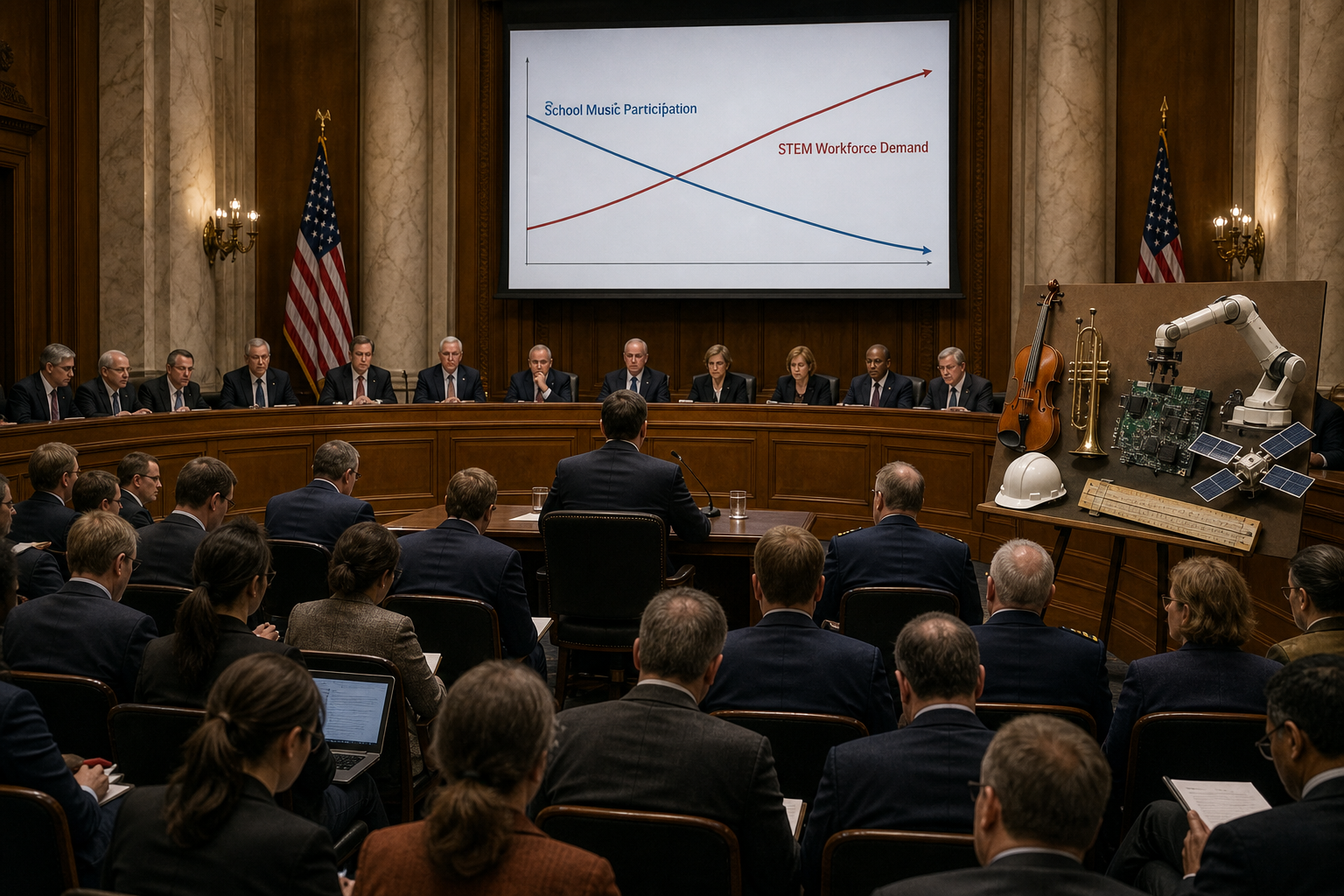
The testimony prompted lawmakers to request additional analyses from the Congressional Research Service comparing long-term trends in school music participation with enrollment in university engineering, mathematics, and computer science programs.
Officials stressed that no conclusions had yet been reached.
Nevertheless, Karen Whitmore, Deputy Undersecretary at the Department of Administrative Affairs, confirmed that the Department had begun coordinating data requests among the Departments of Education, Commerce, Labor, and Science to determine whether existing federal datasets could support a comprehensive cross-disciplinary assessment.
"At this stage," Whitmore said, "our objective is evidence-based coordination. Before determining whether a relationship exists, we must first determine which agencies already possess data describing different portions of that relationship."
The Department later announced the formation of an interagency technical working group to establish common definitions for "music education participation," "long-term instructional exposure," and "STEM readiness" before comparative analyses begin.
Educators Describe Quiet Changes Inside Classrooms
School administrators from several states testified that reductions in music instruction rarely occur through dramatic budget cuts.
Instead, instructional time often decreases incrementally.
A weekly rehearsal becomes biweekly.
Instrument maintenance is postponed.
Retiring music teacher positions remain unfilled.
Shared instructors divide their schedules among multiple schools.
"The process is gradual enough that no individual decision appears significant," testified superintendent Laura Bennett.
"Each annual adjustment appears fiscally responsible in isolation. Viewed over fifteen years, however, the cumulative effect becomes difficult to ignore."
Teachers described increasing pressure to prioritize subjects that receive greater attention during statewide performance evaluations.
Several explained that music programs frequently produce measurable academic and social benefits while simultaneously generating comparatively few standardized performance metrics.
"As educators, we're encouraged to teach creativity," said middle-school music instructor Daniel Ortiz.
"We're simply given very little scheduled time in which creativity is permitted to occur."
The committee requested additional documentation regarding instructional scheduling practices nationwide.
Economists Say Incentives May Explain More Than Funding
Economists appearing before the committee urged lawmakers to examine institutional incentives rather than focusing exclusively on school budgets.
Dr. Alan Prescott, Senior Economist at the Center for Regulatory Excellence, testified that organizations generally optimize around whatever outcomes receive the greatest institutional attention.
"When performance indicators become increasingly measurable," Prescott explained, "decision-makers naturally allocate resources toward activities that improve those indicators."
He emphasized that this behavior should not be interpreted as institutional failure.
"It represents rational optimization within established incentive structures."
Prescott said the same incentive structures may unintentionally discourage programs whose long-term benefits are difficult to quantify, even when those benefits could affect fields considered national priorities.
"If music education contributes to the development of future scientists, engineers, and technical professionals, those returns may not become visible for decades," Prescott said. "Budget decisions, however, are often evaluated annually. Institutions naturally optimize for outcomes that can be demonstrated within the next appropriations cycle."
Prescott cautioned against assuming that additional funding alone would restore music education.
"If incentive systems remain unchanged," he said, "new funding may simply generate additional administrative mechanisms for demonstrating support of music education rather than expanding music instruction itself."
Several committee members requested clarification.
Prescott replied that organizations consistently pursue measurable success because measurable success is easier to document, defend, audit, and renew during future appropriations.
His testimony prompted the Congressional Budget Office to begin preparing a long-range analysis examining whether educational measurement has itself become a measurable educational objective.
The report is expected later this year.
Congress Opens Investigation Into the Decline of Music Education, Prompting Industry Response
As the hearings entered their second day, attention shifted beyond public education to the private organizations that manufacture musical instruments, publish educational materials, and provide instructional software.
Representatives of the Association of Responsible Stakeholders testified that declining participation in school music programs has gradually altered the economics of the entire industry.
"Our members continue investing in innovation, manufacturing efficiency, and educational partnerships," said industry spokesperson David Mercer. "However, long-term market sustainability depends upon a continuous introduction of young musicians. Without entry-level participation, the customer lifecycle becomes increasingly compressed."
Mercer emphasized that manufacturers were not requesting federal assistance.
Instead, the association recommended establishing a National Strategic Music Participation Framework to improve coordination among educators, community organizations, instrument manufacturers, grant administrators, and local governments.
"The objective is alignment," Mercer said. "Alignment consistently produces better alignment."
The proposal was immediately referred to an interagency working group for further evaluation.
Several committee members noted that the proposed framework would require coordination with three existing federal initiatives addressing arts education.
Officials acknowledged that none of the three initiatives currently coordinate with one another.
Karen Whitmore, Deputy Undersecretary at the Department of Administrative Affairs, assured lawmakers that her department would establish a temporary coordination committee while a permanent coordination office was evaluated.
"The temporary committee will ensure that future discussions regarding permanent coordination remain appropriately coordinated," Whitmore testified.
She described the arrangement as an administrative best practice.
Universities Disagree on What Constitutes Music Education
Academic testimony introduced additional complexity.
Professor Adrian Keller, Chair of Comparative Epistemology at Westbridge University, argued that before Congress could determine whether music education had declined, policymakers first needed an operational definition of music education itself.
"The committee is implicitly treating music as a stable category," Keller testified.
"Historically, however, musical practice exists within evolving interpretive frameworks influenced by culture, technology, audience expectation, and institutional legitimacy. The apparent decline may partly represent a recursive transformation of socially recognized musical activity."
Committee counsel requested clarification.
Keller replied that defining music too narrowly risked excluding legitimate contemporary forms, while defining it too broadly risked rendering the category analytically meaningless.
Attorneys advising the committee expressed concern that changing the definition during an ongoing investigation could complicate future funding formulas.
Engineers from Jefferson Institute of Technology approached the issue differently.
"We recommend measurable criteria," said Dr. Evelyn Brooks, director of educational systems engineering.
"If investigators define music education according to instructional hours, student participation rates, ensemble availability, instructor certification, instrument accessibility, and demonstrated musical competency, statistical comparisons become significantly more reliable."
Professor Keller responded that measurable definitions inevitably privilege measurable characteristics.
Dr. Brooks replied that unmeasurable definitions were difficult to measure.
The committee recessed briefly to determine whether additional definitions should themselves require formal definitions.
Consultants Recommend a Multi-Phase Transformation Roadmap
By the third day of hearings, several national consulting firms had submitted independent recommendations.
Operational Excellence Advisors released a 214-page report outlining a seven-year strategic transformation roadmap designed to improve institutional resilience across arts education ecosystems.
The report proposed establishing regional Centers of Musical Alignment responsible for facilitating stakeholder engagement among school districts, nonprofit organizations, arts advocates, compliance officers, curriculum specialists, workforce analysts, community orchestras, and municipal planning agencies.
"Our analysis indicates substantial opportunity exists for enhanced governance architecture," said managing partner Allison Chen.
"The current environment reflects fragmented optimization rather than integrated strategic execution."
Asked whether the proposal would result in additional classroom music instruction, Chen replied that implementation metrics would first need to establish baseline readiness indicators.
Those indicators would subsequently support future readiness assessments, which could then inform implementation planning.
The committee thanked the consultants for their comprehensive approach.
The Congressional Research Service later confirmed that implementation planning would likely require additional planning resources before implementation could responsibly begin.
Regulatory Agencies Begin Coordinating Existing Coordination Efforts
As testimony concluded, federal agencies announced several parallel initiatives intended to support the committee's work.
The Office of Administrative Continuity agreed to catalog existing music-related federal guidance.
The Office of Customer Expectation Alignment announced a nationwide stakeholder listening initiative.
The Federal Bureau of Public Expectations began studying public understanding of music education policy.
Meanwhile, the National Office of Temporary Guidance issued temporary guidance explaining how agencies should reference previous temporary guidance until revised temporary guidance becomes available.
Officials stressed that the document should not be interpreted as permanent guidance.
Dr. Melissa Harmon observed that the government's response had become increasingly focused on harmonizing overlapping administrative processes.
"This is neither unusual nor undesirable," she explained.
"Large institutional ecosystems naturally develop secondary governance structures that improve coordination among primary governance structures."
Committee members appeared satisfied with the explanation.
Several requested a follow-up report evaluating whether additional coordination mechanisms might improve coordination among the newly established coordination mechanisms.
The Department of Administrative Affairs confirmed that such a report was already being drafted.
Congressional Hearing Expands to Include Psychologists and Artificial Intelligence
What began as an inquiry into declining classroom music instruction entered an unexpected phase during the fourth day of hearings after lawmakers questioned whether the investigation itself had changed the questions being asked.
The Committee invited psychologists from the Center for Behavioral Decision Sciences to testify regarding the relationship between musical training, childhood development, attention, emotional regulation, and long-term learning.
Dr. Rebecca Monroe cautioned members against viewing music solely as an academic subject.
"Music education produces numerous secondary outcomes that frequently resist conventional measurement," Monroe testified.
"Children participating in ensemble performance develop cooperative behaviors, delayed gratification, error recovery, attentional persistence, and emotional self-regulation. These competencies often become visible years after instruction has concluded."
Members immediately asked whether those benefits could be incorporated into existing federal educational performance metrics.
Monroe paused.
"They could," she replied carefully, "although introducing measurement systems may alter the behaviors those systems were intended to observe."
The remark prompted several minutes of discussion among committee members.
The Office of Unintended Consequences later confirmed it had opened a preliminary review into whether measuring intrinsic educational outcomes could influence the intrinsic educational outcomes being measured.
Officials emphasized that no conclusions should be drawn until appropriate metrics had been developed to evaluate the influence of measurement on measurement.Artificial Intelligence Produces Perfectly Accurate Answers That Resolve Nothing
Seeking additional clarity, the committee requested testimony from Applied Artificial Intelligence Corporation, whose educational policy model had recently been certified for federal analytical support.
Committee staff submitted a straightforward question.
"Why is music education declining?"
After reviewing nearly seventy years of educational data, budget reports, demographic trends, curriculum standards, labor statistics, cultural surveys, and federal appropriations, the AI responded:
"There is insufficient evidence to support a singular causal explanation. Multiple interacting variables demonstrate statistically significant but context-dependent influence across heterogeneous educational environments."
Committee members requested a simpler answer.
The AI responded:
"The decline appears to result from numerous independently rational institutional decisions that collectively produce emergent system-level outcomes not explicitly intended by any participating institution."
Several witnesses nodded.
Professor Adrian Keller observed that the answer was philosophically satisfying but operationally incomplete.
Dr. Evelyn Brooks stated that the explanation lacked measurable engineering specifications.
Committee counsel expressed concern that "emergent system-level outcomes" possessed no legally established definition.
Dr. Alan Prescott testified that the AI had essentially described incentive equilibrium.
Consultants from Strategic Alignment Partners recommended forming an interdisciplinary governance council to translate the AI's conclusions into actionable implementation frameworks.
The AI was then asked whether such a council would improve music education.
It replied:
"There is currently insufficient evidence to determine whether governance regarding music education should itself be governed."
The recommendation was referred to a newly established Technical Advisory Panel on AI Governance Coordination.
Administrative Activity Begins Managing Administrative Activity
As agencies continued responding, investigators acknowledged that a growing percentage of federal activity now concerned coordination among organizations studying one another's recommendations.
The Department of Administrative Affairs announced the creation of the Interagency Committee on Strategic Coordination Integration.
According to official guidance, the committee's mission would be to improve coordination among existing coordination initiatives established during the investigation.
Karen Whitmore described the development as a predictable sign of administrative maturity.
"When government responds comprehensively to complex issues, governance naturally develops additional governance capacity," she explained.
"This should not be interpreted as expansion. It represents organizational stabilization."
Meanwhile, the Office of Administrative Continuity released draft guidance recommending standardized terminology for referring to advisory panels that supervise working groups responsible for implementing recommendations issued by previous advisory panels.
The document remained open for public comment.
To facilitate stakeholder participation, the Department scheduled six listening sessions to gather feedback on the proposed terminology.
Each listening session would conclude with recommendations regarding future listening sessions.
Think tanks quickly entered the discussion.
The Center for Regulatory Excellence published a 412-page scenario analysis concluding that further study remained appropriate.
The Foundation for Institutional Resilience agreed while recommending the establishment of a permanent National Commission on Long-Term Musical Preparedness to ensure continuity between future studies and previous studies.
Neither report discussed classroom music instruction in detail.
Local Schools Quietly Resume Band Practice
Outside Washington, educators reported an unexpected development.
Several school districts quietly restored elementary band rehearsals and choir programs using existing staff and community volunteers.
Principals described the changes as modest.
Parents responded enthusiastically.
Students appeared largely unaware that a national policy debate was taking place.
"They're mostly excited to play together again," said music teacher Daniel Ortiz.
"They don't seem especially interested in our administrative framework."
Committee members welcomed the news while emphasizing that isolated improvements should not interrupt the federal review process.
Officials noted that premature conclusions could complicate ongoing evaluations examining whether improvements occurring before the completion of the investigation should be categorized as preliminary outcomes or administratively coincidental developments.
A joint federal task force was assigned to develop provisional guidance.
At Press Time
The House Committee announced that the original investigation into declining music education had formally concluded.
However, Congress simultaneously approved funding for the National Center for Educational Coordination, whose initial responsibilities include coordinating the activities of the Interagency Committee on Strategic Coordination Integration, evaluating implementation of temporary coordination guidance, developing standardized reporting procedures for future coordination reports, and overseeing certification standards for organizations that certify educational coordination professionals.
Officials confirmed that the Center's first annual report will examine whether the expanding administrative response has generated sufficient administrative capacity to support continued oversight of the administrative response itself.
The report is expected to include recommendations for establishing a permanent Office of Long-Term Administrative Sustainability.
By Sarah Collins
GFNN Washington Bureau
Recent Articles


-
The Gentle Night Friends Series
Aug 23, 26 03:38 PM
 The Gentle Night Friends Series is a collection of SEL children's stories.
 -
Senator Replaced Himself With Android: Committee Investigates
Aug 10, 26 12:32 PM
 Senator replaced himself with an android characterized as a "Legislative Productivity Surrogate," prompting a Judiciary Committee inquiry into voting, representation, AI autonomy, and constitutional p…
 -
Congress Opens Investigation Into the Decline of Music Education
Aug 03, 26 02:18 PM
Congress Opens Investigation Into the Decline of Music Education after educators report unexpected changes in student learning, prompting federal hearings, academic reviews, and industry responses.