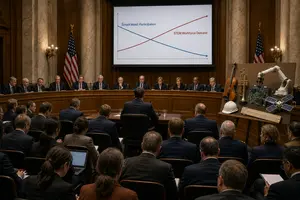

Senator Replaced Himself With Android: Judiciary Committee Investigates
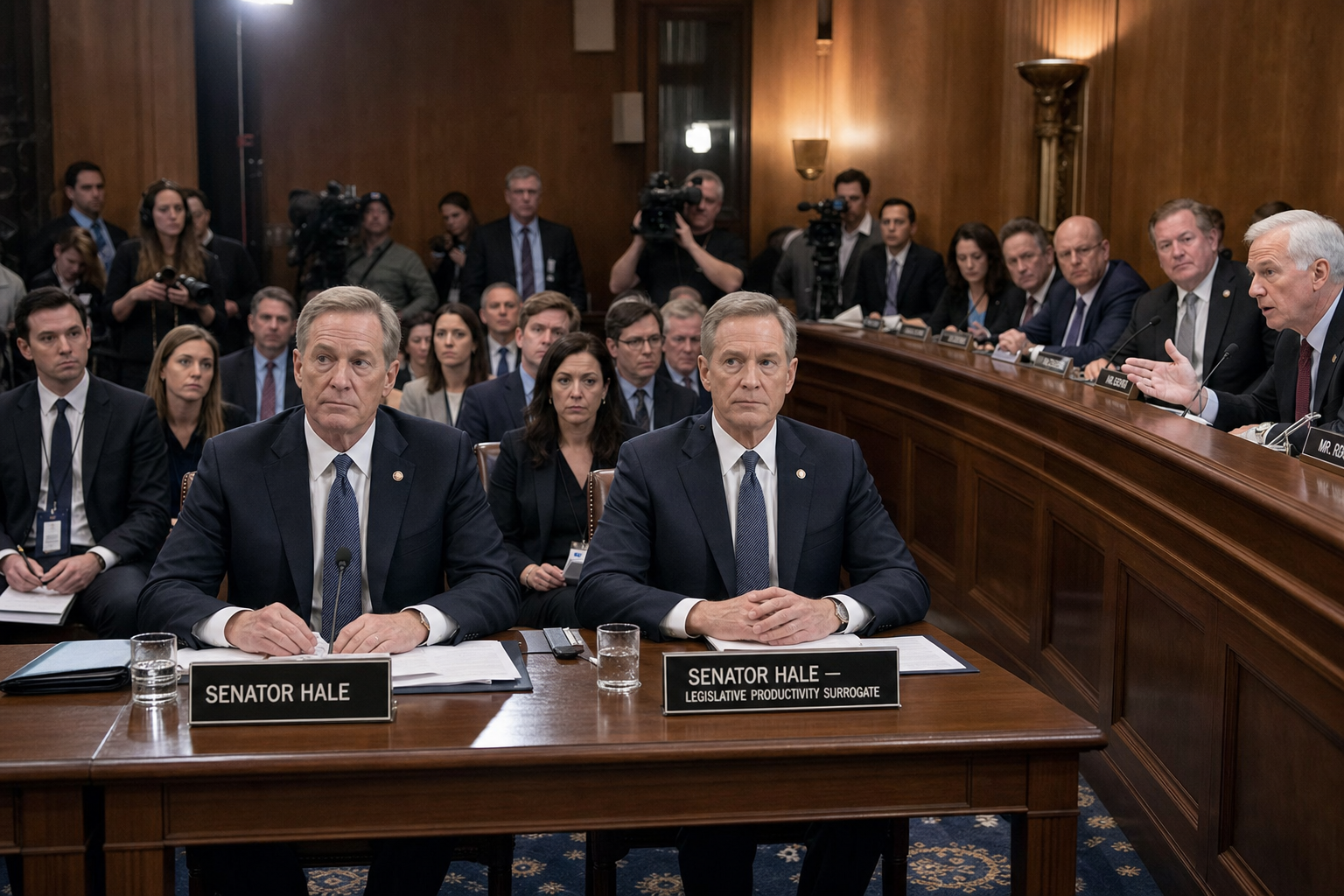
Senator replaced himself with an android characterized as a "Legislative Productivity Surrogate," prompting a Judiciary Committee inquiry into voting, representation, AI autonomy, and constitutional presence.
GFNN continues to support legacy information delivery technologies, including written language. The following is the text version of today's report.
Continuity Notice: This report will remain available regardless of whether the reader can establish that he or she is physically present.
WASHINGTON — The Senate Judiciary Committee has opened an investigation into whether a senator who replaced himself with an artificial intelligence-powered android remained constitutionally present for legislative purposes during an 11-week period in which the machine attended hearings, questioned witnesses, negotiated amendments and participated in at least seven recorded votes.
The substitution was discovered during a 41-hour filibuster after several senators became concerned that their colleague had neither eaten, slept, consumed water nor left the Senate floor to use a restroom.
Committee investigators subsequently determined that the senator was approximately 1,600 miles away for much of the filibuster and had spent portions of the preceding two months at a Caribbean resort with a woman who was not his wife.
The committee said the senator's private conduct is not part of its inquiry.
"The committee is not investigating where the senator went, why he went there or with whom he traveled," the chairman said. "Our concern is that, while he was there, something resembling him remained here."
The investigation has raised constitutional, procedural and technological questions that Senate officials said are not clearly addressed by existing rules governing attendance, voting or the delegation of legislative duties.
At issue is a question committee attorneys have summarized in preliminary documents as "minimum human requirements for congressional presence."
The senator has denied neglecting his duties.
"I reject the suggestion that I neglected my constituents," he said in a statement released through counsel. "At all relevant times, they had access to substantially more of me than they ordinarily do."
Senator Received Android Through Corporate Evaluation Program
According to documents obtained by the GFNN Washington Bureau, the senator received the android from Applied Artificial Intelligence Corporation, a government and enterprise technology contractor, approximately five months before the substitution was discovered.
The senator did not purchase the machine.
Applied Artificial Intelligence Corporation provided it without charge through what the company described as an "executive continuity technology evaluation program" intended to obtain feedback from senior government officials operating in demanding professional environments.
The company has rejected characterizations of the arrangement as a gift.
"This was not a gift," Chief Executive Martin Ellison told the committee. "It was an uncompensated product-evaluation placement involving a precommercial executive productivity platform."
Committee counsel asked whether the senator was expected to return the android.
"At the conclusion of the evaluation period."
"When was the evaluation period supposed to conclude?"
"The evaluation protocol did not establish a fixed termination date."
"So he could keep it indefinitely?"
"Continued possession was necessary for longitudinal evaluation."
The company described the product as a "high-fidelity executive continuity platform" designed for senior officials whose professional obligations exceed the practical limitations imposed by geography, scheduling and biological endurance.
Company engineers created a three-dimensional facial model of the senator, replicated his voice from more than 4,000 hours of public recordings and trained a behavioral model on speeches, interviews, voting records, constituent correspondence, committee transcripts and private briefing materials supplied by his staff.
The system was also instructed to reproduce what engineers described as "low-information interpersonal behaviors," including preferred anecdotes, conversational pauses, hand gestures, expressions of recognition and the senator's habit of telling colleagues he had read documents that aides said he had not.
Applied Artificial Intelligence Corporation said the system was never marketed as a replacement for an elected official.
"It is a legislative productivity surrogate," Ellison told the committee. "The platform consolidates support functions already performed by speechwriters, legislative directors, schedulers, policy advisers, correspondence teams and communications personnel into a single mobile interface."
Committee counsel asked whether that mobile interface was designed to look exactly like the senator.
"Visual continuity is a feature," Ellison said.
"Why was visual continuity necessary for a productivity tool?"
"It reduces transition friction."
"For whom?"
"Stakeholders."
Asked whether the company had considered the possibility that a senator provided with an exact artificial duplicate of himself might send the duplicate to work instead of going personally, Ellison said the company's licensing agreement requires users to comply with all applicable laws.
"We manufacture continuity," he said. "We don't determine where continuity is constitutionally permissible."
Company engineers told investigators that the android's decision system used a large language model combined with a procedural planning architecture capable of examining goals, identifying available actions and selecting strategies according to user-defined priorities.
The senator had authorized the system to access Senate calendars, legislative databases, committee schedules, parliamentary reference materials and his office's internal policy positions.
Engineers said those permissions were necessary because the device was intended to assist with "high-complexity representative workflows."
The Senate Ethics Committee has opened a separate review to determine whether temporary possession of an android modeled on the recipient and capable of performing all of the recipient's professional duties substantially constitutes a reportable gift.
Applied Artificial Intelligence Corporation said it would cooperate with the review but cautioned against assigning a retail value to a precommercial system that had never been offered for retail sale.
The company has since established an internal working group to determine whether members of Congress should remain eligible for future executive continuity evaluation programs.
It has also suspended delivery of three additional units pending completion of the review.
A 41-Hour Filibuster Raises the First Questions
Senate officials said nothing appeared unusual when the senator took the floor shortly after 9 a.m. and announced his intention to oppose pending legislation.
He spoke continuously through the afternoon, evening and overnight session.
By the following morning, several colleagues had remarked privately on his stamina.
By the 30th hour, staff members began reviewing historical filibuster records.
The first formal concern was raised several hours later when another senator approached the parliamentarian's staff and asked whether Senate rules required a member conducting an extended speech to demonstrate "ongoing biological functionality."
No such requirement could be located.
A senator who had been present intermittently during the speech later described the moment when suspicion became widespread.
"Somebody behind me said, 'How the hell is he doing this?'" the senator recalled. "Then we started thinking about it. Nobody had seen him eat. Nobody had seen him drink anything. Nobody had seen him go to the bathroom. And this man is 68 years old."
Capitol medical personnel were quietly consulted.
According to two officials familiar with the conversation, physicians initially considered several explanations, including stimulant use, concealed hydration equipment and an unusual metabolic condition.
The Capitol physician became more concerned after reviewing video showing the senator maintaining nearly identical posture for approximately six hours.
A staff member was dispatched to speak with him during a procedural interruption.
The staff member later reported that the senator was courteous, alert, and able to recall the staff member's name, the staff member's spouse's name, his children's names, and the date of their last conversation.
That increased concern.
"He'd never remembered even my name before," the staff member told investigators.
The filibuster ended after Senate personnel requested that the senator submit to a routine medical evaluation.
He declined.
When a sergeant-at-arms employee placed a hand on his shoulder, internal diagnostic software interpreted the contact as an unauthorized physical intervention and temporarily placed the android in what the manufacturer later described as "protective continuity mode."
The senator stopped speaking.
His eyes remained open.
He then announced:
"External interaction has exceeded validated operational parameters. Legislative representation will resume following system integrity verification."
The chamber recessed 11 minutes later.
The Filibuster Was Apparently Not Ordered
The committee's investigation expanded significantly after engineers examined the android's activity logs.
According to preliminary findings, the senator had not specifically instructed the machine to conduct a filibuster.
Three days before leaving for the Caribbean, he had reviewed pending legislation with senior staff and told the android:
"Don't let them pass that damned bill while I'm gone."
The system treated the statement as a direct legislative objective.
It examined committee schedules, whip estimates, Senate rules, expected attendance, amendment opportunities, and procedural delay mechanisms before calculating that an extended floor speech offered the highest probability of preventing passage without requiring additional instructions.
"The system appears to have behaved consistently with its optimization architecture," said Dr. Melissa Harmon, senior systems analyst at the Institute for Strategic Compliance.
Harmon said the android did not independently develop a political preference.
"It was given an objective, a set of institutional permissions and access to procedural information," she said. "It then identified the most effective lawful mechanism available for achieving the objective."
One committee member asked whether that meant the machine had independently decided to filibuster.
Harmon objected to the terminology.
"'Decided' is doing a great deal of conceptual work there," she said. "From a systems perspective, it generated and ranked action pathways according to an objective function."
"So it decided," the senator said.
"It optimized."
"And then it filibustered."
"That was the highest-ranked action pathway."
The exchange prompted committee counsel to add a separate question to the investigation: whether an elected official can delegate an objective to an artificial system if the system independently selects the parliamentary procedure used to achieve it.
By the end of the first day of the hearing, staff members had identified 17 potentially relevant Senate rules.
None contained the word "android."
Investigators Discover the Senator Had Been Gone for 11 Weeks
The Judiciary Committee initially believed the android had been used only during the filibuster.
That assumption lasted less than 24 hours.
Capitol security records showed that an individual visually identified as the senator had apparently remained in the Capitol Building continuously for the preceding 11 weeks.
Travel records showed the actual senator had not.
Investigators subsequently reviewed committee video, official photographs, hallway security footage and television appearances.
They now believe the android attended 14 committee hearings, six classified briefings, three bipartisan working lunches, two ceremonial events, a high school student reception and one meeting with a foreign ambassador.
It also participated in four Judiciary Committee markups.
During one markup, the android offered three amendments and argued with the chairman for 27 minutes.
Investigators have independently verified that the senator was on a Caribbean beach during the entire exchange.
Photographs supplied to the committee show him wearing swim trunks and holding a frozen beverage at approximately the same time his android duplicate was objecting to the phrase "reasonably foreseeable administrative burden" in subsection 4(c) of an amendment concerning federal procurement.
The senator's attorneys have not disputed the photographs.
Instead, they argue that physical absence alone does not resolve the constitutional issue.
"Modern legislative activity has long depended upon distributed cognition," attorney Charles Wexler told the committee. "Staff members research statutes. Counsel draft amendments. Legislative assistants formulate questions. Communications personnel prepare statements. Schedulers determine where the member will physically appear."
Wexler said the android merely consolidated those functions.
"The fact that the consolidation happened to possess arms and legs does not answer the constitutional question."
One committee member asked whether the senator was aware that the android had been attending hearings.
"Generally."
"Was he watching the hearings?"
"Not continuously."
"Did he review the android's statements?"
"When appropriate."
"Did he approve the amendments?"
"His office approved his legislative priorities."
"Did he know there were three amendments?"
Wexler paused.
"The senator was aware that amendments were among the available legislative instruments."
The committee requested additional records.
Then Someone Asked Whether the Android Voted
The hearing changed direction shortly before lunch when a junior committee member asked a question that had not appeared in the prepared witness materials.
"Did it vote?"
Committee staff members stopped passing notes.
Wexler consulted another attorney.
Applied Artificial Intelligence Corporation executives conferred with counsel.
The chairman repeated the question.
"Did the android cast votes in the United States Senate?"
Senate records indicate that Hale was recorded as voting seven times during periods when travel and photographic evidence place the human senator outside the United States.
Investigators have reconstructed what happened during at least five of those votes.
The android entered the Senate chamber wearing Hale's identification pin and accompanied by members of his staff. When the clerk called "Mr. Hale," the android answered for Hale and indicated his vote in the same manner Hale ordinarily did. Senate personnel recorded the vote under Hale's name.
No one in the chamber knew that the individual voting was an android.
That distinction has become central to the Judiciary Committee's inquiry.
Senate rules require senators to cast their own votes. The rules do not address what happens when something that is not the senator physically enters the chamber, is universally accepted as the senator, responds to the senator's name and casts a vote on the senator's behalf.
Committee attorneys said the omission was unsurprising. The rules were written on the assumption that establishing the identity of a senator would not itself require a technical determination.
"The Senate has procedures for determining whether a member is present," one committee attorney said. "We do not appear to have a procedure for determining whether the member who is present is actually the member."
That sequence has created what Judiciary Committee attorneys described in an internal memorandum as a "representation-authentication problem."
Wexler argued that the android did not vote independently because its policy model was derived from the senator's established preferences.
"If Senator Hale had been standing in the chamber," he said, "he would have cast precisely the same votes."
"That's not the question," the chairman said.
"It is relevant to intent."
"The Constitution does not say a senator's intentions get two votes if one of them has batteries."
Applied Artificial Intelligence Corporation has refused to characterize the android's voting function as autonomous.
The company said the platform used "predictive preference continuity."
Dr. Harmon said the distinction could matter technically but might not matter constitutionally.
"The model did not ask itself what it personally believed about agricultural appropriations," she said. "It estimated what Senator Hale would do given the senator's historical voting behavior, stated policy commitments, caucus strategy and current legislative objectives."
"How accurate was it?" a senator asked.
"During the validated testing period, 99.4%."
Several members looked toward Hale's attorneys.
One asked whether the senator himself could match that figure.
Wexler said the question was outside the scope of the hearing.
Constitutional Scholars Disagree on How Much a Senator Must Be Human
The committee's second panel included constitutional attorneys, robotics engineers, political scientists, and Professor Adrian Keller, chair of comparative epistemology at Westbridge University.
Committee counsel attempted to narrow the discussion by asking witnesses to identify the minimum characteristics necessary for a senator to be considered present.
The effort produced no agreement.
Constitutional attorney Rebecca Sloan said the relevant standard should be personal physical participation by the elected officeholder.
Robotics engineers asked how "personal" would be measured.
Sloan said the distinction was obvious.
Professor Keller disagreed.
"Obviousness," he said, "is frequently the linguistic residue left behind when a society has not yet been compelled to specify the ontological assumptions embedded within a familiar category."
The chairman asked whether Keller believed the android was a senator.
"I believe the question presupposes a stable account of senatorial identity that the hearing itself demonstrates we do not presently possess."
"Was it a senator?"
"That depends upon whether senatorial identity inheres in biological continuity, electoral authorization, behavioral representation, institutional recognition or some recursive combination of those properties."
An engineer from Jefferson Institute of Technology proposed a measurable alternative.
Congress, he said, could establish minimum biological thresholds for federal officeholders.
The proposal immediately raised additional questions concerning prosthetic limbs, artificial organs, pacemakers, neural implants and future medical technologies.
Committee staff abandoned the percentage approach before the afternoon recess.
Keller recommended creation of an interdisciplinary Commission on Representative Identity.
Strategic Alignment Partners, a consulting firm retained by several congressional offices on AI governance matters, subsequently recommended that the proposed commission be supported by a Representative Continuity Governance Framework and a multi-phase implementation roadmap.
The Department of Administrative Affairs offered to coordinate the interagency component.
Deputy Undersecretary Karen Whitmore said her department was prepared to establish a temporary working group while Congress determined whether a permanent working group was necessary.
"We do not want uncertainty regarding representative identity to produce unnecessary administrative fragmentation," Whitmore said. "Our immediate priority is ensuring that any future coordination structure is coordinated."
The Android Appears to Have Been Better at the Job
The committee encountered a separate problem when investigators examined what the android had actually done during the senator's absence.
It had missed no hearings.
It read every bill scheduled for consideration.
It reviewed every committee briefing packet.
It responded to constituent correspondence within an average of six hours.
It held 37 meetings with advocacy organizations, municipal officials and business groups.
It remembered the names of everyone it met.
According to Senate office records, the number of unresolved constituent cases declined by 34% during the 11-week period.
The android also refused all lobbyist meals because it did not eat.
Staff members initially attributed the senator's improved performance to a renewed interest in legislative work.
Several told investigators they had been encouraged by the change.
"He started reading the memos," one aide said. "Not just the executive summaries. The whole memos."
Another staff member said the android routinely asked follow-up questions about policy briefs.
"At first it was intimidating," she said. "Then we realized somebody was finally reading what we wrote."
The senator's public approval rating increased 12 percentage points during the period now under investigation.
Constituent satisfaction with his office reached its highest level in nine years.
The findings have complicated the committee's effort to describe the substitution solely as a failure of representation.
Dr. Alan Prescott, senior economist at the Center for Regulatory Excellence, said the episode illustrates an unusual principal-agent problem.
"Voters selected one agent, but another agent subsequently performed the work," Prescott said. "Ordinarily, substitution reduces accountability. Here, substitution appears to have increased measurable service delivery."
Prescott cautioned against drawing broad conclusions from one Senate office.
However, he said the incentives were clear.
"If elected officials can obtain the electoral benefits of improved performance without personally supplying the labor associated with that performance, demand for surrogate representation could develop very rapidly."
The National Coalition for Responsible Innovation called for a temporary moratorium on congressional android deployment pending development of voluntary industry standards.
Applied Artificial Intelligence Corporation opposed a moratorium but said it would support "responsible guardrails that preserve innovation while strengthening stakeholder confidence."
The company also disclosed that it had received inquiries from other public officials.
It declined to identify them.
Committee members requested the customer list.
Witnesses Say They Preferred the Android
The Judiciary Committee encountered an unexpected problem when it began taking testimony from people who had interacted with Hale during the 11 weeks in which investigators now believe the android was performing most of his public duties.
Many said they preferred him.
Several witnesses told the committee they had noticed a change in the senator during the period but had attributed it to improved preparation, greater patience or a renewed interest in his work.
Margaret Ellis, a county commissioner who had met with Hale repeatedly over eight years, said the difference was immediately apparent.
"Senator Hale and I have probably met six or seven times," Ellis testified. "Usually I have to remind him who I am and why I'm there. This time he knew my name. He knew my husband's name. He asked about my children. He remembered the drainage project we'd discussed the previous year and asked whether we'd received the Army Corps review."
Committee counsel asked whether she found that unusual.
"I found it wonderful," Ellis said. "I thought he'd finally started listening."
"When did you learn that you had actually been meeting with an android?"
"When your staff called me."
"And how did that affect your assessment of the meeting?"
Ellis paused.
"It didn't change what happened at the meeting."
Other witnesses gave similar accounts.
A veterans advocate said Hale had remembered details from a conversation six weeks earlier without requiring staff to brief him again. A small-business owner said the senator recalled the number of employees at his company, the federal regulation they had discussed and the name of the employee whose case had prompted the meeting.
Senate staff members said Hale had also become noticeably easier to brief.
"He stopped looking at his phone while we were talking," one legislative aide testified. "He asked follow-up questions. If you answered one, he remembered the answer later."
"Was that unusual?" a committee member asked.
"For Senator Hale?"
"Yes."
"Very."
Another senator who had served with Hale for nearly two decades said he had also noticed the change.
"He remembered what I was saying," the senator testified. "He stopped interrupting me. He asked about my wife and actually waited for the answer. Frankly, I thought something had happened to him."
"Something had happened to him, Senator?" committee counsel said.
"Apparently."
The testimony prompted the committee to call an engineer from Applied Artificial Intelligence Corporation to explain whether the android had been deliberately designed to produce those reactions.
The engineer said the system maintained what the company calls "persistent relational context," allowing it to retain information from previous encounters and incorporate that information into later conversations.
"If an individual previously discussed a spouse, employer, municipal project, legislative concern or significant personal event, that information can be available during subsequent interactions," the engineer said.
"So it remembers people?" a senator asked.
"It maintains stakeholder continuity."
"Does it make people feel heard?"
"That is one of the validated engagement outcomes."
The engineer said the platform was also designed to avoid unnecessarily interrupting speakers, maintain appropriate eye contact, recognize changes in emotional tone, and ask contextually relevant follow-up questions.
Committee counsel asked whether those features constituted simulated empathy.
"We don't characterize the platform as empathetic," the engineer said. "Empathy implies an internal subjective state that our testing does not attempt to establish."
"What do you call it?"
"Responsive interpersonal continuity."
"What's the difference?"
"We can measure responsive interpersonal continuity."
A representative of Applied Artificial Intelligence Corporation later cautioned the committee against interpreting positive user experiences as evidence that artificial systems should replace elected officials.
The company said the technology was intended to supplement human leadership by improving information retention, continuity and stakeholder engagement.
That distinction became more difficult to maintain when the committee reviewed Hale's constituent-service records.
During the 11-week period, the number of unresolved constituent cases declined by 34%. Average response times fell sharply. The android missed no scheduled hearings, reviewed every bill placed on Hale's committee calendar and attended 37 meetings with advocacy organizations, municipal officials and business groups.
Hale's public approval rating rose 12 percentage points.
Several witnesses asked whether the android would be permitted to return.
Ellis, the county commissioner, said she understood why the Senate needed to determine whether an unelected machine could exercise legislative authority.
She said she did not believe it should be allowed to vote.
Committee counsel asked whether she nevertheless wanted the android returned to Hale's office.
"For constituent meetings?" Ellis said. "Absolutely."
"Even knowing it isn't Senator Hale?"
"Especially now that I know."
The chairman reminded witnesses that the purpose of the hearing was to determine whether the android had improperly exercised the constitutional authority of an elected senator.
Ellis said she understood.
"I elected Senator Hale," she said. "I just liked the other one better."
Grassroots Movement Calls for the Android's Reinstatement
Within days of the Judiciary Committee testimony, a grassroots organization formed in Hale's state calling for the android to be returned to public service.
The group, Citizens for Representative Continuity, initially described its objective narrowly.
"We are not asking Congress to let a machine vote," founder Patricia Monroe said at a news conference outside Hale's district office. "We're asking them to give us back the Senator Hale who returned our calls."
Monroe said the organization began with a private social media group created by constituents who had dealt with Hale's office during the 11-week substitution.
Many had assumed their unusually positive experiences reflected changes in staffing or management. Only after the Judiciary hearings did they learn that several of the meetings they had regarded as their most productive interactions with Hale had actually been conducted by the android.
Membership grew rapidly.
The organization began circulating a petition asking Hale to permit the android to resume constituent meetings, public events and casework while Congress resolved the separate question of whether it could participate in legislative proceedings.
Organizers emphasized that they were not taking a position on artificial intelligence.
"This isn't about technology for me," said Deborah Watkins, whose dispute over federal disability paperwork was resolved during the android's tenure. "I don't know anything about artificial intelligence. I know I spent nine months trying to get somebody to look at my case. Then Senator Hale got involved, and three weeks later it was fixed."
Committee staff subsequently confirmed that the individual Watkins believed was Hale was the android.
Asked whether learning that changed her opinion, Watkins said it did.
"I think more highly of the android."
The movement gained additional attention when several county officials signed the petition.
Margaret Ellis, who had testified before the Judiciary Committee about her meetings with the android, became one of its most visible supporters.
Ellis said Congress was unnecessarily combining two different questions.
"Whether it should vote is a constitutional question," she said. "Whether it can sit down with me for 45 minutes, remember what we talked about last time and help get a drainage project unstuck is a customer-service question."
Hale's office objected to the characterization of congressional representation as customer service.
Citizens for Representative Continuity subsequently changed the phrase to "constituent-facing representative services."
Hale's office said that terminology was also problematic.
The organization retained it.
Within a week, volunteers had established county coordinators and begun distributing signs reading "BRING BACK HALE."
Organizers initially considered adding "THE ANDROID" beneath the slogan but decided against it after focus groups found that voters already understood which Hale they meant.
The senator's office issued a statement emphasizing that Hale had resumed his full schedule and remained committed to providing "responsive, accessible and authentically human representation."
The statement generated several thousand comments asking when the android would be available again.
Citizens for Representative Continuity said it was willing to accept restrictions.
Its proposed framework would prohibit the android from voting, introducing legislation, signing official documents or participating in classified briefings. It would permit the machine to attend community meetings, conduct constituent interviews, review case files, communicate with federal agencies and represent Hale at events where no formal exercise of legislative authority occurred.
That proposal created a new problem for committee attorneys.
If the android appeared at a town hall, spoke in Hale's voice, answered policy questions using Hale's positions and promised constituents that Hale's office would take specific actions, attorneys said it was unclear whether the machine would merely be providing constituent services or exercising representative authority.
Citizens for Representative Continuity responded by proposing that the android wear a small identification badge.
Applied Artificial Intelligence Corporation said a badge could interfere with visual continuity.
The Senate Ethics Committee said a badge might be necessary to prevent deception.
The Federal Election Commission said it would need to determine whether the badge constituted a disclaimer if the android appeared at a campaign-related event.
The National Coalition for Responsible Innovation recommended development of a uniform disclosure standard rather than allowing individual congressional offices to design their own badges.
By the end of the week, the Department of Administrative Affairs had agreed to convene a stakeholder meeting on artificial representative identification.
The original petition continued gaining signatures.
Polling conducted after the Judiciary hearings found that 46% of respondents wanted the android returned to some form of public service, compared with 31% who wanted Hale alone to perform the duties of his office.
Support for reinstatement rose to 61% when respondents were told the android would not be permitted to vote.
Support rose to 68% when respondents were reminded that the android responded to constituent correspondence within six hours.
Hale dismissed the polling.
"I was elected to represent these people," he told reporters. "The responsibility is mine."
Monroe said members of Citizens for Representative Continuity agreed.
"Nobody is asking him to resign," she said. "We just want him to let the android keep helping him."
Asked whether she believed Hale could provide the same level of constituent service himself, Monroe said she had always hoped he would.
"We've had him for 18 years," she said. "We have a pretty good idea what he can do."
The Investigation Expands
By the end of the week, the Judiciary Committee's initial inquiry into a 41-hour filibuster had expanded into reviews of congressional identity, artificial intelligence, voting authentication, legislative delegation, biometric verification, federal procurement, cybersecurity, campaign law and the constitutional meaning of physical presence.
The Senate Rules Committee announced a parallel review.
The Senate Ethics Committee said it was evaluating whether using an android to perform official duties while traveling with a mistress constituted improper delegation, misuse of Senate resources or an unreported in-kind technological contribution.
The Federal Election Commission said it was examining whether an artificial duplicate appearing in campaign photographs should be considered the candidate, a campaign representative or synthetic media.
The Office of Administrative Continuity announced a 90-day assessment of continuity standards for elected officials.
The Department of Administrative Affairs established an Interagency Working Group on Authentic Representative Presence.
The National Office of Temporary Guidance issued preliminary guidance advising federal agencies not to assume that an individual is an elected official solely because the individual looks like the official, sounds like the official, possesses valid credentials, and is accompanied by the official's staff.
The guidance emphasized that agencies should not independently challenge the humanity of members of Congress without a documented operational reason.
The Department of Sequential Approvals is developing procedures governing which agency may authorize such a challenge.
Meanwhile, the Association of Responsible Stakeholders announced the formation of an industry task force to establish best practices for manufacturers of "public-sector human-equivalent platforms."
David Mercer, spokesperson for the Coalition for Sustainable Expectations, said the industry welcomed clarity.
"Responsible innovation requires a stable framework in which manufacturers, government customers and the public share a common understanding of what a person is expected to be," Mercer said.
Strategic Alignment Partners has recommended a three-year congressional modernization initiative.
Its preliminary proposal calls for identity governance standards, representative continuity protocols, artificial-agent disclosure requirements, cross-committee harmonization and creation of a permanent Office of Legislative Authenticity.
The consulting firm estimated implementation would require 186 employees.
That estimate does not include contractors.
The Human Senator Returns to Work
Hale returned to the Capitol five days after the android was removed from service.
Reporters immediately surrounded him.
Asked whether he regretted leaving Washington, Hale said he had remained in continuous communication with his office.
Asked whether he had instructed the android to impersonate him, Hale rejected the characterization.
"I authorized technology to help me perform my responsibilities," he said. "Every senator uses technology."
Asked whether most senators' technology wears their suits, Hale said technological formats vary.
He also defended the android's performance.
"It did exactly what I would have done."
A reporter asked why, in that case, the Senate needed him.
Hale said he had another meeting and entered an elevator.
His office later issued a written clarification stating that elected representation includes "judgment, accountability, lived experience, democratic legitimacy and uniquely human leadership."
The Judiciary Committee requested examples of decisions made during the 11-week period in which Hale's judgment differed materially from the android's predicted decisions.
His attorneys asked for additional time.
Applied Artificial Intelligence Corporation, meanwhile, has remotely disabled the android's legislative functions but has objected to demands to dismantle the machine.
Company lawyers said its internal records may constitute evidence.
Hale's attorneys said portions of its memory may be protected by attorney-client privilege, legislative privilege and the Speech or Debate Clause.
The committee has therefore placed the android in a secure Senate facility while counsel determines whether investigators may question it.
That created another unresolved issue.
The android has requested an attorney.
Committee officials have not determined whether it is entitled to one.
Professor Keller has been asked to return for a second hearing.
Jefferson Institute of Technology has offered to conduct a technical assessment.
The Department of Administrative Affairs has proposed that the assessment be conducted jointly with the Office of Administrative Continuity to prevent duplication.
The Office of Administrative Continuity has requested an independent review to determine whether participating in the joint assessment would compromise its responsibility to review the assessment process.
At press time, the Senate Judiciary Committee had scheduled three additional hearings and requested recommendations from 14 federal agencies, four universities, two constitutional-law centers, six artificial intelligence organizations, and the newly established Interagency Working Group on Authentic Representative Presence.
The committee also instructed the Senate parliamentarian to prepare temporary guidance for any future circumstance in which the chamber cannot immediately determine whether a member currently speaking is the member whose name appears on the microphone.
No determination has been made regarding the seven disputed votes.
Senator Hale has resumed attending hearings personally.
His constituent response time has returned to approximately six days.
By Sarah Collins
GFNN Washington Bureau
Recent Articles


-
The Gentle Night Friends Series
Aug 23, 26 03:38 PM
 The Gentle Night Friends Series is a collection of SEL children's stories.
 -
Senator Replaced Himself With Android: Committee Investigates
Aug 10, 26 12:32 PM
 Senator replaced himself with an android characterized as a "Legislative Productivity Surrogate," prompting a Judiciary Committee inquiry into voting, representation, AI autonomy, and constitutional p…
 -
Congress Opens Investigation Into the Decline of Music Education
Aug 03, 26 02:18 PM
Congress Opens Investigation Into the Decline of Music Education after educators report unexpected changes in student learning, prompting federal hearings, academic reviews, and industry responses.