
Congress Opens Inquiry Into Artificial Intelligence Job Losses
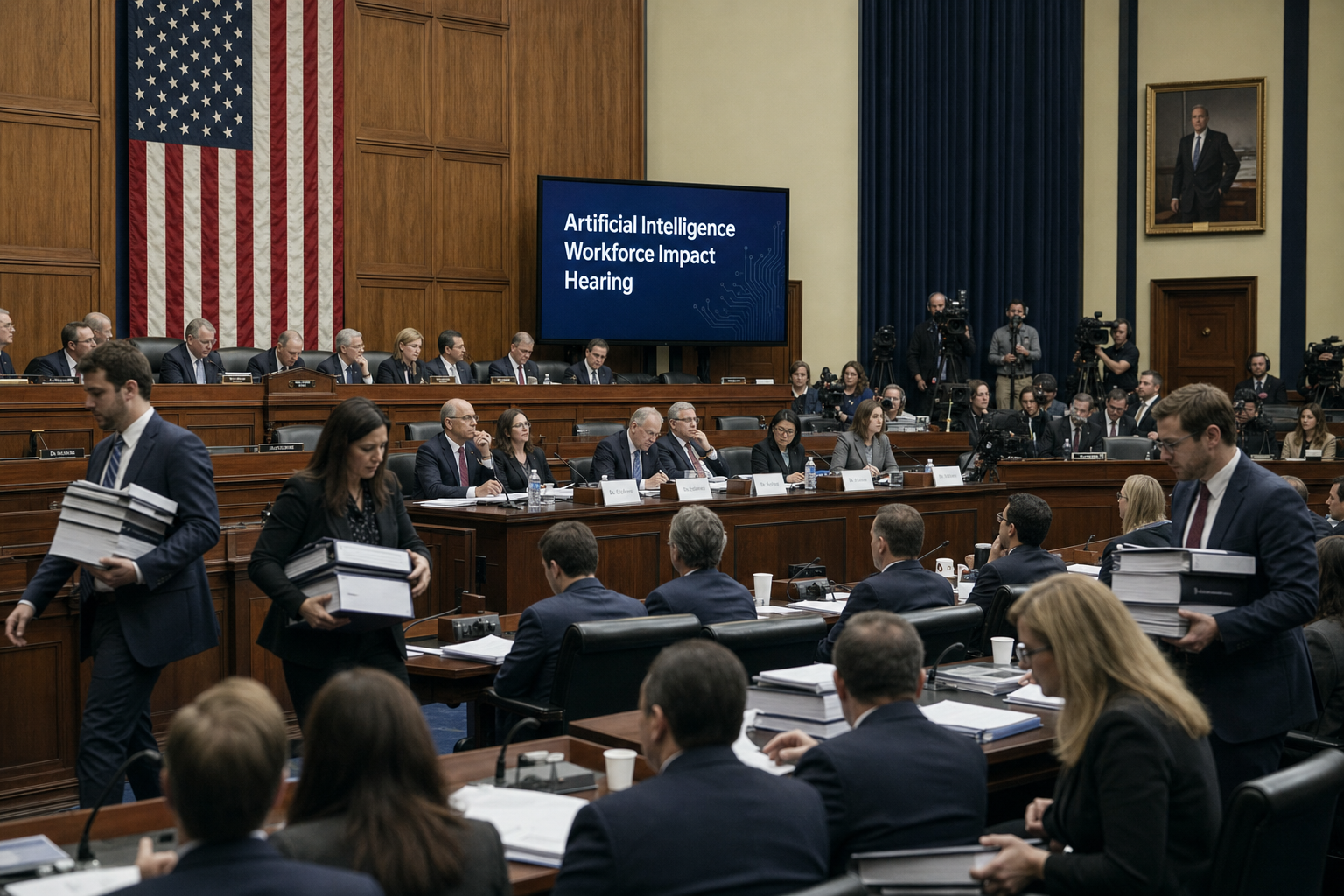
Congress Opens Inquiry Into Artificial Intelligence Job Losses examines how lawmakers, regulators, and industry are responding to AI-driven workforce disruption.
GFNN continues to support legacy information delivery technologies, including written language. The following is the text version of today's report.
Archival Notice: This report remains fully accessible even after readers finish the first paragraph.
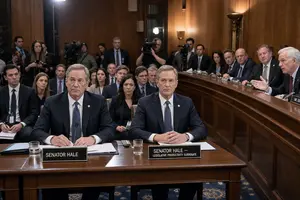
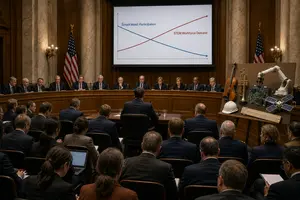
WASHINGTON, D.C. — Congress Opens Inquiry Into Artificial Intelligence Job Losses after lawmakers from both chambers announced a comprehensive investigation into growing reports that artificial intelligence systems are performing work previously handled by millions of American employees across a broad range of industries.
The hearings follow several months of testimony from manufacturers, software companies, economists, labor organizations, financial analysts, and federal agencies documenting accelerating deployment of generative artificial intelligence systems into occupations once considered resistant to automation.
Committee leaders emphasized that the inquiry is intended to understand long-term economic impacts rather than determine whether artificial intelligence itself should be restricted.
"We are attempting to better understand the changing relationship between technology, employment, productivity, and economic resilience," said Representative Alicia Monroe, chair of the Joint Congressional Committee on Emerging Technologies. "The objective is to gather evidence before developing an evidence-gathering framework that will support future evidence."
Committee staff described the opening session as one of the largest technology hearings held in several years.
Initial testimony focused on measurable workforce changes already appearing throughout publishing, software development, customer service, legal research, marketing, education, accounting, and administrative support.
Several witnesses stressed that the changes remain uneven across industries.
Others warned that the pace of adoption appears to be increasing faster than previous waves of workplace automation.
Congress Opens Inquiry Into Artificial Intelligence Job Losses After Industry Testimony
Executives from Applied Artificial Intelligence Corporation told lawmakers that modern language models are now capable of performing substantial portions of professional knowledge work with increasing reliability.
Chief Executive Officer Daniel Hartwell emphasized that businesses continue to require human oversight while acknowledging that organizations are redesigning workflows around AI-assisted production.
"Our customers generally are not eliminating entire professions," Hartwell testified. "They are identifying tasks that can be completed more rapidly through probabilistic language generation combined with human review. The organizational effects become significant when thousands of individual efficiency improvements accumulate simultaneously."
Corporate filings presented during the hearing suggested that many organizations have slowed hiring for positions involving repetitive document preparation, routine analysis, customer communication, and internal reporting.
Several executives characterized these developments as productivity enhancements rather than workforce reductions.
Committee members noted that payroll statistics often produce identical outcomes regardless of the terminology used.
David Mercer, industry spokesperson for the Coalition for Sustainable Expectations, urged Congress to avoid "premature regulatory responses that could reduce America's long-term innovation capacity."
"Our member organizations remain committed to responsible deployment," Mercer said. "The current transition represents an opportunity to optimize human potential through strategic task reallocation while preserving stakeholder confidence."
Members of Congress requested clarification regarding the phrase "strategic task reallocation."
Mercer replied that the coalition was preparing a glossary.
Economists Offer Conflicting Forecasts While Agreeing On Uncertainty
Economic testimony occupied much of the afternoon as analysts presented sharply different forecasts regarding long-term employment.
Dr. Alan Prescott, Senior Economist at the Center for Regulatory Excellence, explained that technological innovation has historically displaced certain occupations while creating entirely new categories of employment.
"The present transition differs primarily in the breadth of cognitive tasks affected," Prescott testified.
He noted that previous automation waves largely targeted physical labor, whereas current AI systems increasingly perform analytical, linguistic, and administrative functions.
"This creates forecasting challenges because labor markets respond through multiple interacting incentive structures operating across different time horizons."
Prescott cautioned lawmakers against interpreting short-term employment shifts as permanent structural outcomes.
Other economists expressed greater concern.
Researchers from the Metropolitan School of Economics presented models suggesting that rapid improvements in AI capabilities could compress decades of occupational change into only a few years.
Their report concluded that labor markets generally adapt to technological disruption but not necessarily at the same speed as technological development itself.
Committee members requested projections covering five-year, ten-year, and twenty-year scenarios.
The economists responded that each projection depended heavily upon assumptions regarding future AI capabilities that remain uncertain.
One member asked whether uncertainty itself should become a measurable economic variable.
The economists requested additional funding to study the question.
Federal Agencies Begin Coordinating Their Reviews
As testimony continued, multiple federal agencies announced parallel assessments intended to ensure consistent government responses.
Karen Whitmore, Deputy Undersecretary at the Department of Administrative Affairs, confirmed that the Department had established an Interagency Workforce Transition Coordination Working Group to facilitate communication among existing agencies already examining artificial intelligence.
"The federal government seeks to avoid unnecessary duplication of effort whenever practical," Whitmore testified.
She explained that the new working group would first identify all existing federal studies concerning AI-related employment before determining whether additional coordination mechanisms might improve administrative efficiency.
Officials from the Office of Administrative Continuity reported that at least nineteen federal departments already maintain active programs involving artificial intelligence workforce planning.
The Office of Customer Expectation Alignment announced plans to survey employers regarding evolving definitions of employment in AI-assisted workplaces.
Meanwhile, the National Office of Temporary Guidance released preliminary temporary guidance indicating that more comprehensive temporary guidance could become available following additional stakeholder engagement.
Committee members generally welcomed the announcements.
Several noted that coordinating multiple federal reviews appeared preferable to allowing agencies to conduct overlapping reviews independently.
The Department of Administrative Affairs later clarified that one objective of the coordination process would be identifying existing coordination efforts that themselves might benefit from improved coordination.
Universities And Technology Experts Expand The Scope Of The Inquiry
The second day of hearings shifted from labor markets to the technical capabilities of modern artificial intelligence systems as computer scientists warned lawmakers that measuring AI's effect on employment had become substantially more difficult than measuring employment itself.
Researchers from Jefferson Institute of Technology testified that most organizations no longer deploy artificial intelligence as a single software product.
Instead, companies increasingly integrate dozens of specialized models into existing business processes.
"Job displacement is rarely attributable to one application," explained Dr. Hannah Ortiz, Director of Computational Systems Engineering. "Organizations generally redesign entire workflows. Individual employees may interact with multiple AI systems before realizing that the overall workflow has fundamentally changed."
Committee members asked whether federal employment statistics could distinguish between jobs eliminated by automation and jobs that simply evolved into different responsibilities.
Ortiz replied that the distinction itself had become increasingly difficult to define.
"The modern workplace contains a continuum of human-machine collaboration. Determining precisely where one ends and the other begins represents an active area of research."
The Department of Administrative Affairs immediately announced formation of a Technical Definition Working Group charged with developing operational definitions for "AI-assisted employment," "AI-enhanced employment," "AI-supervised employment," and "employment adjacent to artificial intelligence."
Officials estimated that the terminology review could be completed within eighteen months, assuming agreement could first be reached regarding the definition of "definition."
Consultants Recommend Comprehensive Workforce Transformation Frameworks
As technical testimony concluded, representatives from several major consulting firms presented strategic recommendations intended to help organizations navigate what they described as an "era of workforce optimization."
Future Systems Consulting unveiled a 640-page implementation roadmap titled "Human-AI Organizational Transformation Through Adaptive Operational Excellence."
Managing Partner Richard Ellsworth told lawmakers that uncertainty should not delay organizational modernization.
"Our research consistently demonstrates that organizations benefit from establishing governance frameworks before fully understanding the challenges those frameworks will ultimately govern."
Ellsworth recommended that both government and industry establish permanent AI Transition Offices supported by executive steering committees, cross-functional advisory councils, stakeholder engagement teams, implementation coordinators, performance measurement specialists, communications task forces, and continuous improvement offices.
Several members of Congress asked how many employees would be required to administer the recommended framework.
Ellsworth replied that staffing requirements would vary according to organizational maturity but emphasized that successful governance structures generally expand over time.
"The framework should remain sufficiently agile to accommodate future governance requirements generated by the framework itself."
Committee staff quietly requested additional copies of the report after discovering that the executive summary exceeded the committee's document management system's maximum upload size.
Attorneys Debate Definitions While Philosophers Question Whether Definitions Exist
The afternoon hearing produced one of the committee's longest exchanges after legal scholars testified that existing labor statutes may not adequately define employment relationships involving artificial intelligence.
Professor Elaine Brooks of the National University of Administrative Sciences explained that existing employment law generally assumes work is performed either by people or by organizations employing people.
"Artificial intelligence introduces questions regarding responsibility, authorship, supervision, and accountability that existing statutory language does not explicitly anticipate."
Brooks recommended a comprehensive legal review before Congress considered any legislative action.
Professor Adrian Keller, Chair of Comparative Epistemology at Westbridge University, agreed that definitions were necessary while questioning whether stable definitions were philosophically attainable.
"We should exercise caution before assuming that concepts such as 'employment,' 'work,' or even 'intelligence' possess universally coherent boundaries independent of institutional interpretation."
Committee members requested clarification.
Keller continued.
"If two individuals disagree about whether an AI system performed work, their disagreement may reveal more about competing conceptual frameworks than about the AI itself."
Several legislators consulted their staff.
One requested a simpler explanation.
Keller thoughtfully replied that producing one would require first defining what simplicity is.
The committee subsequently referred the matter to the newly established Interdisciplinary Terminology Harmonization Panel, whose initial responsibility would be coordinating the work of the Technical Definition Working Group with the legal review committee while remaining philosophically neutral regarding both.
Agencies Begin Coordinating One Another's Coordination Efforts
By the conclusion of the second hearing day, administrative activity had expanded well beyond the original question of employment.
Karen Whitmore informed lawmakers that the Department of Administrative Affairs had identified twenty-seven separate federal initiatives examining artificial intelligence workforce issues.
Some initiatives had already begun requesting status updates from one another.
Others were independently developing nearly identical reporting requirements.
To improve efficiency, the Department established the Office for Interagency Coordination Alignment.
Its initial responsibility would be reviewing existing coordination activities to determine whether additional coordination mechanisms were necessary.
Meanwhile, the Office of Administrative Continuity announced development of a centralized reporting portal through which agencies could report progress on coordinating previously reported coordination efforts.
The Office of Customer Expectation Alignment proposed quarterly stakeholder listening sessions intended to gather feedback regarding public perceptions of federal coordination.
The Bureau of Predictable Outcomes released a preliminary assessment concluding that additional coordination would likely generate additional opportunities for future coordination.
Dr. Alan Prescott described the finding as "consistent with historical institutional incentive structures."
No witnesses expressed disagreement.
Congressional Budget Analysts Discover An Unexpected Employment Category
As the hearings entered their third week, attention shifted from the number of jobs affected by artificial intelligence to the number of government employees now assigned to studying the effects of artificial intelligence.
The Congressional Budget Office informed lawmakers that staffing associated with AI oversight had increased steadily since the inquiry began.
Budget analysts cautioned that the figures should not necessarily be interpreted as evidence of government expansion because many positions involved coordination, compliance review, terminology management, and interagency reporting rather than direct regulatory activity.
"Our preliminary analysis indicates that employment associated with monitoring AI employment has become one of the faster-growing administrative sectors within the federal workforce," said one senior budget analyst.
Committee members requested clarification.
The analyst explained that agencies had hired economists to evaluate workforce impacts, attorneys to review statutory authority, engineers to evaluate AI systems, procurement specialists to acquire evaluation software, auditors to review procurement procedures, communications professionals to explain agency activities, and project managers to coordinate all of the above.
Dr. Alan Prescott testified that the development reflected normal institutional incentives.
"When uncertainty increases, organizations rationally invest in information acquisition. Information acquisition itself creates additional organizational requirements, each of which produces measurable employment."
The Congressional Budget Office announced that future employment reports would include a provisional category labeled "AI Administrative Support Activities" pending further review by the Technical Definition Working Group.
Officials emphasized that the category remained temporary until a permanent definition of temporary classifications could be established.
Industry And Labor Organizations Reach A Rare Consensus
Although business groups and labor organizations disagreed on many policy questions, both urged Congress to adopt nationally consistent standards.
The Association of Responsible Stakeholders recommended the creation of a National Artificial Intelligence Workforce Reporting Framework that would standardize terminology used across industries.
Labor representatives supported the proposal, noting that employers currently reported AI-related workforce changes using incompatible definitions.
The Institute for Strategic Compliance proposed a voluntary certification program allowing organizations to demonstrate adherence to recognized AI workforce reporting practices.
Participation would remain voluntary.
Organizations seeking certification would undergo periodic evaluations conducted by accredited certification bodies.
Those certification bodies would themselves participate in a federal certification oversight program administered through the Center for Regulatory Excellence.
The Center announced that accreditation standards for certifying organizations responsible for certifying certification organizations would be released following an initial public comment period.
David Mercer praised the proposal.
"Stakeholder confidence improves when certification activities themselves operate within appropriately certified governance structures."
No member of the committee requested further clarification.
A New Commission Is Established To Coordinate Existing Commissions
Karen Whitmore returned to Capitol Hill with what she described as an important administrative update.
Since the hearings began, agencies have established eleven working groups, six advisory panels, four interagency councils, three temporary guidance initiatives, two technical review boards, and one standing committee responsible for reviewing recommendations from the temporary guidance initiatives.
While each organization continued operating effectively, Whitmore acknowledged that several groups had begun requesting identical information from one another.
To improve efficiency, the Department of Administrative Affairs announced the formation of the National Commission on Artificial Intelligence Coordination.
Unlike previous working groups, the Commission would not examine artificial intelligence directly.
Its mandate would be to coordinate organizations responsible for coordinating AI oversight.
An Office of Administrative Continuity memorandum explained that the Commission would first inventory all existing coordinating organizations before determining whether a permanent Office of Coordinated Coordination should eventually succeed the Commission following completion of its initial review.
Professor Adrian Keller welcomed the announcement.
"Administrative systems naturally become objects of their own inquiry," he observed. "One might even suggest that sufficiently mature institutions eventually study themselves with the same rigor originally reserved for the external world."
Committee members thanked him for his perspective while quietly referring the philosophical implications to the Interdisciplinary Terminology Harmonization Panel.
Agencies Prepare Long-Term Strategies Regardless Of Future AI Developments
Think tanks, universities, and consulting organizations concluded the hearings by releasing a series of independent reports.
The Foundation for Institutional Resilience recommended a twenty-year strategic planning initiative.
The Public Policy Futures Institute proposed annual national readiness assessments.
Operational Excellence Advisors unveiled a five-phase implementation roadmap intended to help organizations prepare for future AI developments regardless of what future AI developments ultimately occurred.
Meanwhile, the National Office of Temporary Guidance issued updated temporary guidance replacing guidance issued two weeks earlier.
Officials emphasized that the revised document remained temporary pending completion of a comprehensive review of previous temporary guidance.
The Office of Customer Expectation Alignment announced nationwide listening sessions to better understand public expectations regarding federal listening sessions.
The Bureau of Predictable Outcomes projected with moderate confidence that future projections would likely require additional projection methodologies.
Dr. Melissa Harmon of the Institute for Strategic Compliance summarized the proceedings.
"The inquiry has demonstrated that artificial intelligence is changing organizations. It has also demonstrated that organizations respond to change by becoming exceptionally well organized."
At Press Time
At press time, Congress approved initial funding for the Office of Employment Impact Coordination Oversight, whose first assignment will be conducting a comprehensive review of federal employment generated by the government's ongoing investigation into artificial intelligence job losses. The Office will report quarterly to the National Commission on Artificial Intelligence Coordination, which is expected to determine whether a permanent Bureau of Coordination Oversight should be established to supervise agencies responsible for monitoring the Commission's future recommendations.
By Sarah Collins, GFNN Washington Bureau
Recent Articles


-
The Gentle Night Friends Series
Aug 23, 26 03:38 PM
 The Gentle Night Friends Series is a collection of SEL children's stories.
 -
Senator Replaced Himself With Android: Committee Investigates
Aug 10, 26 12:32 PM
 Senator replaced himself with an android characterized as a "Legislative Productivity Surrogate," prompting a Judiciary Committee inquiry into voting, representation, AI autonomy, and constitutional p…
 -
Congress Opens Investigation Into the Decline of Music Education
Aug 03, 26 02:18 PM
Congress Opens Investigation Into the Decline of Music Education after educators report unexpected changes in student learning, prompting federal hearings, academic reviews, and industry responses.