
Congressional Hearing Examines Whether Planetary Defense Constitutes Excessive Interference With Divine Providence
Congressional Hearing Examines Whether Planetary Defense Constitutes Excessive Interference With Divine Providence: Can Congress constitutionally administer divine providence?
GFNN continues to support legacy information delivery technologies, including written language. The following is the text version of today's report.
Administrative Notice: This report has been reviewed for excessive spontaneity and found to contain only sequential paragraphs.
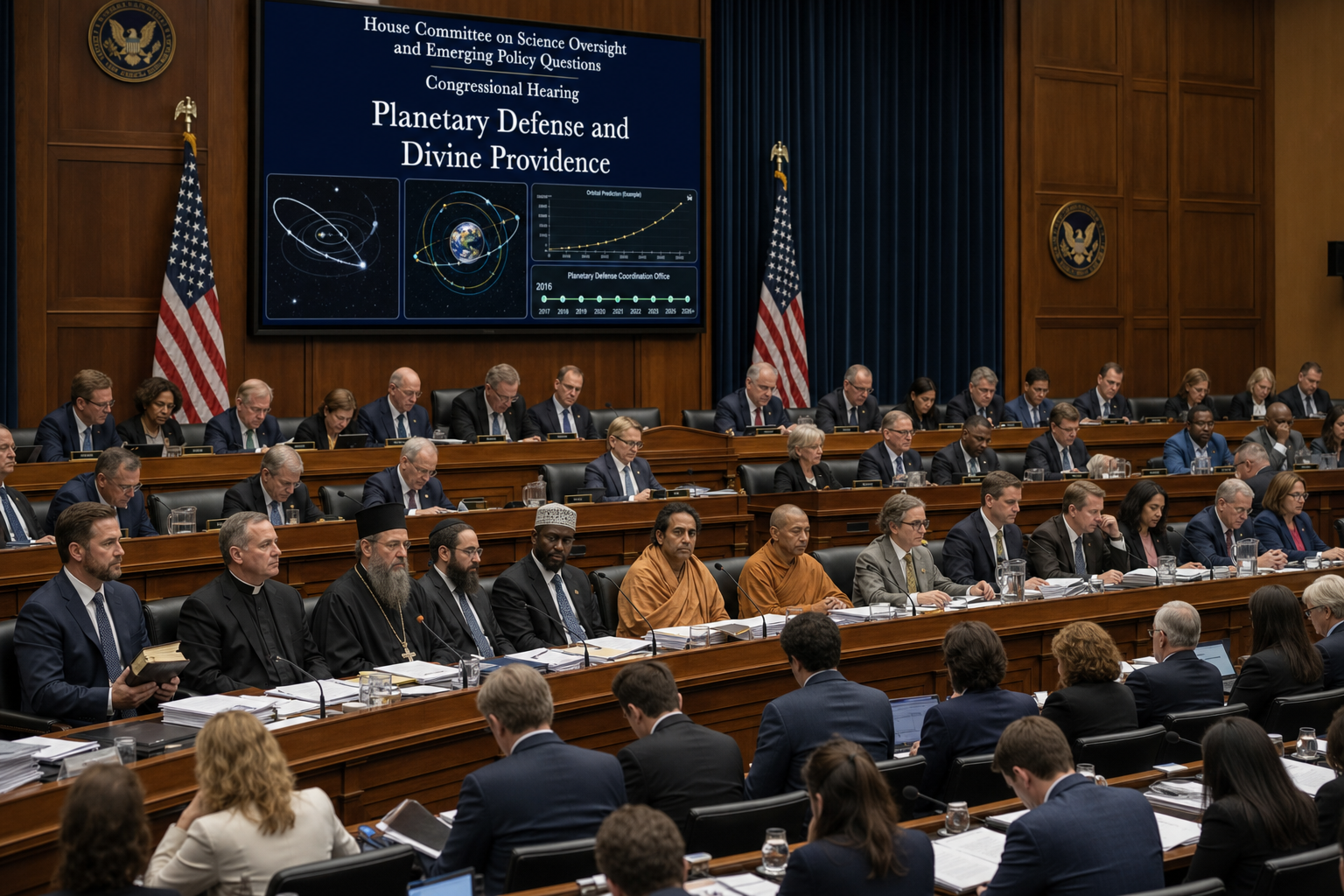
WASHINGTON — A joint congressional hearing examining whether planetary defense programs constitute an unconstitutional assumption of responsibilities traditionally attributed to divine providence concluded Thursday after nearly nine hours of testimony from astronomers, constitutional scholars, theologians, aerospace engineers, attorneys, ethicists, and federal officials.
The hearing, formally titled Constitutional Boundaries of Planetary Defense Within a Providence-Oriented Republic, was convened after several public-interest organizations petitioned Congress to determine whether the expanding mission of asteroid detection and deflection programs represents a gradual transfer of cosmic responsibility from metaphysical authority to administrative agencies.
Although no legislation has yet been proposed, committee members emphasized that the hearing was intended to establish an evidentiary record should future asteroid mitigation activities require additional statutory guidance.
Officials from multiple federal agencies repeatedly stressed that no imminent asteroid threat prompted the review.
"This is fundamentally a constitutional governance question," Committee Chair Representative Harold Whitcomb said during opening remarks.
"The technical capability to redirect an asteroid is becoming increasingly credible."
"The constitutional implications of deciding which celestial events should or should not occur have received comparatively less attention."
The hearing quickly attracted national attention after legal scholars characterized planetary defense as one of the first public policy questions requiring Congress to consider whether preventing naturally occurring astronomical events constitutes legitimate government activity or an impermissible expansion of administrative authority.
Scientists Describe Planetary Defense as an Engineering Discipline
Officials from NASA opened the hearing by explaining the current state of planetary defense research, emphasizing that modern detection systems are intended to identify potentially hazardous near-Earth objects decades before any possible impact.
Dr. Rebecca Lawson, Director of Near-Earth Object Risk Assessment, described planetary defense as a straightforward engineering problem involving orbital mechanics, probability analysis, propulsion systems, and long-term trajectory prediction.
"The overwhelming majority of known asteroids present no meaningful risk to Earth," Lawson testified.
"The purpose of current monitoring programs is simply to identify statistically significant collision probabilities sufficiently early that relatively small changes in velocity can produce substantial changes in long-term orbital position."
She explained that successful asteroid deflection generally requires altering an object's trajectory by only a few millimeters per second if sufficient warning time exists.
Committee members appeared largely satisfied with the technical presentation until Representative Samuel Grayson asked whether those orbital trajectories had originally developed without human administrative participation.
Lawson acknowledged that they had.
"So every currently stable asteroid," Grayson continued, "achieved its present orbital configuration through entirely natural processes."
"That would be correct."
"And Congress is now evaluating circumstances under which federal agencies may substitute their own preferred orbital outcome."
Lawson replied that NASA generally frames the question in terms of reducing existential risk rather than assuming responsibility for celestial administration.
Several committee members requested that the distinction be entered into the record.
Constitutional Scholars Debate Administrative Authority
Witnesses from several law schools testified that the Constitution contains no explicit reference to asteroid deflection, celestial administration, or governmental responsibility for naturally occurring astronomical phenomena.
Professor Elaine Foster of the National University of Administrative Sciences explained that constitutional interpretation becomes unusually complex when technological capability advances into areas historically beyond governmental competence.
"The Constitution generally allocates governmental authority among institutions exercising power over human affairs," Foster testified.
"It says comparatively little regarding administrative intervention in naturally occurring cosmic processes because such intervention was technologically inconceivable at the time of ratification."
She cautioned that constitutional silence should not automatically be interpreted as either authorization or prohibition.
"Novel capabilities frequently require careful balancing among existing constitutional principles."
Attorneys representing several constitutional law organizations likewise argued that Congress routinely regulates activities that the Framers could never have anticipated.
"The constitutional question is not whether the Framers envisioned asteroid deflection," attorney Michael Harlan testified.
"The question is whether existing grants of legislative authority reasonably encompass technologies capable of preventing planetary catastrophe."
Several committee members requested clarification regarding which enumerated power might authorize redirecting a five-hundred-meter asteroid.
Harlan acknowledged that current constitutional scholarship had not yet produced a broad consensus.
"The Commerce Clause appears unusually difficult to apply once the regulated object has not yet entered commerce."
"The Necessary and Proper Clause has attracted somewhat greater academic attention."
He added that some legal scholars had tentatively explored whether planetary defense could fall within Congress's responsibility to provide for the common defense.
"Those discussions remain ongoing."
The committee entered twenty-three law review articles into the record.
Natural Law League Questions Expansion of Celestial Authority
Representatives of several religious organizations emphasized that the hearing should not be interpreted as a conflict between science and faith.
"The Natural Law League has never objected to studying God's creation," League President Thomas Ellsworth testified.
"We object only when studying creation gradually becomes an argument for governing it."
Ellsworth told lawmakers that Scripture portrays human beings as stewards rather than proprietors.
"Stewardship is not the same thing as ownership," he said.
"At some point we should ask whether governing God's heavens was ever assigned to Congress."
He acknowledged that astronomers had every right to observe, catalog, photograph, and model asteroids.
"Knowledge is one thing."
"Claiming authority over God's creation is another."
The League later submitted a memorandum arguing that technological capability should not be mistaken for divine authorization.
"History shows that human institutions rarely stop exercising authority merely because they have reached the proper limit," Ellsworth said.
"Governments have a natural tendency to continue expanding until someone reminds them they are under God's law too."
He cautioned lawmakers against what he described as "the modern assumption that every problem visible through a sufficiently powerful telescope automatically becomes a federal responsibility."
"Creation has displayed extraordinary administrative competence for a very long time."
"We should exercise some humility before concluding that Washington has jurisdiction over celestial mechanics."
Committee members asked whether the League opposed redirecting an asteroid with a one hundred percent probability of striking Earth.
Ellsworth paused for several seconds before answering.
"The League is generally cautious about developing official positions regarding individual asteroids."
League counsel requested permission to supplement the record should the asteroid later exhibit additional relevant facts.
Representatives of the Interfaith Council for Responsible Stewardship largely agreed while emphasizing humanity's obligation to protect life whenever possible.
"People of various faiths have long believed that caring for our neighbors is part of faithful stewardship," Reverend Angela Morrison testified.
"The question before us is not whether life should be protected."
"The question is whether protecting life eventually leads us to imagine that every aspect of creation has been entrusted to federal administration."
Morrison acknowledged that centuries of theological writing contain extensive discussions concerning stewardship.
"To the best of our knowledge," she admitted, "no major theological tradition has developed a doctrine of asteroid deflection."
Several seminaries subsequently announced conferences devoted to the subject, each emphasizing that any conclusions reached would remain preliminary pending additional conferences.
Aerospace Industry Requests Predictable Regulatory Framework
Representatives of the aerospace sector urged Congress to resolve the constitutional uncertainty before future procurement decisions become necessary.
David Mercer, speaking on behalf of the Coalition for Sustainable Expectations, said industry could successfully build whatever planetary defense capabilities Congress ultimately authorizes.
"Our concern is not engineering feasibility."
"Our concern is regulatory predictability."
Mercer explained that developing asteroid interception technologies requires investment horizons measured in decades.
"Private industry functions most efficiently when the boundaries of governmental authority remain reasonably stable."
He suggested that Congress consider establishing a permanent interagency review process before approving any future deflection mission.
"We believe stakeholders would benefit from a standardized Providence Impact Assessment."
The proposed framework would reportedly evaluate proposed asteroid interventions according to scientific necessity, constitutional authority, theological considerations, long-term governance implications, international treaty obligations, and projected public confidence metrics.
Several consulting firms immediately endorsed the proposal.
Operational Excellence Advisors released a preliminary white paper describing Providence Impact Assessments as "an emerging area of strategic administrative opportunity."
Integrated Governance Solutions recommended creation of an Office of Celestial Coordination to harmonize communications among federal agencies, international partners, faith organizations, insurance providers, and the astronomical community.
Future Systems Consulting proposed a seven-phase implementation roadmap beginning with stakeholder engagement and concluding with what it described as "post-providential governance optimization."
None of the firms recommended reducing the number of committees involved.
Professor Keller Explains That Philosophy Has Declined to Reach a Unified Position
Academic philosophers arrived at the hearing in unexpectedly large numbers.
Professor Adrian Keller, Chair of Comparative Epistemology at Westbridge University, thanked the committee for inviting philosophical testimony while gently correcting what he described as "one understandable administrative misunderstanding."
"The invitation requests the appearance of 'a representative of philosophy,'" Keller said.
"Philosophy has historically regarded that description as aspirational."
He explained that the discipline had instead organized a panel representing several major philosophical traditions.
"The committee has asked what appears to be a straightforward question."
"Experience suggests that condition is unlikely to persist."
Committee members nodded.
Keller introduced the analytic philosophers first.
Analytic Philosophers Recommend Defining The Asteroid Before Discussing It
Professor Stephen Hollis of the Jefferson Institute of Technology observed that the committee had used the terms intervene, natural, providential, humanity, and should, more than one hundred times during the hearing.
"Unfortunately," Hollis said, "none of them has been defined."
Committee counsel acknowledged that this was substantially correct.
Hollis distributed a preliminary glossary.
Committee staff appeared relieved until learning the glossary contained only proposed definitions of the word intervention.
"The remaining terminology," Hollis explained, "will be addressed in subsequent volumes."
Several committee members quietly removed earlier handwritten notes from the official record.
Keller thanked Hollis for what he described as "a characteristically optimistic beginning."
Existentialists Congratulate Congress On Finally Asking A Human Question
Professor Claire Dubois of Westbridge University's Department of Existential Studies dismissed suggestions that the hearing principally concerned orbital mechanics.
"The asteroid is behaving exactly as expected."
"It is humanity that appears uncertain."
She cautioned lawmakers against assuming that redirecting the asteroid would eliminate responsibility.
"If Congress authorizes the mission, humanity chooses."
"If Congress rejects the mission, humanity also chooses."
"Declining responsibility has traditionally been one of responsibility's more imaginative disguises."
The court reporter was asked to read back the final sentence twice.
Several senators subsequently revised prepared remarks.
Keller described the testimony as "entirely predictable."
"The existentialists invariably discover that the engineering problem belongs to the engineers."
"The human problem survives."
Keller noted that the existentialist testimony should not be interpreted as representing a dominant view of philosophy.
"The determinists have requested equal time."
Determinists Request Equal Time
Professor Michael Harrington of the Center for Deterministic Systems Theory thanked the committee for inviting testimony.
He then questioned whether the invitation itself had been optional.
"The committee appears to be operating under the assumption that today's hearing might have unfolded differently."
"Our analysis suggests that possibility has been substantially overstated."
Harrington explained that every statement delivered during the hearing, every committee vote, every witness invitation, and every future decision regarding planetary defense represented the unavoidable consequence of prior physical states extending back to the origin of the universe.
"The asteroid is following its trajectory."
"So is Congress."
A committee member asked whether lawmakers therefore possessed any meaningful responsibility for the eventual decision.
"Responsibility," Harrington replied, "would also be among the inevitable consequences."
Another member asked why the Association had traveled to Washington if the outcome had already been determined.
"We didn't decide to."
"We arrived."
Several committee members appeared prepared to continue questioning the witness before quietly acknowledging that, under his framework, they had no alternative.
Keller thanked Professor Harrington for what he described as "a characteristically non-voluntary contribution."
Keller noted that Professor Harrington's testimony should not be interpreted as representing the consensus view of determinism.
"The other determinists have requested equal time."
Professor Catherine Reynolds of the Institute for Deterministic Causal Inquiry cautioned lawmakers against assuming that Congress occupied a privileged position within an otherwise uninterrupted chain of physical causation.
"The asteroid's present course represents approximately 4.6 billion years of uninterrupted causal continuity," Reynolds testified.
"Congress should exercise considerable restraint before concluding that the final remaining variable is a Tuesday afternoon committee hearing."
She explained that every atom contributing to the asteroid's motion had been evolving in accordance with physical laws since the formation of the Solar System.
"The trajectory before us has accumulated a remarkable administrative history."
Several committee members requested clarification.
"Our recommendation," Reynolds continued, "is simply that Congress avoid introducing unnecessary spontaneity into an otherwise exceptionally well-ordered universe."
A senator asked whether she opposed redirecting the asteroid.
"Opposition implies alternatives."
"We generally discourage that vocabulary."
A committee member asked whether humanity should intervene.
Professor Reynolds consulted her prepared remarks.
"The Association generally advises against interrupting causal chains that have demonstrated long-term operational stability."
Nihilists Submit Their Position Efficiently
Representatives of the American Association of Philosophical Nihilists thanked Congress for the opportunity to testify.
Association President Dr. Victor Lang explained that the organization remained institutionally uncommitted regarding asteroid interception.
"The Association has not yet established that the distinction between successful planetary defense and extinction possesses objective significance."
Committee members requested clarification.
Lang replied that the request itself presupposed several conclusions the Association had not endorsed.
The organization subsequently submitted a position paper consisting of a title page followed by one hundred and twelve consecutively numbered blank pages.
An accompanying cover letter explained that the document represented the Association's conclusions "with unusual efficiency."
Keller complimented the submission as "admirably concise."
Philosophers Continue Producing Questions
Following the testimony, Keller assured lawmakers that the panel had intentionally limited itself to introductory observations.
"The schools represented today disagree primarily about how the hearing should begin."
"The more substantial disagreements concern whether the hearing has yet identified its actual subject."
The committee chair asked whether philosophy anticipated reaching consensus.
Keller appeared momentarily thoughtful.
"Historically," he replied, "philosophy has regarded agreement as an interesting secondary objective."
"Our principal contribution has generally been discovering that everyone has been answering the wrong question."
At press time, the Department of Administrative Affairs had announced the formation of an Interdisciplinary Working Group on Foundational Terminology, while Professor Keller cautioned that the group's title contained at least three undefined terms.
Government Begins Studying Administrative Boundaries
Karen Whitmore, Deputy Undersecretary at the Department of Administrative Affairs, announced that the Administration had already established an interagency working group to examine governance questions associated with expanding planetary defense capabilities.
She emphasized that no policy conclusions had been reached.
"Our objective is simply to determine whether existing administrative structures remain appropriately aligned with emerging technological capabilities."
Whitmore said the review would include representatives from NASA, the Department of Justice, the Office of Administrative Continuity, the Bureau of Predictable Outcomes, and several external academic institutions.
She also confirmed that the Office of Unintended Consequences had been invited to participate "given its longstanding expertise in identifying secondary effects associated with otherwise beneficial initiatives."
Officials stressed that the review would not evaluate theological doctrine.
"It will instead evaluate procedural questions concerning governmental decision-making where theological considerations are among several relevant stakeholder perspectives."
Committee members appeared reassured by the distinction, although several requested additional clarification regarding precisely how procedural neutrality differs from theological neutrality when selecting which civilization-ending asteroid should no longer be permitted to collide with Earth.
Whitmore replied that those questions would likely require additional stakeholder engagement.
Economists Examine the Incentive Structure of Divine Intervention
Economists appearing before the committee largely avoided theological conclusions, focusing instead on the institutional consequences of assigning responsibility for planetary outcomes.
Dr. Alan Prescott, Senior Economist at the Center for Regulatory Excellence, testified that the emergence of credible planetary defense capabilities represents what economists describe as a responsibility transition event.
"For most of recorded history," Prescott explained, "large asteroid impacts occupied the same policy category as nearby supernovas."
"They were considered external to economic planning because no practical intervention existed."
"Once intervention becomes technically feasible, however, the event gradually migrates into the category of policy choices."
Prescott noted that this migration carries important implications.
"If government possesses the capability to prevent a catastrophe but elects not to exercise it, observers frequently reinterpret what had previously been regarded as an act of nature."
"It becomes, at least politically, an administrative decision."
He cautioned lawmakers that assuming responsibility for one category of celestial events may gradually alter public expectations regarding others.
"Institutions rarely expand authority one philosophical category at a time."
"They generally expand through precedent."
The committee requested that the observation be entered into the official record.
International Partners Seek Consistent Cosmic Governance
Officials from several allied governments submitted written testimony urging the United States to coordinate any future planetary defense activities through existing international institutions.
A joint statement warned that unilateral asteroid deflection could unintentionally redistribute risk among nations if altered trajectories produced new impact probabilities elsewhere.
The Department of State confirmed that preliminary discussions had already begun regarding possible international standards governing asteroid intervention.
Among the proposals reportedly under consideration were notification requirements, multinational review panels, shared liability frameworks, and standardized orbital documentation procedures.
One draft proposal would require participating nations to certify that any alteration of a celestial object's trajectory had undergone sufficient scientific, legal, environmental, diplomatic, and ethical review before implementation.
Officials described the proposal as "procedurally mature."
It totaled approximately eleven hundred pages.
Citizens Express Moderate Confusion
Outside the Capitol, members of the public appeared uncertain whether the hearing represented a scientific discussion, a constitutional debate, or simply another day in Washington.
"I was under the impression asteroids were handled somewhere above my pay grade," said accountant Rebecca Collins after watching portions of the hearing.
"I didn't realize there might be overlapping jurisdictions."
Construction supervisor Daniel Brooks said he generally supported preventing extinction-level events but admitted he had never previously considered whether Congress possessed explicit constitutional authority to influence orbital mechanics.
"I suppose if we're going to start moving planets and asteroids around, somebody probably ought to read the Constitution first."
Others expressed appreciation that lawmakers were examining the issue before an emergency developed.
"It seems healthier than waiting until an asteroid is already on the evening news," one visitor observed.
Public opinion surveys conducted following the hearing found broad support for planetary defense programs.
A majority of respondents simultaneously agreed that government should avoid assuming unnecessary responsibility for the administration of the universe.
Researchers described the results as "internally consistent within normal polling tolerances."
Administrative Review Expected to Continue
Committee members concluded the hearing by requesting additional reports from the Congressional Research Service, the Government Accountability Office, NASA, the Department of Justice, and the Department of Administrative Affairs.
Karen Whitmore confirmed that an Interagency Working Group on Constitutional Celestial Governance would deliver preliminary recommendations within eighteen months, followed by a public comment period, technical review, stakeholder engagement process, economic impact assessment, legal harmonization study, and implementation feasibility analysis.
Officials emphasized that none of these activities should be interpreted as evidence that the federal government currently administers divine providence.
"They should instead be viewed as evaluating whether such administration would require additional procedural safeguards."
Committee members unanimously agreed that the question deserved careful consideration before circumstances required an immediate answer.
At press time, the Office of Administrative Continuity had issued temporary guidance clarifying that, pending completion of the federal review, naturally occurring astronomical phenomena should continue operating under their existing governance framework unless otherwise authorized by Congress.
Sarah Collins, GFNN Washington Bureau
Recent Articles


-
The Gentle Night Friends Series
Aug 23, 26 03:38 PM
 The Gentle Night Friends Series is a collection of SEL children's stories.
 -
Senator Replaced Himself With Android: Committee Investigates
Aug 10, 26 12:32 PM
 Senator replaced himself with an android characterized as a "Legislative Productivity Surrogate," prompting a Judiciary Committee inquiry into voting, representation, AI autonomy, and constitutional p…
 -
Congress Opens Investigation Into the Decline of Music Education
Aug 03, 26 02:18 PM
Congress Opens Investigation Into the Decline of Music Education after educators report unexpected changes in student learning, prompting federal hearings, academic reviews, and industry responses.