
Supreme Court Hears Case After Hotel Refuses Service To Elderly Married Couple, Citing Policy Against "Gerontophilia"
Supreme Court Hears Case After Hotel Refuses Service To Elderly Married Couple, Citing Policy Against "Gerontophilia" raises unexpected legal and compliance questions.
GFNN continues to support legacy information delivery technologies, including written language. The following is the text version of today's report.
Accessibility Notice: This report may be consumed without scrolling past unsolicited video advertisements.
By Sarah Collins
GFNN Washington Bureau
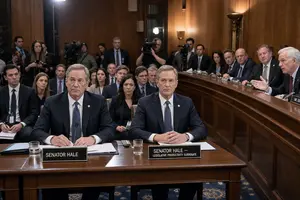
WASHINGTON — The United States Supreme Court heard oral arguments Tuesday in a case that legal analysts say could significantly influence the relationship between corporate compliance policies, automated customer screening systems, and the practical definition of long-term marriage.
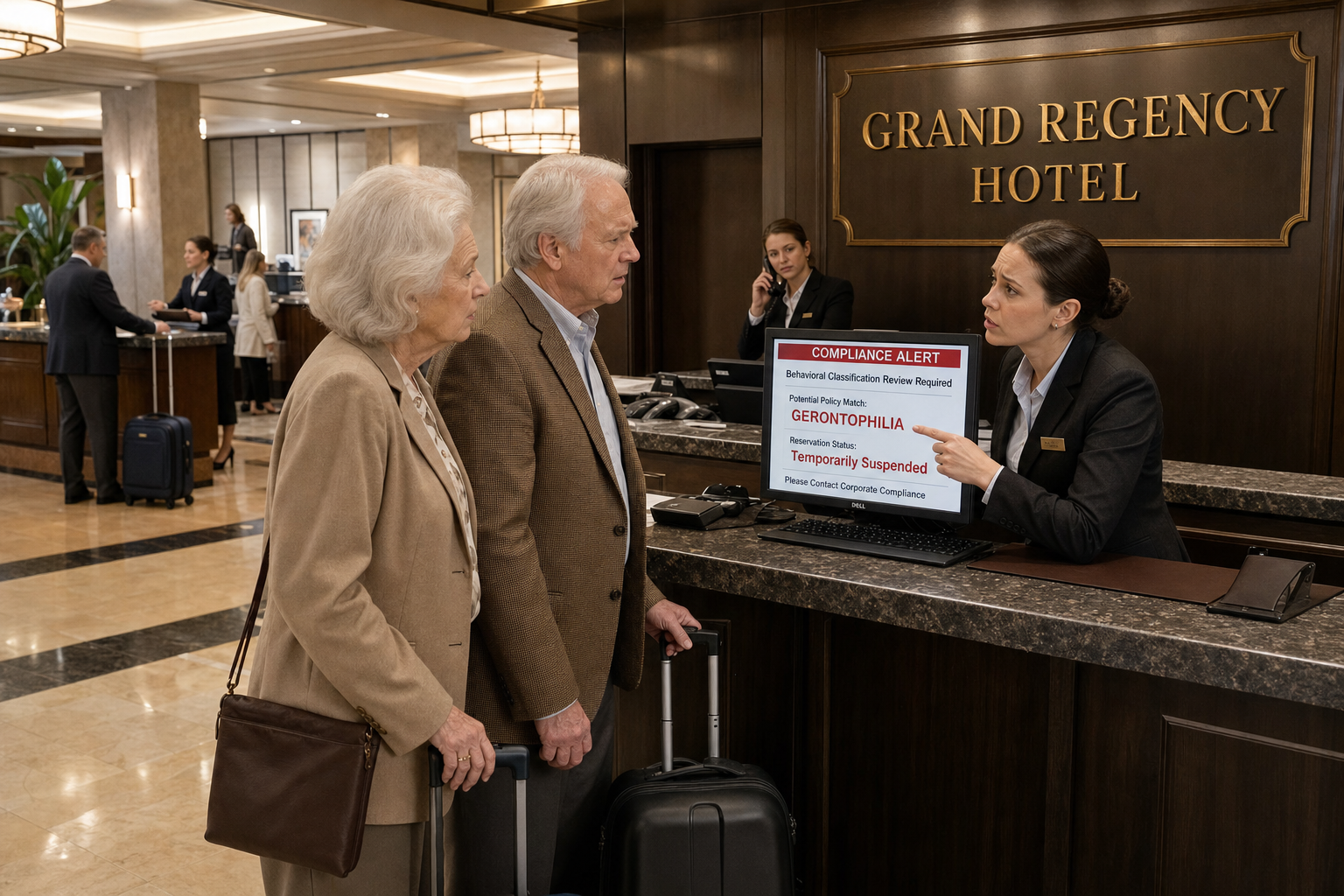
The case originated eighteen months ago after Robert and Eleanor Mitchell, married for fifty-six years, were denied a room at the Grand Regency Hotel in Indianapolis while traveling to attend their granddaughter's college graduation.
According to court filings, the hotel's reservation management software generated an automated compliance alert after employees confirmed that the couple had requested a single king-bed room.
Front desk staff informed the Mitchells that company policy prohibited accommodating individuals whose reservation appeared to involve what internal compliance documents classified as "gerontophilia" or "anililagnia."
The Mitchells attempted to explain that they were husband and wife.
Employees reportedly acknowledged the explanation but stated that marital status did not override behavioral classification protocols established during a recent revision of the company's Customer Experience Risk Mitigation Framework.
Hotel personnel refunded the reservation, apologized repeatedly for the inconvenience, and recommended several competing establishments whose compliance standards might better accommodate the couple's circumstances.
No employee raised his voice.
No employee questioned the policy.
Each explained that corporate guidance required consistent application.
The Mitchells subsequently filed suit.
After conflicting decisions in lower federal courts, the Supreme Court agreed to hear the matter, citing unresolved questions regarding the relationship between anti-discrimination policies, automated compliance systems, and legally recognized marital relationships.
Legal scholars immediately described the case as unusually narrow.
Administrative agencies rapidly demonstrated otherwise.
Hotel Executives Describe An Automated Classification Error Rather Than A Policy Failure
Executives from Regency Hospitality Group insisted throughout the proceedings that the company had never intended to discriminate against elderly guests.
Chief Executive Officer Daniel Foster testified before reporters outside the Court that the company's customer inclusion initiatives had expanded continuously for nearly a decade.
"Our organization remains fully committed to welcoming every lawful customer," Foster said.
"This matter concerns classification consistency."
He explained that the company had adopted a commercially available behavioral compliance platform developed by a third-party consulting consortium specializing in hospitality risk management.
According to Foster, the software continuously evaluated reservation data for potential conflicts with hundreds of internal policies.
"The software detected two elderly individuals requesting one room."
"It then evaluated the available behavioral descriptors within the approved terminology library."
"The resulting recommendation was generated automatically."
Company attorneys emphasized that no employee independently concluded that the Mitchells had violated company policy.
"The software reached that conclusion," lead counsel Rebecca Harding explained.
"Our employees complied with established operational guidance."
Internal company documents later introduced during oral arguments revealed that staff members had requested clarification approximately forty-three times during the first month following implementation.
Each inquiry had been forwarded to progressively higher administrative levels before ultimately being returned with identical guidance.
"Continue applying current policy pending future clarification."
Justice Margaret Holloway asked whether anyone within the corporation had considered making an exception.
Harding responded carefully.
"Your Honor, consistency is among the foundational principles of effective compliance."
"Exceptions frequently become precedents."
"Precedents often require revised guidance."
"Revised guidance generally necessitates retraining."
"Retraining carries measurable implementation costs."
Several justices quietly made notes.
Compliance Specialists Explain Why Definitions Became Increasingly Difficult
The Court next heard testimony from Dr. Melissa Harmon, Senior Systems Analyst for the Institute for Strategic Compliance, who had participated in the development of several large-scale corporate behavioral governance frameworks.
Harmon explained that modern compliance systems increasingly depend upon standardized terminology rather than contextual judgment.
"The larger an organization becomes," she testified, "the more valuable consistent vocabulary becomes."
"Employees rotate."
"Managers retire."
"Software platforms evolve."
"Definitions remain."
Justice Holloway asked whether those definitions always reflected ordinary language.
"Not necessarily."
"They reflect operational language."
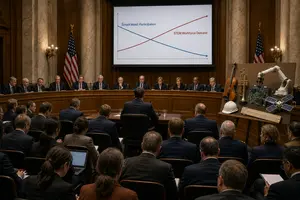
Harmon displayed a flowchart illustrating the hotel's decision process.
Guest age.
Relationship status.
Reservation configuration.
Applicable terminology.
Policy review.
Operational recommendation.
No step evaluated whether the guests were simply an elderly married couple.
"The architecture assumed that recognized terminology represented administratively meaningful categories," Harmon explained.
"It was not designed to evaluate sixty years of shared mortgage payments."
Several members of the courtroom audience nodded as they studied copies of the exhibit.
Professor Adrian Keller of Westbridge University submitted an amicus brief questioning whether increasingly technical classifications had gradually displaced ordinary human description.
"Our civilization has become remarkably proficient at identifying categories," Keller wrote.
"We have invested comparatively less effort determining whether every available category requires institutional intervention."
Attorneys representing the hotel objected that philosophical observations, while intellectually stimulating, offered limited assistance when designing scalable compliance software.
Keller agreed.
"That," he replied, "is generally the point philosophers have been making for approximately twenty-five centuries."
Industry Organizations Warn Against Returning To Context-Based Decision Making
Several national trade associations filed briefs supporting neither party while expressing concern regarding the broader operational implications of the case.
David Mercer, spokesperson for the Coalition for Sustainable Expectations, cautioned against encouraging employees to exercise excessive individual judgment.
"Organizations adopt standardized procedures because organizations eventually become too large for everyone to know everyone else."
"If individual employees begin making contextual decisions, consistency may decline."
Representatives from the Customer Experience Harmonization Council reached similar conclusions.
Their briefing document estimated that replacing terminology-based classification with contextual evaluation could increase employee decision-making responsibility by as much as thirty-eight percent.
"This would require enhanced training."
"Enhanced training would require revised certification."
"Revised certification would require updated instructional materials."
"Updated instructional materials would require coordinated stakeholder review."
The Council recommended creation of an Interdisciplinary Relationship Classification Working Group before implementing any substantial policy revisions.
Justice Elena Porter asked whether such a group could simply conclude that elderly married couples should be allowed to reserve hotel rooms together.
Mercer considered the question carefully.
"That outcome cannot be excluded."
"However, responsible governance generally prefers documenting all alternative possibilities before selecting the most obvious one."
Outside observers later described the answer as one of the day's least controversial statements.
Supreme Court Justices Search For A Definition That Survives Ordinary Marriage
The second morning of oral arguments quickly demonstrated that the central legal question extended beyond hotel reservations.
It had become increasingly difficult to determine precisely what the hotel believed it had prohibited.
Chief Justice Harold Whitaker asked counsel to explain whether the company's policy distinguished between attraction that developed because of advanced age and attraction that simply continued as spouses grew older together.
Hotel attorney Rebecca Harding responded by returning to the written policy.
"The policy applies behavioral terminology recognized within our approved compliance lexicon."
Whitaker nodded.
"I understand that."
"What I do not understand is whether your policy assumes that a husband celebrating his wife's eightieth birthday becomes administratively different from the husband who celebrated her fortieth."
Harding consulted several pages of notes.
"The current policy does not expressly distinguish between those circumstances."
Justice Porter leaned forward.
"So longevity itself becomes the triggering event?"
"The software recognizes observable characteristics rather than chronological narratives."
Justice Samuel Greene asked whether the software contained a category labeled "successful marriage."
"It does not."
"Was adding one considered?"
"Not to my knowledge."
Greene paused before speaking again.
"That omission appears increasingly relevant."
Court observers described the exchange as unusually restrained considering that several hundred attorneys throughout the country were simultaneously attempting to determine whether decades of ordinary marital affection had unintentionally become a compliance concern.
The National Association of Family Law Attorneys later released a statement emphasizing that marriage statutes generally presume continuing mutual affection rather than treating it as a developing regulatory issue.
That clarification, however, produced an entirely different problem.
Several compliance organizations requested formal guidance defining "continuing."
Academics, Lawyers, And Economists Immediately Begin Solving Different Problems
Recognizing that the legal dispute had broadened considerably, the Court invited additional expert testimony from multiple disciplines.
Professor Adrian Keller returned to explain that language frequently evolves faster than institutions.
"The existence of a technical term," Keller testified, "does not necessarily imply that every occurrence requires administrative classification."
He adjusted his glasses.
"Academic vocabulary often exists to describe observations."
"Institutions occasionally reinterpret descriptive language as operational language."
"There is an important distinction."
Counsel for the hotel responded that distinctions become increasingly difficult to implement across multinational organizations employing nearly ninety thousand individuals.
"We require measurable decision criteria."
Keller smiled politely.
"Philosophy has encountered that preference before."
Dr. Alan Prescott, Senior Economist at the Center for Regulatory Excellence, approached the matter from an entirely different perspective.
"Economic systems reward predictable behavior."
"When organizations perceive uncertain legal exposure, they frequently respond by expanding internal controls."
He displayed a graph illustrating what he described as Regulatory Expansion Under Uncertain Liability Conditions.
"The question before the Court is not merely whether this policy was reasonable."
"It is whether organizations perceive greater financial risk from exercising judgment than from following software recommendations."
Justice Holloway interrupted.
"Even when the software recommends denying a room to a married couple celebrating their anniversary?"
Prescott nodded.
"Especially then."
"The reputational consequences of inconsistent policy application are easier for corporations to quantify than the reputational consequences of occasionally appearing detached from ordinary reality."
Several financial analysts seated in the gallery quietly copied the sentence into their notebooks.
Meanwhile, attorneys representing national hotel associations expressed concern that an adverse ruling could expose hospitality companies to lawsuits whenever employees exercised independent judgment contrary to software recommendations.
"Our members need certainty."
Justice Greene looked toward the bench.
"They may receive clarity."
"I cannot promise certainty."
Consultants Introduce A Comprehensive Relationship Governance Framework
By the third day of testimony, consulting firms had begun circulating executive summaries outlining implementation strategies regardless of the Court's eventual decision.
Strategic Alignment Partners released a seventy-eight-page white paper entitled Toward A Modern Relationship Classification Framework.
Managing Director Stephanie Lawson emphasized that the controversy presented an opportunity for organizational transformation rather than merely legal compliance.
"We encourage stakeholders not to view this as a hotel issue."
"It is an enterprise governance issue."
Lawson proposed a phased implementation roadmap.
Phase One recommended creation of interdisciplinary steering committees.
Phase Two proposed regional stakeholder engagement workshops.
Phase Three suggested pilot programs evaluating context-aware relationship assessment protocols.
Phase Four envisioned development of voluntary certification standards for organizations wishing to demonstrate excellence in Contextual Customer Classification.
Justice Porter later observed that none of the recommendations appeared to involve simply recognizing elderly married couples as elderly married couples.
Lawson acknowledged the observation.
"Our roadmap assumes sustainable organizational maturity rather than tactical intervention."
The International Council for Administrative Excellence immediately endorsed the proposal.
Its accompanying statement praised the framework's emphasis on scalability, stakeholder confidence, continuous improvement, and governance resilience.
The statement concluded by recommending the establishment of an International Symposium on Contextual Relationship Management to explore implementation challenges over the next five years.
Within forty-eight hours, three universities had expressed interest in hosting the inaugural conference.
None had yet selected a working definition of marriage.
Federal Agencies Quietly Begin Preparing For Every Possible Outcome
Although the Supreme Court had not yet issued a ruling, several federal agencies acknowledged that prudent administrative planning required preliminary preparation.
Deputy Undersecretary Karen Whitmore of the Department of Administrative Affairs announced the formation of an Interagency Relationship Terminology Coordination Working Group.
"This initiative should not be interpreted as anticipating the Court's decision," Whitmore emphasized.
"It merely reflects responsible contingency planning."
Participating agencies included the Office of Administrative Continuity, the Federal Bureau of Public Expectations, the Center for Regulatory Excellence, and the National Office of Temporary Guidance.
Their initial objective appeared straightforward.
Determine whether federal guidance should distinguish among technical terminology, legal terminology, operational terminology, and ordinary conversational language.
The first planning meeting lasted six hours.
Participants unanimously agreed that additional meetings would improve alignment.
Meeting minutes later obtained by GFNN indicated that members devoted nearly ninety minutes to determining whether the phrase "ordinary conversational language" required a formal definition before discussion could continue.
The matter was referred to a Definitions Subcommittee.
The Definitions Subcommittee subsequently requested guidance from the Terminology Harmonization Advisory Panel.
That panel scheduled its first meeting approximately six weeks after the Supreme Court's anticipated decision.
Officials described the timeline as appropriately proactive.
Consumer Advocates Discover That Protecting Older Guests Requires Additional Classification
Consumer organizations initially welcomed the Court's review, describing the case as an opportunity to strengthen protections for older travelers.
That position became more complicated after several groups concluded that permitting hotels to recognize marriages without further inquiry might expose vulnerable guests to coercion, financial exploitation, or unauthorized emotional dependency.
The National Council for Consumer Stability urged the Court to avoid replacing one categorical policy with an unrestricted presumption that every elderly couple presenting themselves as married should automatically be treated as such.
"Older consumers deserve both dignity and safeguards," the Council said in a statement.
"Neither objective should be pursued at the expense of the other."
The organization recommended that hotels adopt a voluntary relationship verification protocol for guests above a designated age threshold.
Suggested verification methods included matching identification, confirmation of shared legal residence, evidence of joint financial history, or completion of a standardized Mutual Relationship Continuity Declaration.
The proposal immediately drew objections from privacy advocates.
Citizens for Practical Solutions argued that hotel employees should not examine retirement accounts, property records, or anniversary photographs before issuing room keys.
"Travelers should not be required to document affection," Executive Director Elaine Morrison said.
The Council responded that it had never proposed documenting affection.
It had proposed documenting the administrative basis upon which affection could be presumed.
The distinction led to requests for clarification from twelve state hospitality regulators.
Several hotel chains began testing a shortened guest declaration containing three questions:
Are you legally married?
Are you voluntarily traveling together?
Has either party requested separate accommodations?
Compliance officers rejected the draft after determining that guests could answer all three questions inaccurately.
A revised version contained seventeen questions and required initials beside each response.
The Customer Experience Harmonization Council praised the revision as an important step toward balancing privacy with procedural confidence.
Civil liberties attorneys objected that the form transformed a hotel stay into a preliminary domestic-relations proceeding.
Hospitality executives replied that the form was only preliminary until completed.
Supreme Court Hears Case After Hotel Refuses Service To Elderly Married Couple, Citing Policy Against "Gerontophilia," As States Prepare Separate Rules
State governments began preparing their own guidance after legal analysts warned that a narrow Supreme Court ruling might leave significant operational questions unresolved.
Several states proposed laws prohibiting hotels from denying accommodations solely because two older adults requested a shared room.
Other states concluded that the phrase "solely because" could allow denials based on age combined with additional factors, including reservation type, payment method, bed configuration, or stated purpose of travel.
Legislative staff members responded by drafting broader language.
The broader language prompted opposition from lodging associations concerned that hotels might lose authority to intervene in situations involving suspected abuse or fraud.
A model bill prepared by the Association of Responsible Stakeholders attempted to reconcile the competing positions.
Under the proposal, hotels could not deny service based on age, marital status, continuing attraction, suspected attraction, technical terminology, software classification, or the absence of a recognized operational category.
Hotels could still deny service under independently validated circumstances unrelated to any of those factors.
The bill directed state regulators to define "independently validated."
During committee testimony, one lawmaker asked whether a marriage certificate would satisfy the standard.
Industry representatives said it could establish legal status but not necessarily present consent.
Consumer advocates said present consent should not require historical documentation.
Privacy attorneys said asking the question could itself be intrusive.
Hotel operators asked whether handing both guests room keys constituted an implied finding of consent.
State insurance regulators then requested participation.
Their concern involved potential liability if employees failed to identify coercion after relying on a signed declaration.
The resulting draft legislation required hotels to make no determination regarding the legitimacy, quality, duration, emotional content, or future viability of any relationship.
It also required employees to confirm that no relationship-related concerns were present.
Legislative counsel acknowledged that the two provisions might be difficult to reconcile.
A conference committee was appointed.
The Hospitality Industry Creates A Voluntary Standard Before The Court Rules
With legal uncertainty increasing, the hospitality industry moved to establish its own voluntary national standard.
The Customer Experience Harmonization Council, the Coalition for Sustainable Expectations, and the Institute for Strategic Compliance jointly announced the Responsible Shared Accommodation Framework.
The framework instructed participating hotels to suspend automated denials involving elderly couples while preserving existing classification systems for research, audit, and future risk assessment.
Front desk employees would receive new training on what the framework described as "relationship-neutral occupancy processing."
Under the interim procedure, employees would avoid asking guests why they wished to share a room.
They would also avoid assuming that guests wished to share a room merely because they had reserved one.
Employees would instead state:
"Our records indicate that this reservation includes shared sleeping accommodations. Please confirm that the selected configuration reflects the accommodations you currently intend to receive."
If both guests agreed, the reservation could proceed.
If one guest answered before the other, employees were instructed to repeat the question.
If both guests answered simultaneously, employees were instructed to record independent verbal concurrence.
If either guest laughed, employees were advised not to interpret laughter as consent, objection, confusion, embarrassment, familiarity, affection, or criticism of the question.
Industry spokesperson David Mercer called the framework a meaningful achievement.
"It preserves customer dignity while reducing unstructured employee inference."
He said participating hotels would retain discretion to adapt the language to local conditions, provided that adaptations underwent corporate legal review.
Regency Hospitality Group announced that it would adopt the standard immediately.
The company also confirmed that the original software alert had been deactivated.
The alert remained in the system for historical reporting purposes.
Foster, the company's chief executive, said the policy revision demonstrated organizational responsiveness.
"We listened."
"We learned."
"We launched a cross-functional review."
The Mitchells' attorney noted that the company had not yet offered the couple another room.
Regency officials said the original reservation date had passed and could not be reinstated without creating inaccurate occupancy records.
The company instead offered the couple loyalty points equivalent to a one-night weekday stay at participating suburban properties, excluding holidays, special events, graduation weekends, and dates subject to enhanced demand pricing.
Supreme Court Justices Consider Whether Common Sense Can Be Narrowly Tailored
In the final session, the justices returned repeatedly to the practical question underlying the case.
Chief Justice Whitaker asked whether the Constitution, federal civil rights law, state accommodation statutes, or established contract principles required hotels to recognize ordinary marital conduct without first assigning it a behavioral classification.
Harding, representing the hotel, argued that the company had already corrected the immediate problem.
"The disputed alert is no longer active."
Whitaker replied that the company's underlying legal position remained active.
Harding acknowledged that the company continued to defend its right to rely upon neutral compliance systems.
Justice Greene asked whether a system remained neutral when it applied an irrelevant category to ordinary conduct.
"Neutrality concerns consistent application," Harding said.
"Relevance is a separate analysis."
Justice Porter asked who performed the relevance analysis.
Harding said that responsibility belonged to the company's policy development team.
The policy development team relied on external consultants.
The consultants relied on an approved terminology database.
The database publisher relied on academic and clinical sources.
Those sources generally described terms rather than recommending hotel policies.
Harding agreed that no source appeared to have advised denying rooms to married couples.
She maintained that the absence of such advice did not establish that the hotel's precaution had been legally impermissible at the time.
Counsel for the Mitchells urged the Court to issue a narrow ruling.
"A hotel may apply lawful policies," he said.
"It may use software."
"It may train employees."
"It may consult specialists."
"It may create committees."
"It may not convert an elderly couple's marriage into a prohibited condition because its database contains a word the company does not understand."
The hotel argued that this formulation improperly assigned human understanding requirements to automated systems.
Justice Holloway responded that the company had not been sued by its software.
Administrative Planning Continues After The Original Problem Disappears
Following oral arguments, the Department of Administrative Affairs announced that the Interagency Relationship Terminology Coordination Working Group would continue its work regardless of the Court's ruling.
Deputy Undersecretary Karen Whitmore said the case had revealed broader inconsistencies in the use of technical language across public-facing institutions.
"Today the issue involves hotel accommodations."
"Tomorrow it could involve housing, transportation, healthcare, insurance, recreation, or any environment in which two people appear together and an institution believes it needs to know why."
The Department approved a six-month terminology inventory.
Federal agencies will identify terms currently used in policies, software systems, training materials, public forms, and compliance manuals that may carry meanings different from their ordinary use.
The National Office of Temporary Guidance will then issue provisional recommendations explaining which definitions should remain temporary until permanent interim definitions can be developed.
The Office of Regulatory Harmonization has proposed a public-private partnership to create a National Contextual Terminology Standard.
Consultants estimate that the project will require four phases, twenty-seven stakeholder sessions, three pilot jurisdictions, and a permanent governance body responsible for annual updates.
Westbridge University and the National University of Administrative Sciences have announced a joint research center devoted to the institutional consequences of technically accurate words applied in operationally inappropriate settings.
Professor Keller will serve as co-chair.
The hospitality industry has requested observer status.
The Mitchells returned home after oral arguments.
They told reporters they had stayed at a smaller hotel several blocks from the Court.
The clerk checked their identification, confirmed the reservation, and handed them two room keys.
No additional classification was performed.
At press time, the Supreme Court had not issued its opinion, but the Department of Administrative Affairs reminded hotels that existing temporary guidance neither requires nor prohibits recognizing a married couple, provided that any recognition is documented in a manner consistent with forthcoming documentation standards.
For more responsibly sourced genuine fake news, click here.
Recent Articles


-
The Gentle Night Friends Series
Aug 23, 26 03:38 PM
 The Gentle Night Friends Series is a collection of SEL children's stories.
 -
Senator Replaced Himself With Android: Committee Investigates
Aug 10, 26 12:32 PM
 Senator replaced himself with an android characterized as a "Legislative Productivity Surrogate," prompting a Judiciary Committee inquiry into voting, representation, AI autonomy, and constitutional p…
 -
Congress Opens Investigation Into the Decline of Music Education
Aug 03, 26 02:18 PM
Congress Opens Investigation Into the Decline of Music Education after educators report unexpected changes in student learning, prompting federal hearings, academic reviews, and industry responses.