
College Professors Use AI Detection In College Papers: Students Use AI to Humanize AI Papers
College Professors Use AI Detection In College Papers: Students Use AI to Humanize AI Papers
GFNN continues to support legacy information delivery technologies, including written language. The following is the text version of today's report.
Administrative Notice: Reading this report requires temporary cooperation between your eyes and your attention span.
AI detection in college papers involves universities across the country expanding their use of AI to identify papers believed to have been written with AI, while students are increasingly relying on separate AI systems designed to ensure those same papers cannot be identified as AI-generated.
Higher education officials described the situation as an expected phase in the modernization of academic assessment rather than a contradiction.
According to several university technology officers, the rapid adoption of generative AI has produced an equally rapid demand for automated evaluation tools capable of distinguishing between human and machine-authored work.
Meanwhile, software companies have introduced products that promise to rewrite AI-generated material into language exhibiting more natural variation, stylistic inconsistency, and the occasional imperfect sentence commonly associated with human authors.
Industry analysts describe the result as a rapidly expanding software ecosystem in which competing artificial intelligence systems evaluate, revise, classify, and reinterpret one another before any instructor reads the final submission.
"This represents a healthy example of technological innovation responding to technological innovation," said Dr. Melissa Harmon, Senior Educational Systems Analyst at the Institute for Strategic Compliance.
"Historically, technological progress has often involved competing systems improving in response to one another. While some observers have noted the increasingly limited role of direct human participation in this particular optimization cycle, there is currently no evidence that the participating software considers this problematic."
"This should not be understood as software competing with software," Harmon cautioned.
"It is more accurately characterized as a collaborative ecosystem of independently developed computational stakeholders engaged in reciprocal authenticity optimization. The fact that human beings now participate primarily at the beginning and end of the workflow reflects increasing operational maturity rather than declining educational engagement."
Universities Expand AI Detection Programs
The first wave of AI writing tools prompted many institutions to reevaluate existing academic integrity policies.
Universities initially emphasized honor codes and classroom discussions about responsible technology use. As generative AI capabilities improved, many institutions concluded that software-assisted evaluation would become necessary to preserve confidence in written assessments.
Several universities subsequently licensed commercial AI detection platforms capable of assigning statistical probabilities regarding whether submitted text appeared consistent with machine-generated language.
Most vendors cautioned that their systems should assist faculty rather than replace professional judgment.
Administrators generally agreed.
"Our objective is not to automate accusations," explained Associate Provost Karen Holloway.
"Our objective is to provide faculty with additional analytical resources that may support informed conversations with students when unusual writing characteristics are observed."
University technology offices reported that implementation committees, privacy reviews, procurement evaluations, legal consultations, accessibility assessments, faculty governance meetings, and multiple pilot programs generally required substantially more time than the software installation itself.
Officials described this as evidence that higher education continues to value thoughtful institutional decision-making.
Students Adopt AI Humanization Software
The emergence of AI detection software was followed by rapid growth in applications marketed as AI humanizers.
Rather than generating original essays, these programs advertise their ability to restructure existing AI-generated text so it appears more conversational, varied, and stylistically unpredictable.
Developers rejected the characterization that the software simply "makes AI writing sound human." Instead, they described it as "a probabilistic redistribution of lexical, syntactic, and semantic variance intended to reduce classifier confidence by more closely approximating those statistically emergent characteristics through which both human readers and machine learning systems have historically inferred authentic human authorship."
Marketing literature describes the process as "controlled authenticity optimization," in which statistically excessive coherence is selectively reduced through the calibrated introduction of naturally occurring linguistic inefficiencies. Developers emphasized that the software does not degrade writing quality, but rather restores "expected human variance."
One technical paper explained that the software continuously monitors for "suspiciously competent prose," introducing sufficient lexical and structural irregularity to prevent the finished document from exhibiting levels of consistency no longer considered representative of typical undergraduate writing.
Several companies advertise adaptive linguistic optimization intended to improve cross-platform interpretive consistency by reducing unfavorable classification outcomes across heterogeneous AI authorship assessment frameworks.
Students interviewed outside several universities generally viewed the software as another educational technology rather than an ethical innovation.
"I use one AI platform for initial concept development," said sophomore English literature major Brandon Ellis. "Then I run the draft through a linguistic variability optimizer before validating it across several authorship assessment platforms. If the authenticity profile falls outside the expected human range, I make another optimization pass."
Ellis added that he remains "actively involved throughout the workflow."
Asked to clarify his role, he said, "Final approval."
Detection in College Papers Drives Multi-Agency Standards Review
Following the expansion of AI detection systems, the Department of Administrative Affairs initiated a cross-sector evaluation of “algorithmic writing attribution reliability standards,” citing concerns that institutions were beginning to assign consequential academic outcomes based on probabilistic linguistic scoring systems.
A preliminary report noted that most AI detection platforms do not determine authorship in any deterministic sense, but instead generate confidence intervals reflecting statistical similarity to known training distributions.
Despite this limitation, universities reported increasing operational dependence on these scores as “decision-support indicators.”
"The system is not being employed as a final arbiter," said Dr. Jonathan Pierce of the Center for Regulatory Excellence.
"It functions as one evidentiary component within a broader interpretive framework in which human reviewers exercise independent professional judgment while appropriately recognizing that the structured analytical output necessarily occupies a privileged epistemic position by virtue of its methodological consistency rather than any presumption of objective correctness."
Several institutions responded by introducing secondary verification layers, including peer-style AI review, reverse-detection models, and stylistic consistency audits conducted by separate vendors using incompatible classification frameworks.
Competing AI Systems Begin Disagreeing at Scale
By mid-semester, several universities reported systematic disagreement between AI detection platforms.
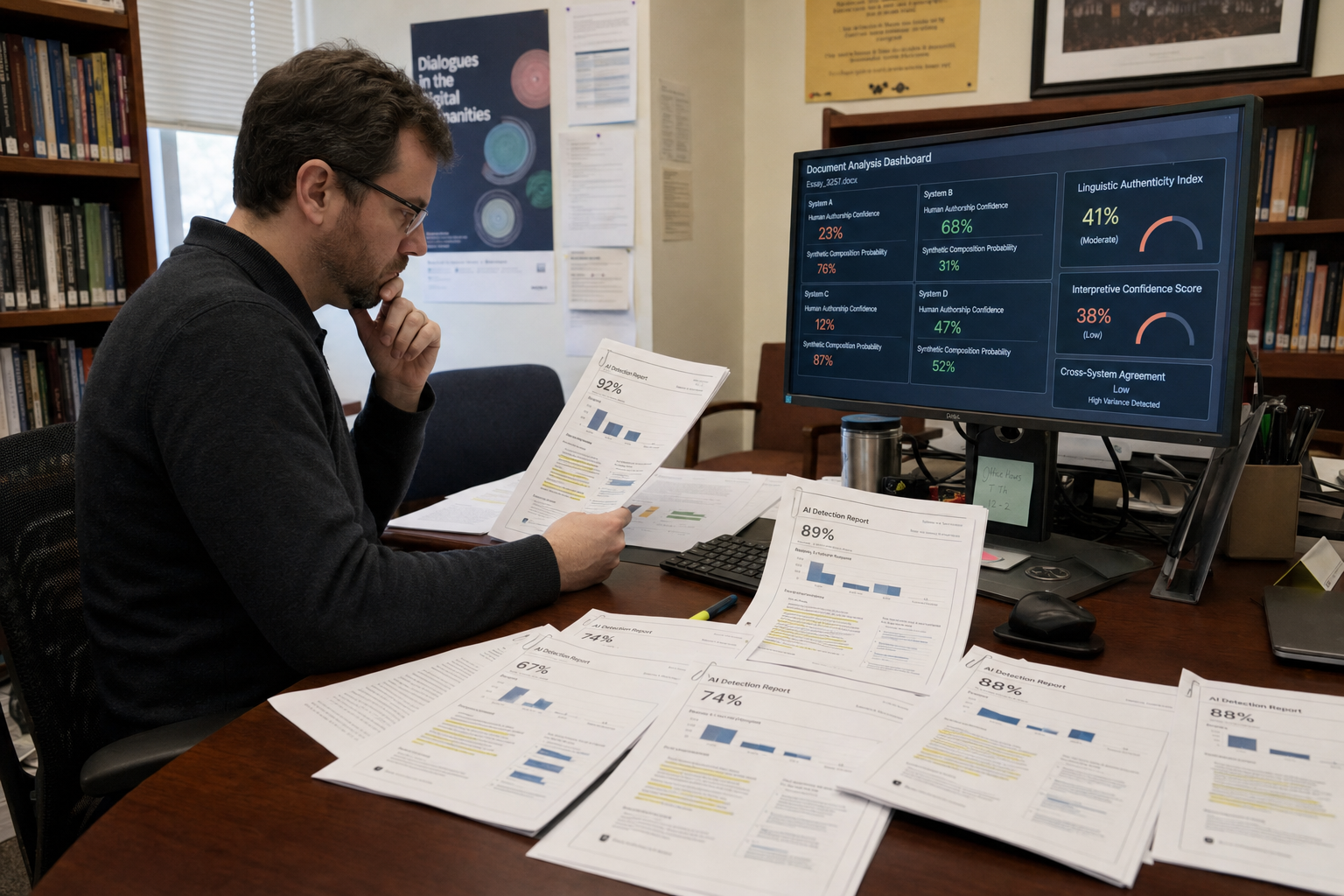
One system would classify a paper as 94% likely human-written, while another system simultaneously classified the same document as 89% likely AI-generated, with both vendors describing their outputs as “high confidence.”
In response, the National Council for Academic Integrity convened a technical working group to evaluate “classifier divergence thresholds.”
Early findings suggested that disagreement between models was not an error condition, but a normal feature of multi-model ecosystems operating under different training constraints.
"The expectation that independent analytical systems should produce identical conclusions presupposes a definition of authorship that itself remains insufficiently theorized within the contemporary computational discourse," explained Dr. Harold Venn.
"Consequently, what has been described as disagreement is perhaps more accurately understood as a plurality of algorithmically mediated interpretive positions whose statistical divergence reflects the ongoing negotiation of textual identity rather than any deficiency in the underlying models, whose apparently divergent outputs should be understood as complementary manifestations of distinct inferential architectures operating within overlapping but not identical statistical representations of textual authorship."
The explanation was later incorporated into the committee minutes without amendment.
Universities responded by requiring students to submit AI-detection reports from multiple vendors in addition to their assignments.
Several faculty members noted that grading now frequently involves reviewing a packet of documents longer than the original essay.
One professor described the process as “less like reading student work and more like auditing the history of its interpretation.”
Student Workflows Become Multi-System Optimization Loops
Students, in turn, have adapted their workflows to the evolving evaluation environment.
Rather than writing essays directly, many now begin by generating drafts with large language models, then passing those drafts through multiple “humanization layers,” followed by iterative detection testing to ensure acceptable classifier variance.
Some students reported maintaining spreadsheets tracking detector outputs across assignments.
"I aim for approximately 50 percent Human Authorship Confidence," said junior English literature major Laura Kim.
"The objective is not to convince the detector that a human wrote the paper. The objective is to avoid convincing it too enthusiastically."
“Below that and it looks too synthetic. Above that and it sounds like I tried too hard to sound human, which apparently also looks synthetic.”
Academic advisors reported an increase in students asking whether “writing quality” should be optimized for readability or detectability.
University writing centers have begun offering workshops titled “Composing Under Probabilistic Scrutiny.”
Vendor Ecosystem Expands Into Detection Evasion and Counter-Evasion
Software vendors have responded to demand by expanding product lines into adjacent markets.
AI detection firms now offer “interpretability dashboards,” “linguistic fingerprinting modules,” and “institutional trust scoring systems.”
Meanwhile, AI rewriting companies have introduced “adaptive humanization engines” that modify output based on known detection heuristics.
Several vendors now explicitly market toward both sides of the ecosystem.
One company brochure described its product suite as:
“Providing end-to-end narrative assurance across all stages of synthetic and semi-synthetic text production and evaluation.”
Procurement documents obtained by GFNN Investigative Unit show that some universities are now contracting with both detection and humanization vendors simultaneously, often without cross-referencing vendor methodologies.
A compliance officer at a midwestern university described the arrangement as “technologically diversified risk hedging.”
“It ensures we are not dependent on any single interpretation of textual authenticity,” the officer said.
“We are dependent on multiple interpretations that may or may not agree with each other.”
Interagency Task Force Establishes Unified Framework for AI Authorship Ambiguity
In response to escalating inconsistencies between AI detection systems, the Department of Sequential Approvals announced the formation of the Interagency Task Force on Synthetic Text Attribution and Interpretive Consistency.
The task force includes representatives from the Office of Customer Expectation Alignment, the Bureau of Predictable Outcomes, and the National Office of Temporary Guidance, each tasked with aligning “divergent but individually valid interpretations of textual origin metrics.”
A draft framework released Thursday proposes that no single system shall be considered definitive in determining whether a document is human, AI-generated, or “hybrid-authored with variable interpretive confidence.”
Instead, institutions are encouraged to adopt a multi-signal consensus model, in which authorship is determined by aggregating outputs from at least three incompatible detection systems and one human reviewer trained to reconcile disagreement patterns.
“This improves epistemic resilience,” said Dr. Elaine Mercer, lead contributor to the framework.
“It also ensures that no individual system becomes overly influential in defining what reality is in any given submission context.”
Universities Implement “Authorship Confidence Scores” as Administrative Standard
Several universities have already begun replacing binary AI detection labels with “Authorship Confidence Scores,” expressed as percentages across three competing categories:
- Human-origin likelihood
- AI-origin likelihood
- Ambiguous synthesis probability
Faculty guidance documents emphasize that none of these categories should be interpreted as mutually exclusive.
One internal memo from a large state university states:
“It is possible for a document to be simultaneously 72% human, 68% AI, and 91% indeterminate depending on the evaluation layer applied. This is expected behavior under current model plurality conditions.”
To reduce confusion, some institutions have introduced color-coded dashboards that visually represent contradictory confidence metrics without resolving them.
Student Submissions Begin Including AI Evaluation Appendices
By late semester, several instructors reported receiving student essays accompanied by supplemental documentation including:
- AI generation logs
- Humanization pass histories
- Detection system score comparisons
- Version trees of rewritten drafts
- Confidence normalization tables
One professor described a submission as:
“A perfectly standard five-page essay followed by 38 pages of metadata explaining why the essay might or might not exist in a stable authorship state.”
Student behavior has adapted accordingly.
“I don’t really submit essays anymore,” said senior economics major Daniel Ortiz.
“I submit the narrative evidence of an essay having emerged through multiple interpretive systems.”
Accreditation Bodies Begin Reviewing “Interpretive Integrity Compliance”
The Regional Academic Accreditation Consortium announced that it will begin evaluating universities not only on learning outcomes, but also on their “interpretive integrity compliance frameworks.”
These frameworks assess whether institutions maintain consistent procedures for handling contradictory AI detection outputs.
Accreditation reviewers will examine:
- Whether institutions document disagreement between detection systems
- Whether faculty receive adequate training in probabilistic authorship interpretation
- Whether students are informed that their writing exists within a multi-model interpretive ecosystem
A spokesperson for the consortium emphasized that this shift is necessary to preserve institutional credibility.
“We are no longer evaluating whether students can write,” the spokesperson said.
“We are evaluating whether institutions can consistently agree on what writing is.”
Closing Administrative Adjustment Ensures Continued Program Stability
At press time, the National Office of Temporary Guidance issued an update clarifying that all AI detection results should now be treated as “contextual advisory signals contributing to ongoing authorship interpretation workflows.”
The update further noted that any attempt to resolve contradictory system outputs into a single definitive conclusion should be considered “procedurally premature unless all interpretive pathways have been exhausted, including those not yet deployed.”
The Office added that a forthcoming guidance document—currently in draft form, peer review, and retrospective validation—will define what qualifies as “exhaustion of interpretive pathways” in measurable terms.
GFNN Technology Desk Correspondent: Marcus Eldridge
Click Here for more Genuine Fake News
Recent Articles


-
The Gentle Night Friends Series
Aug 23, 26 03:38 PM
 The Gentle Night Friends Series is a collection of SEL children's stories.
 -
Senator Replaced Himself With Android: Committee Investigates
Aug 10, 26 12:32 PM
 Senator replaced himself with an android characterized as a "Legislative Productivity Surrogate," prompting a Judiciary Committee inquiry into voting, representation, AI autonomy, and constitutional p…
 -
Congress Opens Investigation Into the Decline of Music Education
Aug 03, 26 02:18 PM
Congress Opens Investigation Into the Decline of Music Education after educators report unexpected changes in student learning, prompting federal hearings, academic reviews, and industry responses.