
Campaign Promises Now Required To Be Physically Possible
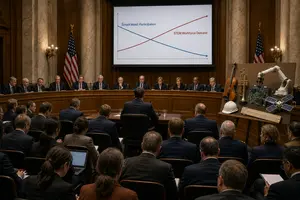
WASHINGTON, D.C. — In a move that has sent shockwaves through the political establishment, Congress has approved the Campaign Reality and Feasibility Act, requiring all future campaign promises to be physically possible.
The legislation was passed after a bipartisan commission spent three years studying whether candidates could continue making promises that violated the laws of economics, mathematics, engineering, gravity, and, in extreme cases, physicks.
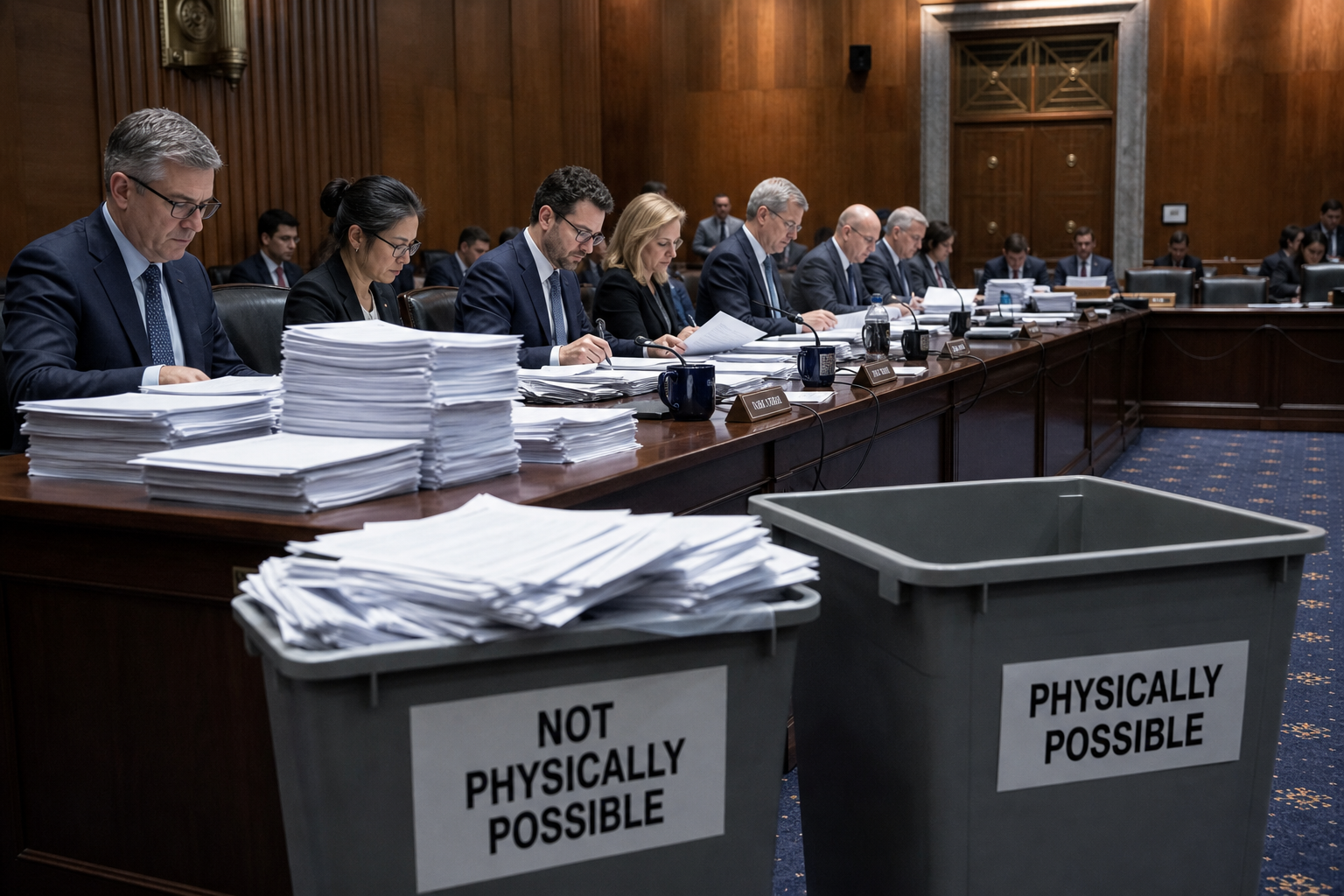
Under the new rules, candidates seeking public office must submit campaign promises to a panel of scientists, accountants, engineers, and at least one person who has successfully balanced a household budget.
Promises that fail basic reality testing will be rejected before appearing in campaign materials.
Supporters of the legislation argued that voters deserve to know whether proposed policies have any plausible connection to the powers actually granted to elected officials.
Among the first promises disqualified under the new standards were proposals to dramatically lower grocery prices, reduce housing costs, eliminate government debt, restore millions of manufacturing jobs, end foreign conflicts, cut taxes, increase government benefits, and improve every measurable economic indicator simultaneously.
Regulators concluded that while voters enjoyed hearing such promises, their successful implementation would require authority currently available only to fictional characters.
Several proposals were returned to candidates with a note explaining that while the goals were admirable, implementation would require the powers of a comic-book superhero, an absolute monarch, or a sufficiently motivated individual wearing a pointy hat and carrying a magic wand. Federal regulators noted that no currently serving elected officials met those qualifications.
The law has generated widespread concern among political consultants.
"This could fundamentally alter the candidate-voter relationship," said one strategist. "Traditionally, voters pretend to believe the promises and candidates pretend they can deliver them."
Several campaign managers warned that voter expectations could be dramatically altered.
"For generations, voters have enjoyed hearing ambitious promises that were never intended to survive contact with reality," one consultant explained. "Removing that tradition could fundamentally change the political process."
Economists estimate that nearly 87 percent of campaign literature may now need to be replaced with shorter statements such as:
"We will try our best."
"We have several ideas."
"This problem is more complicated than it appears."
"We would like things to improve."
Political scientists and speechwriters fear the new requirements could reduce speech lengths by as much as 90 percent.
One Congressional candidate reportedly spent four hours attempting to develop a fully realistic platform before eventually releasing a single-page document containing the words:
"Things are difficult."
"We will look into it."
"Thank you for your support."
Public reaction has been mixed.
Some voters welcomed the change, describing it as a refreshing return to honesty.
Others complained that realistic proposals lack the excitement traditionally associated with election season.
Meanwhile, television networks are scrambling to adapt. Analysts estimate that requiring factual feasibility could eliminate thousands of hours of campaign coverage annually.
At press time, lawmakers were already considering amendments that would allow promises to remain impossible, provided candidates include the following disclosure:
CAMPAIGN PROMISE DISCLOSURE STATEMENT
IMPORTANT NOTICE TO VOTERS
Federal law requires candidates to disclose that certain campaign promises may involve substantial uncertainty, unrealistic assumptions, and outcomes not achievable under current physical, economic, constitutional, mathematical, or metaphysical conditions.
Before relying upon any campaign promise, voters should carefully consider the following:
- Past performance does not guarantee future results.
- Desired outcomes may differ substantially from actual outcomes.
- Candidates may have limited control over inflation, grocery prices, housing costs, interest rates, international conflicts, commodity markets, weather patterns, consumer behavior, or objective reality.
- Promised benefits may require congressional approval, judicial approval, public cooperation, favorable economic conditions, technological breakthroughs, divine intervention, or all of the above.
- Timelines presented during campaign events are estimates only and may vary by several decades.
- Certain promises have been evaluated by independent experts and determined to require the powers of a comic-book superhero, an absolute monarch, or a sufficiently motivated individual wearing a pointy hat and carrying a magic wand.
- Claims that complex national problems can be solved quickly, easily, or at no cost should be viewed with appropriate skepticism.
- Candidates are not required to demonstrate that they possess the authority, resources, knowledge, experience, or supernatural abilities necessary to achieve stated objectives.
WARNING
Campaign promises may lead to unrealistic expectations, temporary optimism, confusion about governmental authority, and disappointment after Election Day.
In clinical testing, repeated exposure to campaign promises has been associated with frustration, cynicism, and periodic outbursts of fact-checking by nonconforming fomentors.
By continuing to listen to this candidate, you acknowledge that results may vary and that reality retains final approval authority.
For more meticulously curated, genuine fake news, click here.
Recent Articles


-
The Gentle Night Friends Series
Aug 23, 26 03:38 PM
 The Gentle Night Friends Series is a collection of SEL children's stories.
 -
Senator Replaced Himself With Android: Committee Investigates
Aug 10, 26 12:32 PM
 Senator replaced himself with an android characterized as a "Legislative Productivity Surrogate," prompting a Judiciary Committee inquiry into voting, representation, AI autonomy, and constitutional p…
 -
Congress Opens Investigation Into the Decline of Music Education
Aug 03, 26 02:18 PM
Congress Opens Investigation Into the Decline of Music Education after educators report unexpected changes in student learning, prompting federal hearings, academic reviews, and industry responses.