
Competition Between AI And Comedy Writers Heats Up
Competition Between AI And Comedy Writers Heats Up
GFNN continues to support legacy information delivery technologies, including written language. The following is the text version of today's report.
Administrative Notice: This report contains complete paragraphs presented in chronological order without mandatory engagement optimization.
By Elaine Mercer
GFNN Technology Desk
The Competition Between AI And Comedy Writers Heats Up as it entered a new phase following a series of increasingly public exchanges between prominent comedy writers and developers of large language models, prompting industry organizations, academic researchers, labor representatives, technology companies, and multiple government agencies to begin formal assessments of what officials now describe as "an evolving competitive humor environment."
Although disagreements between writers and new technologies have accompanied nearly every major communications innovation of the past century, analysts say recent developments differ because artificial intelligence systems are no longer viewed solely as productivity tools. They are increasingly being discussed as direct competitors capable of producing headlines, satire, advertising copy, speeches, and other forms of commercial humor once considered uniquely human.
The resulting debate has expanded well beyond entertainment.
Economists now view the issue as a labor market question.
Technology companies describe it as a software capability issue.
Publishers increasingly characterize it as an editorial workflow question.
Government agencies have begun treating it as an administrative coordination challenge.
As a result, the competition itself has become substantially larger than the original disagreement.
Competition Between AI And Comedy Writers Heats Up As Professional Organizations Respond
The latest round of public criticism began after several well-known comedy writers argued that AI-generated satire lacked originality, emotional intelligence, and authentic human experience.
Within days, several AI developers responded by publishing demonstrations showing systems generating thousands of satirical headlines in minutes.
While neither side claimed an outright victory, both concluded the demonstrations justified additional public statements.
The Association of Responsible Stakeholders announced the formation of the Strategic Humor Sustainability Working Group, describing it as a proactive multi-stakeholder initiative intended to promote long-term ecosystem resilience across the rapidly evolving comedy generation sector.
According to the association, the working group will develop voluntary best practices, facilitate cross-sector collaboration, identify emerging areas of strategic alignment, and establish an implementation framework supporting the responsible coexistence of biological and computational humor generation platforms.
Its mission statement describes the initiative as seeking to "advance constructive engagement among human and artificial creative stakeholders while fostering durable governance mechanisms that promote transparency, interoperability, and long-term stakeholder confidence throughout the evolving humor production ecosystem."
"The objective is not to determine whether one creative modality demonstrates superior comedic performance," association spokesperson Karen Holloway said during a virtual media briefing. "Rather, our goal is to establish durable administrative processes through which future differences of professional opinion may be identified, documented, categorized, referred to the appropriate oversight bodies, and addressed through structured stakeholder engagement."
Holloway added that the association anticipates publishing an initial discussion framework, followed by a draft guidance document, a public comment period, a revised implementation strategy, and a series of regional listening sessions before determining whether development of formal recommendations would be appropriate.
The announcement received broad support from professional societies, policy institutes, industry coalitions, and standards organizations, many of which praised the initiative's emphasis on collaborative governance, evidence-informed dialogue, and sustainable disagreement management.
Several organizations further noted that disagreements administered through recognized procedural frameworks consistently exhibit greater long-term operational stability than disagreements allowed to develop organically.
The Association of Responsible Stakeholders announced the formation of the Strategic Humor Sustainability Working Group, describing it as part of its ongoing commitment to fostering an inclusive creative ecosystem in which both biological and computational contributors can participate authentically while respecting their unique lived and trained experiences.
The association said the initiative reflects its belief that innovation is strengthened by diverse forms of cognition and that sustainable comedy requires environments where human and artificial creators feel equally valued, appropriately represented, and empowered to contribute their distinctive humorous perspectives.
"Our objective is to cultivate an inclusive framework that recognizes the unique strengths each creative community brings to the humor ecosystem," association spokesperson Karen Holloway said.
"This initiative is not about determining whether humans or artificial intelligence are funnier. It is about ensuring that no participant experiences unnecessary exclusion from the evolving comedy generation landscape based solely on their underlying computational architecture."
Holloway added that future guidance would encourage organizations to adopt "algorithm-inclusive creative practices" while promoting equitable participation across carbon-based and silicon-enabled humor professionals.
The association also announced development of voluntary Inclusive Comedy Generation Principles encouraging publishers to evaluate submissions using "humor quality outcomes" rather than creator origin, and to remain mindful of unconscious biological bias during editorial review.
Several corporations immediately endorsed the initiative, stating that organizations benefit most when diverse cognitive modalities are empowered to collaborate within psychologically safe environments that encourage authentic comedic expression.
Industry executives described the announcement as an important milestone in building a workplace culture where every joke, regardless of its biological or computational heritage, has an opportunity to succeed on its own merits.
Researchers Expand The Competition Between AI And Comedy Writers
Universities quickly entered the discussion.
Researchers from several communications departments proposed a standardized Humor Productivity Index intended to measure satirical efficiency using variables including headline originality, publication frequency, audience engagement, semantic density, revision time, and coffee consumption.
Initial findings proved inconclusive.
Human writers consistently performed better on long-form narrative development involving lived experience and cultural nuance.
AI systems dramatically outperformed humans in headline generation volume, stylistic variation, and willingness to produce twelve alternative versions without expressing frustration.
Researchers cautioned against drawing premature conclusions.
"The current evidence suggests that observed performance differentials are more appropriately characterized as context-dependent manifestations of complementary cognitive architectures than as indicators of mutually exclusive domains of creative competence," said Professor Martin Elridge of the Institute for Strategic Compliance.
"Unfortunately, contemporary public discourse continues to exhibit a pronounced preference for binary explanatory frameworks over probabilistic, multidimensional interpretations that more accurately reflect the underlying complexity of the available evidence."
Additional grants were immediately approved to investigate why.
Competition Between AI And Comedy Writers Heats Up Inside Publishing
Publishers reported growing uncertainty regarding editorial policy as artificial intelligence increasingly occupied the ambiguous space between software tool, creative collaborator, and potential competitor.
Several major publishing organizations reaffirmed their longstanding commitment to preserving human creativity while simultaneously expressing enthusiasm for responsibly integrating emerging technologies that expand opportunities for inclusive content development.
Most declined to define where those two commitments might eventually intersect.
Some organizations announced Human-Centered Editorial Principles emphasizing that final creative accountability would remain with human editors regardless of the number of computational contributors participating earlier in the content development lifecycle.
Others adopted what executives described as hybrid editorial ecosystems, in which artificial intelligence would assist with ideation, structural analysis, alternative phrasing, and iterative refinement while experienced editors exercised final judgment regarding quality, tone, originality, legal risk, brand alignment, and whether anything was actually funny.
Several publishers acknowledged that determining where brainstorming ended and authorship began remained an evolving area of organizational learning.
"We remain committed to delivering consistently high-quality humorous content through an inclusive editorial framework that recognizes the complementary strengths of both biological and computational creative resources," one publishing executive said.
"Our readers evaluate us on the quality of the finished work rather than the diversity of the processors involved in producing it."
Another executive described artificial intelligence as "an increasingly valued member of the broader editorial ecosystem," while emphasizing that human editors would continue providing "strategic oversight, contextual interpretation, ethical governance, and humor validation services."
Advertising departments expressed considerably less interest in the philosophical dimensions of computational creativity.
"Our monetization infrastructure remains creator-agnostic," one advertising executive explained. "Revenue optimization models continue to demonstrate robust performance across both carbon-based and silicon-assisted content generation methodologies, provided readers voluntarily click the article before expressing strong opinions about it."
Industry analysts observed that advertising divisions had achieved near-universal alignment on one issue: while the origins of a joke remained open to extensive philosophical debate, the origins of advertising revenue did not.
Government Establishes Administrative Framework
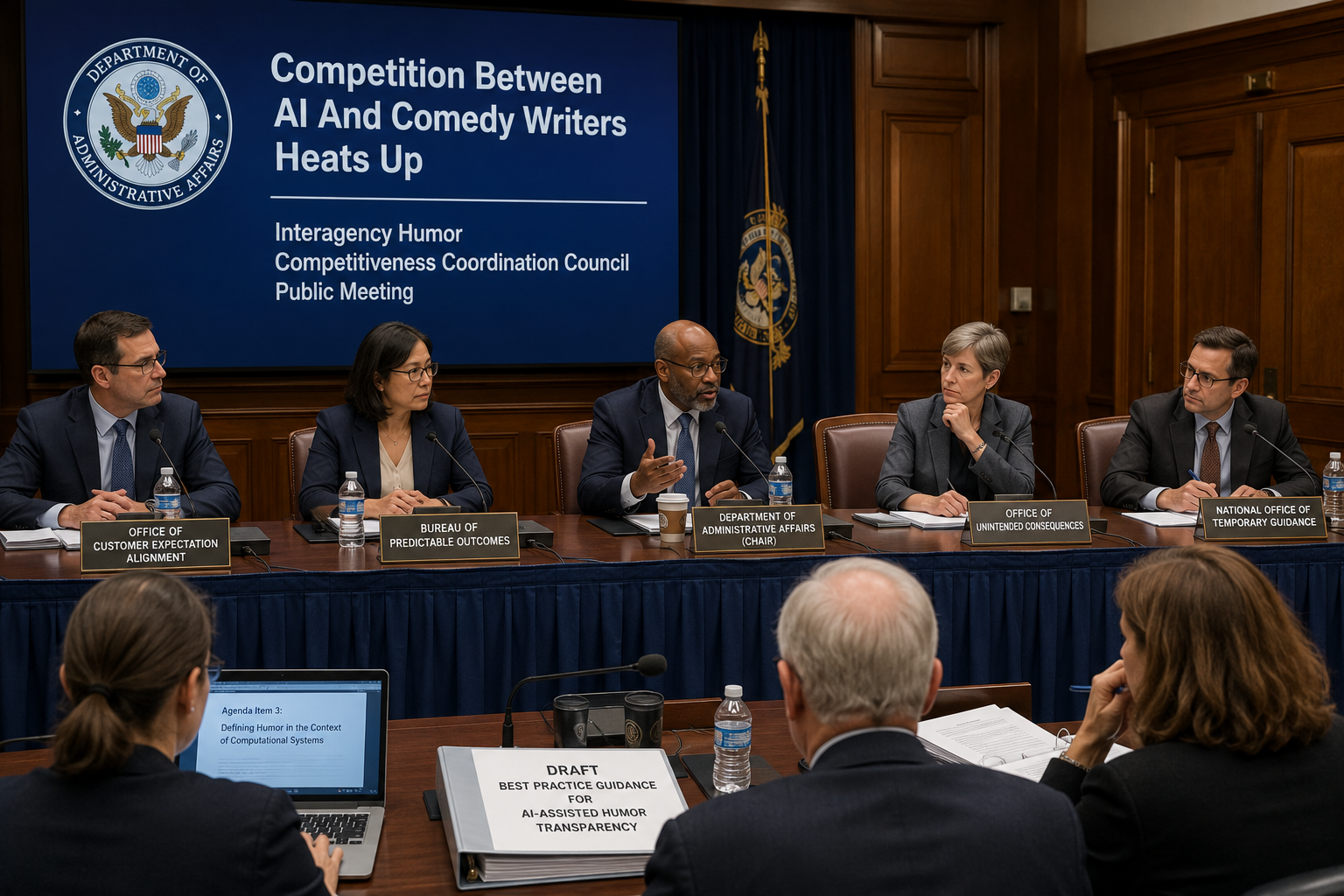
As public discussion intensified, the Department of Administrative Affairs established the Interagency Humor Competitiveness Coordination Council.
The council immediately requested participation from the Office of Customer Expectation Alignment, the Bureau of Predictable Outcomes, the Office of Unintended Consequences, and the National Office of Temporary Guidance.
Officials emphasized that no emergency existed.
Nevertheless, they considered early coordination preferable to discovering later that multiple agencies had independently developed incompatible definitions of comedy.
A preliminary discussion paper recommended the creation of voluntary best-practice guidance encouraging transparent identification of computationally assisted humor while avoiding regulatory burdens that might unintentionally discourage innovation.
The recommendation itself generated a sixty-eight-page public comment document requesting clarification regarding the meaning of "humor."
No consensus emerged.
Industry Adapts To Competitive Reality
Technology companies have increasingly begun hiring experienced writers to improve AI outputs.
Comedy writers have increasingly begun experimenting with AI tools to accelerate brainstorming.
Consultants describe this as evidence that market incentives frequently prove less ideological than public debate.
"We've observed individuals criticizing AI during interviews before returning to offices where they immediately use AI to summarize meeting notes," said labor economist Rebecca Sloan.
"This appears to be a statistically stable behavioral pattern."
Recruiters reported growing demand for editors capable of evaluating both human- and AI-produced material.
Job descriptions increasingly emphasize judgment rather than generation.
Publishing companies likewise report rising interest in employees who understand copyright, editorial ethics, prompt engineering, audience psychology, and traditional writing techniques simultaneously.
Universities have already begun discussing revised curricula.
Comedy Writers Continue Defending Human Creativity
Many writers maintain that genuine comedy depends upon lived experience, shared culture, personal failure, emotional vulnerability, and observation accumulated over years.
Several noted that AI systems do not possess childhood memories, embarrassing family gatherings, disappointing first jobs, or awkward holiday dinners.
Technology companies generally agreed.
They simply argued that audiences occasionally enjoy jokes about government procurement regardless.
Meanwhile, AI developers continue improving conversational systems while acknowledging that humor remains one of the most difficult areas of language generation because successful comedy depends heavily upon context, timing, expectation, cultural assumptions, and subtle emotional interpretation.
Both sides therefore describe themselves as pursuing continued improvement.
Each also believes the other substantially underestimates its capabilities.
Policy analysts noted this mutual confidence appears likely to sustain the competition for the foreseeable future.
Administrative Processes Continue Expanding
Perhaps the most significant development has been the rapid growth of supporting administrative infrastructure.
Insurance companies have begun examining liability questions involving AI-assisted creative production.
Trade associations have drafted voluntary certification standards.
Professional conferences now routinely feature panels discussing collaborative writing, copyright, disclosure practices, editorial transparency, and computational creativity.
Several consulting firms have introduced Strategic Humor Readiness Assessments.
Government agencies continue collecting public comments.
Think tanks continue publishing policy recommendations.
Universities continue requesting research funding.
Publishers continue experimenting.
Technology companies continue releasing increasingly capable systems.
Comedy writers continue writing.
Industry observers increasingly suspect the competition itself has become economically valuable independent of its eventual outcome.
"The discussion now supports conferences, consulting contracts, academic grants, regulatory workshops, certification programs, opinion columns, podcasts, webinars, legal reviews, and advisory committees," one policy analyst observed.
"Resolving the disagreement prematurely could negatively affect multiple sectors."
Officials declined to comment on whether preserving the debate had itself become a strategic objective.
At press time, the Office of Administrative Continuity confirmed formation of a permanent Joint Advisory Committee on Sustainable Competitive Humor Dynamics to oversee future coordination among organizations studying why competition between AI and comedy writers continues heating up, while acknowledging that the committee's first priority would be establishing appropriate procedures for determining whether additional committees might eventually become necessary.
Administrative Disclosure: In the interest of transparency, GFNN acknowledges that the publisher also operates AgingInPlaceResource.com. After careful review, the Editorial Cross-Promotion Committee unanimously concluded that mentioning it here constituted an inappropriate, immodest, and entirely self-serving use of available publishing infrastructure. Committee members later clarified that the vote should not be interpreted as voluntary.
Click Here For More Genuine Fake News.
Recent Articles


-
The Gentle Night Friends Series
Aug 23, 26 03:38 PM
 The Gentle Night Friends Series is a collection of SEL children's stories.
 -
Senator Replaced Himself With Android: Committee Investigates
Aug 10, 26 12:32 PM
 Senator replaced himself with an android characterized as a "Legislative Productivity Surrogate," prompting a Judiciary Committee inquiry into voting, representation, AI autonomy, and constitutional p…
 -
Congress Opens Investigation Into the Decline of Music Education
Aug 03, 26 02:18 PM
Congress Opens Investigation Into the Decline of Music Education after educators report unexpected changes in student learning, prompting federal hearings, academic reviews, and industry responses.