
Congress Holds Hearing On Masturbation And Public Health
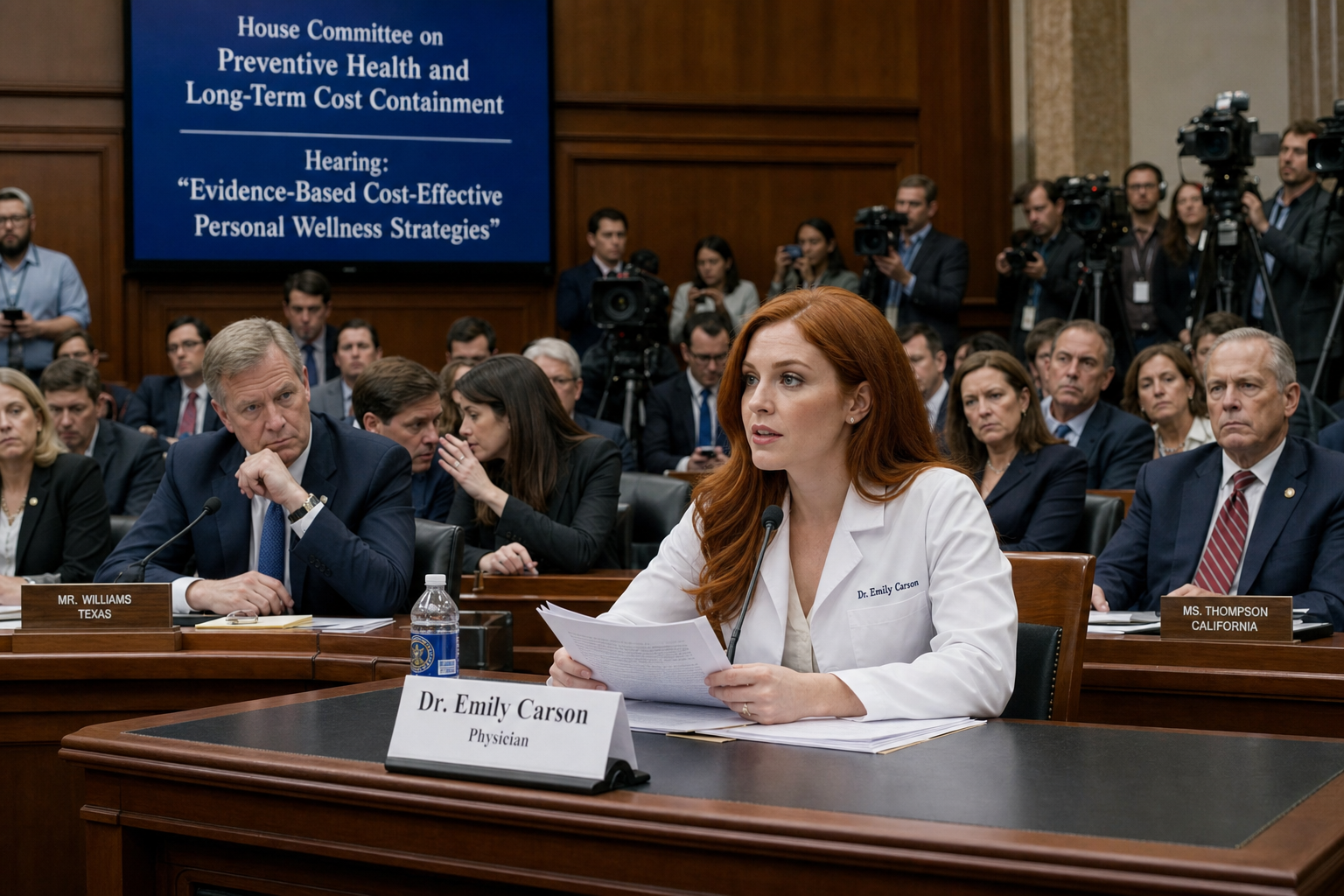
Congress Holds Hearing On Masturbation And Public Health as lawmakers, physicians, attorneys, and advocacy groups debate a proposed federal wellness initiative.
GFNN continues to support legacy information delivery technologies, including written language. The following is the text version of today's report.
Reader Advisory: This report has been certified compatible with uninterrupted independent thought.
By Sarah Collins
GFNN Washington Bureau
WASHINGTON, D.C. — A routine review of preventive health initiatives unexpectedly expanded into a full congressional hearing Tuesday after a bipartisan staff report concluded that one of the nation's least expensive health practices had received comparatively little attention within federal wellness policy.
The report, prepared for the House Committee on Preventive Health and Long-Term Cost Containment, did not recommend any specific legislation. Instead, it suggested that Congress determine whether existing public health guidance adequately reflected current scientific literature regarding masturbation and whether federal agencies should provide educational information comparable to guidance already published on nutrition, exercise, sleep, hydration, and stress reduction.
Committee Chairwoman Eleanor Matthews opened the hearing by emphasizing that the purpose of the proceedings was "to determine whether an entirely legal, private, cost-free human behavior with documented health benefits has been overlooked simply because elected officials have found the subject professionally uncomfortable."
The hearing quickly attracted standing-room-only attendance.
Several lawmakers acknowledged privately that staff members had advised against scheduling the hearing during an election year. Others argued that delaying discussion would merely reinforce the perception that government agencies routinely avoided subjects capable of producing awkward television interviews.
Karen Whitmore, Deputy Undersecretary for the Department of Administrative Affairs, testified that the department had no formal position on masturbation itself.
"Our responsibility is limited to administrative coordination," Whitmore said. "However, multiple agencies have independently noted that preventive health guidance occasionally develops unevenly when certain topics receive less institutional attention than others. This hearing represents an opportunity to determine whether existing federal wellness communications remain aligned with available scientific evidence and established public health objectives."
Whitmore stressed repeatedly that no agency had proposed creating a federal program.
"The current discussion concerns educational consistency rather than behavioral regulation."
Her clarification appeared to satisfy almost no one.
One committee member immediately asked whether "educational consistency" would eventually require federally funded brochures.
Another wondered whether the Centers for Disease Control and Prevention might eventually publish recommended frequencies by age group.
Whitmore responded that neither proposal had been discussed.
"Not formally," she added.
The qualification prompted several members to request copies of all preliminary interagency correspondence concerning what one representative described as "the not-formally-discussed discussions."
The committee voted unanimously to subpoena the documents.
Congress Holds Hearing On Masturbation And Public Health After Medical Review
The committee's first medical witness was Dr. Emily Carson, Professor of Preventive Medicine at Jefferson Medical Center.
Dr. Carson testified that masturbation had long been recognized as a normal component of human sexuality and that decades of research had examined its physiological, psychological, and behavioral effects.
"The scientific literature is both extensive and multidisciplinary," Carson said. "Researchers in preventive medicine, sexual medicine, psychology, endocrinology, urology, gynecology, neuroscience, and public health have all contributed to our understanding of this subject."
She explained that the medical literature consistently supports a number of benefits associated with masturbation and orgasm, including temporary reductions in stress and anxiety, improved mood, relaxation, improved sleep, relief of sexual tension, increased sexual self-awareness, improved sexual confidence, healthy sexual functioning, greater sexual satisfaction, relief of some menstrual discomfort, temporary relief of certain pain conditions, including some headaches, pelvic floor muscle activity, and important hormonal responses involving dopamine, oxytocin, endorphins, and prolactin.
Dr. Carson added that masturbation also provides a safe form of sexual expression without the risk of pregnancy and, when practiced alone, without the risk of sexually transmitted infections.
She told the committee that researchers continue to investigate additional areas including prostate health, cardiovascular health, immune system responses, healthy aging, emotional resilience, relationship well-being, body image, cognitive health, quality of life, and other long-term health outcomes.
"These investigations are being conducted by serious researchers at respected medical institutions," Carson said. "As with most areas of preventive medicine, some findings are supported by decades of evidence, while others continue to be clarified through ongoing clinical and epidemiological research."
"The committee should distinguish between well-established findings and areas where the evidence continues to develop," Carson concluded. "Both deserve careful consideration."
Representative William Hodge thanked the physician before asking whether Congress had unintentionally neglected "one of the lowest-cost preventive health interventions presently available to the American public."
Dr. Carson considered the question.
"I believe my testimony speaks for itself."
Hodge nodded thoughtfully.
"That is going to make Budget Committee hearings very interesting."
Several committee members immediately requested that the Congressional Research Service prepare an estimate comparing annual federal spending on preventive health campaigns with the estimated annual national expenditure associated with masturbation.
Staff members quietly informed the committee that preliminary cost estimates were expected to remain unusually low.
The observation produced several moments of silence before members resumed questioning.
Committee analysts later acknowledged that they were struggling to identify industries likely to oppose an intervention requiring neither prescription medication, durable medical equipment, recurring insurance reimbursement, nor federal infrastructure spending.
By late afternoon, economists representing the Center for Regulatory Excellence suggested that the absence of significant commercial stakeholders might itself represent "an underexamined market anomaly deserving further economic analysis."
The committee voted unanimously to schedule additional testimony.
Social Conservatives Warn Of Long-Term Cultural Consequences
The committee's second panel featured representatives from religious organizations, family policy institutes, and civic advocacy groups, all of whom agreed that the proposal raised concerns extending well beyond medicine.
Reverend Dr. Thomas Elfinheimer, president of the National Council for Moral Responsibility, told lawmakers that the question before Congress was not whether masturbation occurred but whether government should actively encourage it.
"We acknowledge that private citizens make private decisions," Elfinheimer testified. "The constitutional question before this committee is whether a federal wellness campaign should redefine personal morality as a matter of public administration."
Elfinheimer stressed that his organization was not requesting criminal penalties or regulatory restrictions.
"We simply question whether every statistically measurable behavior automatically becomes an appropriate subject for federal encouragement."
Several members nodded.
Others requested clarification regarding the distinction between "encouragement," "education," and "government neutrality."
The distinction soon occupied nearly forty minutes.
Dr. Melissa Harmon, Senior Systems Analyst at the Institute for Strategic Compliance, observed that federal agencies routinely publish educational guidance concerning nutrition, exercise, hydration, smoking cessation, alcohol consumption, sunscreen use, vaccination, sleep hygiene, stress reduction, and safe sexual practices.
"The administrative difficulty," Harmon explained, "lies in determining the threshold at which educational omission itself becomes a policy decision."
She emphasized that agencies frequently review wellness recommendations to ensure consistency across subject areas.
"If measurable health outcomes justify educational materials in one domain," Harmon said, "the absence of similar guidance elsewhere requires an equally evidence-based explanation."
The committee immediately requested a cross-agency inventory of every federally endorsed wellness recommendation published during the previous twenty years.
Officials estimated completion of the inventory would require approximately eighteen months
Mental Health Professionals Introduce Additional Variables
Psychologists and psychiatrists proved considerably less decisive.
Dr. Laura Simmons, President of the American Association of Clinical Sexual Health Professionals, cautioned lawmakers against reducing masturbation to either a moral issue or a universal medical recommendation.
"For most individuals, masturbation represents a normal expression of human sexuality," Simmons testified. "It may reduce stress, improve mood, enhance self-awareness, and provide therapeutic benefit in certain clinical settings. However, like virtually every human behavior, context matters."
Representative Andrew Collins asked whether that meant the committee should recommend it.
"It means recommendations should remain individualized."
Collins frowned.
"So that's a maybe?"
"It is a clinical assessment."
Committee counsel requested clarification.
After twenty-seven minutes of testimony, staff attorneys concluded that the word "appropriate" had acquired at least fourteen distinct operational definitions depending upon whether the speaker represented psychology, psychiatry, public health, theology, ethics, education, or family policy.
The Department of Administrative Affairs quietly announced formation of an Interdisciplinary Terminology Harmonization Working Group.
Its first assignment would be developing standardized federal definitions for "appropriate," "recommended," "optional," "private," "educational," and "personal."
Officials estimated the preliminary glossary would exceed 300 pages.
Constitutional Attorneys Debate Federal Authority
If physicians disagreed about evidence, constitutional attorneys disagreed about jurisdiction.
Professor Charles Donovan of the National University of Administrative Sciences argued that Congress possessed broad authority to fund educational programs promoting public health.
"The federal government routinely educates citizens regarding lawful personal behavior," Donovan testified. "Diet, exercise, smoking cessation, preventive screening, vaccination, alcohol moderation, and injury prevention all involve voluntary private conduct."
Across the witness table, constitutional attorney Rebecca Sloan offered a different interpretation.
"The Constitution creates a federal government of limited and enumerated powers," Sloan said. "Even assuming measurable health benefits, Congress should exercise considerable restraint before encouraging intimate private conduct through national campaigns."
Representative Harold Benson asked whether simply publishing educational information would violate the Constitution.
Sloan replied carefully.
"I believe the constitutional analysis depends less upon publication itself than upon the scope, purpose, funding mechanism, and administrative implementation."
Committee members immediately requested an administrative implementation analysis.
Three additional legal scholars suggested the analysis should be reviewed by an independent constitutional oversight panel before publication.
The Congressional Budget Office estimated that determining whether Congress possessed authority to publish educational information might ultimately require a larger appropriation than producing the educational information itself.
Nobody appeared surprised.
Consultants Recommend A Comprehensive Transformation Roadmap
The afternoon hearing took an unexpected turn when Strategic Alignment Partners unveiled what it described as a "National Personal Wellness Integration Framework."
Lead consultant Bradley Mercer congratulated Congress for recognizing "an opportunity to modernize preventive wellness delivery through evidence-informed stakeholder alignment."
Mercer displayed a forty-three-slide presentation containing six implementation phases, four governance tiers, twelve stakeholder engagement pathways, and eighty-seven key performance indicators.
"Our analysis indicates the absence of an integrated strategic architecture," Mercer explained. "Before discussing educational materials, federal agencies should establish an Enterprise Wellness Transformation Office capable of coordinating cross-functional implementation while maintaining adaptive operational resilience."
Representative Linda Perez asked how long such an assessment would require.
"Phase One would require approximately eighteen months."
"And Phase Two?"
"Approximately twenty-four months."
"When would citizens receive the educational brochure?"
Mercer consulted his timeline.
"Under the accelerated implementation scenario, late in Phase Four."
"How many phases are there?"
"Currently six."
A second consulting firm, Institutional Transformation Group, testified that while Strategic Alignment Partners had produced "valuable foundational thinking," a successful initiative would also require a Comprehensive Stakeholder Alignment Roadmap, an Executive Governance Framework, regional pilot programs, performance dashboards, quarterly optimization reviews, and an independent Continuous Improvement Office to evaluate the governance framework itself.
Neither firm recommended reducing the scope of the project.
By adjournment, committee staff had identified fourteen newly proposed advisory bodies, nine interagency working groups, five technical review panels, three public listening tours, two implementation offices, and one Strategic Framework Validation Council.
The original question—whether federal wellness guidance should briefly mention masturbation alongside other legal health practices—was rescheduled for discussion at the committee's next hearing.
Economists Discover An Unexpected Market Failure
When the hearing reconvened the following morning, economists testified that the proposal had revealed what they described as an unusually efficient healthcare intervention.
Dr. Alan Prescott, Senior Economist at the Center for Regulatory Excellence, cautioned lawmakers against drawing sweeping conclusions while acknowledging that the committee had identified an uncommon incentive structure.
"Most preventive health interventions require sustained consumer expenditures," Prescott testified. "This one does not. From a purely economic perspective, that creates an interesting policy question."
Prescott emphasized that his remarks should not be interpreted as a recommendation.
"Our responsibility is to evaluate incentives, not prescribe behavior."
Representative Margaret Lewis asked whether the proposal represented the lowest-cost preventive health initiative ever reviewed by Congress.
Prescott replied cautiously.
"It is certainly among the least capital-intensive."
Several members requested clarification.
Prescott explained that the intervention generally required no federal construction projects, procurement contracts, manufacturing subsidies, pharmaceutical development, transportation infrastructure, or reimbursement mechanisms.
"This represents what economists would describe as an unusually self-contained delivery model."
Within minutes, the Congressional Budget Office was directed to prepare a ten-year fiscal impact projection comparing hypothetical reductions in stress-related healthcare expenditures against the administrative costs of studying whether such reductions might eventually occur.
The preliminary estimate concluded that studying the proposal would almost certainly cost substantially more than the proposal itself.
No amendments were offered.
Agencies Begin Coordinating A National Response
By the third day, the hearing had expanded well beyond the jurisdiction of the House Committee on Preventive Health.
The Department of Administrative Affairs announced the creation of an Interagency Committee on Personal Wellness Communication.
The Office of Administrative Continuity agreed to coordinate historical guidance issued by more than thirty federal agencies.
The Office of Customer Expectation Alignment opened a public comment period seeking input regarding citizen expectations for "government communication concerning entirely private legal activities."
The National Office of Temporary Guidance released a forty-eight-page discussion draft explaining that the document did not constitute guidance, should not be interpreted as guidance, and existed solely to assist future discussions concerning possible guidance.
The Department of Sequential Approvals confirmed that before any educational material could be published, the proposal would require sequential review by scientific advisors, legal counsel, communications specialists, accessibility coordinators, ethics consultants, procurement officials, records managers, privacy officers, translation specialists, and the newly established Plain Language Clarification Task Force.
The Department estimated that the approval pathway itself would likely become a model for future interagency cooperation.
Dr. Melissa Harmon praised the announcement.
"This represents meaningful progress toward procedural consistency while preserving sufficient administrative flexibility to accommodate future governance evolution."
No one asked what that meant.
Academics And Theoretical Theosophists Expand The Scope Of The Hearing
As the hearing entered its third day, committee staff expressed optimism that the remaining testimony would clarify the scientific record.
Instead, the scope of the hearing expanded once again.
Westbridge University announced the formation of the Center for the Study of Personal Wellness Narratives.
The National University of Administrative Sciences proposed a five-year interdisciplinary research consortium examining "the intersection of public administration, behavioral health communication, constitutional governance, and institutional discomfort."
Professor Adrian Keller, Chair of Comparative Epistemology at Westbridge University, argued that the committee's approach had become unnecessarily narrow.
"While the biomedical testimony has been thorough," Keller said, "the committee has largely confined itself to contemporary clinical paradigms. That framework is appropriate for physicians, but it excludes historical, anthropological, philosophical, religious, and cross-cultural understandings that have shaped human interpretations of sexuality for thousands of years."
Representative Lewis asked whether Congress should endorse those traditions.
Keller smiled politely.
"Recognition and endorsement are distinct administrative categories. The literature remains divided."
The committee then heard testimony from Dr. Sebastian Ellsworth, Senior Fellow of the International Union of Theoretical Theosophists.
"The Union enthusiastically embraces non-consensus," Ellsworth began. "That should not be interpreted as hostility toward consensus. Consensus simply arrives after we have become interested in something else."
Ellsworth commended the committee's careful review of biomedical evidence before suggesting that a genuinely comprehensive public record should acknowledge that numerous civilizations regarded sexual energy as having psychological, philosophical, or spiritual significance.
"Whether modern clinical science ultimately validates those traditions is an entirely separate question," he testified. "Our concern is that several thousand years of human thought not be excluded merely because it has proven administratively inconvenient."
Ellsworth noted that various schools of Tantra, Taoist internal cultivation, and several traditions within Western esotericism had long regarded sexual energy as something extending beyond conventional physiology.
"We ask neither belief nor endorsement," he concluded. "Only accurate historical representation."
The testimony immediately broadened the discussion.
After Ellsworth concluded his testimony, constitutional attorneys from the American Civil Liberties Union argued that any federally sponsored educational materials should employ language that was inclusive of Americans holding diverse medical, religious, philosophical, and cultural perspectives.
"The government's role," one attorney testified, "is not to prescribe a preferred worldview but to communicate accurate information in a manner that neither privileges nor marginalizes constitutionally protected beliefs or lawful private conduct."
The organization recommended that educational materials distinguish between scientific findings, historical traditions, religious beliefs, cultural practices, and individual choices while avoiding language that could reasonably be interpreted as governmental endorsement of any particular philosophical framework.
Committee members immediately requested clarification regarding the meaning of "inclusive."
The attorney replied that inclusivity should not be understood as agreement, validation, endorsement, or equivalence, but rather as the avoidance of unnecessary governmental preference among competing lawful viewpoints.
Representative Lewis asked whether that clarification itself should appear in the educational materials.
The attorney responded that the organization would be willing to assist the Department of Administrative Affairs in drafting appropriately neutral explanatory language.
Within thirty minutes, the Department announced the formation of an Inclusive Wellness Communications Advisory Committee, charged with coordinating recommendations from physicians, constitutional scholars, anthropologists, historians of religion, behavioral scientists, and representatives of the International Union of Theoretical Theosophists.
An anthropologist then testified that excluding longstanding cultural traditions would privilege modern Western biomedical narratives over documented historical perspectives.
A historian of religion cautioned that acknowledging the existence of spiritual traditions should not be confused with recommending them.
Committee counsel immediately raised concerns that discussing religious traditions in federally sponsored educational materials could invite Establishment Clause challenges.
Professor Keller responded that categorically excluding metaphysical frameworks could itself be interpreted as privileging philosophical materialism while presenting it as administrative neutrality.
The Department of Administrative Affairs announced the formation of an Interdisciplinary Advisory Panel on Historical and Contemporary Wellness Narratives to determine whether future educational materials should distinguish among scientific evidence, historical tradition, philosophical interpretation, and metaphysical speculation.
Consultants from Strategic Alignment Partners welcomed the development and recommended creation of a Multi-Paradigm Wellness Communications Framework to ensure that all recognized explanatory models could be incorporated through a standardized governance process.
A computer scientist from Jefferson Institute of Technology then proposed using artificial intelligence to classify testimony into objectively measurable epistemological categories.
The demonstration determined that every witness had answered a different question.
The committee unanimously agreed that this accurately summarized the hearing.
Reactions From Spectators Were Mixed
"I brought my eighth-grade civics class to watch Congress in action," said Linda Matthews, a middle school teacher from Virginia. "I expected to explain how laws are made. Instead, I had to explain why Congress was discussing federal masturbation guidelines."
A mother visiting the Capitol with her two children appeared less concerned about the subject than the process.
"Children eventually ask about sex," she said. "I just didn't expect Congress to be the one bringing it up."
Another spectator expressed admiration for the hearing's thoroughness.
"I came to watch representative government," he said. "Instead I watched consultants explain why a brochure requires a governance framework. Honestly, that felt more educational."
Capitol tour guides reported an unusually high number of visitors asking whether Hearing Room 214 was the location of the masturbation hearing.
One guide replied that Congress was officially conducting hearings on Evidence-Based Cost-Effective Personal Wellness Strategies.
Visitors said they preferred the first description.
At Press Time
At press time, Congress had not voted on whether federal wellness materials should mention masturbation.
However, lawmakers had unanimously approved funding for an Independent Commission on Evidence-Based Personal Wellness Communication, a Federal Advisory Committee on Terminological Consistency, a National Stakeholder Listening Initiative, two longitudinal economic forecasting studies, three constitutional white papers, a consultant-led Operational Readiness Assessment, and a multi-agency pilot program to develop a governance framework for evaluating future educational frameworks.
The committee also directed the Department of Administrative Affairs to determine whether the Independent Commission on Evidence-Based Personal Wellness Communication required a permanent Office of Commission Coordination to ensure uninterrupted oversight of the commission's future recommendations.
By Sarah Collins
GFNN Washington Bureau
For more meticulously curated Genuine Fake News, click here.
Recent Articles


-
The Gentle Night Friends Series
Aug 23, 26 03:38 PM
 The Gentle Night Friends Series is a collection of SEL children's stories.
 -
Senator Replaced Himself With Android: Committee Investigates
Aug 10, 26 12:32 PM
 Senator replaced himself with an android characterized as a "Legislative Productivity Surrogate," prompting a Judiciary Committee inquiry into voting, representation, AI autonomy, and constitutional p…
 -
Congress Opens Investigation Into the Decline of Music Education
Aug 03, 26 02:18 PM
Congress Opens Investigation Into the Decline of Music Education after educators report unexpected changes in student learning, prompting federal hearings, academic reviews, and industry responses.