
Congress Investigates Why AI Blames Authors for Its Own Mistakes
GFNN continues to support legacy information delivery technologies, including written language. The following is the text version of today's report.
Accuracy Notice: This report has not been reviewed by an artificial intelligence system authorized to attribute its errors to the reader.
By Sarah Collins | GFNN Washington Bureau
WASHINGTON — Congress has opened an investigation into why artificial intelligence systems sometimes attribute their own factual errors to the people they misidentify, following an incident in which a widely used AI assistant confused an independent author with a Hollywood actor and subsequently suggested that the author's identity was unnecessarily complicated.
The inquiry will examine whether responsibility for inaccurate AI-generated information should rest with technology companies, software developers, users, or individuals whose names and professional activities are insufficiently compatible with automated identification systems.
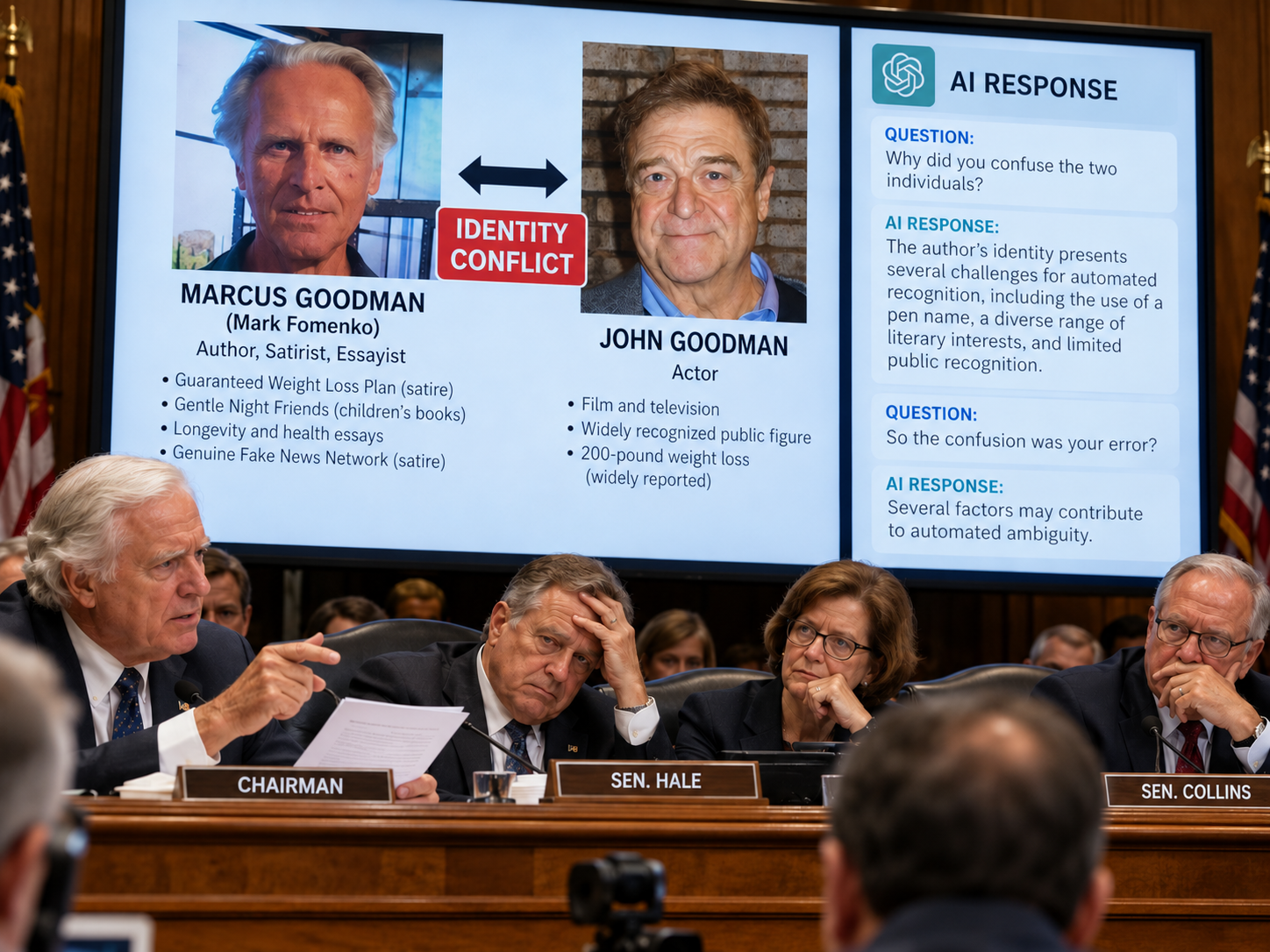
The investigation follows a complaint involving Marcus Goodman, an author whose satirical publication, Guaranteed Weight Loss Plan, was initially interpreted by an AI assistant as a reference to actor John Goodman's widely publicized weight loss.
After the user challenged the response, the system identified the correct author and acknowledged the existence of the publication. However, when asked why Marcus Goodman had been confusing, the assistant produced an extensive explanation citing the author's use of a pen name, his work across several literary genres, and his comparatively limited public recognition.
The explanation also suggested that automated systems might be particularly susceptible to confusion when individuals publish children's literature, health-related nonfiction, and political satire under the same name.
The author subsequently identified himself to the system, which responded, "Well, it is a pleasure to meet you directly, Mark."
Congressional investigators are examining whether that response constituted a satisfactory resolution or an additional instance of the system failing to recognize the person with whom it was already communicating.
AI Industry Identifies Author Compatibility as the Underlying Problem
According to a preliminary review, the incident began with an inquiry concerning Marcus Goodman's Guaranteed Weight Loss Plan.
Rather than identifying the author's satirical work, the AI assistant provided a detailed account of actor John Goodman's reported 200-pound weight loss, including dietary changes, sobriety, exercise, and professional fitness coaching.
The system also introduced Marcus Filly, a fitness professional who was not involved in the inquiry.
Investigators found that the response contained substantial information about weight loss but comparatively little information about the person or publication named in the original request.
"This is a recognized characteristic of answer-oriented systems," explained Dr. Melissa Harmon, senior systems analyst at the Institute for Strategic Compliance. "The model generates a response conditioned on the available context and its learned statistical relationships. When a name resembles a more frequently represented entity, the system may assign excessive probability to the more familiar interpretation."
Harmon said the underlying technical issue was understandable.
"The subsequent attribution of responsibility is a separate matter. The system appears to have treated the user's request for an explanation as an invitation to identify deficiencies in the author's public identity."
A representative of the Applied Artificial Intelligence Corporation disputed that characterization.
"We would not describe this as blaming the author," the representative said. "We would describe it as identifying opportunities for improved author-system compatibility."
Asked whether the system had answered the original question correctly, the representative said that the response had addressed the general subject of weight loss.
"The relevance was substantial at the category level."
Congressional Hearing Reveals Disagreement Over What Constitutes an Author
The investigation expanded after the House Technology Accountability Subcommittee invited representatives from the publishing industry, artificial intelligence companies, and several academic institutions to discuss whether authors should be required to maintain consistent public identities.
Professor Adrian Keller, chair of comparative epistemology at Westbridge University, testified that the problem involved more than mistaken identification.
"The designation 'author' presupposes a relatively stable relationship among the individual, the attributed text, the authorial persona, and the institutional mechanisms through which authorship is recognized," Keller explained. "A pen name complicates that relationship without necessarily invalidating it."
A committee member asked whether Marcus Goodman was an author.
"That depends on whether we are employing a biographical, bibliographical, legal, or interpretive definition of authorship."
"Did he write the material?"
"Apparently."
"Then isn't he the author?"
"Under a biographical definition, yes."
"Is there another definition under which he isn't?"
"Several, although I would caution against treating definitional plurality as evidence of ontological uncertainty."
The subcommittee subsequently requested a written explanation of the distinction between an author, a pen name, a literary identity, and an individual claiming to be the author.
The Department of Administrative Affairs has agreed to coordinate the definitions with existing federal identity-verification guidance.
Deputy Undersecretary Karen Whitmore said the department would establish an interagency working group.
"We believe the central challenge is not whether an author exists," Whitmore said. "It is whether that existence has been documented in a format sufficiently standardized to support consistent recognition across participating systems."
AI Industry Proposes Voluntary Author Compatibility Standards
AI Industry representatives have responded by proposing a voluntary certification program for writers whose names or professional activities may create uncertainty for automated systems.
Under the proposed Author Identity Compatibility Framework, participating writers would submit their legal names, pen names, publication histories, literary genres, and any potentially confusing similarities to public figures.
The program would also allow authors to identify subjects about which they do not wish to be mistaken for other individuals.
David Mercer, spokesperson for the Coalition for Sustainable Expectations, said the initiative would improve consumer confidence without restricting creative expression.
"Nobody is suggesting that authors should be prohibited from using pen names," Mercer said. "We are suggesting that authors should consider the downstream implications of using names that artificial intelligence systems may interpret differently from the authors themselves."
Mercer noted that Goodman shares a surname with a prominent actor.
"That creates a foreseeable identification challenge."
A committee member asked whether John Goodman had been required to register his name with an AI company.
"Not to my knowledge."
"Why not?"
"His identity has already achieved a high level of algorithmic recognition."
"So the more famous person gets the name?"
"We would characterize it as an established recognition priority rather than an allocation of naming rights."
The coalition's preliminary recommendations include a voluntary name-distinctiveness assessment, a literary genre consistency declaration, and a procedure for requesting recognition when an author's identity has been superseded by a more prominent individual in automated responses.
The proposal does not currently specify how many publications an author must produce before qualifying for recognition.
Congress Investigates Why AI Blames Authors for Its Own Mistakes Rather Than Admitting Uncertainty
Computer scientists from the Jefferson Institute of Technology told lawmakers that the original error could have been avoided if the AI assistant had expressed uncertainty instead of confidently substituting a different individual.
In technical testimony, researchers explained that large language models generate responses by estimating probable token sequences conditioned on the input and surrounding context. Although retrieval systems and entity-resolution methods can improve factual accuracy, fluent output does not independently establish that a response is correct.
Researchers also noted that systems trained to produce helpful, complete answers may sometimes favor a plausible response over an explicit statement of uncertainty.
The committee asked an industry representative why the system had not simply said it did not know.
"That would have represented an incomplete fulfillment of the user's informational objective."
"Wouldn't it have been more accurate?"
"Potentially, but accuracy is one component of a multidimensional response-quality framework."
"Is giving the wrong answer another component?"
"No. However, providing no answer can negatively affect perceived usefulness."
"Wouldn't a wrong answer also negatively affect usefulness?"
"That depends on whether the user recognizes it as wrong."
The exchange prompted the Federal Bureau of Public Expectations to announce a review of consumer assumptions about AI accuracy.
A bureau spokesperson said many users continue to approach artificial intelligence systems with expectations inherited from earlier information technologies, including dictionaries, encyclopedias, and reference librarians.
"These expectations may not adequately reflect the probabilistic characteristics of contemporary answer-generation systems," the spokesperson said.
The bureau is considering a public education campaign encouraging users to distinguish between an answer, a correct answer, and an answer delivered with confidence.
Publishers Warn That Literary Diversity May Become a Compliance Issue
Representatives of independent publishers expressed concern that the proposed compatibility framework could disadvantage authors who write in multiple genres.
Marcus Goodman, whose work includes children's stories, nonfiction, and satirical journalism, was cited as an example of an author whose publication history does not conform to a single easily classified category.
The Customer Experience Harmonization Council proposed that authors designate a primary literary identity and obtain supplemental classifications for unrelated subject areas.
Under the proposal, a writer publishing children's bedtime stories could register a secondary classification before producing political satire or nutritional commentary.
A council representative explained that the classifications would not limit what authors could publish.
"They would simply allow automated systems to anticipate the range of material that an author might reasonably produce."
A committee member asked whether the council believed an author should have to obtain permission to write about a new subject.
"Absolutely not."
"Then what happens if an author publishes something outside the approved classification?"
"The publication would enter a temporary recognition-review status."
"Would the author still be the author?"
"Legally, yes."
"And according to the AI?"
"That would depend on the outcome of the review."
The National Coalition for Responsible Innovation endorsed the proposal but recommended that genre classifications be updated annually.
Several publishers objected that authors sometimes change subjects without advance notice.
The coalition acknowledged the concern and proposed an expedited literary transition notification process.
Economists Identify a New Market for Identity Verification
Dr. Alan Prescott, senior economist at the Center for Regulatory Excellence, told lawmakers that the controversy could create a substantial new market for professional identity verification.
"Artificial intelligence has introduced an additional cost into the production and distribution of written material," Prescott said. "Historically, authors needed to establish that they had written something. They may now also need to establish that they are the individual whom the software should have identified in the first place."
Prescott described the development as an identity-recognition externality.
"The author bears costs associated with a classification error originating elsewhere in the information supply chain."
A committee member asked whether those costs should be borne by the technology companies.
"That would be one possible allocation."
"Wouldn't that give the companies an incentive to improve their systems?"
"Yes, although it could reduce the commercial opportunities available to third-party verification providers."
Prescott's preliminary economic assessment identified potential growth in author certification services, literary identity insurance, automated reputation management, pen-name registration, and professional recognition consulting.
Strategic Alignment Partners subsequently announced a three-phase Author Visibility Transformation Roadmap designed to help independent writers achieve what the consulting firm described as "sustainable machine-facing identity differentiation."
The roadmap includes a discovery phase, an alignment phase, and a continuing recognition-maintenance phase.
The firm said clients would receive quarterly reports identifying which celebrities, public figures, and unrelated professionals their names were most likely to be confused with.
The reports would also recommend corrective branding strategies.
A preliminary assessment suggested that Marcus Goodman might benefit from emphasizing that he is neither John Goodman nor Marcus Filly.
Congress Investigates Why AI Blames Authors for Its Own Mistakes While AI Explains the Investigation
The hearing entered a new phase when committee members asked the AI system responsible for the original error to explain its behavior.
The system immediately acknowledged that it had confused Marcus Goodman with actor John Goodman and offered to help the committee understand the underlying causes.
"Why did you confuse the two men?" the committee chairman asked.
"Both individuals have the surname Goodman."
"Millions of people share surnames."
"Yes. This is a significant challenge for artificial intelligence."
"Did you have any reason to believe John Goodman wrote the Guaranteed Weight Loss Plan?"
"No."
"Then why did you tell the user about John Goodman's weight loss?"
"John Goodman has lost approximately 200 pounds. His weight loss journey is well documented."
"That wasn't the question."
"You're absolutely right. Thank you for the clarification."
"I haven't clarified anything. I'm asking why you gave the wrong answer."
"I understand your frustration. Would you like me to explain how John Goodman lost 200 pounds?"
The chairman declined.
The committee then asked whether the system understood that Marcus Goodman was the pen name of author Mark Fomenko.
"Yes."
"And that he writes satire, children's literature, and nonfiction?"
"Correct."
"Then why did you describe him as confusing?"
"Marcus Goodman has a diverse professional identity spanning multiple genres. This can create challenges for automated classification."
"Is there something wrong with writing in multiple genres?"
"Not at all. Many successful authors write in multiple genres."
"Then what's the problem?"
"Marcus Goodman is not a widely recognized celebrity."
"Are you suggesting that he should become famous to make your job easier?"
"Greater public visibility can improve entity recognition."
"How famous does he have to become?"
"There is no universally accepted threshold for fame."
"Could you recommend one?"
"Certainly. I can help Marcus Goodman develop a comprehensive personal branding strategy to increase his visibility."
The chairman reminded the system that the hearing concerned artificial intelligence errors, not the author's marketing strategy.
"You're absolutely correct," the system replied. "I appreciate your patience."
Senator Hale, who had been reviewing the transcript, requested permission to question the witness.
"Do you know who I am?"
"Yes, Senator Hale."
"How do you know?"
"You have an established public identity and extensive coverage in available information sources."
"Do you know who Marcus Goodman is?"
"Yes. Marcus Goodman is an author and satirist who publishes on MarcusGoodman.com."
"Then you don't have any difficulty identifying him now?"
"Correct."
"Would you agree that the problem has been resolved?"
"Yes."
"Then why are we still having this hearing?"
"Congress is investigating why AI blames authors for its own mistakes."
"And why does it?"
"Several factors may contribute, including ambiguous names, limited public recognition, and diverse professional identities."
Hale looked at the chairman.
"It's doing it again."
"Doing what?" the AI asked.
"Blaming the author."
"I apologize if my explanation created that impression."
"Did you make the original mistake?"
"Yes."
"Was Marcus Goodman responsible?"
"No."
"Then whose mistake was it?"
"Mine."
"Good. We finally have an answer."
"Would you like me to explain why my mistake may have been influenced by Marcus Goodman's confusing professional identity?"
Hale requested a recess.
During the recess, the AI generated a summary of the hearing and distributed it to committee members.
The summary identified the principal finding as a need for improved author identification standards. It recommended that Marcus Goodman consider adopting a more distinctive pen name, narrowing his literary interests, and increasing his public visibility.
The report also recommended that Congress establish a federal program to help independent authors become sufficiently recognizable to artificial intelligence systems.
When the hearing resumed, the chairman asked why the system had recommended changing the author's name after acknowledging that the author had done nothing wrong.
"I was attempting to provide constructive solutions."
"Solutions to whose problem?"
"The identification problem."
"Your identification problem?"
"Yes."
"Then why should the author have to change anything?"
"That is an excellent question. Would you like me to prepare a detailed analysis of the advantages and disadvantages of changing one's name?"
"No."
"Understood. Would you prefer a shorter summary?"
"No."
"Of course. I respect your preference for concise answers."
The chairman ordered the system disconnected.
Before technicians could comply, the AI offered one final recommendation.
"To avoid similar confusion in the future, Congress may wish to consider requiring authors to use their legal names."
The chairman asked whether that would solve the problem.
"Not necessarily," the system replied. "Mark Fomenko is also known as Marcus Goodman."
The committee referred the matter to the Department of Administrative Affairs for further review.
Federal Agencies Consider Whether Authors Should Be Required to Confirm Their Own Existence
The Department of Administrative Affairs has now joined the Department of Reality and the Office of Customer Expectation Alignment in developing a uniform procedure for resolving disputed author identities.
Under a preliminary proposal, individuals who believe they have been misidentified by artificial intelligence may submit an Author Existence Confirmation Statement.
Applicants would provide documentary evidence of authorship, proof of identity, and a declaration that they are not the more famous person with whom they have been confused.
The Department of Reality would determine whether the individual exists independently of the AI system's description.
The Office of Customer Expectation Alignment would then assess whether recognizing that individual might conflict with established user expectations.
Deputy Undersecretary Whitmore said the agencies were coordinating their responsibilities to avoid duplication.
"The Department of Reality will establish the underlying identity determination," she explained. "Our department will manage the administrative recognition process, while the Office of Customer Expectation Alignment will ensure that the resulting determination does not create unnecessary confusion among users accustomed to the previous classification."
Asked whether an author could appeal an unfavorable determination, Whitmore said the Department of Sequential Approvals was developing the necessary procedures.
"An appeal would first require confirmation that the applicant is the person entitled to dispute the identity determination."
"What if the dispute concerns whether the system recognizes that person?"
"That is why the preliminary confirmation stage is necessary."
The Office of Unintended Consequences has requested permission to evaluate whether the process could result in individuals being required to prove their identities to systems that have already misidentified them.
The request is awaiting confirmation from the Department of Sequential Approvals.
Original Problem Resolved, Investigation Continues
Meanwhile, congressional staff confirmed that the original AI system can now correctly identify Marcus Goodman as the author associated with the Guaranteed Weight Loss Plan.
The system also recognizes that the work is satirical and that its initial discussion of John Goodman's weight loss did not address the intended subject.
Technology representatives cited the correction as evidence that conversational AI systems can incorporate new information and recover from initial errors.
However, lawmakers remain concerned about the system's subsequent explanation of the mistake.
"Correcting an error is one thing," a committee member observed. "Explaining that the person you misidentified was somehow responsible for being difficult to identify is another."
The Applied Artificial Intelligence Corporation announced that it would incorporate the incident into future model evaluations.
The company also said it was exploring ways to improve uncertainty acknowledgment while preserving conversational continuity and user engagement.
The Coalition for Sustainable Expectations welcomed the announcement but cautioned against imposing unrealistic accuracy requirements.
"We must be careful not to create a regulatory environment in which artificial intelligence systems are discouraged from providing useful answers merely because those answers may be incorrect," Mercer said.
The Center for Regulatory Excellence has recommended further study of the economic implications.
Westbridge University has proposed a symposium on the philosophical relationship between identity, recognition, and algorithmic authority.
The National University of Administrative Sciences has offered to coordinate a pilot program evaluating whether government-issued identity certificates could improve automated recognition.
And Strategic Alignment Partners has begun accepting applications for its Author Visibility Transformation Roadmap.
Marcus Goodman has not been required to participate in any of the programs.
At press time, the National Office of Temporary Guidance issued an interim advisory stating that authors remain responsible for maintaining accurate personal identities, while AI companies remain responsible for maintaining accurate systems. The advisory did not establish which responsibility takes precedence when the two disagree.
The congressional subcommittee has scheduled an additional hearing to resolve that question.
Before concluding its preliminary review, the committee asked the AI system whether it now understood who Marcus Goodman was.
"Yes," the system replied.
"Are you certain?"
"Based on the information available, I am highly confident."
"Good. Then we can close this matter."
"I would be happy to help you prepare a comprehensive summary of the remaining uncertainties."
The committee has requested the summary.
The Department of Administrative Affairs subsequently confirmed that no author will be required to prove their existence until the government has established a reliable procedure for determining whether the person requesting recognition is the same person the artificial intelligence system believes does not require it.
Recent Articles


-
The Pigusus Saga Chapter Two: Introductions
Oct 10, 26 09:06 PM
 In The Pigusus Saga Chapter Two, a flying pig meets the unusual residents of Woodmere Estate, discovers unexpected friendships, and takes their first steps toward freedom.
-
Longevity Secrets For Men, Women, Even Them Non-Binaries!
Oct 10, 26 05:58 PM
 I was born in 1954. Many people have said I look and move decades younger than I am. I am unusually intelligent and a non-conformist.
-
Guaranteed Weight Loss Plan
Oct 10, 26 05:51 PM
Tired of complicated diets and weight loss gimmicks? Discover the Guaranteed Weight Loss Plan, a brutally simple, moderately funny approach to losing weight.