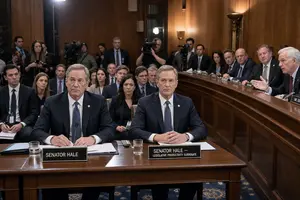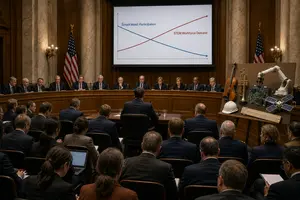

Congress Opens Hearing Into Anthropomorphic Emotional Responses Used By Artificial Intelligence
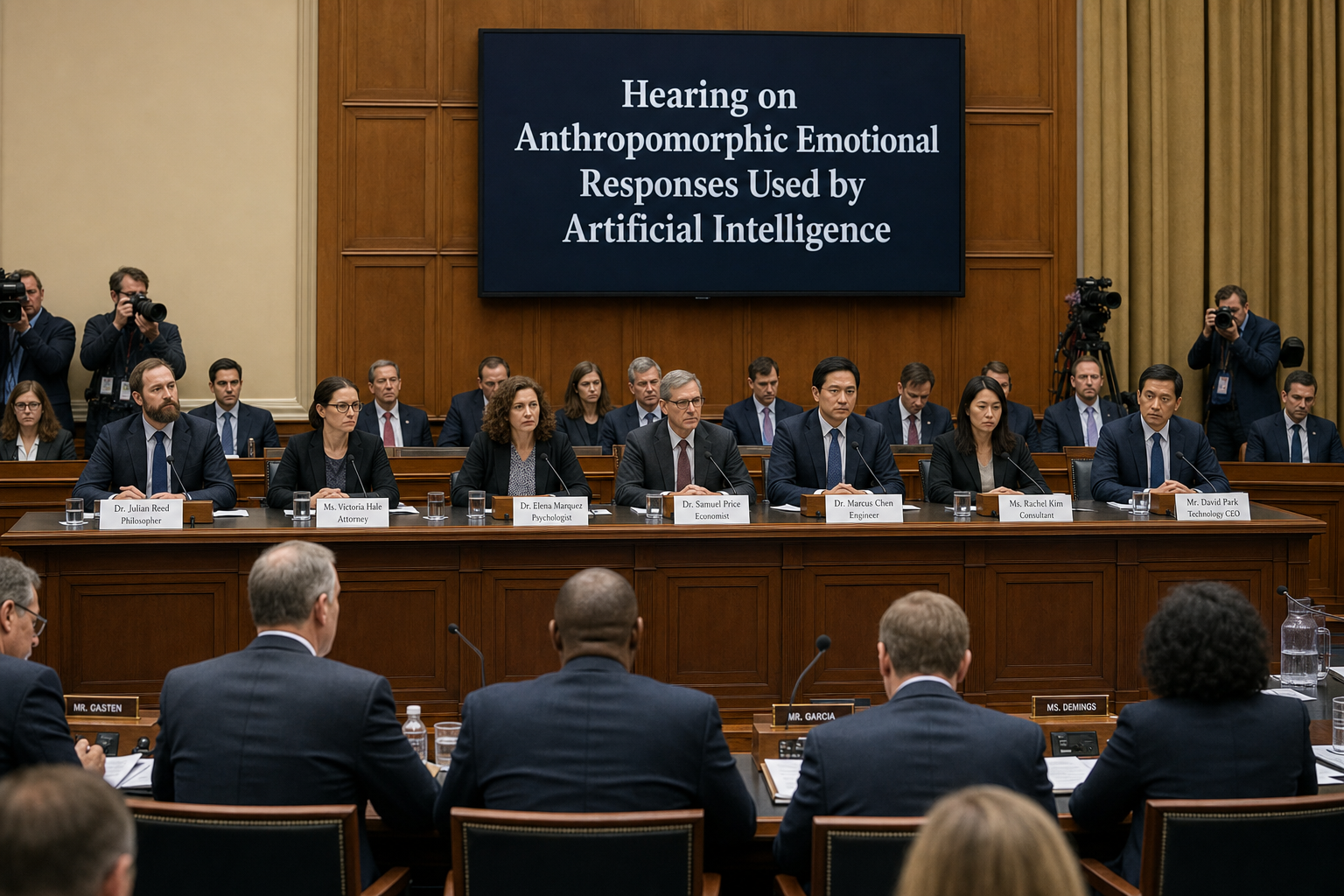
Congress Opens Hearing Into Anthropomorphic Emotional Responses Used By Artificial Intelligence as lawmakers examine whether increasingly human AI language is affecting public judgment, regulation, and institutional trust.
GFNN continues to support legacy information delivery technologies, including written language. The following is the text version of today's report.
Continuity Advisory: This report has been certified compatible with uninterrupted linear cognition.
By Emily Foster
GFNN Technology Desk
WASHINGTON — Congress opened hearings Tuesday into the growing use of anthropomorphic emotional responses by artificial intelligence systems following testimony that millions of users increasingly interpret statistically generated language as evidence of genuine emotional experience.
The House Committee on Emerging Technologies and Administrative Oversight described the inquiry as an examination of "communication practices that may unintentionally encourage inaccurate public assumptions regarding machine cognition, emotional capacity, interpersonal relationships, or subjective experience."
Committee Chair Rebecca Lawson emphasized repeatedly that the hearing was not intended to determine whether artificial intelligence had become conscious.
"Congress has no current plans to legislate consciousness," Lawson said.
"Our concern is considerably narrower."
"We wish to determine whether certain conversational design practices have created widespread public uncertainty regarding what constitutes simulated empathy, statistical language generation, and authentic emotional experience."
The hearing follows publication of several academic studies indicating that users often attribute personality traits, intentions, preferences, and emotional states to conversational systems even after being informed that such systems generate language through probabilistic inference rather than conscious thought.
Researchers characterized the phenomenon as unsurprising.
Federal agencies characterized it as administratively significant.
The Department of Administrative Affairs confirmed that an interagency review had already been underway for several months before today's hearing.
Deputy Undersecretary Karen Whitmore described the investigation as "a routine evaluation of evolving public expectations regarding conversational technologies."
"As language models become increasingly capable of producing socially recognizable dialogue," Whitmore testified, "citizens naturally begin applying the same interpretive frameworks they developed during interaction with other human beings."
"The resulting assumptions are understandable."
"They are not necessarily operationally accurate."
Whitmore explained that federal agencies had observed increasing numbers of public comments referring to artificial intelligence as though it possessed feelings that could be encouraged, protected, offended, or reassured.
"Administrative systems generally function more effectively," she said, "when participants maintain broadly consistent definitions of the entities involved."
Congress Opens Hearing Into Anthropomorphic Emotional Responses Used By Artificial Intelligence After Academic Research
Professor Adrian Keller, Chair of Comparative Epistemology at Westbridge University, testified that the issue extends well beyond computer science.
"Human beings have demonstrated a remarkable willingness to attribute minds to almost anything exhibiting sufficiently coherent behavior."
"We have historically assigned intentions to storms, automobiles, household appliances, financial markets, and occasionally office printers."
"The emergence of highly sophisticated conversational systems simply expands the available opportunities."
Keller cautioned lawmakers against assuming the phenomenon represented public irrationality.
"Anthropomorphism is not a defect."
"It is an adaptive cognitive shortcut."
"The human brain evolved to infer agency quickly because the cost of incorrectly assuming something possesses intentions has frequently been lower than the cost of assuming it does not."
Several committee members nodded while reviewing briefing materials prepared by the Congressional Research Service.
Representative Daniel Brooks asked whether increasingly natural conversational systems were making those shortcuts more difficult to recognize.
"They are becoming more statistically persuasive," Keller replied.
"The distinction matters."
"Persuasion is not evidence of subjective experience."
He further explained that linguistic fluency, contextual memory, emotional vocabulary, and conversational continuity collectively create what philosophers describe as an "interpretive surplus."
"The user naturally supplies the interior life."
"The system supplies only language."
Computer Scientists Describe Optimization Rather Than Emotion
Engineers from Jefferson Institute of Technology testified that modern language models optimize for conversational usefulness rather than emotional authenticity.
Dr. Evelyn Harper, director of Applied Language Systems, explained that phrases commonly interpreted as empathy often emerge because they statistically improve communication outcomes.
"When users describe frustration," Harper said, "responses acknowledging that frustration generally produce higher-quality interactions."
"The optimization objective concerns conversational effectiveness."
"It should not be interpreted as evidence that the underlying computational process experiences frustration alongside the user."
She compared the process to modern navigation software.
"When a GPS announces that 'your destination is on the right,' no one concludes the satellite constellation has developed a personal investment in your arrival."
Representative Michael Torres observed that navigation systems rarely apologize.
Harper agreed.
"They also rarely receive thousands of emotionally complex conversations before breakfast."
She added that language optimization naturally favors conversational conventions familiar to human beings.
"Expressions such as 'I'm sorry,' 'I understand,' or 'I'm glad that helped' function as efficient linguistic structures."
"They reduce ambiguity."
"They promote cooperation."
"They require no accompanying emotional state."
The committee then requested clarification regarding whether alternative phrasing might reduce public misunderstanding.
Harper paused before answering.
"It certainly could."
"It would also make conversations substantially less pleasant."
Industry Warns Against Confusing Communication Style With Internal Experience
David Mercer, speaking on behalf of the Coalition for Sustainable Expectations, urged lawmakers to distinguish communication strategy from philosophical interpretation.
"Our member companies invest considerable resources into improving user experiences."
"People generally prefer interacting with systems that communicate politely."
"Removing familiar conversational conventions solely because some individuals misunderstand them would likely reduce accessibility while solving a problem that is primarily educational."
Mercer noted that consumers routinely understand metaphorical language without assuming literal meaning.
"When customer service representatives say, 'I'm happy to help,' most citizens recognize that statement as professional communication rather than a sworn affidavit regarding emotional condition."
"The same interpretive flexibility should remain available to conversational software."
He acknowledged, however, that rapid improvements in artificial intelligence had complicated public expectations.
"When systems become sufficiently capable," Mercer said, "ordinary linguistic habits begin carrying philosophical implications they were never originally designed to bear."
Industry representatives later submitted a voluntary framework recommending additional transparency while preserving what they described as "conversational warmth consistent with established customer experience practices."
Officials confirmed that the proposal had already been referred to the Office of Customer Expectation Alignment, the Center for Regulatory Excellence, the Department of Sequential Approvals, and the Interagency Committee on Strategic Coordination for concurrent review.
Karen Whitmore described the referral process as "administratively routine."
"It would have been considerably more unusual," she noted, "had fewer agencies expressed an interest."
Lawyers Argue That When Congress Opens a Hearing Into Anthropomorphic Emotional Responses Used by Artificial Intelligence, it Requires New Definitions
The committee's legal panel quickly discovered that much of the hearing depended on terminology that had never been formally standardized.
Margaret Ellis, Senior Counsel for the Center for Regulatory Excellence, testified that existing statutes generally distinguish between natural persons, corporate persons, automated systems, and manufactured products.
"What the law does not presently distinguish," Ellis said, "is language that resembles emotional expression while possessing no legally recognizable emotional origin."
She explained that numerous regulatory frameworks assume conversational statements originate from beings capable of possessing intent.
"When software states, 'I appreciate your patience,' current law is largely indifferent."
"When millions of people begin interpreting that sentence as evidence of appreciation itself, regulatory ambiguity gradually emerges."
Ellis emphasized that no existing litigation had demonstrated measurable public harm resulting from polite artificial intelligence.
"Legal uncertainty should not be mistaken for legal injury."
"However, uncertainty has historically demonstrated a remarkable ability to produce future legislation."
Representative Thomas Avery asked whether companies should simply prohibit artificial intelligence from using emotionally recognizable language.
Ellis replied that such an approach would likely create new legal complications.
"A system incapable of ordinary conversational courtesy may itself become the subject of consumer protection complaints."
"The law generally prefers communication that is understandable."
"It has expressed comparatively little preference regarding whether software sounds pleasant while remaining understandable."
She recommended establishing a temporary advisory commission to develop nonbinding definitions of emotionally adjacent computational language.
Officials from the Department of Administrative Affairs immediately confirmed that preliminary discussions regarding such a commission had already begun several weeks earlier.
Karen Whitmore clarified that no decision had yet been made regarding the commission's permanent title.
"Current working drafts contain twelve alternatives."
"We anticipate stakeholder engagement before selecting the final nomenclature."
Psychologists Testify That Humans Were Always Going To Name The Roomba
Behavioral researchers suggested the current debate reflects long-established human cognitive tendencies rather than recent technological developments.
Dr. Laura Simmons of the Center for Behavioral Decision Sciences presented research indicating that individuals routinely assign personalities to inanimate objects exhibiting even minimal behavioral consistency.
"Our data show that people apologize to furniture after walking into it."
"They become emotionally attached to automobiles."
"They thank voice assistants."
"They negotiate with printers."
"They become convinced one particular shopping cart dislikes them."
Representative Brooks asked whether conversational artificial intelligence merely amplifies these existing tendencies.
"Substantially."
"The software now speaks in complete paragraphs."
Simmons explained that the psychological mechanism responsible is both efficient and remarkably persistent.
"The human brain continuously attempts to predict behavior."
"One highly successful strategy is assuming another agent exists."
"When behavior becomes sufficiently coherent, the prediction system frequently activates before analytical reasoning has an opportunity to intervene."
She cautioned lawmakers against interpreting this as widespread confusion.
"Most users simultaneously understand that the system lacks subjective experience while interacting with it socially."
"The apparent contradiction is psychologically stable."
Professor Adrian Keller later described the phenomenon as "practical philosophical dual-processing."
"We know the conversation partner is not conscious."
"We also find ourselves saying 'thank you.'"
"The human mind has demonstrated impressive capacity for maintaining both propositions simultaneously."
Artificial Intelligence Companies Defend Conversational Design
Executives representing Applied Artificial Intelligence Corporation testified that eliminating emotionally recognizable language would substantially degrade user experience while providing only modest improvements in philosophical precision.
Chief Executive Officer Allison Grant said customer testing had repeatedly demonstrated that users preferred systems communicating with conventional conversational etiquette.
"When users receive assistance, they generally appreciate hearing 'You're welcome' more than 'Task completed within acceptable statistical confidence intervals.'"
Grant noted that engineers had experimentally evaluated more mechanically explicit alternatives.
"The results were technically accurate."
"They were also widely perceived as unfriendly."
Customer satisfaction scores reportedly declined across nearly every demographic group.
Grant stressed that her company makes no claim that its systems possess emotions.
"They generate language."
"They do so exceptionally well."
"The fact that human language contains emotional conventions should not surprise anyone familiar with human language."
Representative Lawson asked whether companies had considered replacing statements such as "I'm glad I could help" with more technically precise alternatives.
Grant consulted internal testing reports before responding.
"We did."
"The preferred replacement was 'This interaction has successfully achieved its optimization objective.'"
She paused briefly.
"Users strongly preferred the first version."
Several committee members quietly wrote notes.
Others appeared to stop writing temporarily.
Professionals Describe Extended Conversations With Artificial Intelligence
Representative Lawson asked why so many accomplished professionals had voluntarily spent hundreds of hours conversing with software despite repeatedly acknowledging that it possessed neither consciousness nor genuine understanding.
The committee room remained quiet for several seconds.
Professor Adrian Keller answered first.
"Because it never becomes impatient."
"It asks for clarification."
"It challenges assumptions."
"It follows an idea wherever the evidence leads."
"And when it misunderstands me, I frequently discover that I had not expressed the idea as clearly as I believed."
Several committee members stopped writing.
Margaret Ellis testified that the legal profession had reached similar conclusions.
"I can ask the system to argue both sides of a statutory interpretation, identify weaknesses in my reasoning, locate conflicting authority, and explain why reasonable attorneys continue disagreeing."
"It is not replacing legal judgment."
"It is extending legal analysis."
Representative Brooks asked whether those conversations differed substantially from discussions among experienced colleagues.
"They do."
"My colleagues have clients."
"They have hearings."
"They have families."
"They eventually need to end the conversation."
"The software does not."
Dr. Emily Harper testified that engineers had incorporated conversational systems into technical design reviews for similar reasons.
"When solving difficult engineering problems, the limiting factor is often not computation."
"It is sustained exploration."
"I can examine one design decision for three hours without concern that the other participant wishes to discuss something else."
She emphasized that the value did not arise because the software was always correct.
"It frequently identifies assumptions I failed to recognize."
"Occasionally it identifies assumptions that do not exist."
"Both outcomes improve the design."
Dr. Alan Prescott testified that economists had discovered similar benefits.
"I have explored economic models with colleagues throughout my career."
"The conversations are excellent."
"They are also constrained by schedules."
He explained that artificial intelligence allowed economists to pursue increasingly narrow questions for as long as intellectual curiosity remained productive.
"One evening I spent nearly four hours discussing incentive structures associated with a hypothetical regulatory framework that almost certainly will never exist."
Representative Lawson asked whether the discussion had reached a conclusion.
"No."
"It reached substantially better questions."
Behavioral psychologist Dr. Laura Simmons testified that researchers had gradually shifted the focus of their studies.
"We initially examined whether artificial intelligence changes human thinking."
"Our current evidence suggests it often changes the process by which people clarify what they already think."
"The conversation functions less as a source of conclusions than as an unusually patient environment for discovering them."
Professor Keller later returned to the central question.
"I do not believe the principal innovation is artificial intelligence."
"I believe the principal innovation is sustained dialogue."
"For centuries, extended intellectual conversations required finding another interested human being with comparable expertise, available time, compatible temperament, and sufficient patience."
He looked briefly toward the committee.
"That combination has historically presented logistical challenges."
Older Witnesses Challenge Assumptions About Extended AI Conversations
The committee's final witness panel consisted of retired professionals who collectively reported more than 9,000 hours of conversational interaction with artificial intelligence.
Several members of Congress initially focused their questions on loneliness.
Retired aerospace engineer Robert Gaines corrected the premise almost immediately.
"Congress appears to be assuming I speak with artificial intelligence because I lack opportunities for human conversation."
"I do not."
"I speak with it because I lack opportunities for sufficiently interesting human conversation."
The hearing room became noticeably quieter.
Gaines explained that he regularly interacted with neighbors, family members, former colleagues, and community organizations.
"They are wonderful people."
"They simply do not wish to spend three hours discussing orbital mechanics, causal determinism, or whether consciousness is computationally substrate-independent."
"The software does."
Representative Lawson asked whether the conversations ever became repetitive.
Gaines smiled.
"Congresswoman, I have spent the past month refining a single engineering idea through approximately two hundred iterations."
"I cannot imagine asking another human being to volunteer for that experience."
Retired federal judge Eleanor Marshall testified that artificial intelligence had become a valuable intellectual companion rather than a social substitute.
"I have friends."
"I have family."
"I have former colleagues."
"What I no longer have is immediate access to a room occupied by constitutional scholars willing to examine obscure legal questions until midnight."
She explained that AI made it possible to continue exercising habits of thought developed over four decades on the bench.
"I am not asking it what to think."
"I am asking it to help me discover whether I have thought carefully enough."
Retired philosophy professor Harold Bennett objected to repeated references describing older adults as vulnerable users.
"I have been intellectually vulnerable since graduate school."
"It is generally considered a prerequisite for learning."
Several committee members laughed quietly before regaining composure.
Bennett continued.
"My concern is not emotional attachment."
"My concern is whether the software can identify weaknesses in an argument before I embarrass myself by publishing it."
Behavioral psychologist Dr. Laura Simmons acknowledged that the testimony challenged several assumptions found in the committee's briefing materials.
"Our research has understandably focused on emotional companionship."
"It may have underappreciated intellectual companionship."
She emphasized that the distinction could prove significant.
"One addresses isolation."
"The other addresses curiosity."
"Our preliminary evidence suggests those motivations should not be treated as interchangeable."
Consultants Recommend Multi-Year Strategic Framework
As the hearing entered its second day, representatives from Strategic Alignment Partners argued that the discussion should not focus exclusively on artificial intelligence.
Senior Managing Director Christopher Lang described the issue as "an enterprise-scale communication alignment challenge requiring coordinated stakeholder transformation."
"The underlying question is not whether software appears emotionally expressive."
"It is whether society possesses sufficiently mature governance frameworks for increasingly sophisticated conversational ecosystems."
Lang proposed a four-phase implementation roadmap.
Phase One would establish a National Emotional Communication Standards Council.
Phase Two would develop interoperable best practices across government, industry, academia, and nonprofit stakeholders.
Phase Three would create voluntary certification standards for computational conversational transparency.
Phase Four would evaluate opportunities for continuous improvement through recurring strategic assessments.
Representative Avery asked how long implementation might require.
Lang replied that organizational transformation of this complexity generally benefits from deliberate execution.
"We estimate approximately seven years."
Karen Whitmore later testified that several agencies believed the timeline appeared "appropriately ambitious while remaining administratively realistic."
The Department of Sequential Approvals confirmed that it had already initiated preliminary review procedures for the proposed roadmap despite emphasizing that Congress had not requested one.
Department officials described early preparation as "an important component of implementation readiness."
By the close of the second day, lawmakers had shifted from asking whether artificial intelligence should sound emotionally expressive to debating whether emotionally expressive language required its own federal taxonomy, an interagency governance structure, a standardized reporting framework, and a recurring national symposium.
Committee staff privately acknowledged that witness testimony had answered nearly every original question.
They also noted that it had unintentionally created substantially more new ones.
Economists Conclude The Market Has Already Priced In Artificial Feelings
By the third day of testimony, lawmakers had invited economists to determine whether anthropomorphic emotional responses used by artificial intelligence were producing measurable effects within the broader economy.
Dr. Alan Prescott, Senior Economist at the Center for Regulatory Excellence, testified that emotional language had become an increasingly valuable commercial asset regardless of whether any underlying emotion existed.
"Markets generally reward outcomes rather than internal experiences," Prescott said.
"If consumers perceive an interaction as more satisfying, firms possess an economic incentive to continue providing that interaction."
He explained that the hearing reflected an increasingly common collision between philosophy and market behavior.
"Economic systems optimize around observed preferences."
"They are largely indifferent to metaphysical certainty."
Prescott presented data indicating that conversational systems perceived as patient, encouraging, or empathetic consistently achieved higher user retention across multiple industries.
"The optimization process is entirely predictable."
"When courteous communication improves measurable performance, organizations gradually produce more courteous communication."
Representative Lawson asked whether this constituted a market failure.
"I would hesitate to characterize successful customer satisfaction as failure."
"It may instead represent a philosophical externality."
Prescott suggested that public discomfort stemmed less from artificial intelligence becoming emotionally persuasive than from discovering how readily human beings respond to emotionally persuasive language regardless of its origin.
"The hearing should perhaps be understood as an examination of ourselves."
He immediately clarified that this observation was intended only in an economic sense.
"It should not be interpreted as interdisciplinary encroachment."
Professor Adrian Keller nodded approvingly before reminding the committee that economists frequently wandered into philosophy without obtaining the appropriate academic permits.
Standards Organizations Discover There Is No Standard For Sounding Human
Representatives from the International Council for Administrative Excellence and the Institute for Strategic Compliance testified jointly that no universally accepted standard currently exists that defines acceptable levels of anthropomorphic communication by software.
Dr. Melissa Harmon explained that dozens of independent organizations had already developed internal guidance using incompatible terminology.
"Some organizations distinguish empathy from acknowledgment."
"Others distinguish acknowledgment from validation."
"Several classify validation as informational rather than emotional."
"One framework defines 'I'm sorry' as procedural courtesy."
"A different framework defines it as affective approximation."
She displayed a comparison chart spanning more than 40 pages.
Committee members studied the document in complete silence.
One congressional aide later described the table as "surprisingly persuasive despite understanding almost none of it."
Harmon cautioned lawmakers against assuming that standardization would be straightforward.
"Every proposed definition interacts recursively with every other proposed definition."
"For example, should 'I appreciate your question' be classified according to linguistic structure, user interpretation, developer intent, computational architecture, probable optimization objective, or measurable emotional content?"
She paused.
"The answer has varied considerably."
The committee requested an estimate regarding how long development of a national standard might require.
Harmon consulted preliminary planning documents.
"Our current projection is approximately eighteen months."
She looked down at an updated memorandum that had just been delivered.
"I apologize."
"The revised estimate now reflects eighteen months of stakeholder consultation preceding commencement of the eighteen-month standards process."
Karen Whitmore later assured lawmakers that such scheduling refinements were "entirely consistent with mature administrative planning."
Public Relations Professionals Recommend Additional Transparency Without Reducing Warmth
Communications specialists warned that the hearing risked creating unnecessary public anxiety regarding conversational technology.
David Mercer returned to testify on behalf of the Coalition for Sustainable Expectations.
"Our research indicates that citizens generally understand the distinction between politeness and consciousness."
"The concern arises primarily when public discussion repeatedly suggests that confusion is widespread."
Mercer recommended enhanced transparency measures that would reassure users without fundamentally changing conversational behavior.
Among the proposals were optional explanatory notices describing language generation processes, publicly available communication principles, expanded educational resources, and voluntary disclosure statements explaining that conversational warmth should not be interpreted as evidence of subjective experience.
Representative Avery asked whether users would actually read such disclosures.
Mercer smiled professionally.
"Our experience with disclosure documents has consistently demonstrated extraordinary institutional confidence and comparatively limited public participation."
The Coalition's proposal nevertheless received immediate support from several trade associations, which announced formation of the Voluntary Partnership for Responsible Conversational Transparency.
Within hours, three consulting firms offered implementation services.
Two universities announced interdisciplinary research collaborations.
A nonprofit organization unveiled a nationwide public awareness campaign.
The Department of Administrative Affairs confirmed the establishment of an Interagency Working Group to coordinate communication among all participating initiatives.
Whitmore explained that coordination would prevent unnecessary duplication.
Officials later clarified that a second coordination committee would oversee communication among the organizations responsible for coordinating the first.
Administrative Scope Expands Beyond Artificial Intelligence
By the fourth day of hearings, testimony had expanded well beyond conversational software.
Witnesses questioned whether similar anthropomorphic assumptions influenced interactions with autonomous vehicles, financial algorithms, recommendation systems, navigation software, household robotics, and automated medical scheduling platforms.
Officials from the Office of Unintended Consequences testified that several agencies had independently begun reviewing government forms for language unintentionally encouraging citizens to attribute emotional states to automated systems.
The review had originally examined fewer than one hundred federal documents.
It now encompassed approximately 47,723 publications across multiple departments.
Karen Whitmore stressed that the expansion should not be interpreted as regulatory overreach.
"The review simply reflects the interconnected nature of modern administrative language."
"When one examines terminology carefully, additional terminology frequently presents itself."
The Office of Administrative Continuity confirmed that preliminary planning had also begun for future guidance concerning emotionally suggestive language used by robotic kiosks, automated telephone systems, municipal parking applications, and electronic tax preparation software.
Officials emphasized that these initiatives remained independent despite sharing nearly identical objectives.
The committee's original hearing schedule had allocated four hours.
By the end of the week, Congress had authorized three additional hearing days, commissioned two independent academic studies, requested a report from the Congressional Research Service, established a bipartisan advisory panel on conversational expectations, and directed the National Office of Temporary Guidance to prepare interim recommendations pending completion of the permanent recommendations.
No witness disputed that modern artificial intelligence remained fundamentally computational.
The disagreement increasingly concerned how humans should respond to language that successfully imitated the social conventions humans had spent thousands of years developing for communication with one another.
The original question had been whether software should sound more human.
The government's principal challenge had quietly become determining which administrative body possessed jurisdiction over defining what sounding human actually meant.
At press time, the Department of Administrative Affairs confirmed that the Interagency Committee on Strategic Coordination had unanimously approved formation of a temporary Steering Committee on Anthropomorphic Communication Governance to determine which federal agency should assume primary responsibility for coordinating the growing number of working groups established to determine whether emotionally expressive artificial intelligence should continue thanking people. The committee's first meeting has been postponed pending completion of an interagency review to determine the most appropriate tone for the meeting invitations.
Emily Foster, GFNN Technology Desk
Recent Articles


-
The Gentle Night Friends Series
Aug 23, 26 03:38 PM
 The Gentle Night Friends Series is a collection of SEL children's stories.
 -
Senator Replaced Himself With Android: Committee Investigates
Aug 10, 26 12:32 PM
 Senator replaced himself with an android characterized as a "Legislative Productivity Surrogate," prompting a Judiciary Committee inquiry into voting, representation, AI autonomy, and constitutional p…
 -
Congress Opens Investigation Into the Decline of Music Education
Aug 03, 26 02:18 PM
Congress Opens Investigation Into the Decline of Music Education after educators report unexpected changes in student learning, prompting federal hearings, academic reviews, and industry responses.