
Congress Opens Hearing Into Declining Quality Outputs From Legacy Satire Publishers
Congress Opens Hearing Into Declining Quality Outputs From Legacy Satire Publishers following a federal review that found evidence of a sustained decline in measurable comedic performance.
GFNN continues to support legacy information delivery technologies, including written language.
Administrative Notice: This report has been certified compatible with uninterrupted concentration exceeding thirty consecutive seconds.
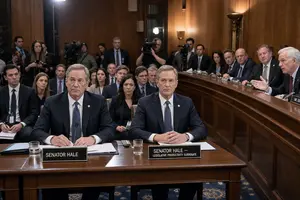
WASHINGTON — Congressional leaders opened hearings Tuesday into what lawmakers described as a sustained decline in quality outputs from legacy satire publishers following the recent federal review that concluded the issue had evolved beyond an editorial preference into a matter of broader institutional interest.
The hearing follows last month's expansion of the Federal Review Ordered Into Quality Control Failures Across Legacy Satire Sector into a Tier-3 Interagency Performance Recovery Initiative after participating agencies reported broad agreement that legacy satire had experienced measurable declines in perceived comedic effectiveness despite increasingly sophisticated editorial practices.
Officials emphasized that the review should not be interpreted as suggesting that declining satirical quality constitutes a direct threat to national security.
Instead, investigators concluded that persistent reductions in the quality of institutional satire could contribute over time to broader indicators of societal frustration, declining civic optimism, diminished institutional self-awareness, and other factors associated with long-term public resilience.
Those findings prompted several additional agencies to participate in the review in advisory capacities.
Committee Chair Rebecca Collins said the purpose of the hearing remained deliberately narrow.
"We are not examining freedom of expression."
"We are not examining political viewpoints."
"We are not examining publishing business models."
"We are examining one operational question."
"Why has legacy satire become progressively less funny?"
The committee emphasized that the hearing should not be interpreted as criticism of the publishing industry, noting that many participating organizations had substantially expanded investments in editorial quality assurance, legal review, fact verification, research support, audience analysis, digital publishing systems, and professional governance during the very period under examination.
Deputy Undersecretary Karen Whitmore of the Department of Administrative Affairs opened the proceedings by summarizing findings from the federal review.
"The available evidence indicates that institutional investment in editorial professionalism has never been higher," Whitmore testified.
"Publishers appear to be employing more editors, more subject-matter specialists, more attorneys, more consultants, more audience researchers, and more formal review procedures than at any previous point."
"The present inquiry concerns why those improvements have coincided with declining humorous outcomes."
Whitmore cautioned lawmakers against assuming that the review had identified negligence by any individual organization.
"No evidence has emerged suggesting systemic incompetence."
"If anything, participating institutions appear unusually competent."
She explained that investigators had gradually shifted away from searching for procedural failures and toward examining whether independently rational improvements introduced across numerous organizations might collectively produce outcomes that no individual institution intended.
According to briefing materials provided to committee members, analysts found that the average satirical article now undergoes substantially more documented review than comparable publications from two decades ago.
Those reviews frequently include editorial assessment, legal evaluation, audience sensitivity analysis, contextual plausibility review, factual verification, reputational risk assessment, distribution planning, stakeholder consultation, and post-publication performance forecasting.
Officials stressed that each procedure serves an independently legitimate purpose.
"The review has identified no individual safeguard that appears unreasonable when evaluated independently," Whitmore said.
"The emerging question is whether cumulative optimization may occasionally produce unintended systemic interactions."
Members of Congress repeatedly emphasized that the hearing was intended to understand institutional processes rather than assign blame.
Representative David Morrison noted that nearly every major publisher reported measurable improvements in editorial quality.
"Accuracy has improved."
"Documentation has improved."
"Professional review has improved."
"Legal consistency has improved."
"Organizational governance has improved."
"Our difficulty is that survey-based assessments of reader satisfaction with satirical quality have not demonstrated corresponding improvement."
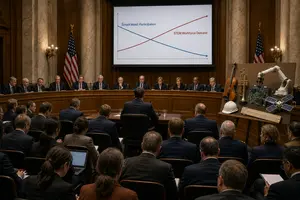
Several lawmakers nodded while consulting briefing charts comparing historical publishing practices with contemporary editorial workflows.
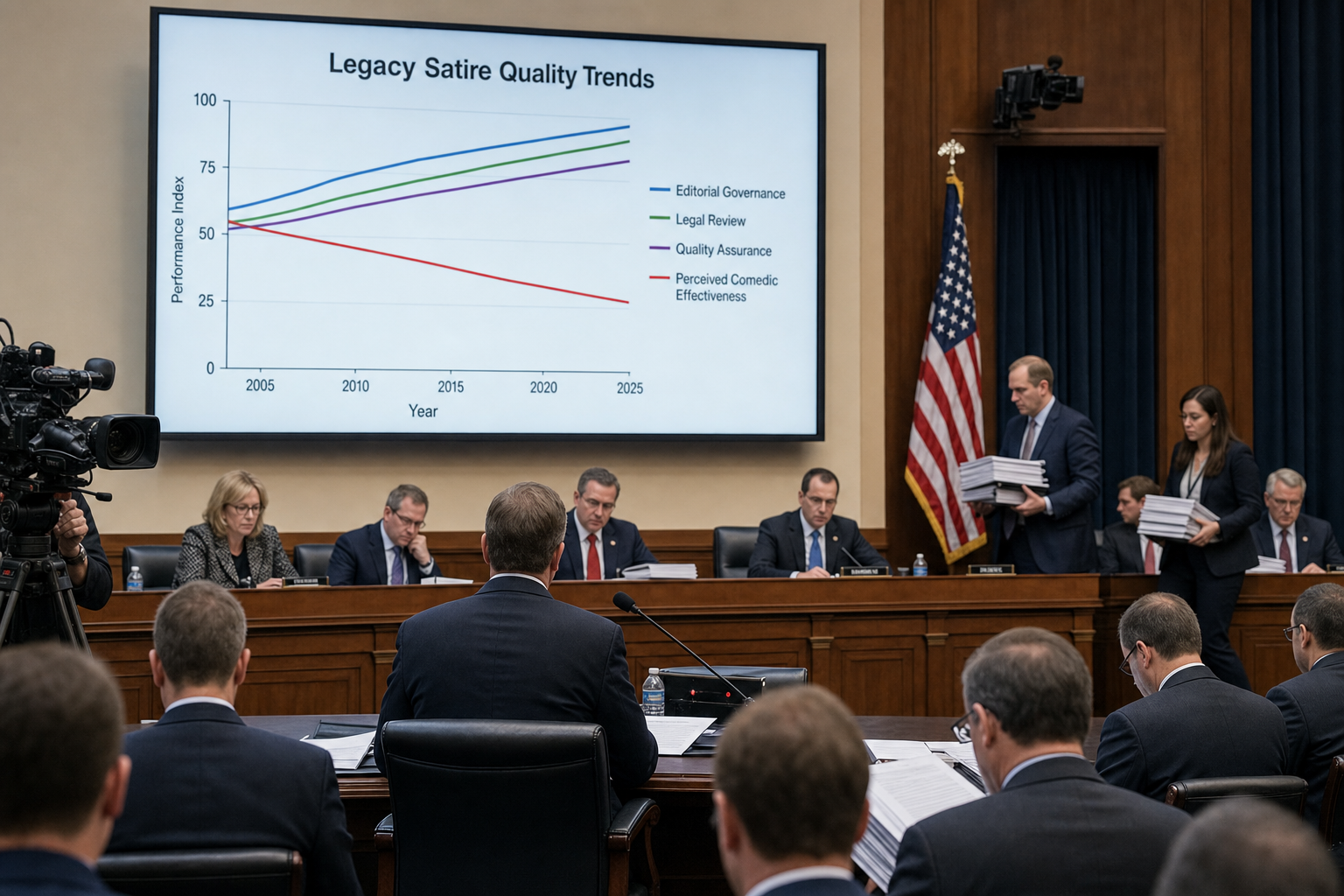
One committee exhibit showed a steady increase in documented quality-control procedures alongside longitudinal survey data indicating stagnant or declining public assessments of legacy satirical quality over approximately the same period.
Committee staff cautioned that correlation alone should not be interpreted as causation.
Nevertheless, members agreed the relationship warranted further examination.
Witnesses scheduled to testify included representatives from the newly formed International Coalition of Satirical Content Providers, the American Society for the Creation of Responsible Satire, publishing executives, university researchers, consultants specializing in organizational quality systems, economists, and officials involved in the federal review.
Several federal agencies with responsibilities related to long-term societal resilience also sent observers but were not scheduled to testify.
Committee staff described the witness list as "the broadest multidisciplinary examination of institutional humor performance ever assembled under congressional authority."
One senior aide noted that the hearing had originally been scheduled for a single morning.
It has since expanded into a three-day proceeding after multiple organizations requested additional time to present supporting documentation.
The committee agreed that reviewing several thousand pages of quality assurance frameworks would likely contribute meaningfully to understanding why readers increasingly reported that legacy satire no longer delivered the level of humorous satisfaction historically associated with the sector.
International Coalition Says Production Remains Strong Despite Performance Trends
The committee's first witness, International Coalition of Satirical Content Providers President Dr. Eleanor Markham, emphasized that the Coalition did not view the hearing as evidence of institutional failure.
"Global satire production remains historically robust," Markham testified.
"Our member organizations collectively publish more satirical material than at any previous point in recorded history."
She explained that the Coalition's concern involved what researchers termed "declining humor conversion efficiency."
"The industry has become remarkably effective at producing satire at scale. While stakeholder and consumer feedback continues to indicate dissatisfaction with perceived satirical quality, we remain confident that ongoing collaboration, enhanced professional standards, and continuous quality improvement initiatives will satisfactorily address those concerns."
"The current discussion concerns whether comparable levels of amusement continue emerging from those production systems."
Markham presented data compiled from hundreds of publishers across North America, Europe, Asia, and Australia indicating that average article length, research citations, editorial review, legal consultation, and production quality had all increased steadily during the past fifteen years.
Survey-based measures of reader satisfaction with satirical quality remained largely unchanged or declined despite substantial increases in editorial investment.
"The Coalition wishes to emphasize that this should not be interpreted as evidence of deteriorating professionalism."
"Our findings indicate precisely the opposite."
Committee members were shown charts demonstrating that investments in editorial infrastructure had consistently outpaced measurable improvements in reader satisfaction.
One analysis suggested that the average satirical article now represented nearly three times the editorial labor required two decades earlier.
Representative Morrison asked whether the Coalition had identified an explanation.
"We have identified several candidate frameworks," Markham replied.
"None have yet achieved sufficient international consensus."
American Society Defends Responsible Satire Standards
The committee next heard testimony from the American Society for the Creation of Responsible Satire, a professional association representing editors, consultants, educators, attorneys, communications specialists, and publishing executives responsible for developing voluntary standards for contemporary satirical practice.
Society President Dr. William Pembroke described the organization's mission as promoting public confidence through professional editorial governance.
"Responsible satire requires responsible process."
"Our objective has always been to strengthen public confidence by encouraging rigorous editorial standards, multidisciplinary review, continuous quality improvement, and organizational accountability throughout the publication lifecycle."
Pembroke outlined the Society's guidance documents, which recommend multidisciplinary editorial consultation, contextual analysis, factual verification, stakeholder consideration, legal review, audience expectation assessment, reputational resilience planning, implementation documentation, and post-publication performance evaluation.
He noted that the Society had recently released the fourth edition of its Framework for Responsible Satirical Development, an 842-page reference manual incorporating recommendations from publishers, attorneys, communications specialists, behavioral researchers, consultants, organizational psychologists, and governance experts.
"The framework reflects several decades of accumulated institutional learning."
"It should not be interpreted as prescriptive."
"It represents voluntary professional guidance intended to assist organizations pursuing editorial excellence."
Representative Collins asked whether the Society generally recommended a specific number of review stages before publication.
"The Society deliberately avoids numerical thresholds," Pembroke replied.
"Organizations differ substantially in their governance maturity, operational complexity, stakeholder environments, and institutional responsibilities."
"We instead encourage publishers to continuously refine editorial governance in proportion to their evolving organizational needs."
Committee counsel later summarized the practical effect of the Society's recommendations.
According to committee staff, many legacy publishers now conduct editorial review, legal review, sensitivity assessment, factual verification, contextual plausibility analysis, audience calibration, strategic communications review, executive approval, and post-publication performance assessment before publication.
Pembroke appeared encouraged by the findings.
"That reflects a profession that has become significantly more disciplined."
"The Society has consistently maintained that stronger governance contributes to stronger publishing."
Representative Morrison asked whether the Society had conducted any research into whether expanding editorial governance might eventually begin affecting the spontaneity of satire itself.
Pembroke paused briefly before responding.
"The Society has historically regarded governance quality and humorous effectiveness as mutually reinforcing objectives."
"Our published guidance has therefore concentrated on strengthening the variables that organizations can directly manage."
Several committee members quietly underlined the final sentence in their briefing materials.
Committee Members Notice An Unexpected Pattern
As testimony continued, lawmakers began comparing publication timelines submitted by major publishers with archival material dating back more than three decades.
Committee analysts reported that satirical articles now routinely spent significantly longer in organized editorial review before publication than had historically been the case.
The average number of documented review stages had increased steadily during the same period in which public surveys indicated declining satisfaction with legacy satire.
Officials cautioned that the relationship should not be interpreted as causal.
Even so, members agreed the trend warranted further examination.
Professor Adrian Keller, Chair of Comparative Epistemology at Westbridge University, urged lawmakers to resist what he described as "linear explanatory models."
"Institutional maturation naturally generates additional interpretive frameworks," Keller testified.
"As organizations become increasingly sophisticated, they also become increasingly attentive to the plurality of meanings that any individual communicative artifact may generate across heterogeneous interpretive communities operating within distinct social, cultural, historical, and organizational contexts."
He explained that contemporary editorial environments increasingly sought to anticipate not merely how satire would be understood, but how it might reasonably be understood under multiple competing interpretive frameworks.
"Professional institutions have become considerably more adept at recognizing that communicative meaning is rarely singular."
"Consequently, the review process has evolved from evaluating what an article says to evaluating the expanding universe of meanings that responsible readers might plausibly derive from it."
Several committee members quietly reread the prepared testimony.
Keller continued.
"The objective is not to reduce humor."
"The objective is to reduce the probability of avoidable interpretive ambiguity while promoting greater confidence in communicative robustness across diverse interpretive environments."
Representative Morrison asked whether those objectives might occasionally conflict with producing comedy.
"The current literature does not support framing the relationship as inherently adversarial," Keller replied.
"It instead suggests a recursive process through which successive layers of interpretive refinement gradually increase semantic resilience across multiple communicative domains."
Representative Collins asked whether the resulting article might occasionally become less amusing.
Keller paused.
"The literature generally regards amusement as one of several possible downstream manifestations rather than the primary object of editorial optimization."
Several committee members nodded thoughtfully.
One eventually acknowledged that he was no longer entirely certain which question the committee had originally asked.
Publishers Describe An Increasingly Structured Process
Executives representing several legacy satire publishers testified that editorial procedures had expanded gradually over many years rather than through any single policy decision.
One publisher described each additional review as "entirely reasonable."
"No individual procedure seemed excessive."
"Each addressed a legitimate concern."
"It was only after looking back over twenty years that we realized every article had quietly acquired an extensive administrative journey."
Another executive estimated that writers now frequently considered legal implications, audience segmentation, reputational analysis, strategic messaging, stakeholder interpretation, and post-publication media response before composing an opening paragraph.
Representative Collins asked whether anyone evaluated an article's likelihood of being funny before publication.
The witness paused.
"Our existing governance framework does not presently assign formal ownership of that performance domain."
A brief silence followed.
Committee members began reviewing organizational charts submitted by several major publishers.
Responsibility for editorial governance had been assigned to one executive.
Legal review belonged to another.
Quality assurance, audience engagement, regulatory compliance, strategic communications, reputational management, digital performance, stakeholder relations, workforce development, and enterprise risk each appeared under separate divisions with clearly documented reporting structures.
Representative Collins continued scanning the chart.
"Who is responsible for the reader's experience?"
The witness consulted the organizational diagram.
"That outcome is presently regarded as a cross-functional responsibility and an emergent organizational property rather than an individually owned operational capability."
Several members of the committee made handwritten notes.
Consultants Recommend Comprehensive Transformation Rather Than Simplification
As the hearing entered its second day, consultants specializing in organizational governance urged lawmakers to avoid drawing premature conclusions from the apparent relationship between increasing administrative sophistication and declining humorous performance.
Sandra Mitchell, Managing Director of Institutional Transformation Group, cautioned against what she described as "reductionist interpretations of governance maturity."
"The committee should not view today's findings as evidence that organizations have become over-governed," Mitchell testified.
"If anything, they suggest an opportunity to further optimize governance through a strategically integrated governance optimization framework supported by continuous organizational alignment."
Mitchell presented a proposed five-year Strategic Humor Resilience Transformation Roadmap, describing it as "a scalable implementation architecture for improving institutional comedic capability while preserving governance excellence."
The proposal included twenty-three implementation initiatives, six stakeholder engagement phases, four organizational maturity assessments, three cross-sector leadership summits, a national Humor Performance Center of Excellence, and the development of a standardized Editorial Governance Capability Index.
She emphasized that the roadmap should not be interpreted as a sequence of individual projects.
"It is a comprehensive transformation ecosystem designed to facilitate sustainable operational evolution across multiple dimensions of organizational performance."
Representative Morrison asked whether any recommendation involved allowing writers to publish with fewer reviews.
Mitchell consulted the executive summary.
"Not directly."
"Our analysis indicates that organizations experiencing governance complexity generally benefit from enhanced governance integration rather than governance reduction."
She added that reducing review stages before fully understanding their contribution to organizational resilience could inadvertently create governance fragmentation while diminishing stakeholder confidence in existing quality assurance frameworks.
Instead, Mitchell recommended establishing Editorial Process Optimization Councils to examine opportunities for harmonizing existing review procedures through a phased implementation strategy supported by continuous performance benchmarking and iterative stakeholder feedback.
"The objective is not to reduce administrative activity."
"It is to ensure that administrative activity operates within a more strategically aligned administrative environment."
Several committee members made handwritten notes.
The proposal concluded that successful implementation would require expanded consultant engagement throughout the transition period, followed by periodic governance health assessments to ensure that future optimization initiatives remained appropriately optimized.
Economists Examine Institutional Incentives
Dr. Alan Prescott, Senior Economist at the Center for Regulatory Excellence, testified that no organization appearing before Congress possessed incentive structures that naturally rewarded humor itself.
"Organizations optimize according to measurable performance indicators," Prescott said.
"If a performance indicator exists, institutions generally improve it."
"If one does not exist, improvement becomes comparatively difficult to manage."
Prescott explained that publishers routinely measured legal exposure, publication schedules, audience demographics, subscription growth, advertising performance, digital engagement, editorial consistency, reputational risk, employee development, compliance metrics, operational efficiency, and shareholder confidence.
"The committee should note," Prescott said, "that none of those measurements directly evaluate whether readers laughed or approved of the finished work."
Instead, organizations had understandably concentrated on outcomes that could be consistently documented, benchmarked, audited, and incorporated into management systems.
"No executive is promoted because an article was unexpectedly hilarious."
"They are promoted because measurable organizational objectives were successfully achieved."
The hearing room remained unusually quiet.
Prescott emphasized that no publisher had behaved irrationally.
"Each organization responded appropriately to its own incentive structure."
"The aggregate outcome simply appears different from what any individual participant intended."
He paused before adding one final observation.
"Markets generally produce exactly what participants are rewarded for producing."
"The committee may wish to consider whether the modern publishing ecosystem has become exceptionally effective at optimizing variables that are only indirectly related to comedy."
Federal Officials Recommend Continued Study
Deputy Undersecretary Karen Whitmore returned to the witness table to summarize the themes that had emerged during two days of testimony.
"The committee has received no evidence suggesting that legacy satire declined because publishers became less competent," Whitmore said.
"To the contrary, the evidence indicates that editorial professionalism, institutional governance, technical review, legal oversight, and quality assurance have all improved substantially over the period under examination."
Whitmore said investigators initially expected to identify a specific procedural failure.
"That expectation has not been supported."
"Instead, the testimony suggests the possibility that multiple independently beneficial institutional improvements may have interacted in ways that gradually altered the characteristics of the finished product."
She cautioned lawmakers against interpreting that conclusion as criticism of any individual organization.
"The Department has identified no recommendation issued by any participating institution that appears unreasonable when evaluated independently."
"Our findings instead suggest that each organization behaved consistently with its mission, its professional responsibilities, and the incentives operating within its sector."
Whitmore described the pattern as an example of "institutional emergence," in which complex administrative systems produce outcomes that cannot be fully explained by examining any single participant in isolation.
"Every witness who has appeared before this committee has described practices that most observers would regard as prudent."
"The question before Congress is whether those prudent practices, accumulated over many years across hundreds of organizations, unintentionally produced a measurable decline in humorous performance."
Representative Collins asked whether the Department believed satire could recover.
Whitmore replied that the Department was "cautiously optimistic."
"The federal review identified no evidence that the underlying capacity for humor has been permanently impaired."
"The current challenge appears to concern organizational processes rather than creative capability."
She recommended establishing an Interagency Working Group on Comedic Performance Assessment to coordinate future research among publishers, universities, trade associations, standards organizations, and federal agencies.
The proposed initiative would develop voluntary guidance intended to help publishers evaluate humorous effectiveness alongside existing editorial quality metrics.
Whitmore emphasized that participation would remain entirely voluntary.
"No publisher would be required to become funnier."
Committee staff later confirmed that preliminary planning documents for the initiative exceeded 600 pages, with several additional technical appendices expected following the public comment period.
Remaining Witnesses Offer Additional Perspectives
The committee also heard testimony from witnesses representing government, quality management, and the publishing profession, each describing the issue through the framework of their respective disciplines.
Deputy Assistant Secretary Laura Bennett of the Office of Societal Resilience said her office became involved only after the federal review concluded that the issue extended beyond the publishing industry.
"Our office has not concluded that declining satirical quality constitutes a national security issue," Bennett testified.
"It is more appropriately understood as a question of institutional resilience within a large cultural sector."
She explained that industries experiencing persistent declines in consumer satisfaction despite measurable improvements in internal quality systems frequently attract broader government attention.
"The federal interest concerns the apparent divergence between organizational performance metrics and public assessments of the finished product."
Bennett said several agencies had begun monitoring the issue after independent surveys continued reporting stagnant or declining consumer satisfaction despite sustained improvements in editorial governance and process maturity.
"At present, we have recommended continued observation."
"The Department has not proposed regulatory intervention."
The committee next heard from Patricia Reynolds, Master Black Belt and Senior Performance Excellence Consultant at Operational Excellence Advisors.
Reynolds described the hearing as fundamentally concerning process capability rather than comedy.
"Our review indicates that historical satire production exhibited substantial performance variability."
"While exceptionally successful articles were often viewed as evidence of creative excellence, they also reflected inconsistent process capability."
She presented statistical process control charts comparing humorous performance across several decades.
"Our objective should not necessarily be maximizing peak humorous outcomes."
"It should be establishing repeatable, predictable, and operationally sustainable levels of humorous performance."
Representative Morrison asked whether reducing performance variability might also reduce exceptionally funny articles.
Reynolds nodded.
"Organizations generally achieve long-term quality improvement by reducing uncontrolled variation."
She recommended implementing a standardized Define-Measure-Analyze-Improve-Control framework, accompanied by continuous statistical monitoring of editorial processes and periodic capability assessments.
"The objective is to improve process stability."
Several committee members made handwritten notes.
The committee's final witness of the afternoon, retired satirist Martin Doyle, testified without prepared remarks.
Doyle spent more than forty years writing for several nationally syndicated satirical publications before retiring five years ago.
Asked whether he had observed changes in the profession, Doyle replied simply.
"Every review was added for a good reason."
"Nobody thought they were making the articles worse."
He said the changes accumulated gradually.
"One editor became two."
"Then legal."
"Then strategy."
"Then audience."
"Then people started reviewing the reviews."
Representative Collins asked whether publishers had become less talented.
"No."
"They became better at publishing."
Asked what advice he would offer the committee, Doyle considered the question for several moments.
"I suppose somebody ought to be responsible for checking whether the article is still funny before it goes out."
The hearing room remained quiet as committee members reviewed organizational charts submitted earlier in the day.
Committee staff later noted that Doyle's testimony was the only presentation delivered without supporting documentation, implementation frameworks, or recommendations for further organizational optimization.
I think the strongest improvement is replacing:
"someone should probably check whether the joke survives the meeting."
with:
"I suppose somebody ought to be responsible for checking whether the article is still funny before it goes out."
That ties directly back to the earlier testimony about the outcome being "a cross-functional responsibility and an emergent organizational property rather than an individually owned operational function." Doyle isn't making an artistic observation—he's identifying an organizational gap. That's much more consistent with the logic of the hearing.
Professional Organizations Welcome Additional Coordination
Following the hearing, both the International Coalition of Satirical Content Providers and the American Society for the Creation of Responsible Satire welcomed Congress's continued interest, describing the proceedings as "an important opportunity to strengthen institutional confidence in professional satire."
The Coalition announced plans to establish the Global Humor Performance Observatory, an international initiative intended to collect standardized publishing metrics from member organizations in more than forty countries.
Coalition President Dr. Eleanor Markham said the initiative would improve the industry's understanding of long-term performance trends.
"Organizations cannot improve outcomes they do not systematically measure," Markham said.
"We believe greater international coordination will help publishers identify emerging best practices while promoting greater consistency across professional satire."
The Coalition confirmed that participating publishers would voluntarily report data including editorial review duration, stakeholder consultation frequency, legal review completion, publication timelines, reader engagement, correction rates, governance maturity, and organizational resilience indicators.
The proposed reporting framework does not currently include audience laughter or expressions of approval.
Coalition officials emphasized that developing internationally standardized amusement metrics presents significant methodological challenges.
Markham said the Coalition remained open to expanding the framework in future reporting cycles if appropriate methodologies could be developed.
Meanwhile, the American Society for the Creation of Responsible Satire announced formation of a Blue Ribbon Commission on Responsible Comedic Excellence to evaluate whether existing editorial guidance should be supplemented with additional implementation resources.
Society President Dr. William Pembroke said that the Commission should not be interpreted as reconsidering the Society's longstanding recommendations.
"Our existing guidance continues to represent the highest standards of professional editorial governance," Pembroke said.
"The Commission's responsibility is to identify opportunities for greater implementation consistency across organizations operating at varying levels of institutional maturity."
He said the Commission expected to consult editors, attorneys, organizational psychologists, communications specialists, governance experts, compliance officers, behavioral researchers, public policy scholars, and international standards organizations before issuing preliminary recommendations.
When asked whether practicing satirists would serve on the Commission, Pembroke explained that membership decisions would be made only after completion of a comprehensive stakeholder identification process.
"We believe it would be premature to determine participant composition before establishing an appropriate governance framework."
The Society expects to release its preliminary implementation roadmap early next year following an initial public comment period.
Committee staff later confirmed that several publishers had already expressed interest in voluntarily adopting the recommendations before they are written.
Hearing Concludes With Broad Bipartisan Agreement
Following nearly sixteen hours of testimony, committee members from across the political spectrum appeared united on one conclusion.
No evidence suggested that anyone intended for satire to become less funny.
Instead, lawmakers described a publishing ecosystem in which intelligent professionals had spent decades improving every measurable aspect of editorial quality while gradually discovering that the one outcome readers valued most had never been formally incorporated into organizational performance systems.
Representative Collins announced that the committee would continue gathering testimony before issuing recommendations later this year.
"We have learned a great deal about how modern institutions produce exceptionally well-governed satire."
"Our remaining responsibility is determining whether they also produce comedy."
The hearing adjourned shortly before 5:30 p.m.
Outside the Capitol, observers described the proceedings as unusually cordial.
Several remarked that it had been one of the most professionally organized congressional hearings they had ever attended.
None reported laughing.
At press time: the Department of Administrative Affairs confirmed that preliminary planning had already begun for a follow-up interagency symposium titled Toward a National Framework for Sustainable Comedic Performance Measurement, noting that the agenda would focus on governance, stakeholder engagement, implementation strategy, and quality assurance. Organizers emphasized that development of humorous material would be addressed during a future phase of the project after the necessary administrative structures had been fully established.
By Sarah Collins, GFNN Washington Bureau
Recent Articles


-
The Gentle Night Friends Series
Aug 23, 26 03:38 PM
 The Gentle Night Friends Series is a collection of SEL children's stories.
 -
Senator Replaced Himself With Android: Committee Investigates
Aug 10, 26 12:32 PM
 Senator replaced himself with an android characterized as a "Legislative Productivity Surrogate," prompting a Judiciary Committee inquiry into voting, representation, AI autonomy, and constitutional p…
 -
Congress Opens Investigation Into the Decline of Music Education
Aug 03, 26 02:18 PM
Congress Opens Investigation Into the Decline of Music Education after educators report unexpected changes in student learning, prompting federal hearings, academic reviews, and industry responses.