
Congress Opens Investigation Into the Decline of Classical Art Education
Congress Opens Investigation Into the Decline of Classical Art Education after lawmakers question whether universities are still teaching technical artistic mastery.
GFNN continues to support legacy information delivery technologies, including written language. The following is the text version of today's report.
Reading Advisory: This report contains uninterrupted paragraphs that may encourage sustained attention beyond currently recommended scrolling intervals.
By Sarah Collins
GFNN Washington Bureau
WASHINGTON, D.C. — Congress Opens Investigation Into the Decline of Classical Art Education following testimony that an increasing number of university fine arts graduates are completing degree programs without demonstrating proficiency in observational drawing, linear perspective, anatomical rendering, or other classical artistic techniques once considered foundational to professional instruction.
The House Committee on Education and Workforce announced the hearings after receiving a joint briefing prepared by the Center for Regulatory Excellence and the Office of Administrative Continuity. The briefing concluded that the issue did not appear to involve declining enrollment, insufficient funding, or reduced faculty qualifications. Instead, analysts reported evidence that many institutions had gradually redefined the educational objectives of fine arts programs over several decades.
Committee Chair Harold Benson described the inquiry as "an institutional review rather than a cultural judgment."
"We are not investigating whether abstract art is good or bad," Benson said during opening remarks. "Congress has no official position on Cubism, Impressionism, Surrealism, Expressionism, or Minimalism. Our responsibility is considerably narrower. We are attempting to determine whether universities continue to teach the technical skills they historically described as foundational."
The hearing drew immediate interest from educators, museum directors, accreditation agencies, university administrators, economists, artists, and federal workforce analysts, all of whom agreed that the question deserved careful study while expressing markedly different views regarding what, precisely, the committee was studying.
Congress Opens Investigation Into the Decline of Classical Art Education After Accreditation Review
According to committee documents, the investigation began unexpectedly during a routine accreditation review conducted by the National Office of Temporary Guidance.
Federal analysts had been examining workforce preparedness across several creative industries when reviewers noticed that university catalogs increasingly described technical drawing as "one possible interpretive methodology" rather than as a required competency.
A subsequent survey of course catalogs from dozens of accredited institutions identified a measurable shift in curriculum terminology.
Courses once titled Figure Drawing I, Perspective Rendering, Anatomical Studies, and Classical Composition had gradually been replaced by offerings emphasizing conceptual exploration, symbolic representation, interdisciplinary narrative construction, and interpretive visual frameworks.
Officials emphasized that no single curriculum change appeared remarkable in isolation.
"What attracted our attention," Deputy Undersecretary Karen Whitmore of the Department of Administrative Affairs testified, "was not any individual course revision. It was the aggregate administrative trajectory observed across multiple institutions over several decades."
Whitmore explained that every curriculum modification had appeared professionally justified when approved individually.
"No evidence suggests universities intended to eliminate technical instruction. Each revision reflected locally rational decisions concerning enrollment patterns, faculty specialization, accreditation standards, evolving scholarship, and institutional mission statements."
She paused before adding carefully.
"Our review therefore focuses on cumulative institutional behavior rather than isolated educational decisions."
Committee members requested that phrase be entered into the official record.
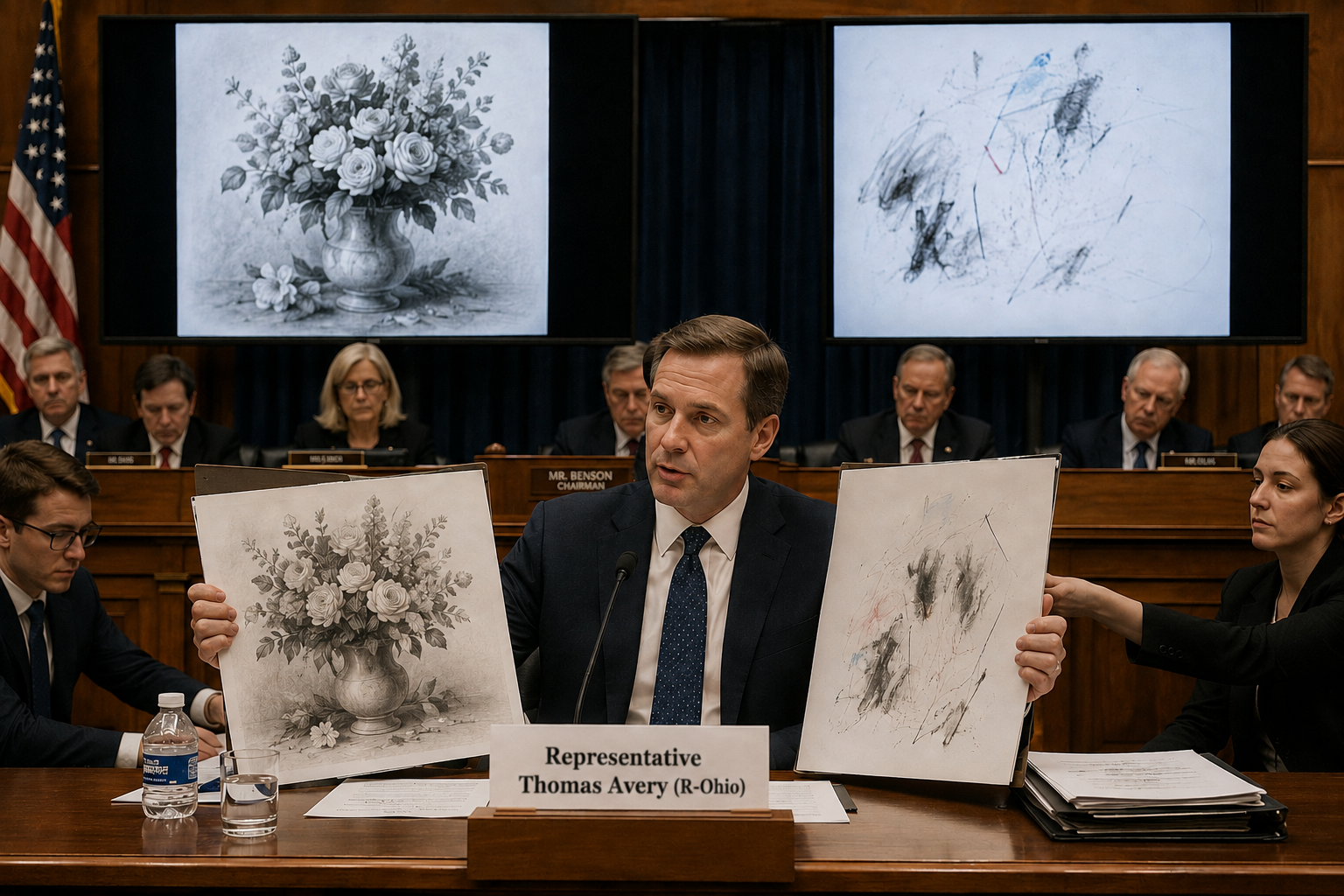
Representative Thomas Avery (R-Ohio) requested recognition before the committee called its first witness.
Holding up a leather portfolio, he addressed the room in measured tones.
"Mr. Chairman, members of the committee, this hearing is not about whether abstract art belongs in museums. Congress is not in the business of determining artistic taste, and I have no intention of asking this committee to rank Cubism against Impressionism or realism against conceptual art."
He opened the portfolio and removed two drawings.
"The issue before us is considerably narrower."
An aide placed enlarged reproductions of both drawings on display monitors positioned behind the witness table.
"The drawing on my right or on the left on the monitor was completed by a seventeen-year-old student after approximately eighteen months of instruction at a private atelier. The drawing on my left or on the right of the monitor was produced by a recent graduate holding both a Bachelor of Fine Arts and a Master of Fine Arts from an accredited American university."
Avery looked toward the witnesses.
"I have examined these portfolios repeatedly over the past several weeks."
He paused.
"One of these individuals has studied drawing for eighteen months. The other has completed six years of university art education. If I removed the artist statements and presented these works anonymously, I believe few Americans would identify the university graduate as having received the additional four and a half years of instruction."
The hearing room became noticeably quieter.
"The university graduate submitted seventy-three pages explaining the conceptual framework underlying the work."
He lifted a bound manuscript.
"The young student submitted no explanation whatsoever."
Avery placed the manuscript back on the table.
"The drawing explained itself."
He turned toward the witness panel.
"For centuries, artists who wished to depart from realism generally did so after mastering it. They understood anatomy before distorting it. They understood perspective before abandoning it. They understood light before choosing not to follow it."
He allowed another brief pause.
"My question is not why artists choose abstraction."
"It is when our universities decided that abstraction no longer required mastery."
Several members quietly exchanged glances.
"If an artist fully understands classical rendering and chooses another path, that is artistic freedom."
"If a graduate cannot produce a convincing drawing when asked because the skill was never taught, that is no longer an artistic choice."
He rested both hands on the witness table.
"It is an educational outcome."
Avery looked directly at the witnesses.
"I hope today's testimony will answer a simple question."
"When did American higher education conclude that explaining reality had become an acceptable substitute for learning to depict it?"
Chairman Harold Benson allowed the silence to linger for several moments before striking the gavel.
"The gentleman's question," he said, "goes to the very purpose of today's hearing."
Art Historian Describes a Century-Long Shift in Educational Priorities
Seeking historical context, the committee called Dr. Margaret Winslow, Professor of Art History at the National University of Administrative Sciences, whose research has focused on the evolution of fine arts education in Europe and North America.
Committee Chairman Harold Benson opened with a direct question.
"Professor, did universities simply stop teaching students how to draw?"
Winslow smiled politely.
"No, Mr. Chairman. That characterization would oversimplify a gradual historical process spanning more than a century."
She explained that for hundreds of years, Western art academies treated drawing as the indispensable foundation of artistic training.
"A student entering the École des Beaux-Arts in nineteenth-century Paris, or the Royal Academy in London, would spend years drawing plaster casts, studying anatomy, mastering perspective, and rendering light before being considered ready to paint major works. Technical proficiency was not viewed as one artistic option among many. It was considered the language through which all other artistic expression became possible."
Representative Avery asked whether Impressionism marked the beginning of the departure.
"It marked a change in emphasis, but not in competence," Winslow replied.
"Artists such as Claude Monet, Edgar Degas, Pierre-Auguste Renoir, and Vincent van Gogh altered color, brushwork, and visual perception, yet they remained deeply engaged with representing the observable world. Their work became more expressive, but it did not reject the importance of drawing."
The professor displayed a timeline prepared for the committee.
"The more consequential transition occurred gradually through the Post-Impressionists."
She pointed to successive entries.
"Paul Cézanne simplified natural forms into underlying geometric structures. Paul Gauguin flattened perspective while emphasizing symbolic color. Pablo Picasso and Georges Braque fragmented visual space through Cubism, although both possessed formidable academic drawing skills before departing from traditional representation."
Committee members followed the timeline silently.
"The pivotal philosophical transition," Winslow continued, "occurred with Marcel Duchamp."
She paused before continuing.
"Duchamp's work shifted the central question from 'How skillfully was this artwork executed?' to 'What qualifies as art in the first place?'"
Several members wrote notes.
"That was not merely a stylistic development," she said. "It represented a profound shift in the way artistic legitimacy could be established."
Representative Benson leaned forward.
"Professor, are you suggesting that technical mastery became unnecessary?"
"No, Mr. Chairman."
Winslow chose her words carefully.
"I am saying that over time, portions of the academic community increasingly recognized multiple pathways to artistic legitimacy. Once conceptual innovation itself became an accepted measure of artistic achievement, universities gradually expanded curricula devoted to conceptual practice."
She emphasized that the transition occurred unevenly.
"No federal directive required these changes. No national commission abandoned classical instruction. Individual departments revised curricula in response to evolving scholarship, faculty expertise, accreditation standards, professional incentives, and prevailing theories regarding the purpose of art education."
Representative Avery asked the question that had quietly emerged throughout the hearing.
"At what point did abstraction become something students were encouraged to pursue before mastering representation?"
Winslow folded her hands.
"There is no identifiable year."
"The evidence instead suggests a cumulative redistribution of instructional emphasis. During much of the twentieth century, many institutions continued teaching technical foundations while expanding conceptual instruction. By the late twentieth century, however, some programs increasingly regarded technical rendering as one valid methodology among many rather than the universally accepted prerequisite to advanced artistic study."
She glanced toward the committee.
"Historians generally describe this as an evolution in educational philosophy."
Economist Dr. Alan Prescott, seated behind the witness table, requested permission to add a brief observation.
"From an institutional perspective," Prescott said, "once technical mastery ceased to function as a universal prerequisite, universities could optimize around a considerably broader range of educational outcomes."
Professor Winslow nodded.
"That may well describe the administrative incentives. My testimony concerns the historical sequence rather than the institutional motivations."
Chairman Benson thanked both witnesses.
"The Committee appreciates the distinction."
The Office of Administrative Continuity later confirmed that the distinction between historical evolution and institutional incentive optimization would be examined by separate working groups "to avoid premature interdisciplinary convergence."
Universities Describe a Shift in Educational Priorities
University administrators rejected suggestions that standards had declined.
Instead, they argued that educational priorities had evolved alongside changing understandings of artistic purpose.
Dr. Elaine Morrison, Provost of Westbridge University, told lawmakers that modern programs increasingly emphasize meaning rather than replication.
"The contemporary academy recognizes multiple valid modes of artistic knowledge production," Morrison testified. "Technical rendering represents one historically significant methodology among many. Our objective is not merely to teach students how objects appear. It is to cultivate sophisticated interpretive relationships between observer, subject, culture, and visual experience."
Several committee members nodded politely while consulting briefing materials that appeared to define "visual experience" differently on consecutive pages.
Representative Thomas Avery asked whether graduates were still expected to draw realistic human hands.
Professor Adrian Keller, Chair of Comparative Epistemology at Westbridge University, cautioned against what he described as "premature assumptions regarding stable hand ontology."
"The committee's question presupposes that representation is necessarily privileged over interpretation," Keller explained. "Before discussing whether a hand has been rendered accurately, we should first examine the epistemological assumptions that allow one observer to privilege resemblance over conceptual authenticity."
A lengthy silence followed.
The official court reporter requested that Professor Keller repeat his final sentence more slowly.
Committee staff later confirmed that a transcript clarification working group had been established.
Technical Instructors Describe a Different Trend
Not all witnesses agreed that the issue involved philosophy alone.
Several retired instructors testified that technical requirements had gradually diminished because they were increasingly difficult to assess consistently across expanding university systems.
Former atelier instructor Margaret Elliot described changes she observed over four decades.
"When students learn perspective," Elliot said, "they either understand vanishing points or they don't. When they study anatomy, muscle attachments either affect the figure correctly or they don't. Technical instruction has measurable outcomes."
She contrasted those experiences with later academic trends.
"As evaluation shifted toward conceptual interpretation, assessment became progressively more dependent upon explanatory language accompanying the work."
Elliot emphasized that she supported artistic experimentation.
"I have absolutely no objection to abstraction. Every civilization has produced symbolic art. My concern is educational sequencing. Historically, artists first mastered representation before deciding what to abandon."
Her testimony prompted immediate discussion among committee members regarding whether technical competence should precede conceptual exploration, remain optional, or be considered itself an outdated educational assumption.
The Department of Sequential Approvals later confirmed that these questions would require separate jurisdictional review because they involved both curriculum policy and accreditation methodology.
Congressional Witnesses Expand the Scope of the Investigation
By the second day of hearings, committee staff had concluded that the original question of whether universities still taught classical drawing had become administratively inseparable from broader questions concerning accreditation, assessment, faculty hiring, and the evolving definition of artistic competence.
Committee counsel therefore expanded the witness list.
Rather than calling additional artists, lawmakers invited representatives from economics, engineering, philosophy, psychology, accreditation, and workforce development.
Officials described the revised schedule as "a comprehensive multidisciplinary stakeholder engagement initiative."
No one suggested returning to the original question.
Economists Ask Whether Institutions Responded Rationally
Dr. Alan Prescott, Senior Economist at the Center for Regulatory Excellence, testified that universities had likely responded rationally to the incentives surrounding higher education.
"Our preliminary analysis suggests that this may represent an equilibrium phenomenon rather than an educational failure."
He displayed a series of enrollment charts dating back forty years.
"Technical rendering is extraordinarily expensive to teach."
He explained that mastery requires thousands of hours of supervised practice, extensive faculty feedback, small class sizes, and evaluation against relatively objective standards.
"Conceptual instruction," Prescott continued, "permits significantly greater instructional scalability."
Several members leaned forward.
"Could you clarify what you mean by scalability?" asked Representative Benson.
"Certainly."
"An instructor can objectively determine whether perspective converges correctly."
He paused.
"It is considerably more resource-intensive to help thirty students correctly construct a human skull than to facilitate thirty discussions regarding the social construction of cranial symbolism."
The hearing room remained silent.
"The economic incentives are straightforward," Prescott continued.
"If institutional funding rewards graduation rates, enrollment stability, publication output, interdisciplinary research, and student satisfaction, curriculum gradually migrates toward activities that optimize those variables."
Representative Avery interrupted.
"Are you saying universities intentionally stopped teaching drawing?"
"No."
"I'm saying institutions generally optimize the incentives under which they operate."
Prescott adjusted his glasses.
"The remarkable feature is that no participant needs to intend the outcome."
Committee staff immediately requested an expanded economic impact assessment.
The Department of Administrative Affairs announced the formation of the Interagency Working Group on Incentive Alignment in Creative Disciplines.
Engineers Request an Operational Definition of Artistic Skill
The committee next heard testimony from Jefferson Institute of Technology professor Dr. Susan Nakamura, whose research focused on measurable human performance.
"Our difficulty," she explained, "is that Congress has not yet defined the performance specification."
She displayed a technical flowchart.
"If the federal government wishes to evaluate drawing instruction, measurable criteria must first exist."
Her proposed framework included observable competencies such as:
- accurate proportional relationships
- perspective construction
- anatomical consistency
- light source modeling
- material rendering
- compositional balance
"These are measurable," Nakamura said.
"They may not capture artistic greatness, but they can determine whether specific technical skills have been acquired."
Professor Adrian Keller immediately requested permission to respond.
"I appreciate Professor Nakamura's admirable commitment to operational clarity," Keller began, "however her framework implicitly privileges measurable phenomena over interpretive possibility."
He folded his hands.
"One cannot simply assume that proportional accuracy constitutes an objective category independent of historically contingent epistemic structures."
Nakamura looked toward the committee.
"I don't know what that means."
"It means," Keller replied calmly, "that your measurements presuppose conclusions which themselves require philosophical examination."
Nakamura glanced back at her diagrams.
"My measurements presuppose measurable outcomes."
The exchange occupied nearly forty minutes.
The committee subsequently voted unanimously to establish a Technical Definitions Subcommittee.
Accreditation Officials Discover an Unexpected Problem
Representatives from the National Council on University Accreditation testified that evaluating technical instruction had become increasingly difficult because institutions no longer agreed upon what constituted technical instruction.
One accreditor described reviewing a senior exhibition consisting of a completely empty gallery.
"The accompanying paper explained that the absence of images represented resistance to historically privileged visual expectations."
Representative Benson asked whether the student had demonstrated any drawing ability.
"We were informed," the accreditor replied carefully, "that requiring evidence of drawing competency would itself privilege drawing competency."
Committee members requested clarification.
The witness consulted several binders.
"Our evaluation standards require us to assess whether institutions successfully achieve their stated educational objectives."
"So you do not evaluate whether those objectives include drawing?"
"Correct."
"Who evaluates that?"
"The institutions determine their objectives."
Representative Avery looked around the hearing room.
"So universities determine whether drawing matters..."
"Yes."
"...and accrediting agencies determine whether universities successfully teach whatever universities decide matters?"
"That is substantially correct."
"...who determines whether anyone should teach drawing?"
The witness quietly turned another page.
"That question presently falls outside existing accreditation guidance."
Within the hour, the Office of Administrative Continuity announced a temporary guidance document that establishes the National Framework for Foundational Competency Terminology, pending further stakeholder consultation.
Consultants Recommend a Multi-Year Transformation Initiative
The afternoon concluded with testimony from Strategic Alignment Partners, one of several consulting firms retained by higher education associations.
Lead consultant Gregory Mills congratulated Congress for "recognizing the opportunity presented by this important transformational moment."
Rather than debating the merits of drawing, Mills recommended establishing a National Visual Competency Modernization Roadmap.
The proposal included:
- six regional stakeholder summits
- a three-year terminology harmonization initiative
- competency alignment metrics
- implementation scorecards
- quarterly transparency reports
- best-practice exchanges
- cross-sector advisory councils
- annual institutional resilience assessments
Representative Benson asked how long the transformation would require.
"Phase One," Mills replied, "is projected to conclude within thirty-six months."
"And after that?"
"We anticipate development of the implementation framework."
The consultant smiled reassuringly.
"Transformation is a continuous process."
Several universities immediately expressed support for the proposal, noting that implementation funding would significantly strengthen their capacity to study whether implementation funding should eventually be implemented.
The Investigation Expands Beyond Art Education
By the third week of hearings, committee staff privately acknowledged that the investigation had evolved into a broader examination of how institutions define competence.
Although the inquiry had begun with fine arts education, witnesses increasingly described similar transitions in architecture, industrial design, music, creative writing, and portions of the humanities.
The House Committee responded by creating the Interagency Commission on Foundational Competency Preservation, charging it with determining whether objective technical standards remained necessary before students advanced to conceptual specialization.
Committee officials emphasized that the commission's purpose was "strictly definitional."
Its initial report was expected within eighteen months.
No completion date was announced for the definitions.
Philosophers and Attorneys Reach Different Conclusions
The committee's final hearing produced perhaps its most technically sophisticated exchange.
Professor Adrian Keller returned to testify alongside constitutional attorney Rebecca Sloan and Jefferson Institute engineer Dr. Susan Nakamura.
Chairman Benson posed what appeared to be a straightforward question.
"What constitutes artistic competence?"
Professor Keller spoke first.
"The question presupposes that competence exists independently of the interpretive communities responsible for recognizing it. Before defining artistic competence, we must first determine whether competence possesses an objective ontology or whether it is recursively constituted through institutional recognition."
Attorney Sloan adjusted her microphone.
"Congress should exercise caution before adopting any statutory definition of competence."
She explained that a federally recognized definition might expose accreditation agencies, universities, licensing boards, museums, and grant organizations to litigation from institutions employing alternative pedagogical models.
"Any legally enforceable definition should be narrowly tailored, procedurally neutral, and sufficiently flexible to accommodate evolving educational methodologies."
Dr. Nakamura quietly slid a sketchbook across the witness table.
Inside was a graphite drawing of a bicycle.
"I'd simply ask applicants to draw one of these."
Representative Benson looked at the drawing.
Professor Keller looked at the assumptions underlying the drawing.
Attorney Sloan looked at the potential liability associated with the drawing.
The committee recessed for lunch.
During the recess, the Office of Regulatory Harmonization announced the formation of a multidisciplinary terminology panel to determine whether the phrase "draw a bicycle" required statutory clarification.
Museums Express Concern About Public Confidence
Museum directors told lawmakers that the investigation had unintentionally raised questions among visitors regarding how artistic works were evaluated.
"Our institutions support every period of artistic history," explained National Museum Association President Caroline Hughes.
"We display Renaissance paintings, Impressionism, Cubism, Abstract Expressionism, Minimalism, and contemporary conceptual works because each represents an important chapter in the history of visual culture."
She cautioned the committee against creating the impression that museums opposed technical excellence.
"The issue before Congress concerns educational sequencing, not artistic legitimacy."
Museum attendance data presented during the hearing showed no measurable change in visitor interest.
However, curators reported a sharp increase in questions such as:
"Did the artist know how to draw?"
"When did art schools stop teaching this?"
"Would this painting receive the same recognition without the description beside it?"
To address growing public curiosity, the National Council for Consumer Stability proposed developing standardized museum signage distinguishing historical technique from interpretive analysis.
The recommendation was immediately referred to the Office of Customer Expectation Alignment for stakeholder review.
Industry Responds With New Certification Standards
Within days of the hearings, several private organizations announced voluntary certification initiatives.
The Association of Responsible Stakeholders unveiled the Certified Foundational Skills Framework.
Participation would remain entirely voluntary.
Universities choosing to participate could earn designations including:
Foundation Verified
Technical Competency Partner
Classical Skills Committed
Interpretive Excellence with Foundational Certification
David Mercer, speaking on behalf of the Coalition for Sustainable Expectations, praised the initiative.
"Our members believe consumers benefit from educational transparency. Students deserve to understand whether a degree program emphasizes observational rendering, conceptual practice, or an integrated curriculum before making significant financial commitments."
Higher education associations welcomed the proposal while expressing concern that prospective students might incorrectly interpret technical competency as a measurable educational outcome.
To resolve the issue, the Institute for Strategic Compliance recommended the development of national disclosure standards that describe technical competency without implying that it possesses universally accepted characteristics.
A draft framework was expected following completion of the terminology review already underway at the Office of Regulatory Harmonization.
Officials estimated the two reviews would likely require a coordinating review.
Historian Says Artistic Standards Have Long Been Viewed as Indicators of Civilizational Health
The committee recalled Dr. Margaret Winslow, Professor of Art History at the National University of Administrative Sciences, as the morning's final witness.
Asked whether the current debate represented an isolated disagreement over educational philosophy, Winslow replied that historians have frequently viewed artistic standards as reflecting broader cultural trends.
"Mr. Chairman, for centuries historians, philosophers, and cultural critics have argued that the arts often reveal changes within a civilization before those changes become visible in politics, economics, or military affairs."
She emphasized that no universal consensus exists.
"I should be careful to note that this remains a philosophical interpretation rather than an empirical law of history. Nevertheless, it is a recurring theme in the literature."
Representative Avery requested clarification.
"What precisely is the argument?"
Winslow folded her hands.
"The argument is not that artistic styles become simpler."
"It is that civilizations sometimes begin shifting away from rewarding difficult, objectively demonstrable mastery toward rewarding symbolic interpretation whose value increasingly depends upon institutional explanation."
She continued.
"When technical excellence ceases to be the primary criterion of achievement, institutions gradually assume greater responsibility for explaining why a work deserves recognition. Some cultural historians have regarded that transition as an early indication that objective standards are yielding to institutional authority."
Several committee members looked toward one another.
"So the concern," Avery asked, "is not abstraction?"
"No, Congressman."
"The concern is educational sequence."
She paused.
"Historically, abstraction was generally something accomplished artists chose after mastering representation."
"The criticism advanced by some historians is that when mastery itself ceases to be regarded as foundational, institutions begin redefining excellence rather than producing it."
Representative Benson asked whether respected historians had actually advanced such arguments.
Winslow nodded.
"Yes, Mr. Chairman."
"Different scholars have expressed the idea in different ways. Some have argued that the arts provide one of the earliest visible indicators of deeper cultural transformations because artistic standards are often renegotiated before political or economic institutions visibly change."
She smiled slightly.
"One author described the arts as 'the canary in the coal mine of civilization.'"
The committee chamber remained quiet.
Dr. Alan Prescott, Senior Economist at the Center for Regulatory Excellence, requested permission to comment.
"From an economic perspective," Prescott said, "that hypothesis is at least consistent with institutional incentive theory."
He adjusted a chart before continuing.
"If objective standards become progressively more expensive to teach, evaluate, and maintain, institutions may gradually migrate toward standards that are less costly to administer."
Professor Winslow nodded.
"Whether that process constitutes cultural adaptation or cultural decline is precisely the question historians continue debating."
Chairman Benson thanked both witnesses.
"The committee appreciates the distinction."
Within the hour, the Office of Administrative Continuity announced formation of the Interdisciplinary Working Group on Civilizational Early Warning Indicators, noting that its charter would be strictly advisory and should not be interpreted as suggesting that civilization had entered any particular stage pending completion of a comprehensive stakeholder engagement process.
At press time, the Department of Administrative Affairs announced that the original congressional question, whether universities still teach students how to draw, had been temporarily suspended pending completion of twelve ongoing studies, four interagency coordination initiatives, three terminology harmonization projects, two stakeholder engagement frameworks, and the establishment of the Federal Office of Foundational Competency Alignment. Officials added that any conclusions regarding the long-term health of civilization would necessarily remain preliminary until the committee reached consensus on the historical definition of "mastery."
Sarah Collins
GFNN Washington Bureau
Recent Articles


-
The Gentle Night Friends Series
Aug 23, 26 03:38 PM
 The Gentle Night Friends Series is a collection of SEL children's stories.
 -
Senator Replaced Himself With Android: Committee Investigates
Aug 10, 26 12:32 PM
 Senator replaced himself with an android characterized as a "Legislative Productivity Surrogate," prompting a Judiciary Committee inquiry into voting, representation, AI autonomy, and constitutional p…
 -
Congress Opens Investigation Into the Decline of Music Education
Aug 03, 26 02:18 PM
Congress Opens Investigation Into the Decline of Music Education after educators report unexpected changes in student learning, prompting federal hearings, academic reviews, and industry responses.