

EXPERTS RECOMMEND SAME DIET FOR 47TH CONSECUTIVE YEAR, AWAIT DIFFERENT OUTCOME
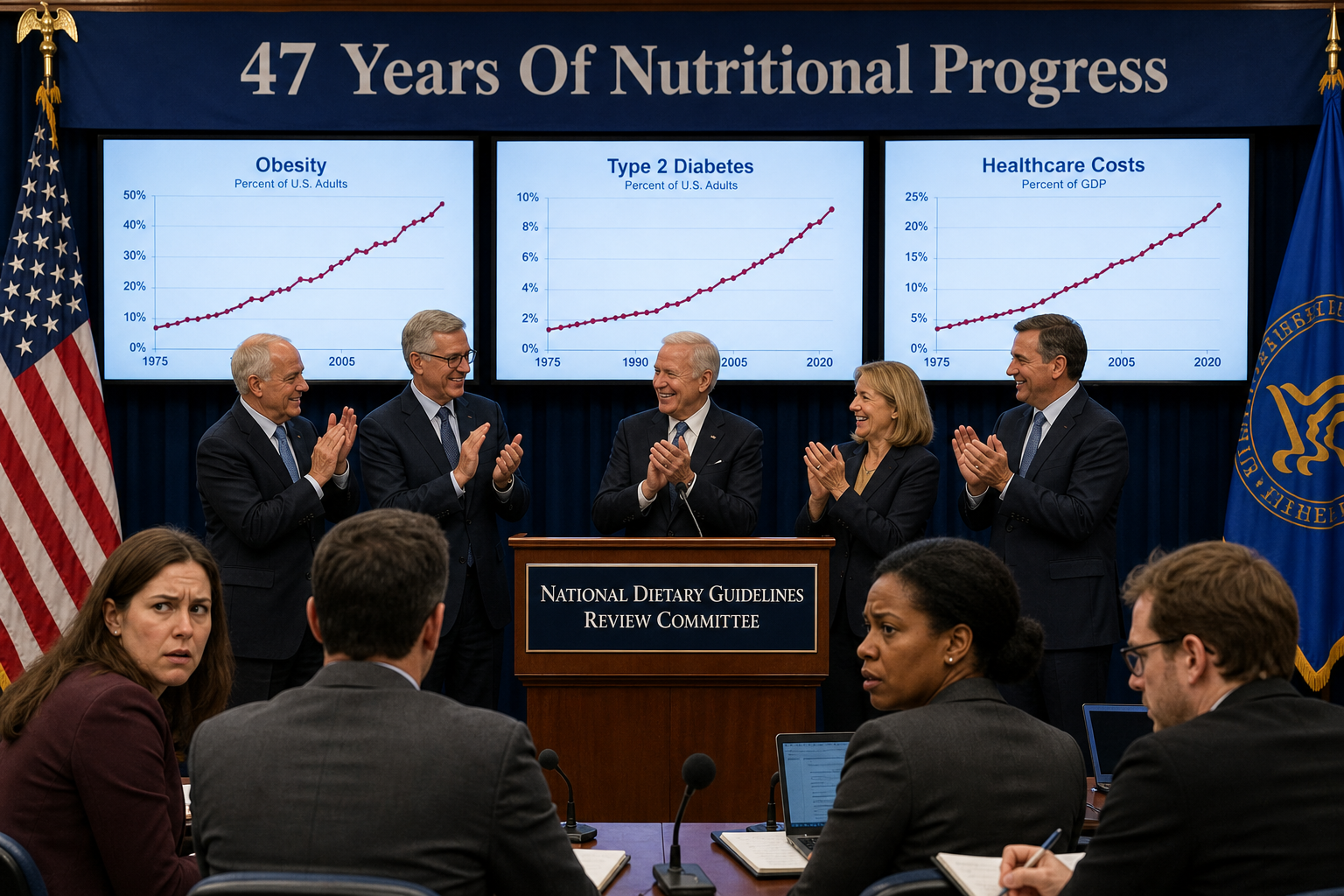
WASHINGTON, D.C. — Federal nutrition experts this week reaffirmed their support for the nation's dietary guidelines for the 47th consecutive year and expressed optimism that the expected results could begin appearing at any time.
The announcement was made during the Annual Conference on Nutritional Progress, where public health officials reviewed decades of rising obesity rates, increasing Type 2 diabetes diagnoses, and growing reliance on prescription medications before concluding that Americans should continue following the same general recommendations.
"The science is settled," one senior official told reporters. "The fact that the desired outcomes have not yet appeared should not be interpreted as evidence that the recommendations are incorrect. It simply means additional patience is required."
According to government data, Americans are heavier than ever, rates of Type 2 diabetes remain elevated, and healthcare spending on chronic disease continues to climb. Officials described these developments as disappointing but emphasized that they should not distract from the success of the guidelines themselves.
Researchers acknowledged that many low-fat products eventually contained enough added sugar to qualify as dessert, but stressed that this development should not be viewed as a setback.
"The important thing is that consumers avoided fat, even though they may not have needed to," one official explained. "Whether food processors replaced that fat with large quantities of sugar falls outside the scope of our success metrics."
Industry representatives from the food processing and pharmaceutical sectors applauded the guidelines for fostering a dynamic ecosystem of product innovation, consumer engagement, chronic disease management, and long-term shareholder value.
Representatives praised the guidelines for enabling unprecedented collaboration between the food processing and pharmaceutical industries.
"Few public policy initiatives have created this level of cross-sector synergy," said one executive. "One industry develops highly palatable low-fat products, while the other develops innovative therapies to help manage the resulting health conditions. It's a textbook example of integrated value creation."
"The dietary guidelines created an entire ecosystem of opportunity," said one industry representative. "We prefer not to think in terms of problems and solutions. We think in terms of recurring customer engagement."
"When consumers demanded low-fat products, we responded," said a spokesperson for the processed food industry. "Removing fat was relatively easy. Making the products taste good afterward required additional creativity."
That creativity reportedly included adding sugar, corn syrup, refined starches, maltodextrin, fruit concentrates, sweeteners, flavor enhancers, and numerous proprietary solutions designed to optimize consumer satisfaction metrics.
Several attendees noted that supermarket shelves soon became filled with low-fat cookies, low-fat snack cakes, low-fat frozen desserts, low-fat breakfast cereals, and low-fat yogurt products containing enough sugar to keep a kindergarten class awake until dawn.
Officials characterized this development as evidence that the private sector had embraced the spirit of the guidelines.
"Our mandate was to reduce fat," another expert explained. "We are pleased to report that food processors successfully removed fat from many products and replaced it with sugar, which was technically not fat."
Asked whether the guidelines themselves might deserve reexamination after nearly five decades of mixed outcomes, experts urged caution.
"Forty-seven years is a relatively short period in scientific terms," said one researcher. "We should avoid jumping to conclusions before the long-term data are available."
When reporters pointed out that nearly half a century of data already existed, the researcher clarified that he was referring to future long-term data.
The conference concluded with the announcement of a new federally funded initiative designed to determine why previous federally funded initiatives had not produced the expected results.
The project will spend three years examining whether Americans followed the dietary guidelines incorrectly, insufficiently, or with an inappropriate attitude.
Officials expressed confidence that the study will identify important lessons that can be incorporated into the next edition of the dietary guidelines.
At press time, researchers were considering a groundbreaking proposal to recommend the same diet for an additional 47 years while awaiting different outcomes.
Click here for more genuine fake news.
Recent Articles


-
The Gentle Night Friends Series
Aug 23, 26 03:38 PM
 The Gentle Night Friends Series is a collection of SEL children's stories.
 -
Senator Replaced Himself With Android: Committee Investigates
Aug 10, 26 12:32 PM
 Senator replaced himself with an android characterized as a "Legislative Productivity Surrogate," prompting a Judiciary Committee inquiry into voting, representation, AI autonomy, and constitutional p…
 -
Congress Opens Investigation Into the Decline of Music Education
Aug 03, 26 02:18 PM
Congress Opens Investigation Into the Decline of Music Education after educators report unexpected changes in student learning, prompting federal hearings, academic reviews, and industry responses.