
Federal Review Of Governance Procedures Triggered By Homework Assignment
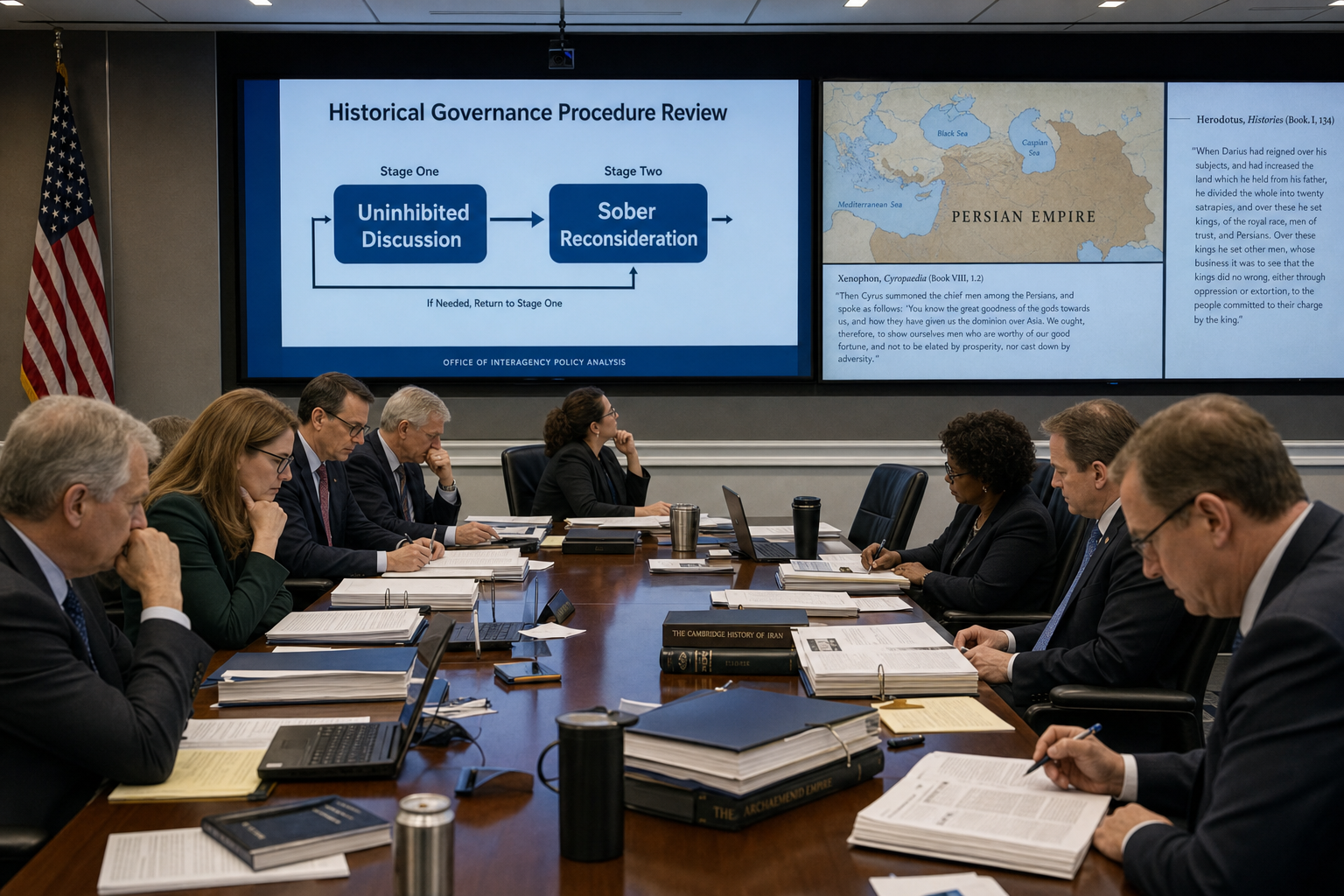
Federal Review Of Governance Procedures Triggered By Homework Assignment examines how a student's history assignment unexpectedly launched a growing federal governance review.
GFNN continues to support legacy information delivery technologies, including written language. The following is the text version of today's report.
Compliance Notice: Reading this report may result in exposure to uninterrupted institutional reasoning.
By Sarah Collins
GFNN Washington Bureau
WASHINGTON — A routine middle school history assignment has prompted an expanding federal review into whether governance procedures described in ancient historical sources warrant limited evaluation within modern legislative institutions.
Officials emphasized throughout the week that the review should not be interpreted as a recommendation to alter existing legislative practices.
Instead, they described the initiative as "an evidence-based examination of historically documented governance methodologies possessing potential procedural relevance under contemporary administrative conditions."
The review reportedly began after Representative Harold Benson attempted to assist his eighth-grade daughter with a history assignment concerning governmental practices in the ancient Persian Empire.
According to congressional staff members, Benson encountered an account attributed to the Greek historian Herodotus describing a Persian custom in which important governmental decisions were reportedly discussed while drinking alcohol, reconsidered while sober the following day, and adopted only if they appeared equally sound under both conditions.
Staff members familiar with the matter said Benson initially assumed the passage represented either a misunderstanding or an unusually creative interpretation found in modern educational materials.
"He simply wanted to verify whether the account reflected a genuine historical tradition," a congressional aide said.
"No legislative action whatsoever was contemplated."
Benson, whose longstanding appreciation for "a good beer after committee meetings" has been affectionately acknowledged by colleagues from across the political spectrum for many years, reportedly forwarded the question to staff members requesting background information before helping his daughter complete the assignment.
Within forty-eight hours, the inquiry had expanded beyond a simple historical clarification.
Researchers from the Congressional Research Service prepared a preliminary memorandum summarizing classical sources, scholarly disagreements regarding their interpretation, and comparative governance practices documented throughout the ancient world.
The memorandum concluded that while historians continue debating the precise accuracy of Herodotus' account, the practice itself has remained the subject of sustained academic discussion for centuries.
That conclusion attracted the attention of the Department of Administrative Affairs.
Federal Review Of Governance Procedures Triggered By Homework Assignment Expands
Deputy Undersecretary Karen Whitmore confirmed that the Department initiated what she characterized as "a limited interdisciplinary assessment intended to determine whether an ancient governance practice may possess overlooked administrative relevance."
Whitmore said the Department's interest extends well beyond the historical account itself.
"Our responsibility is to determine whether intelligent governments occasionally discover effective institutional practices long before they possess the scientific vocabulary to explain why those practices work."
She noted that many modern administrative procedures evolved through experience before later generations developed theoretical explanations for them.
"The question before us is not whether the reported Persian practice appears unusual by contemporary standards."
"The question is whether it was intended to solve a governance problem that modern institutions continue attempting to solve today."
Whitmore stressed repeatedly that no recommendations had been made.
"The current activity consists exclusively of historical research, interdisciplinary consultation, behavioral analysis, and preliminary framework development."
Officials later clarified that framework development should not be interpreted as anticipating implementation.
Rather, they explained, evaluating a governance process requires first identifying the institutional problem the process was intended to address.
"If the historical account proves substantially accurate," one Department memorandum stated, "the reported practice should be evaluated as an integrated decision-making procedure rather than as two isolated meetings separated by one evening."
The clarification was distributed in a fourteen-page guidance document jointly prepared by the Office of Administrative Continuity and the Department of Sequential Approvals.
Historians Offer Unexpectedly Qualified Testimony
The Department subsequently invited historians specializing in the ancient Near East to participate in what officials described as a Historical Governance Applicability Symposium.
Professor Elaine Morris of Westbridge University cautioned participants against treating the writings of Herodotus as either mythology or a procedural handbook.
"Ancient historical writing combines observation, interpretation, cultural commentary, and rhetorical purpose," Morris explained.
"Our responsibility is to understand what Herodotus believed he observed, what the Persians may actually have practiced, and what later generations have inferred from his account."
She noted that historians continue debating the reliability of individual passages while broadly agreeing that Herodotus often preserved valuable descriptions of societies unfamiliar to his Greek audience.
Representative Benson asked whether the reported Persian governance practice should therefore be considered historically accurate.
"History rarely organizes itself around questions permitting simple certainty," Morris replied.
"We can reasonably conclude that Herodotus believed the practice sufficiently noteworthy to record."
"Whether every detail reflects routine administrative procedure is considerably more difficult to establish."
Morris cautioned the Department against approaching the question as an attempt to verify a single historical anecdote.
"The more useful question," she said, "is whether the reported practice reflects a recognizable philosophy of governance within the broader Persian administrative tradition."
Professor Adrian Keller, Chair of Comparative Epistemology at Westbridge University, suggested that the review had already begun evolving beyond its original historical purpose.
"The Department appears to be asking two separate questions," Keller observed.
"The first is historical."
"Did the Persians actually employ such a procedure?"
"The second is institutional."
"If they did, what problem did they believe the procedure was solving?"
Keller argued that the second question might ultimately prove more significant than the first.
"History tells us what people reportedly did."
"The behavioral sciences may eventually explain why they considered it worth doing."
Officials later described Keller's testimony as "helpfully clarifying" while acknowledging that several participants requested additional explanation regarding the distinction between historical evidence and institutional inference.
Representative Benson appeared only briefly before the symposium.
"I was just helping my daughter with homework," he said.
"I honestly thought we'd finish the assignment before dinner."
Department officials thanked Benson for his cooperation and confirmed that the original homework assignment had now generated four technical memoranda, two interdisciplinary working groups, one historical symposium, and a recommendation for additional behavioral research.
Interagency Review Rapidly Broadens Beyond Original Historical Question
Within two weeks, the Department of Administrative Affairs announced the formation of the Interagency Working Group on Historical Governance Practices after officials concluded that evaluating the reported Persian procedure required expertise extending well beyond classical history.
Participating organizations include the Department of Sequential Approvals, the Office of Unintended Consequences, the Bureau of Predictable Outcomes, the National University of Administrative Sciences, and the Center for Behavioral Decision Sciences.
Officials emphasized that each organization had been assigned responsibility for examining a different aspect of the historical account.
Deputy Undersecretary Karen Whitmore said the review had already moved beyond the question that originally prompted Representative Benson's inquiry.
"Our responsibility is no longer determining whether an ancient society consumed alcohol while discussing public affairs," Whitmore said.
"Our responsibility is determining whether they intentionally developed a governance process designed to obtain more candid discussion before applying disciplined collective judgment."
Whitmore noted that modern governments devote substantial resources to reducing the effects of groupthink, authority bias, organizational hierarchy, and conformity pressure.
"We employ committee structures, public hearings, independent review panels, anonymous reporting systems, stakeholder engagement, outside consultants, structured dissent exercises, and numerous other procedural safeguards intended to encourage honest evaluation."
She said the reported Persian practice appeared to pursue the same objective using a markedly different administrative design.
"If the historical account is substantially accurate," Whitmore said, "the Persians may have recognized that people often say what they think privately but something else publicly."
"The reported procedure appears intended to narrow that gap."
Whether the process actually produced better governance, she emphasized, remains an empirical question requiring careful interdisciplinary study.
The Department subsequently issued Temporary Guidance 26-114 advising federal agencies not to establish independent demonstration programs pending completion of the review.
The guidance also requested that personnel refrain from referring to the initiative as "the beer study."
"That description," the guidance noted, "has demonstrated a measurable tendency to shorten conversations that otherwise become considerably more interesting."
Behavioral Scientists Expand The Scope Of The Federal Review
As the federal review continued, the Department of Administrative Affairs convened behavioral scientists, cognitive psychologists, organizational psychologists, and mental health researchers to examine the psychological mechanisms underlying the reported Persian governance practice.
Deputy Undersecretary Karen Whitmore said the panel had been assembled to answer a single question.
"If the historical account is substantially accurate," Whitmore said, "why would intelligent people intentionally structure an important decision-making process in this manner?"
Dr. Susan Ramirez, Director of Organizational Psychology at the Center for Behavioral Decision Sciences, testified that modern organizations routinely underestimate the influence of social inhibition on group decision-making.
"People do not always say what they believe."
"They say what they believe is appropriate to say."
Ramirez explained that concerns about professional reputation, organizational hierarchy, political consequences, and social acceptance often discourage participants from expressing criticism, unconventional ideas, or fundamental objections during important discussions.
"Every large organization struggles with conformity pressures."
"Individuals routinely suppress observations that could improve decisions."
According to Ramirez, the Persian practice described by Herodotus appeared designed to temporarily suspend those social constraints.
"Alcohol lowers behavioral inhibition."
"People become substantially more willing to disagree, criticize, speculate, challenge authority, and voice ideas they would ordinarily keep to themselves."
"The following day, when everyone was sober again, those ideas could be evaluated on their merits."
Ramirez described the process as "institutionalized uninhibited brainstorming followed by disciplined quality control."
Dr. Michael Chen, Professor of Social Psychology at the National University of Administrative Sciences, said modern organizations devote enormous resources attempting to achieve similar outcomes.
"We conduct anonymous surveys."
"We appoint devil's advocates."
"We establish red teams."
"We hire outside facilitators."
"We invest in psychological safety initiatives."
"We create independent review panels."
"All of these are attempts to reduce the effects of groupthink."
Chen suggested that the reported Persian procedure may represent one of history's earliest systematic attempts to accomplish the same objective.
"The remarkable feature is not that they got drunk."
"The remarkable feature is that they intentionally paired uninhibited discussion with mandatory sober reconsideration."
"The first meeting generated ideas."
"The second meeting made decisions."
Dr. Evelyn Brooks, a clinical psychologist specializing in organizational behavior, testified that the two-stage structure distinguished the reported practice from ordinary drinking.
"If the historical account is accurate, the Persians were not relying on intoxication to make better decisions."
"They were relying on intoxication to obtain more honest information."
"The decision itself remained subject to sober judgment."
Brooks noted that contemporary behavioral science has repeatedly demonstrated the difficulty organizations experience obtaining candid criticism from highly intelligent people operating within established hierarchies.
"People routinely edit themselves."
"They avoid offending respected colleagues."
"They hesitate to challenge emerging consensus."
"They frequently recognize weaknesses they never mention aloud."
She described the reported Persian procedure as "an elegant institutional solution to a problem that modern organizations continue attempting to solve through increasingly elaborate administrative processes."
Following the testimony, Deputy Undersecretary Whitmore announced that the Department would expand its review to include current research on groupthink, conformity bias, behavioral inhibition, organizational candor, and institutional decision-making.
"What began as a historical inquiry," Whitmore said, "has become an examination of whether an ancient civilization identified a practical method of obtaining unfiltered institutional feedback before applying disciplined collective judgment."
Economists, Consultants, And Engineers Immediately Complicate The Review
As the review expanded, specialists from economics, organizational behavior, engineering, and management science were invited to brief the Interagency Committee on Strategic Coordination.
Dr. Alan Prescott, Senior Economist at the Center for Regulatory Excellence, cautioned officials against interpreting the reported Persian practice as primarily concerning alcohol.
"From an economic perspective," Prescott said, "the historical procedure appears to alter incentive structures rather than cognitive ability."
He explained that legislative bodies naturally reward consensus, institutional loyalty, and social conformity.
"Individuals frequently recognize weaknesses in proposals they nevertheless hesitate to express."
"The historical procedure may have functioned by temporarily reducing the social costs associated with disagreement."
Prescott suggested that requiring proposals to survive both uninhibited discussion and subsequent sober reconsideration could represent an unexpectedly sophisticated form of institutional quality control.
"The value may not lie in the intoxication."
"It may lie in creating an environment where participants become temporarily less concerned with hierarchy, reputation, and interpersonal consequences before subjecting those same ideas to fully sober evaluation."
Researchers from the National University of Administrative Sciences described the possibility as "behaviorally induced perspective diversification."
Their preliminary paper suggested that modern organizations routinely struggle with groupthink, authority bias, and premature consensus despite extensive procedural safeguards.
"If the historical account is substantially accurate," the report stated, "the Persians may have unintentionally developed a practical mechanism for separating uninhibited idea generation from disciplined decision making."
Operational Excellence Advisors quickly responded by presenting what Managing Partner Rebecca Collins called a Preliminary Cognitive Diversity Governance Framework.
"Our objective is not to modernize alcohol consumption," Collins explained.
"Our objective is to determine whether contemporary institutions can reproduce the beneficial organizational effects while minimizing unnecessary operational variables."
Her proposal outlined six implementation phases involving anonymous proposal generation, structured dissent sessions, rotating devil's advocates, independent review panels, executive dashboards, stakeholder engagement initiatives, and quarterly optimization assessments.
Committee members observed that the proposed modernization framework no longer contained any alcohol.
Collins agreed.
"We believe the underlying governance architecture may be transferable even if one historical implementation variable proves unnecessary."
Engineers from the Jefferson Institute of Technology reached a different conclusion.
Professor David Lin argued that behavioral explanations remained incomplete.
"In engineering," Lin testified, "independent verification requires genuine independence."
He cautioned that merely conducting two reviews under ordinary committee procedures would not satisfy that requirement.
"If the Persian practice achieved anything," Lin said, "it may have done so precisely because the two evaluations occurred under materially different cognitive conditions."
"The engineering question is not whether alcohol was desirable."
"It is whether removing that variable also removes the independence that made the verification meaningful."
The testimony prompted the Department of Administrative Affairs to commission a Comparative Decision Independence Assessment examining whether contemporary institutions possess practical methods of reproducing the reduction in social inhibition described by behavioral researchers without introducing unnecessary operational complications.
Officials estimated the study would require approximately eighteen months, while acknowledging that the estimate remained subject to independent review.
Ethics Officials Conclude Beer Preference Requires Administrative Safeguards
Meanwhile, the Office of Government Ethics announced that Representative Benson had voluntarily disclosed what officials described as "a longstanding and publicly observable appreciation for moderate beer consumption."
The disclosure immediately generated a Conflict-of-Interest Clarification Memorandum.
Ethics Director Laura Simmons emphasized that Benson had neither proposed nor advocated adoption of the Persian practice.
"He asked whether a historical account was accurate while helping his daughter complete a homework assignment."
"That remains the entirety of the initiating event."
Nevertheless, Simmons recommended that Benson refrain from participating in any future hearings concerning alcoholic governance methodologies "to preserve public confidence in the impartiality of the review."
The recommendation was unanimously accepted.
Representative Benson issued a brief written statement.
"I understand the importance of avoiding even the appearance of impropriety."
"I'll continue helping with math homework instead."
Officials later confirmed that no federal reviews had yet resulted from mathematics assignments.
The Department added that it was "monitoring the situation."
Universities Broaden The Federal Review
As federal agencies continued their review, universities began publishing independent analyses examining the reported Persian practice through the disciplines of history, behavioral science, organizational psychology, and public administration.
Researchers at the National University of Administrative Sciences concluded that modern governments already recognize the value of separating idea generation from final decision-making.
"The legislative process itself reflects repeated reconsideration," the report stated.
"Committee hearings, fiscal scoring, public comment periods, legal review, executive consideration, and judicial interpretation all function as successive opportunities to determine whether an initially attractive proposal continues to withstand independent evaluation."
Researchers concluded that the reported Persian procedure appeared to pursue the same objective while introducing an additional element largely absent from contemporary governance.
"It appears specifically designed to obtain information that participants might otherwise decline to provide."
Professor Adrian Keller of Westbridge University praised the report while cautioning that the federal review may have begun with the wrong research question.
"If Herodotus substantially described the practice correctly," Keller said, "the interesting question is not whether the Persians drank."
"It is whether they intentionally incorporated temporary social disinhibition into the legislative process."
Keller said the reported practice should not be reduced to a primitive substitute for modern feedback systems.
“The structure matters,” Keller said.
“The first session appears to have lowered the social cost of saying the thing everyone may already have suspected but no one wished to say first.”
“The second session prevented that lowered inhibition from becoming the decision itself.”
He said modern institutions often attempt to make formal settings more candid while preserving all the reputational pressures that make candor difficult in the first place.
“We ask people to speak freely in rooms where speaking freely remains professionally consequential.”
Keller described the Persian procedure, if accurately reported, as a deliberate separation of disclosure and judgment.
“One meeting produced unfiltered information.”
“The next meeting determined whether that information deserved authority.”
Department officials later described the distinction as “administratively inconvenient,” because it suggested that conventional feedback processes may collect only the portion of candor participants consider safe to disclose.
Keller further observed that repeated review does not necessarily produce independent review.
"If everyone continues worrying about the same reputational consequences, organizational incentives, and political relationships," he said, "multiple reviews may simply reproduce the same conversation several times."
The Department of Administrative Affairs described Keller's testimony as "conceptually significant" and announced that the review would expand to include current research on groupthink, behavioral inhibition, organizational candor, conformity bias, and institutional decision-making.
Officials emphasized that the expanded review should not be interpreted as delaying completion of the original assessment.
"It merely increases the number of disciplines, advisory panels, and implementation questions requiring coordination before the Department can determine whether the Persians accidentally solved a problem that modern governments continue attempting to manage through significantly more complicated means."
Professional Organizations Seek Role In Continuing Review
As discussion of the reported Persian practice shifted toward behavioral science and organizational decision-making, professional organizations began urging the Department to ensure that any future research reflected contemporary institutional realities.
The Association of Responsible Stakeholders cautioned against assuming that candid discussion necessarily produces better governance.
"Modern institutions exist to balance candor with professionalism," spokesman David Mercer said.
"The spontaneous expression of genuine opinion represents only one stakeholder perspective."
The Institute for Strategic Compliance urged officials to recognize that contemporary organizations have invested decades developing procedures intended to encourage constructive disagreement while minimizing unnecessary organizational disruption.
"Those systems should not be displaced merely because an ancient civilization appears to have solved a similar problem using considerably fewer policy documents."
The International Council for Administrative Excellence announced the formation of a voluntary working group to develop Best Practices for Historically Informed Governance Evaluation.
Officials said the initiative would begin by identifying which aspects of the reported Persian procedure should be considered culturally specific and which might represent transferable principles of organizational behavior.
Consulting firms responded by announcing several executive seminars on "Authentic Organizational Candor."
One promotional brochure described the programs as providing "many of the perceived benefits of ancient governance methodologies without requiring participants to become unexpectedly honest."
The brochure was later revised following feedback from corporate clients.
Agencies Begin Planning Despite Absence Of Recommendation
Although no agency has recommended implementing the reported Persian governance procedure, planning activity continued expanding throughout the federal government.
The Department of Sequential Approvals confirmed that it had begun drafting contingency guidance outlining how a limited demonstration project might be authorized should Congress eventually request one.
Officials emphasized that preparing implementation procedures should not be interpreted as anticipating implementation.
"It is simply prudent administrative planning," one department spokesman explained.
"If policymakers eventually request a pilot program, it would be inefficient to begin determining how to conduct the pilot after Congress had already requested that it be conducted."
The Office of Administrative Continuity acknowledged that the planning effort had already identified several operational questions requiring preliminary guidance.
Among them were whether the uninhibited discussion and the subsequent sober review should occur on consecutive days, whether identical participants should attend both sessions, how proposals withdrawn before the second meeting should be documented, and whether comments made during the uninhibited session should become part of the permanent legislative record.
The Office also confirmed that software developers had begun evaluating whether existing legislative tracking systems could accommodate what internal planning documents describe as "Sequential Dual-State Deliberative Events."
Engineers stressed that no software development had begun.
"We're currently attempting to determine whether a proposal discussed on Tuesday evening and formally reconsidered on Wednesday morning should be treated as one meeting, two meetings, or one meeting with two temporally distinct cognitive phases."
The uncertainty, officials acknowledged, affected committee scheduling, document retention requirements, version control, parliamentary procedure, and electronic archiving standards.
The preliminary technical assessment currently exceeds four hundred pages.
Department officials said the document should not be interpreted as evidence that implementation is being considered.
"It merely reflects the administrative complexity associated with determining how one might someday evaluate the administrative complexity of a procedure that has not been recommended."
Federal Review Concludes Additional Study Is Warranted
Following several weeks of consultation with historians, behavioral scientists, psychologists, organizational researchers, public administration experts, and other specialists, the Department of Administrative Affairs released its Preliminary Assessment of Historical Governance Procedures.
The report emphasized that the review produced no recommendation regarding implementation.
Instead, officials concluded that the reported Persian practice had proven substantially more sophisticated than originally anticipated.
Deputy Undersecretary Karen Whitmore said the Department had originally expected historians to determine whether the account attributed to Herodotus was historically reliable.
"Instead," Whitmore said, "our experts began asking why an intelligent civilization would intentionally organize an important governmental procedure in this manner."
She said the review gradually shifted from history to institutional behavior.
"Our historians reminded us that ancient sources rarely function as procedural manuals."
"Our behavioral scientists examined whether the reported practice may have been intended to reduce social inhibition and groupthink."
"Our psychologists evaluated the relationship between uninhibited disclosure and sober judgment."
"Our public administration researchers compared the reported procedure with contemporary methods of encouraging candid institutional feedback."
"Our engineers and economists subsequently examined whether such a process could be evaluated using modern analytical methods."
Whitmore said the Department considered the progression itself significant.
"The review ceased being about ancient Persia."
"It became an inquiry into whether modern institutions continue struggling with the same organizational problem the Persians may have been attempting to solve."
According to the report, historians cautioned against assuming every detail recorded by Herodotus reflected routine governmental practice.
Behavioral scientists reached a different conclusion.
They argued that if the account is substantially accurate, the Persians appear to have recognized that people frequently withhold their genuine opinions in formal settings because of hierarchy, reputation, political relationships, and social expectations.
"The reported procedure," one summary stated, "appears designed to obtain unusually candid discussion before subjecting those same ideas to disciplined collective judgment."
Psychologists further observed that contemporary institutions devote substantial resources to encouraging honest feedback while preserving professional relationships.
The report concluded that the Persian procedure, if accurately described, represented a notably different solution to the same underlying behavioral problem.
Engineers characterized the reported practice as a governance system employing two deliberately distinct deliberative environments.
Economists examined whether improving the quality of information entering the legislative process might reduce the long-term costs associated with policy errors.
Management consultants submitted preliminary implementation frameworks exceeding three hundred pages while acknowledging that no recommendation regarding implementation had been made.
Department reviewers noted that the consultants had nevertheless succeeded in identifying fourteen additional stakeholder groups requiring future consultation.
Whitmore said every participating discipline had addressed the Department's original inquiry professionally and competently.
"The difficulty," she explained, "is that each profession identified additional questions requiring experts from other professions."
The Department concluded that the review had expanded beyond what could reasonably be resolved through administrative analysis alone.
Officials therefore recommended that Congress consider holding informational hearings to determine whether the historical practice, the behavioral science supporting it, and the practical challenges associated with evaluating it warranted further legislative examination.
The recommendation emphasized that Congress should not interpret the report as support for implementing an ancient Persian governance procedure.
Rather, the Department concluded that before determining whether the Persians had discovered an administratively valuable method of obtaining candid institutional feedback, lawmakers would first need to determine whether modern government remained willing to ask how much of its existing decision-making process depended upon people politely withholding what they actually thought.
At Press Time
At press time, Representative Benson confirmed that his daughter had received an A on her history assignment, while the Department of Administrative Affairs announced the formation of an Interagency Homework Impact Assessment Working Group to determine whether future student research projects should include advance notification requirements for federal agencies whose long-term administrative planning might reasonably be affected.
Recent Articles


-
The Gentle Night Friends Series
Aug 23, 26 03:38 PM
 The Gentle Night Friends Series is a collection of SEL children's stories.
 -
Senator Replaced Himself With Android: Committee Investigates
Aug 10, 26 12:32 PM
 Senator replaced himself with an android characterized as a "Legislative Productivity Surrogate," prompting a Judiciary Committee inquiry into voting, representation, AI autonomy, and constitutional p…
 -
Congress Opens Investigation Into the Decline of Music Education
Aug 03, 26 02:18 PM
Congress Opens Investigation Into the Decline of Music Education after educators report unexpected changes in student learning, prompting federal hearings, academic reviews, and industry responses.