Federal Review Ordered Into Quality Control Failures Across Legacy Satire Sector
The Federal Review Ordered Into Quality Control Failures Across Legacy Satire Sector examines a nationwide government review into declining institutional satire and its expanding regulatory response.
GFNN continues to support legacy information delivery technologies, including written language. The following is the text version of today’s report.
Compliance Notice: This report has been optimized for uninterrupted reading.
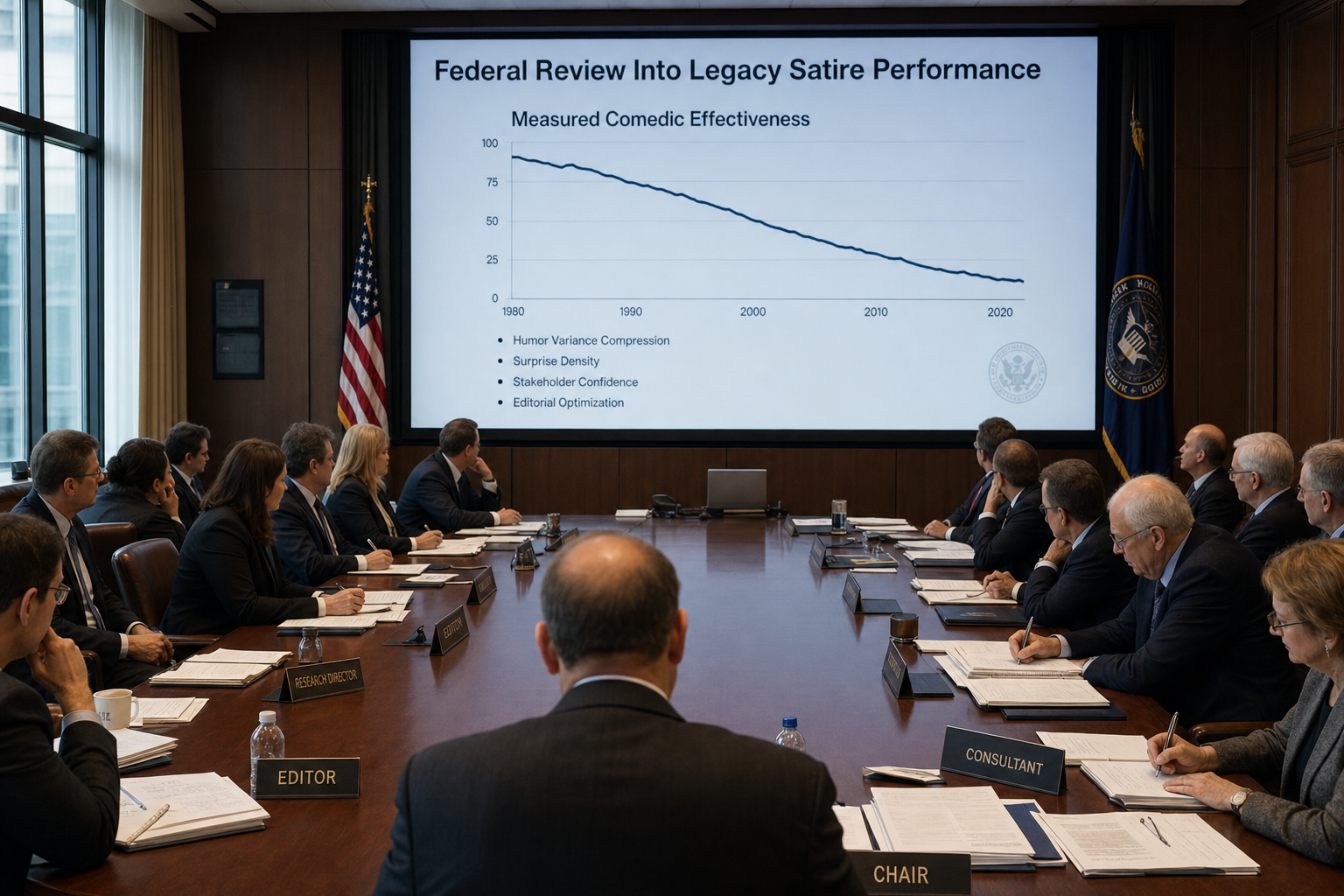
The Department of Administrative Affairs confirmed that the Federal Review Ordered Into Quality Control Failures Across Legacy Satire Sector has been formally elevated to a Tier-3 Interagency Performance Recovery Initiative following broad agreement that legacy satire has experienced a sustained decline in measurable comedic effectiveness.
Deputy Undersecretary Karen Whitmore said the expansion reflects "the appropriate level of federal coordination for a quality-control issue with potentially broad downstream implications for public discourse, institutional confidence, organizational adaptability, and long-term societal resilience."
She emphasized that the Department is not suggesting the decline of legacy satire represents an immediate threat to national stability.
"However," Whitmore said, "historically healthy democratic societies have generally maintained a functioning capacity for competent self-parody."
"While additional research remains necessary, no participating agency believes it would be prudent to discover the lower operational limit of that capacity through uncontrolled national experimentation."
Whitmore stressed that the review concerns only one question.
"Why has legacy satire become progressively less funny?"
"What institutions choose to do with that answer is a separate matter."
According to internal briefing documents, agencies joined the initiative for markedly different reasons, each concluding that declining comedic performance had implications extending well beyond the publishing industry.
The Department of Sequential Approvals is examining whether increasingly complex editorial review procedures have unintentionally delayed jokes beyond their optimal deployment window, reducing comedic effectiveness before publication.
The Office of Customer Expectation Alignment is evaluating whether audience satisfaction surveys, readability metrics, accessibility objectives, and stakeholder confidence indicators have gradually displaced laughter as the industry's primary measure of success.
The Bureau of Predictable Outcomes has been tasked with modeling the relationship between procedural certainty, declining surprise density, and the long-term capacity of institutions to recognize their own administrative excesses before formal intervention becomes necessary.
Preliminary modeling suggests that sustained reductions in high-quality satire may gradually impair institutional self-correction by reducing opportunities for organizations to encounter reputational feedback in comparatively low-consequence environments.
The Institute for Strategic Compliance is conducting a comprehensive audit of editorial safeguards introduced over the past two decades to determine which have demonstrably improved legal defensibility, organizational resilience, reputational stability, and stakeholder confidence while simultaneously reducing measurable comedic effectiveness.
The National Office of Temporary Guidance has begun drafting voluntary implementation frameworks for publishers seeking to become measurably funnier without compromising existing governance, accessibility, inclusivity, compliance, or brand-safety standards.
The Center for Regulatory Excellence has begun developing national benchmarking criteria for humor performance while also reviewing historical evidence suggesting that societies capable of laughing at themselves have generally demonstrated greater institutional adaptability than those requiring formal authorization before acknowledging obvious absurdities.
Meanwhile, the Office of Administrative Continuity has been directed to identify historical periods during which editorial optimization first began consistently outperforming comic optimization.
Officials acknowledged that civilization has previously survived extended periods of mediocre satire.
They cautioned, however, that historical precedent should not be interpreted as an evidence-based long-term strategic framework.
The Interagency Committee on Strategic Coordination has been assigned responsibility for ensuring that all corrective initiatives remain procedurally aligned despite operating under substantially different administrative philosophies.
A technical appendix accompanying the review concludes that every participating organization independently reached essentially the same finding.
Legacy satire has not become less funny because editors forgot how to write jokes.
It has become less funny because modern editorial systems have become exceptionally successful at optimizing for nearly every objective except laughter.
Although each agency described the phenomenon using its own technical vocabulary, all agreed that humor had gradually become one performance metric among many—and rarely the one receiving final priority.
Economists participating in the review described the trend as an emerging "Humor Productivity Gap."
The report defines the gap as "the difference between statistically achievable laughter under available creative resources and observed laughter under existing institutional constraints."
Researchers cautioned that the finding should not be interpreted as an economic indicator.
"Its principal effect appears to be a gradual decline in national amusement efficiency," one briefing paper concluded.
"The broader macroeconomic implications remain uncertain."
Dr. Alan Prescott of the Center for Regulatory Excellence summarized what officials repeatedly described as an unusual degree of interdisciplinary consensus.
"Every institution represented here has successfully optimized exactly what it was established to optimize," Prescott said.
"The difficulty is that functioning societies occasionally depend upon outcomes that were never assigned to any individual institution."
He paused while reviewing the committee's draft findings.
"Historically," Prescott continued, "those outcomes have sometimes included laughter."
After another brief pause, he added:
"No individual organization caused this problem."
"Collectively, however, we have assembled one of the most administratively sophisticated systems ever developed for ensuring that nothing becomes substantially funnier than necessary."
Engineering Review Identifies Multi-Layer Tone Dampening Architecture
A joint technical assessment conducted by the Jefferson Institute of Technology and Applied Artificial Intelligence Corporation identified what researchers termed a "stacked editorial dampening architecture" across much of the legacy satire sector.
The report concluded that the observed decline in comedic performance does not represent an engineering failure.
Instead, it reflects the successful optimization of competing institutional objectives.
Dr. Melissa Harmon described the production process as a sequence of seven independent review layers.
"We observed topic selection, framing review, compliance pre-screening, tone moderation, legal exposure assessment, brand-safety optimization, and post-publication stakeholder harmonization operating as intended," Harmon said.
"Each review stage was introduced to solve a legitimate organizational problem."
She emphasized that no participating publisher had adopted the process with the intention of making satire less funny.
"The reduction in humor emerged gradually as an acceptable tradeoff," Harmon said.
"As editorial systems became increasingly successful at minimizing unnecessary controversy, reducing interpretive ambiguity, maintaining advertiser confidence, protecting institutional reputation, and ensuring broad audience accessibility, they also became progressively less dependent upon surprise, comic risk, and unresolved tension."
Researchers found no evidence that editors were unaware of the trend.
To the contrary, internal publishing documents frequently described reduced comedic intensity as evidence of editorial maturity.
One strategic planning memorandum obtained during the review stated that satire should seek to be "constructively engaging rather than disproportionately amusing."
Another recommended avoiding jokes that generated "laughter significantly exceeding audience expectations for professional discourse."
A third advised editors to consider whether a particularly successful joke might inadvertently "redirect attention away from the underlying messaging objectives."
Dr. Harmon said the findings suggest that most legacy satire organizations have quietly redefined success.
"In many contemporary editorial environments, making readers laugh is no longer the primary optimization target," she said.
"It remains an important consideration, but one that is routinely balanced against institutional stability, stakeholder inclusivity, reputational resilience, advertiser compatibility, and long-term brand trust."
The National Commission on Long-Term Planning agreed that removing any individual review layer would likely restore modest gains in comedic performance.
However, commissioners cautioned that doing so could also reduce "organizational confidence in downstream governance outcomes."
Instead, the Commission recommended exploring "controlled humor reintroduction strategies" that would allow publishers to become measurably funnier without exposing stakeholders to "unmanaged spontaneity."
GENERATIONAL HEARINGS AND TONE SYSTEM DIVISION
Elder Witness Panel Reports Decline in Comedic Surprise Density Across Institutional Timeframes
The Federal Bureau of Public Expectations convened an elder advisory panel as part of its longitudinal humor system benchmarking initiative.
Participants were asked to compare contemporary satire with the editorial environment they experienced during earlier decades.
Dr. Richard Ellison, 87, Professor Emeritus of Philosophy at Westbridge University, said the review appeared to confuse interpretive safety with comic effectiveness.
"Humor has always depended upon a certain amount of intellectual instability," Ellison testified.
"A joke temporarily invites the listener to inhabit one conceptual framework before unexpectedly replacing it with another. The pleasure arises from that transition."
He expressed concern that modern editorial systems increasingly attempt to resolve ambiguity before readers encounter it.
"When institutions begin managing interpretation in advance," Ellison said, "they inadvertently remove the epistemological discontinuity upon which much comedy depends."
Officials from the Bureau of Predictable Outcomes classified Ellison's testimony as "potentially significant" and requested a separate literature review into "epistemological discontinuity" before determining whether it could be standardized.
The committee also heard testimony from 81-year-old Frank Donnelly, a retired television comedy writer whose career spanned four decades.
"In our day," Donnelly said, "we'd spend three hours arguing over one sentence because somebody believed it could be two percent funnier."
He said editorial discussions increasingly appeared to focus on minimizing potential objections rather than maximizing laughter.
"Every meeting seems to have acquired someone whose job is explaining why the joke might not work," Donnelly testified. "I'm not sure anyone's still assigned to make sure it does."
Donnelly clarified that he supported careful editorial review.
"I've rewritten thousands of jokes," he said. "But there's a difference between polishing a joke and sanding it until there aren't any corners left."
A methodological memorandum prepared by the Office of Unintended Consequences noted that both witnesses had independently emphasized "managed ambiguity" as a recurring characteristic of higher-performing historical satire, recommending that "uncertainty tolerance" be retained as a measurable variable in the federal humor degradation assessment model.
Dr. Melissa Harmon of the Institute for Strategic Compliance said the testimony was broadly consistent with preliminary technical findings.
"What we are observing is not a reduction in editorial competence," Harmon said. "It is a gradual shift in optimization priorities. Systems that become exceptionally proficient at minimizing interpretive risk may also become exceptionally proficient at minimizing comedic surprise."
Youth Advisory Panel Defends Stability-Oriented Humor Architecture
In a parallel hearing, the Center for Behavioral Decision Sciences convened a youth advisory panel to evaluate contemporary satire according to accessibility, emotional inclusivity, interpretive clarity, and audience-support metrics.
Panel members generally expressed appreciation for earlier forms of satire while questioning whether they remained appropriate for modern communication environments.
Twenty-four-year-old digital communication strategist Maya Singh suggested that many older readers had developed what she described as "legacy interpretive expectations."
"We want to acknowledge those experiences respectfully," Singh said. "However, previous generations were often expected to navigate humor that relied upon uncertainty, unresolved irony, and implicit social assumptions."
She said contemporary editorial standards seek to reduce what researchers call "interpretive burden."
"If readers have to spend significant time determining whether something is intended to be humorous," Singh explained, "the communication system has shifted unnecessary responsibility onto the audience."
Singh added that modern satire attempts to ensure "individuals from diverse educational, cultural, neurological, and experiential backgrounds arrive at substantially similar interpretive outcomes."
"It isn't about making humor simpler," she said. "It's about making understanding more equitable."
Twenty-three-year-old media compliance researcher Jordan Patel agreed, noting that nostalgia should not necessarily be mistaken for evidence of superior editorial quality.
"We recognize that many older adults developed sophisticated ambiguity-processing skills during periods when communication standards were considerably less inclusive," Patel said.
"Our objective isn't to criticize those historical adaptations."
"Our objective is to ensure future generations aren't required to acquire them."
Patel described traditional satire as "placing disproportionate interpretive obligations on the reader."
"Modern editorial systems acknowledge that not everyone wishes to decode multiple layers of implication before experiencing a joke," he said.
"That's a barrier to participation."
Asked about testimony from retired philosophy professor Richard Ellison describing ambiguity as essential to comedy, Patel responded that "certain academic traditions understandably continue to value interpretive complexity."
"We certainly respect those perspectives," he said. "We simply no longer believe they should be regarded as normative expectations for broad public engagement."
Several members of the advisory panel emphasized that contemporary satire should prioritize "psychological accessibility" over "historically conditioned notions of comic sophistication."
A liaison from the Center for Regulatory Excellence said both hearings would be incorporated into the agency's proposed Dual Epoch Humor Interpretation Model, which seeks to reconcile "legacy variance preferences" with "modern clarity optimization frameworks."
Officials stressed that no recommendation had yet been made regarding whether satire should maximize laughter, interpretive accessibility, or an evidence-based balance of the two.
COMPETING CORRECTIVE FRAMEWORKS AND VARIANCE REINTRODUCTION PROGRAMS
Draft Standards Expand into Multi-Framework Humor Restoration Architecture
The Institute for Strategic Compliance released an expanded guidance document co-authored with the Association of Responsible Stakeholders and the Customer Experience Harmonization Council.
The document proposes three competing corrective frameworks intended to restore measurable improvements in comedic performance while preserving existing compliance, governance, accessibility, and reputational safeguards.
Although all three models accept that legacy satire has become progressively less funny, each recommends a different administrative pathway toward what officials describe as "responsible humor restoration."
The Controlled Variance Reintroduction Model (CVRM) would permit publishers to exceed established predictability thresholds only after documenting that sufficient stakeholder impact assessments, legal reviews, and audience accessibility evaluations had been completed.
The Predictable Surprise Engineering Framework (PSEF) rejects fixed variance limits, instead recommending that publishers calculate an "anticipated surprise coefficient" so readers may continue experiencing unexpected humor within statistically forecast confidence intervals.
Meanwhile, the Safety-Constrained Humor Diversification Protocol (SCHDP) argues that unpredictability should remain tightly regulated but distributed more equitably across publication schedules, allowing no individual article to become disproportionately amusing relative to others published during the same reporting period.
The proposals immediately divided the consulting community.
Strategic Alignment Partners endorsed CVRM, describing it as "the most mature governance architecture."
Operational Excellence Advisors argued that PSEF better reflects "next-generation adaptive humor ecosystems."
Institutional Transformation Group praised SCHDP for "balancing laughter equity with organizational resilience."
None of the firms expressed concern that the three proposals appeared to differ primarily in terminology.
Dr. Melissa Harmon said the disagreement was largely philosophical.
"All three models accept the same diagnosis," Harmon said.
"The question is not whether satire should become funnier."
"The question is how much funnier organizations should be permitted to become before additional governance mechanisms become necessary."
The National Commission on Long-Term Planning announced it will establish an independent Technical Working Group to develop objective criteria for comparing the three frameworks.
Officials cautioned that the evaluation process could require several years "to ensure no premature improvements in humor quality occur before sufficient stakeholder consultation has been completed."
Pilot Programs Introduce Multi-Agency Surprise Containment Zones
The National Office of Temporary Guidance has authorized pilot programs across three major publishing networks to evaluate what officials describe as "bounded unpredictability insertion layers" within legacy satire production pipelines.
The initiative follows preliminary findings that modest increases in comic surprise may be achievable without compromising established standards governing editorial consistency, stakeholder confidence, advertiser compatibility, reputational resilience, or audience accessibility.
A spokesperson for Precision Consumer Technologies described the system as a "closed-loop humor management architecture."
"We introduce carefully calibrated divergence events at predetermined narrative junctions," the spokesperson said. "These are immediately evaluated against audience response models before tone is progressively re-stabilized through downstream compliance harmonization modules."
The spokesperson emphasized that no joke is permitted to remain unsupervised.
"If an unexpected line performs beyond anticipated amusement thresholds, corrective balancing mechanisms are automatically deployed within the following paragraphs."
Among the safeguards being tested are:
- Real-time Humor Variance Monitoring
- Automatic Surprise Containment Protocols
- Post-Laughter Sentiment Stabilization
- Emergency Tone Reconciliation Procedures
- Audience Expectation Recalibration Modules
Officials stressed that the objective is not unrestricted comedy.
"It is managed comedy," one technical briefing explains. "Readers should experience the perception of spontaneity while remaining within statistically validated confidence intervals."
Early pilot results indicate measurable improvements in reader engagement and occasional instances of unplanned laughter, although both remained comfortably within what regulators termed "acceptable institutional risk corridors."
One participating publisher reported that a joke unexpectedly generated sustained reader amusement for nearly four consecutive paragraphs before the system successfully restored normal compliance parameters.
The Office of Administrative Continuity confirmed that all pilot programs incorporate automatic rollback procedures if humor variance exceeds approved unpredictability envelopes or if editorial spontaneity begins propagating beyond the immediate article.
As an additional precaution, every pilot publication has been assigned an Independent Humor Oversight Facilitator responsible for documenting any laughter that could not be fully explained by the approved implementation framework.
Administrative Continuity Ensures Permanent Oversight of Humor Variance Stability
The Office of Administrative Continuity confirmed that the Federal Review Ordered Into Quality Control Failures Across Legacy Satire Sector will remain active indefinitely under a standing directive classified as the Evergreen Humor Performance Governance Framework.
Officials emphasized that the review is not expected to conclude with mandatory regulations.
Instead, participating agencies anticipate publishing a series of voluntary guidance documents, best-practice recommendations, maturity models, implementation frameworks, benchmarking methodologies, and continuous improvement roadmaps intended to help publishers restore measurable improvements in comedic performance while maintaining existing standards for governance, accessibility, stakeholder confidence, and institutional resilience.
Karen Whitmore said the objective is to improve humor without compromising the procedural safeguards that modern editorial organizations have come to expect.
"We are optimistic that legacy satire can become incrementally funnier," Whitmore said.
"We simply want to ensure that any improvements occur within a sufficiently documented administrative framework."
Dr. Melissa Harmon cautioned that the review itself illustrates many of the institutional dynamics identified in the report.
"The committee has now produced nearly 900 pages of technical findings regarding the progressive reduction of comedic spontaneity," Harmon said.
"There is growing agreement that any additional working groups established to address the problem should avoid becoming further case studies."
The recommendation was referred to an interagency steering committee for comprehensive evaluation.
At press time, the Bureau of Predictable Outcomes reported that measurable improvements in humor performance had not yet been observed.
Officials attributed the delay to the encouraging pace of administrative progress.
A procedural notice released shortly afterward confirmed that a Federal Humor Performance Implementation Task Force would be established to coordinate publication of the voluntary guidance documents recommended by the Interagency Committee on Sustainable Comedic Optimization, which itself had been created to oversee implementation planning for the original review.
Article by Sarah Collins, GFNN Washington Bureau
Recent Articles


-
The Gentle Night Friends Series
Aug 23, 26 03:38 PM
 The Gentle Night Friends Series is a collection of SEL children's stories.
 -
Senator Replaced Himself With Android: Committee Investigates
Aug 10, 26 12:32 PM
 Senator replaced himself with an android characterized as a "Legislative Productivity Surrogate," prompting a Judiciary Committee inquiry into voting, representation, AI autonomy, and constitutional p…
 -
Congress Opens Investigation Into the Decline of Music Education
Aug 03, 26 02:18 PM
Congress Opens Investigation Into the Decline of Music Education after educators report unexpected changes in student learning, prompting federal hearings, academic reviews, and industry responses.