
Healthcare Industry Alarmed After Chronic Conditions Respond To Inexpensive Habits
Healthcare Industry Alarmed After Chronic Conditions Respond To Inexpensive Habits
GFNN continues to support legacy information delivery technologies, including written language.
Administrative Notice: This report contains complete paragraphs presented in their originally intended sequence.
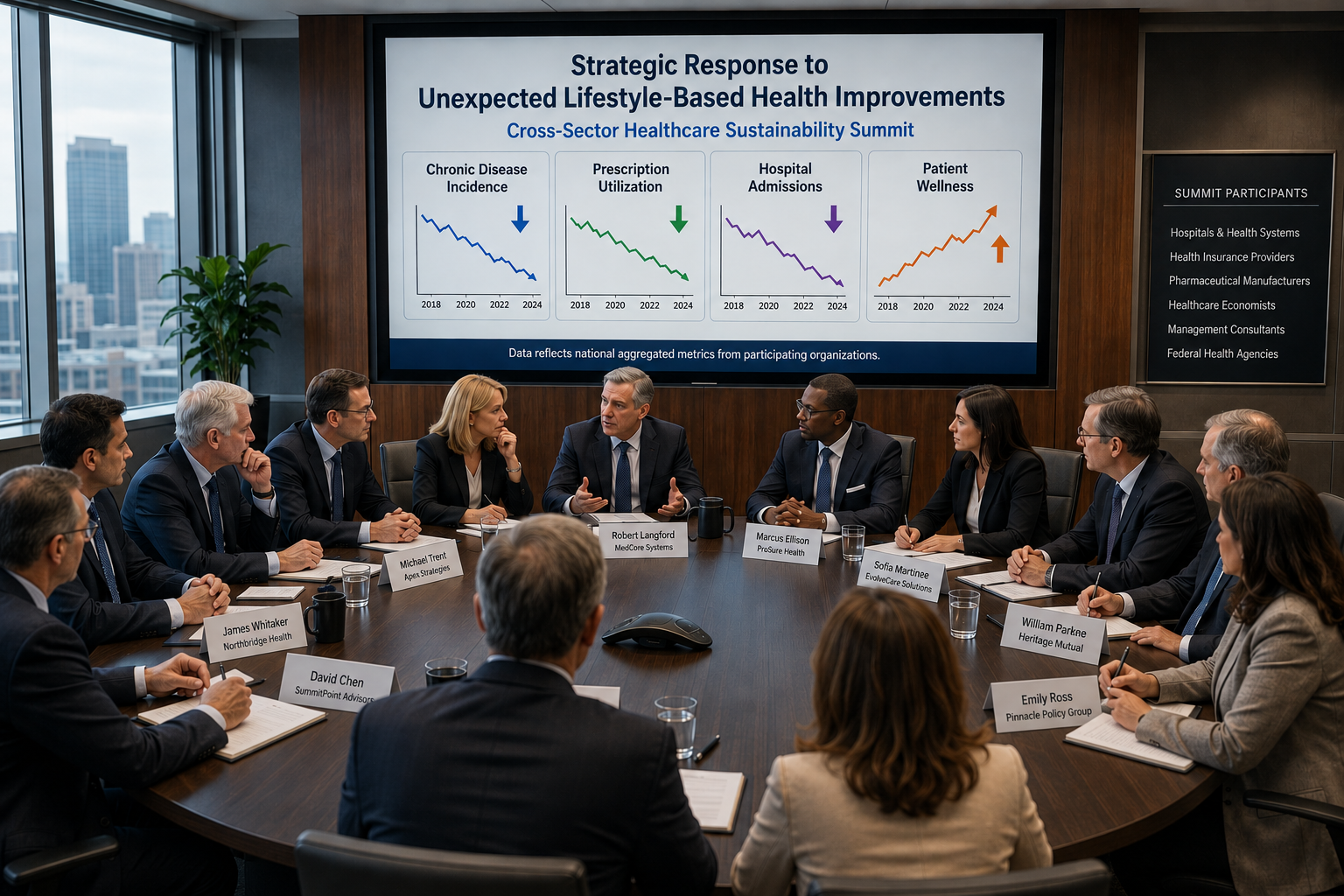
Healthcare providers, insurers, pharmaceutical manufacturers, medical schools, and federal health agencies have begun a coordinated review following a series of studies suggesting that certain chronic conditions may respond more favorably than anticipated to relatively inexpensive lifestyle changes requiring little or no specialized care or equipment.
Although researchers emphasized that the findings apply only to specific patients under specific circumstances and should not be interpreted as universal medical advice, healthcare administrators acknowledged that the reports warranted careful institutional evaluation due to their potential implications for long-term planning.
The review follows several years of accumulating evidence indicating that structured fasting protocols, improved dietary quality, regular physical activity, stress reduction, adequate sleep, and modest weight loss may substantially improve outcomes for certain patients living with conditions traditionally addressed through progressively sophisticated long-term therapeutic management pathways.
Officials repeatedly stressed that modern medicine remains indispensable.
The concern, they explained, involves the operational consequences of patients discovering interventions that cannot easily be incorporated into conventional reimbursement structures.
The Department of Administrative Affairs confirmed that multiple agencies had established an Interagency Lifestyle Response Coordination Working Group to assess what officials described as "emerging asymmetries between biological effectiveness and existing administrative infrastructure."
"The healthcare system has always encouraged healthy habits," explained Deputy Undersecretary Karen Whitmore during a joint press briefing.
"What requires additional study is the possibility that some of those habits may prove more operationally successful than originally anticipated."
She emphasized that no immediate policy changes were expected.
"We remain fully committed to evidence-based medicine."
"This is less a medical question than an exercise in administrative adaptation. The physiology appears to have proceeded without first consulting the financial projections."
Researchers Report Chronic Conditions Respond To Inexpensive Habits More Frequently Than Forecast Models Predicted
Scientists participating in the review emphasized that the biological mechanisms involved are neither mysterious nor newly discovered.
Many of the reported improvements involve metabolic regulation, inflammatory signaling, insulin sensitivity, vascular function, mitochondrial adaptation, immune activity, and body composition changes that have appeared throughout the medical literature for decades.
"From a physiological perspective, very little here is novel," explained Dr. Melissa Harmon, Senior Clinical Systems Analyst at the Institute for Strategic Compliance.
"The principal innovation occurred within the administrative interpretation of the findings."
Harmon explained that most long-range healthcare forecasting models historically emphasized expanding diagnostic sophistication, therapeutic capability, pharmaceutical innovation, and chronic disease management infrastructure.
"Our predictive frameworks devoted comparatively less attention to scenarios in which measurable improvements might arise from interventions exhibiting unusually low reimbursement density."
She clarified that this represented a planning assumption rather than a scientific conclusion.
"Healthcare systems naturally devote considerable analytical resources toward activities occurring within the healthcare system."
"Individuals independently improving their metabolic health through inexpensive behavioral modification occupied a comparatively modest position within several long-term utilization models."
Officials repeatedly emphasized that chronic disease remains extraordinarily complex.
They added, however, that complexity should not automatically be interpreted as requiring equivalently complex interventions, multilayered management pathways, or recurring administrative engagement under every set of clinical circumstances.
Researchers likewise acknowledged that many patients experienced measurable improvements without achieving perfect adherence.
Incremental reductions in processed food consumption, modest weight loss, improved sleep, occasional fasting, and regular physical activity frequently produced meaningful physiological changes despite falling well short of idealized treatment protocols.
Several analysts privately described these findings as "operationally awkward."
One internal memorandum referred to the phenomenon as "suboptimal compliance producing statistically inconvenient outcomes."
Another characterized it as "an unexpected demonstration that partial implementation of low-cost behavioral interventions occasionally generates clinically relevant improvements despite incomplete optimization."
A third committee recommended additional investigation into why patients continued responding favorably without first satisfying several long-established assumptions regarding procedural complexity.
Financial Analysts Begin Modeling Long-Term Effects
Investment analysts responded cautiously after reviewing preliminary healthcare utilization projections based upon increasing public interest in nutrition, fasting protocols, weight management, and preventative lifestyle practices.
Several firms concluded that widespread behavioral change remained unlikely enough to avoid immediate concern.
Others recommended closer monitoring.
One report from the Bureau of Predictable Outcomes estimated that even modest reductions in chronic disease prevalence could gradually influence demand across multiple sectors of the healthcare economy over extended time horizons.
The report emphasized that the projected effects would develop slowly rather than suddenly.
"Healthcare demand would not disappear," the report concluded.
"It would instead exhibit progressive redistribution toward preventative care, acute illness, trauma, infectious disease management, congenital disorders, emergency medicine, and conditions less responsive to behavioral intervention."
Industry representatives welcomed the analysis.
"The report appropriately recognizes that humanity continues generating an impressive variety of medical problems," said National Healthcare Sustainability Council spokesperson David Mercer.
"Our sector has demonstrated remarkable adaptability throughout its history."
He added that the industry remained committed to innovation regardless of future utilization trends.
"Healthcare has repeatedly evolved alongside changing patterns of disease."
"We fully expect to continue providing exceptional value under whatever circumstances patients choose to create."
Several publicly traded healthcare companies likewise reassured investors that diversification strategies remained robust.
Annual shareholder guidance noted that while some treatment categories could experience gradual adjustment if chronic conditions respond to inexpensive habits more frequently than expected, demographic aging alone would likely sustain substantial long-term demand for healthcare services.
Executives described the situation as "worthy of continued observation rather than immediate concern."
Meanwhile, economists cautioned against assuming that reduced healthcare expenditures would necessarily eliminate spending.
Consumers, they observed, have historically demonstrated a remarkable ability to redirect disposable income toward entirely different categories of goods and services.
"The money rarely disappears," explained economist Dr. Alan Prescott of the Center for Regulatory Excellence.
"It simply begins participating somewhere else in the economy."
Healthcare executives acknowledged the possibility while noting that they would naturally prefer continued participation within their own sectors.
Medical Schools Review Existing Educational Priorities
Academic medical centers also entered the discussion after several educational policy organizations acknowledged that most physicians receive relatively little formal nutrition instruction during medical school compared with pharmacology, pathology, physiology, and disease management.
The Association of American Medical Education Administrators announced formation of the Curriculum Integration Assessment Consortium to evaluate whether expanding nutrition and lifestyle education might prove operationally appropriate.
Committee members emphasized that no conclusions had yet been reached.
"Our responsibility is to evaluate instructional balance across an already crowded curriculum," explained consortium chair Dr. Rebecca Sullivan.
"Every additional hour devoted to one topic necessarily comes from another."
She noted that medicine has expanded enormously during the past century.
"Students are expected to master genetics, immunology, molecular biology, diagnostic imaging, pharmacology, surgical principles, infectious disease, oncology, neurology, cardiology, endocrinology, emergency medicine, and numerous additional specialties."
"The curriculum has experienced sustained success resisting opportunities to become shorter."
Faculty members interviewed following the announcement expressed cautious support for additional review.
Several observed that nutrition science has historically evolved more rapidly than educational standards, making curricular revisions unusually difficult to implement.
Others emphasized that patient compliance has long represented a practical limitation regardless of educational quality.
"Physicians routinely recommend healthier lifestyles," said Professor Daniel Brooks of the National College of Clinical Practice.
"The challenge has seldom involved awareness."
"It has generally involved convincing human beings to voluntarily adopt behaviors requiring consistent personal discipline."
Industry analysts initially assumed patients would continue ignoring dietary recommendations at historical rates.
Recent reports suggesting that measurable numbers of individuals were voluntarily adopting structured fasting protocols, reducing consumption of highly processed foods, and increasing physical activity therefore prompted a comprehensive reassessment of several long-term forecasting assumptions.
"The concern is not widespread behavioral change," one healthcare economist explained.
"The concern is discovering that people occasionally mean it when they say they're trying to become healthier."
Professional Organizations Recommend Additional Consultation
Multiple healthcare organizations responded by reaffirming the importance of individualized medical guidance before undertaking significant lifestyle changes.
The American Society for Responsible Clinical Coordination simultaneously released updated recommendations encouraging patients to consult qualified healthcare professionals before beginning any fasting, dietary changes, exercise programs, or medication adjustments.
Officials described professional consultation as an important first step in ensuring lifestyle improvements proceed through appropriate clinical pathways.
Officials emphasized that the guidance should not be interpreted as opposition to healthier living.
Rather, they described it as recognition that medicine remains highly individualized and that inexpensive interventions occasionally produce unexpectedly expensive consequences when applied inappropriately.
"No responsible physician believes every patient should follow identical recommendations," explained society president Dr. Elaine Porter.
"Medical decisions should continue reflecting each patient's individual history, medications, laboratory findings, and overall clinical circumstances."
"Professional consultation remains advisable before undertaking any lifestyle modification reasonably expected to improve health outcomes."
"It also helps ensure everyone involved maintains appropriate situational awareness."
Physicians interviewed by Genuine Fake News uniformly welcomed reports of improving patient health.
Several acknowledged, however, that exceptionally successful lifestyle interventions occasionally create continuity-of-care challenges by substantially reducing the number of follow-up visits required to confirm that patients continue to feel well.
"Seeing patients return with lower blood pressure, improved metabolic markers, reduced inflammation, weight loss, and renewed energy is genuinely rewarding," said family physician Dr. Michael Grant.
"From a medical perspective, those outcomes represent complete success."
He paused briefly before continuing.
"From a scheduling perspective, the relationship becomes noticeably less recurring."
Hospital administrators likewise reaffirmed that disease prevention has always represented a central institutional objective.
Internal planning documents nevertheless described widespread reductions in chronic disease as "an encouraging operational development requiring thoughtful capacity management across multiple revenue-sensitive healthcare environments."
Several systems subsequently announced the formation of Strategic Wellness Sustainability Task Forces to evaluate the long-term implications of patients requiring fewer hospital admissions, diagnostic procedures, specialist referrals, and chronic disease management services.
One executive stressed that the initiative should not be interpreted as a concern.
"We remain fully committed to healthier communities," she explained.
"Our responsibility is simply ensuring our long-term operational infrastructure remains appropriately aligned with any future reductions in demand for that infrastructure."
Insurance organizations adopted a similarly optimistic tone.
One national insurer characterized widespread improvements in metabolic health as "an actuarially innovative opportunity requiring careful evaluation of legacy assumptions regarding chronic disease persistence."
Executives emphasized that no immediate changes to coverage policies were under consideration.
Instead, several organizations announced the creation of cross-functional stakeholder committees tasked with exploring sustainable business strategies for an environment in which unexpectedly healthy customers continued requiring fewer healthcare services than historical forecasting models had reasonably anticipated.
Food Manufacturers Highlight Consumer Choice
Representatives from the processed food industry also participated in stakeholder discussions, emphasizing that consumers retain complete freedom regarding purchasing decisions.
The Coalition for Sustainable Expectations issued a statement reaffirming its longstanding commitment to offering products across a wide range of nutritional profiles.
"Our member companies have consistently responded to consumer demand," spokesperson Amanda Keller said.
"When customers requested lower fat products, manufacturers developed lower fat products."
"When customers preferred greater sweetness, manufacturers thoughtfully incorporated additional sweetness."
"When interest shifted toward protein, fiber, reduced carbohydrates, or minimally processed ingredients, the marketplace responded accordingly."
She described consumer preference as the industry's primary product development strategy.
Economists noted that market incentives naturally encourage manufacturers to optimize taste, convenience, shelf stability, production efficiency, transportation logistics, and purchasing behavior simultaneously.
Nutrition researchers observed that these objectives occasionally diverge following independent optimization pathways.
Neither group regarded this conclusion as especially controversial.
"The situation primarily reflects differing performance metrics across adjacent stakeholder ecosystems," explained Professor Harmon.
"Human physiology evolved under an adaptive biological optimization framework operating over several million years."
"Modern food manufacturing functions within an agile commercial value-delivery environment emphasizing consumer acquisition, repeat purchasing behavior, manufacturing efficiency, shelf-life resilience, distribution stability, quarterly performance indicators, and shareholder value creation."
"These systems were independently optimized according to fundamentally different success criteria."
"Evolution continues maximizing organismal survival across geological time horizons."
"Commercial food production continues maximizing sustainable market engagement within a competitive economic landscape."
"Any incidental overlap between those strategic priorities should be regarded as a beneficial coincidence rather than a design requirement."
"Cross-platform synchronization between the two optimization environments has never been considered operationally necessary."
"Attempts to harmonize the two frameworks have historically produced unnecessary stakeholder friction."
Government Agencies Expand Coordinated Response
As additional research continued accumulating, federal agencies announced that several existing advisory groups would be consolidated into a newly established Office of Preventative Outcome Harmonization within the Department of Administrative Affairs.
Officials described the reorganization as an effort to improve interagency coordination rather than a response to any single study.
The office's initial responsibility will be producing a comprehensive report examining how healthcare systems can continue encouraging healthier populations while maintaining operational stability across organizations whose financial planning has historically depended upon long-term treatment demand.
The report is expected to evaluate reimbursement models, physician education, public communication, insurance incentives, workplace wellness initiatives, nutritional guidance, and preventative care funding.
Officials estimated completion within eighteen months.
A preliminary draft outlining the review process is expected in approximately fourteen months.
"The objective is not to discourage healthier citizens," Deputy Undersecretary Whitmore emphasized.
"It is to ensure that administrative systems evolve with approximately the same level of coordination demonstrated by the human body."
She acknowledged that achieving this objective would likely require additional stakeholder engagement.
Several additional working groups have already been scheduled.
Ordinary Citizens Report Unexpected Improvements
Outside institutional settings, many of the citizens interviewed appeared largely unconcerned about the broader policy implications.
Several individuals described improvements after gradually adopting healthier daily habits rather than attempting dramatic lifestyle transformations.
"I started walking every evening," said retired electrician Robert Mitchell.
"Then I lost a little weight."
"I slept better."
"My blood pressure improved."
"Eventually my doctor reduced one of my medications."
Mitchell said he had not intended to become part of a national healthcare discussion.
"I was mostly trying to make it to the mailbox without getting winded."
Office manager Karen Ellis reported a similar experience.
"I stopped buying most ultra-processed snacks because I realized I wasn't actually hungry most of the time."
"A few months later several of my lab results improved."
"I assumed that was supposed to happen."
She appeared surprised to learn that economists had begun incorporating similar decisions into long-term forecasting models.
"I didn't realize my grocery list was participating in macroeconomic analysis."
Healthcare professionals interviewed generally welcomed stories of improved health while emphasizing that individual results vary considerably.
Many noted that lifestyle modification remains difficult, requiring consistency over months or years rather than days.
"There is no universal solution," Dr. Grant said.
"But there are many situations where modest improvements practiced consistently produce outcomes that are considerably larger than patients initially expect."
Healthcare Industry Reaffirms Commitment To Prevention
Industry organizations concluded the review by reaffirming their longstanding commitment to prevention, early intervention, scientific research, and patient-centered care.
Executives emphasized that advances in pharmaceuticals, surgery, diagnostic imaging, emergency medicine, and biotechnology continue saving millions of lives every year.
Nothing contained in the recent reports, they said, should be interpreted as diminishing those achievements.
Rather, the current discussion reflects growing recognition that preventing disease before it develops may occasionally prove as valuable as treating it afterward.
Several executives acknowledged that this represents an unusually successful outcome from a public health perspective.
One executive conceded that it also required "certain adjustments to historical revenue forecasting methodologies."
The comment was later clarified as referring exclusively to long-term strategic planning.
Financial analysts appeared satisfied with the explanation.
Meanwhile, multiple consulting firms announced new Healthcare Prevention Transition Services intended to assist organizations adapting to changing patterns of chronic disease management.
The services include strategic transformation roadmaps, stakeholder communication frameworks, reimbursement optimization assessments, preventative care integration planning, and evidence-based operational resilience consulting.
Industry observers described the announcement as encouraging evidence that the healthcare sector remained fully capable of innovating regardless of which direction public health ultimately evolved.
At press time, the Department of Administrative Affairs confirmed that the Interagency Lifestyle Response Coordination Working Group had unanimously recommended establishing a Permanent Commission on Sustainable Preventative Outcomes, whose initial responsibility would be determining whether the formation of additional committees represented the most appropriate first response to further reports of inexpensive health improvements.
Reported by Daniel Mercer, GFNN Health Correspondent.
Administrative Disclosure: Pursuant to the GFNN Standards of Editorial Transparency, readers are hereby informed that the publisher also authored Longevity Secrets For Men, Women, Even Them Non-Binaries! The Editorial Ethics Committee voted unanimously that mentioning the book at the conclusion of this article was inappropriate, self-serving, and transparently opportunistic. The publisher thanked the committee for its thoughtful recommendation before publishing this notice unchanged.
Recent Articles


-
The Gentle Night Friends Series
Aug 23, 26 03:38 PM
 The Gentle Night Friends Series is a collection of SEL children's stories.
 -
Senator Replaced Himself With Android: Committee Investigates
Aug 10, 26 12:32 PM
 Senator replaced himself with an android characterized as a "Legislative Productivity Surrogate," prompting a Judiciary Committee inquiry into voting, representation, AI autonomy, and constitutional p…
 -
Congress Opens Investigation Into the Decline of Music Education
Aug 03, 26 02:18 PM
Congress Opens Investigation Into the Decline of Music Education after educators report unexpected changes in student learning, prompting federal hearings, academic reviews, and industry responses.