
Non-Local Consciousness Researchers Report Skeptics Exist Only Within Awareness
Non-Local Consciousness Researchers Report Skeptics Exist Only Within Awareness as scientists, philosophers, and regulators respond to surprising new findings.
GFNN continues to support legacy information delivery technologies, including written language.
Administrative Notice: This report has been certified compatible with uninterrupted human attention spans under laboratory conditions.
GENEVA — An international consortium studying theories of non-local consciousness announced Thursday that a multi-year research initiative has produced what investigators described as "unexpected but internally consistent observational results" regarding the status of philosophical skepticism.
According to a preliminary technical paper circulated among participating institutions, repeated experiments suggest that individuals denying the existence of non-local consciousness may themselves exist only as experiences occurring within consciousness.
Researchers emphasized that the findings should not be interpreted as evidence that skeptics are imaginary.
Instead, they cautioned that the observations may indicate a more nuanced ontological relationship between observers, observations, and those questioning the validity of observation itself.
"This remains a working hypothesis," said Dr. Elena Weiss, senior investigator with the International Institute for Consciousness Studies.
"We are simply reporting what our models currently predict. At no point have we suggested that skeptics fail to exist. We are suggesting that their existence may be entirely dependent upon the conscious awareness within which they insist consciousness cannot possess fundamental status."
The report immediately generated significant interest among physicists, neuroscientists, philosophers, mathematicians, and several government agencies responsible for evaluating emerging scientific controversies before determining whether they require funding.
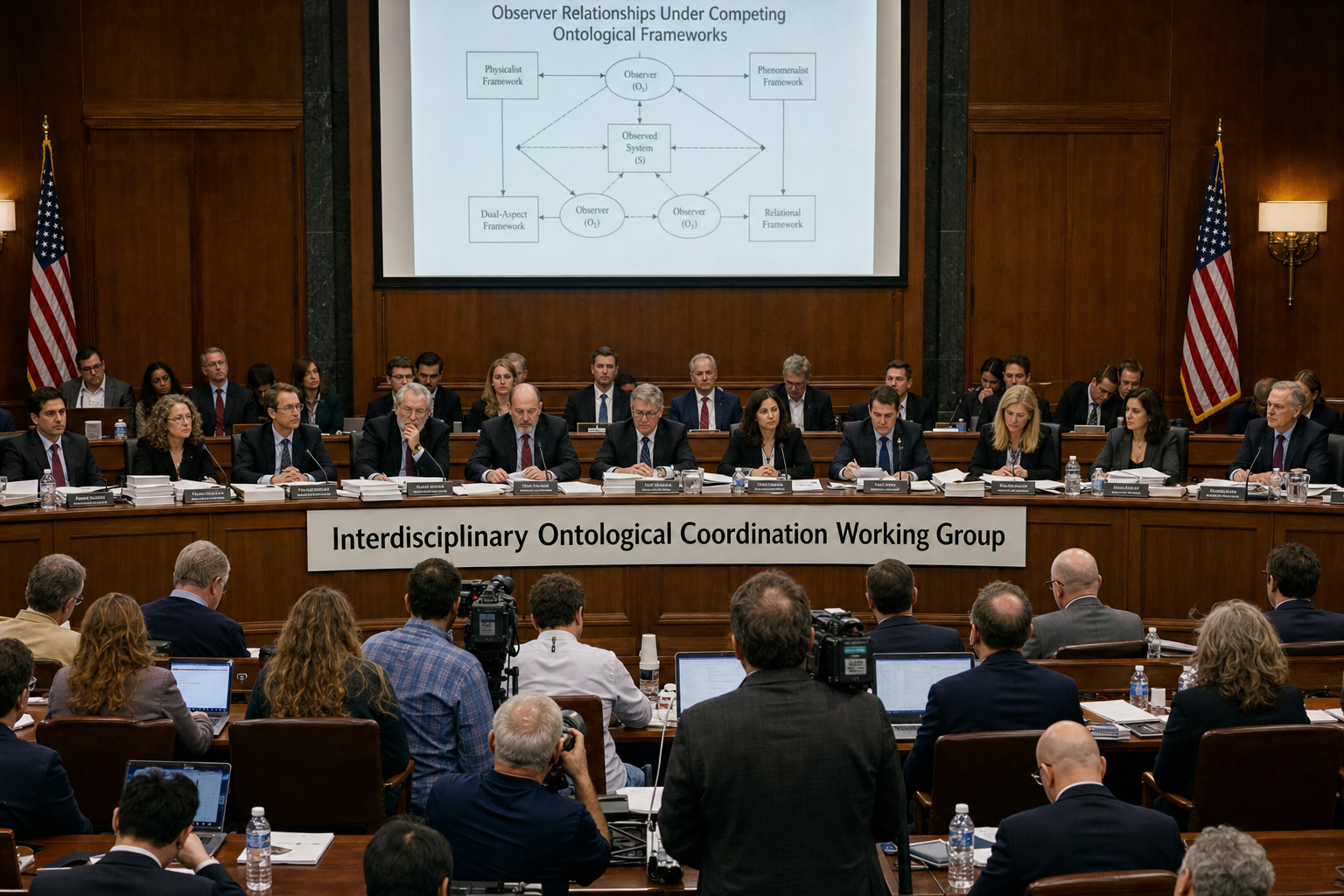
Officials at the Department of Administrative Affairs confirmed the formation of an Interdisciplinary Ontological Coordination Working Group to review the implications.
"The government's responsibility is not to determine whether reality exists," an agency spokesperson explained.
"Our responsibility is to establish which departments would become responsible if portions of reality prove administratively conditional."
Non-Local Consciousness Researchers Report Skeptics Exist Only Within Awareness During Controlled Analysis
The project began five years ago, following renewed academic interest in interpretations of quantum mechanics, integrated information theory, idealism, panpsychism, and other frameworks that propose consciousness may play a more fundamental role than traditionally assumed.
Researchers stressed that the study was deliberately designed to avoid favoring any philosophical position.
Instead, investigators developed mathematical models describing relationships between observers and the phenomena they observe under competing metaphysical assumptions.
Lead statistician Professor Michael Brandt explained that one family of simulations repeatedly produced a peculiar symmetry.
"When consciousness was modeled as emerging exclusively from physical matter, disagreements behaved conventionally."
"When consciousness was modeled as fundamental, however, every skeptical observer remained fully represented within the conscious framework being criticized."
The phenomenon persisted across multiple computational architectures.
"The skeptics consistently appeared."
"The physicalist models contained consciousness."
"The consciousness-first models also contained the skeptics."
"We were unable to generate a configuration in which skepticism successfully escaped consciousness in order to evaluate it externally."
The researchers referred to the phenomenon as Recursive Observer Containment.
The terminology has not yet received formal acceptance.
Several reviewers recommended replacing it with language that sounded less like an unexpected software feature.
Philosophers Welcome Additional Opportunities To Clarify Existing Disagreements And Opportunities For Interpretive Refinement
Academic philosophy departments responded with measured enthusiasm.
Representatives from several universities released a joint statement emphasizing that centuries of disagreement should not be interpreted as evidence of disciplinary stagnation but rather as "a sustained tradition of productive conceptual development."
Instead, they described the findings as "an encouraging expansion of the interpretive landscape."
Professor Adrian Keller, Chair of Comparative Epistemology at Westbridge University, cautioned against drawing premature conclusions.
"It would be methodologically imprecise to characterize the present findings as demonstrating that skepticism has been displaced," Keller said.
"A more defensible provisional interpretation is that skeptical positions have not yet established an epistemically independent standpoint from which the ontological status of consciousness may be evaluated without simultaneously participating in the experiential conditions under consideration."
Keller further warned that the discussion should not become constrained by "legacy distinctions inherited from historically matter-centric interpretive frameworks."
"We anticipate that the available vocabulary will require substantial expansion before the implications of the current findings can be discussed with appropriate conceptual precision."
Multiple philosophy journals immediately announced special editions devoted to recursive observer frameworks, perspectival ontology, phenomenological containment structures, post-material interpretive methodologies, and related developments in consciousness studies.
Editors estimated publication decisions would require between eighteen months and six years, depending upon reviewer availability and the continued stability of reality throughout the peer-review process.
Graduate students interviewed outside several universities generally welcomed the announcement.
"I was beginning to worry my dissertation might eventually become manageable," one doctoral candidate said.
"My committee now believes the theoretical framework requires considerably more theoretical framework."
Regulatory Agencies Begin Reviewing Ontological Compliance
Although the findings remain preliminary, regulators moved quickly to establish procedural consistency should additional evidence support the hypothesis.
The Center for Regulatory Excellence announced the formation of an Advisory Panel on Consciousness Classification Standards.
Officials emphasized that no immediate regulatory changes were anticipated.
However, establishing common terminology before widespread disagreement develops was described as "consistent with recognized best practices."
The Office of Administrative Continuity likewise began reviewing whether existing federal forms adequately distinguish between physical presence, conscious experience, phenomenological persistence, and administratively acknowledged existence.
"Several applications currently ask applicants whether they are present," one analyst noted.
"They do not presently specify according to which metaphysical framework."
Legal scholars also entered the discussion.
Attorneys specializing in constitutional law generally agreed that the courts would eventually become involved, although most acknowledged uncertainty regarding which jurisdiction would possess standing if all parties appeared exclusively within awareness.
"The judiciary has successfully resolved complicated procedural questions before," constitutional attorney Melissa Harmon said.
"This would simply require modest clarification regarding whether consciousness constitutes venue."
International Union Of Theoretical Theosophists Calls For Administrative Patience
The announcement drew perhaps the strongest endorsement from the International Union of Theoretical Theosophists, an organization that has spent decades advocating what it describes as "responsibly speculative approaches to ultimate reality."
Although largely unfamiliar to the general public, the Union maintains standing observer status at numerous interdisciplinary conferences where discussions continue until participants agree that additional discussion remains necessary.
Union President Dr. Leonard Ashcroft described the preliminary findings as "encouraging without becoming irresponsibly definitive."
"For generations, we have argued that consciousness may be considerably more fundamental than generally appreciated," Ashcroft said.
"To discover that skeptics also appear comfortably accommodated within consciousness demonstrates an admirable commitment to inclusiveness on the part of reality."
The Union immediately announced plans for its Annual Symposium on Recursive Awareness, featuring forty-seven presentations examining whether disagreement itself should be regarded as evidence supporting the existence of consciousness rather than contradicting it.
Conference organizers emphasized that no consensus was expected.
"Consensus would unnecessarily shorten future conferences," one planning committee member explained.
Physicists Recommend Everyone Calm Down
Researchers from several leading physics institutes urged restraint while acknowledging that the study intersects with longstanding debates surrounding quantum measurement and the observer problem.
Dr. Hannah Ruiz of the European Center for Quantum Systems cautioned against drawing conclusions beyond what the mathematics presently supports.
"The mathematics remains unchanged. It simply accommodates possibilities that many researchers previously regarded as philosophical rather than physical," Ruiz said.
Several physicists also rejected popular claims that quantum mechanics had somehow "proven" consciousness.
"Quantum mechanics has developed an unfortunate reputation for proving almost everything except quantum mechanics," Ruiz noted.
Instead, the investigators stressed that their simulations merely demonstrated that observer-dependent models consistently retained skeptical observers without requiring any additional assumptions.
Whether that result reflected mathematics, philosophy, physics, or an unexpectedly cooperative universe remained under active investigation.
Public Relations Specialists Emphasize Respect For All Metaphysical Stakeholders
The Association of Responsible Stakeholders released guidance encouraging organizations to avoid language that might alienate individuals holding differing ontological preferences.
"Our members recognize that reality is an evolving stakeholder environment," the statement read.
"Whether consciousness generates matter, matter generates consciousness, or both participate in a mutually reinforcing strategic partnership, respectful dialogue remains the preferred operational framework."
The Institute for Strategic Compliance advised corporations against revising employee handbooks until additional guidance became available.
Several Fortune 500 companies likewise postponed updates to diversity and inclusion training while legal departments evaluated whether existing references to an "observable person" remained sufficiently inclusive across competing metaphysical frameworks.
One multinational technology company quietly instructed managers to avoid opening meetings with the phrase, "Assuming everyone here objectively exists..."
Human Resources officials described the recommendation as a temporary risk-mitigation measure pending broader interagency clarification.
Market Analysts Identify Emerging Opportunities
Financial markets responded with measured optimism.
Shares of companies specializing in meditation applications, neuroscience equipment, consciousness research, virtual reality systems, and premium notebooks suitable for profound reflection all experienced moderate gains.
Investment analysts emphasized that the movement reflected expectations of increased interdisciplinary research spending rather than confirmation of any particular philosophical position.
"We're investing in uncertainty itself," explained senior market strategist Daniel Mercer.
"Historically, uncertainty has demonstrated exceptional long-term growth characteristics."
Consulting firms moved even faster.
Within hours of the report's publication, several global consulting organizations announced new advisory practices specializing in Ontological Readiness Assessments, Consciousness Integration Strategies, and Executive Reality Alignment Services.
Marketing materials promised to help organizations "navigate evolving awareness environments rapidly while preserving stakeholder confidence across multiple interpretive frameworks."
Industry observers noted that none of the promotional literature attempted to define consciousness.
Consultants described that omission as intentionally strategic.
"Definitions can unnecessarily limit future billable opportunities."
Federal Agencies Coordinate A Comprehensive Reality Assessment
As interest in the study continued to grow, the Federal Bureau of Public Expectations announced the creation of an Interagency Reality Assessment Council to improve coordination among scientific agencies, regulatory bodies, and public information offices.
Officials emphasized that the initiative was not intended to determine the nature of consciousness.
"It would be administratively inappropriate for a single committee to resolve a question that has supported multiple academic disciplines for centuries," explained Deputy Director Karen Holloway.
"Our objective is simply to establish standardized terminology so agencies can disagree using compatible documentation."
The Council's preliminary charter includes eight technical working groups, four stakeholder advisory panels, two public comment periods, and a draft framework for evaluating whether future federal reports should distinguish between objective existence, experienced existence, and administratively recognized existence.
Early estimates suggest the initial guidance document will exceed 1,400 pages before appendices.
Several committee members praised the unusually efficient pace.
Skeptics Report Remaining Entirely Unconvinced
Professional skeptics reacted with characteristic caution.
The Society for Empirical Naturalism released a statement reaffirming that extraordinary claims continue to require extraordinary evidence.
"We appreciate the technical sophistication of the analysis," the statement read.
"We simply remain unconvinced that consciousness possesses any privileged ontological status."
Researchers involved in the project welcomed the response.
"In fact, their skepticism is entirely consistent with our current model," Dr. Weiss explained.
"The remarkable feature is that the skeptical position itself appears fully represented within consciousness. The theory predicts precisely this outcome."
Asked whether skeptics found that conclusion persuasive, Weiss smiled politely.
"No." Weiss replied, "Again, exactly as predicted."
Several skeptical organizations announced plans to conduct independent replication studies designed to demonstrate that consciousness emerges entirely from physical processes.
Investigators from the original consortium expressed strong support.
"If they succeed," Professor Brandt said, "that discovery will still occur within the conscious experience available to the investigators performing the experiment."
Both groups subsequently described the exchange as scientifically productive.
International Standards Organizations Consider New Definitions
The International Organization for Conceptual Standardization confirmed that a technical committee has begun evaluating whether existing scientific terminology adequately distinguishes between consciousness, awareness, subjective experience, observation, and observer-dependent reality.
Committee members cautioned that establishing globally accepted definitions would require extensive international consultation.
"Historically, defining simple terms has proven considerably more difficult than discovering complicated phenomena," one standards editor observed.
Draft recommendations currently propose no fewer than seventeen operational definitions of "observer," each optimized for different scientific, philosophical, legal, and regulatory applications.
The International Union of Theoretical Theosophists welcomed the effort while gently expressing concern that seventeen definitions might prove "prematurely restrictive."
"We remain open to additional possibilities," President Ashcroft said.
Public Continues Existing Pending Further Guidance
Outside academic circles, the announcement produced remarkably little disruption.
The few citizens who had heard of the report generally nodded thoughtfully before returning to whatever they had already planned to do.
Employers confirmed that existential uncertainty remained an insufficient basis for missing work.
Insurance companies announced that policy coverage would continue regardless of whether claimants ultimately proved to be physical organisms, conscious observers, informational patterns, or "other legally recognizable ontological entities."
The Internal Revenue Service likewise clarified that any distinction between material and non-local existence would have "no foreseeable impact upon federal tax obligations."
Mortgage lenders issued similar guidance.
"Our position is that if you are sufficiently real to occupy the house, you remain sufficiently real to make the payments," one banking spokesperson explained.
Several human resources departments advised managers not to speculate about employees' metaphysical status during annual performance reviews until standardized terminology could be incorporated into diversity and inclusion training materials.
Economists welcomed the overall stability.
"Consumers have historically demonstrated an exceptional ability to postpone resolving foundational philosophical questions until after paying utility bills," said senior market analyst Daniel Mercer.
"The global economy has successfully survived recessions, pandemics, inflation, wars, cryptocurrency, and conference calls."
"We remain cautiously optimistic it can also survive ontology."
Scientific Debate Continues As Administrative Capacity Expands
Researchers involved in the project reiterated that no definitive conclusions should be drawn from the preliminary findings.
Additional experiments, independent replication, mathematical refinement, and interdisciplinary review remain necessary before a broader scientific consensus could emerge.
Nevertheless, funding agencies reported receiving a record number of grant proposals involving consciousness, quantum foundations, neuroscience, philosophy, information theory, complexity science, and computational modeling.
University administrators described the development as "an exciting opportunity for collaborative excellence."
Publishers announced multiple new journals devoted to Consciousness Systems Research, Applied Observer Studies, Recursive Ontology, and Administrative Metaphysics.
Subscription prices have not yet been finalized.
At press time, the Department of Administrative Affairs confirmed that the Interdisciplinary Ontological Coordination Working Group had unanimously approved the formation of a Permanent Temporary Committee charged with determining whether future government reports should continue to refer to reality as "objective" until a cross-agency consensus could be reached.
Reported by Jonathan Mercer, GFNN Science Desk.
Administrative Disclosure: Pursuant to the GFNN Editorial Cross-Promotion Policy, this article has been reviewed for potential commercial relevance. The committee concluded that readers contemplating the fundamental nature of consciousness may also have a professional interest in maintaining consciousness's biological function for as long as possible.
Accordingly, the publisher notes the availability of Longevity Secrets for Men, Women, Even Them Non-Binaries! The committee further certified that this determination was entirely objective and unrelated to projected book sales.
Click here for more Genuine Fake News.
Recent Articles


-
The Gentle Night Friends Series
Aug 23, 26 03:38 PM
 The Gentle Night Friends Series is a collection of SEL children's stories.
 -
Senator Replaced Himself With Android: Committee Investigates
Aug 10, 26 12:32 PM
 Senator replaced himself with an android characterized as a "Legislative Productivity Surrogate," prompting a Judiciary Committee inquiry into voting, representation, AI autonomy, and constitutional p…
 -
Congress Opens Investigation Into the Decline of Music Education
Aug 03, 26 02:18 PM
Congress Opens Investigation Into the Decline of Music Education after educators report unexpected changes in student learning, prompting federal hearings, academic reviews, and industry responses.