
Organizations Rush To Join Persian Governance Pilot Before Applications Exist
Organizations Rush To Join Persian Governance Pilot Before Applications Exist, leaving federal officials to manage thousands of unsolicited volunteers.
GFNN continues to support legacy information delivery technologies, including written language. The following is the text version of today's report.
Technical Notice: This report contains paragraphs that must be advanced manually.
WASHINGTON — Thousands of businesses, universities, nonprofit organizations and government agencies have volunteered to participate in the federal Persian Governance Pilot Program, although officials say no application process has been created and the program itself has not yet received final authorization.
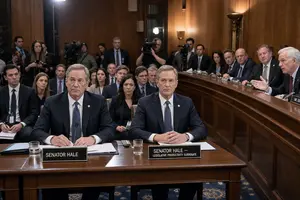
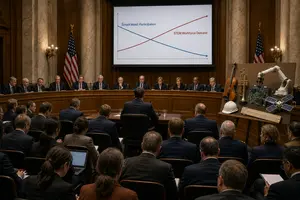
The Department of Administrative Affairs began receiving participation requests within hours of a congressional hearing examining an ancient Persian decision-making procedure described by the Greek historian Herodotus.
Under the procedure, important proposals were discussed twice: once while participants were intoxicated and again when they were sober. A proposal was adopted only if it survived both rounds of discussion.
Researchers testifying before the House Committee on Government Modernization said the procedure may have separated uninhibited idea generation from disciplined evaluation in ways that reduced conformity pressures, reputational concerns and organizational groupthink.
Congress has not authorized any pilot sessions.
No federal funds have been appropriated.
No eligibility standards have been established.
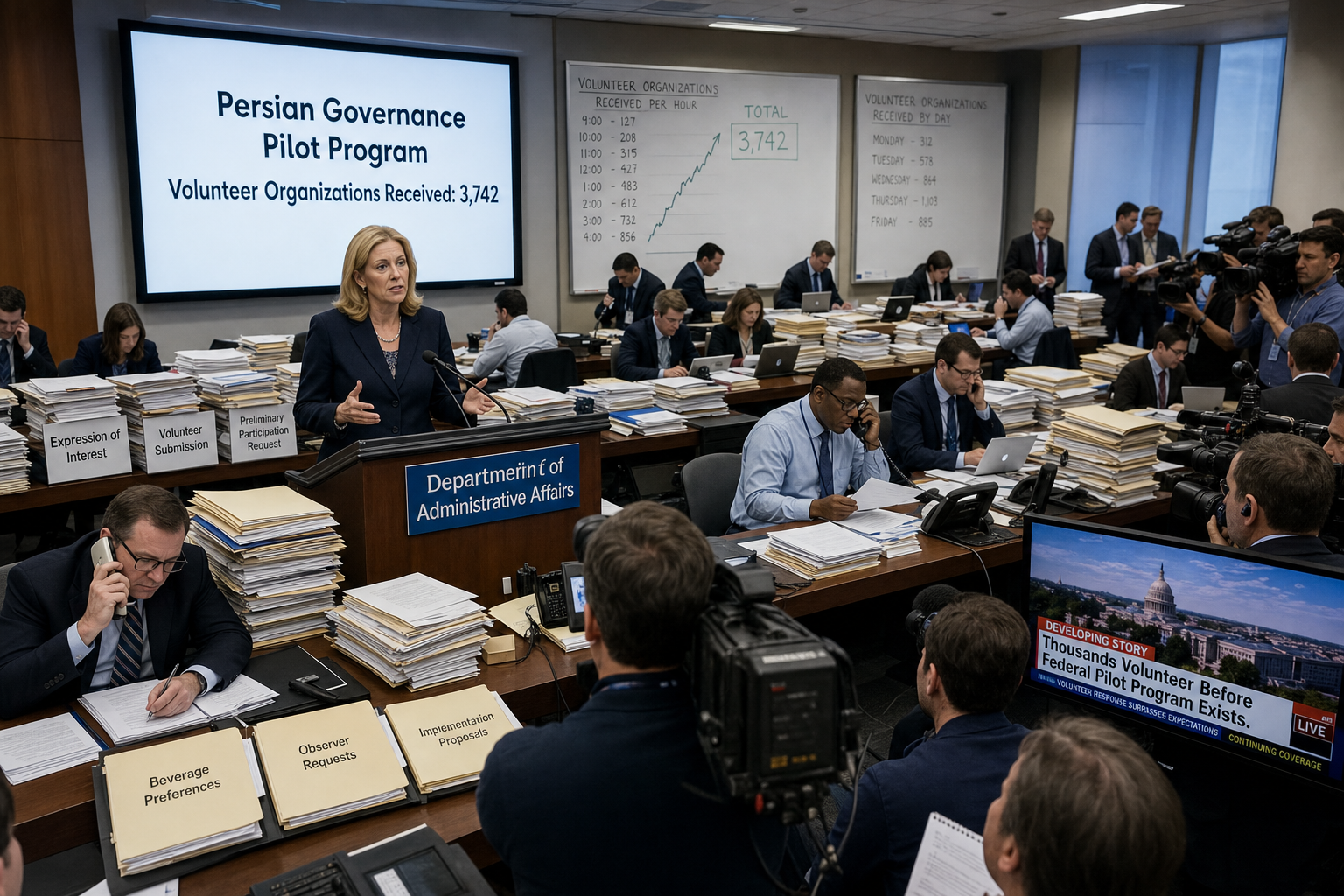
Nevertheless, the Department of Administrative Affairs confirmed that more than 3,700 organizations had submitted letters, memoranda, expressions of interest, preliminary participation statements and, in several cases, detailed beverage preferences by the close of the first business day.
Officials acknowledged that some organizations appeared to be interpreting the phrase "Persian Governance Pilot" somewhat more enthusiastically than intended.
"We have received a surprising number of questions regarding beverage logistics," Whitmore said. "Relatively few concern governance."
“We want to emphasize that there is presently nothing to join,” Deputy Undersecretary Karen Whitmore said during a hastily scheduled press briefing.
“Nevertheless, we have received an extraordinary number of requests to join the Persian Governance Pilot Program.”
Whitmore said the department had created a temporary email address to redirect inquiries away from officials responsible for determining whether the pilot should exist.
The temporary address exceeded its storage allocation within 47 minutes.
Thousands Rush To Join Persian Governance Pilot Program Before Applications Exist
The unexpected response followed several days of national news coverage describing testimony from engineers, economists, psychologists, and organizational researchers who said the Persian method deserved controlled study.
Witnesses did not claim that consuming alcohol improved judgment.
They said alcohol predictably reduced inhibition during the initial discussion, allowing participants to say things they might otherwise suppress because of hierarchy, professional caution, social convention or fear of appearing foolish.
That explanation required little elaboration for most viewers.
People who consume enough alcohol commonly become more talkative, cheerful, confident, affectionate, argumentative or sleepy, sometimes progressing through several of those conditions during the same evening. They may repeat themselves, interrupt established reporting relationships, rediscover old friendships, challenge decisions made six years earlier, and express sincere admiration for coworkers whose names they cannot immediately recall.
Those outcomes do not establish that intoxication is beneficial or that intoxicated people lack intelligence. They establish that alcohol changes human behavior in recognizable ways.
According to researchers, the Persians appear to have deliberately used those behavioral changes. Intoxication loosened the discussion. Sobriety later tested what the discussion produced.
The possibility that a structured federal pilot might recreate the procedure attracted immediate interest from organizations that had spent decades trying to encourage employees to speak candidly.
Among the first volunteers was Continental Mobility Group, which submitted a 64-page participation proposal describing the pilot as “a strategic opportunity to accelerate cross-functional truth accessibility.”
The company said it could provide 240 executives, managers and selected high-potential employees across six operational divisions.
“We already possess extensive institutional experience with facilitated ideation, leadership retreats and evening stakeholder engagement,” said company spokesperson Laura Pembroke.
“What has historically been missing is a validated governance framework allowing the conclusions reached after dinner to enter the formal decision environment.”
Pembroke said the company’s legal department had reviewed the congressional testimony and identified no immediate obstacle to volunteering for a program that had not been established.
She emphasized that the review should not be interpreted as legal approval.
The Coalition for Sustainable Expectations issued a similar statement on behalf of more than 300 member companies.
“American industry is prepared to support responsible experimentation within clearly defined parameters,” spokesperson David Mercer said.
“Once those parameters have been developed, reviewed, circulated, revised and provisionally approved, our members would welcome the opportunity to begin immediately.”
Mercer said several companies had offered conference centers, executive dining facilities and corporate retreat properties as possible test locations.
One member organization proposed holding its pilot aboard a chartered vessel to reduce what it called “uncontrolled post-session mobility.”
Educational Organizations Rush To Join Persian Governance Pilot Before Applications Exist
By Tuesday morning, the National University of Administrative Sciences had proposed a multidisciplinary research consortium involving specialists in organizational behavior, public administration, hospitality management, neuropsychology, risk communication, and institutional dining services.
The university requested federal recognition as the consortium’s coordinating institution.
Westbridge University requested the same designation.
The Jefferson Institute of Technology submitted a separate proposal recommending that all pilot sessions be instrumented with wearable sensors, biometric monitors, directional microphones and real-time conversational mapping software.
Engineers said the equipment could measure participation frequency, interruption patterns, vocal intensity, hierarchical deference and the point at which discussions shifted from policy analysis to personal recollection.
“Alcohol consumption introduces variability, but variability is not the same as immeasurability,” said Dr. Elena Park, director of applied decision systems at Jefferson.
“We can quantify speech distribution, response latency, topic recurrence and authority-gradient compression.”
Park said the institute would also monitor what researchers termed conversational persistence: the tendency of a participant to continue explaining an idea after everyone else had demonstrated that they understood it.
Preliminary laboratory models suggested conversational persistence might increase substantially during the intoxicated phase.
“That is not necessarily a methodological defect,” Park said.
“It may provide additional observation time.”
The Center for Behavioral Decision Sciences proposed a parallel study examining emotional progression during the sessions.
Its initial protocol identified five anticipated behavioral stages: elevated sociability, declining inhibition, interpersonal friction, renewed sentimentality and reduced alertness.
Researchers cautioned that the sequence would not occur uniformly.
Some participants might become sentimental before becoming argumentative.
Others might become argumentative almost immediately.
A smaller subgroup might spend the entire session explaining why alcohol had no effect on them.
Dr. Rebecca Sloan, who directs the center’s Group Dynamics Laboratory, said those differences could produce useful information about how organizations process disagreement.
“In ordinary meetings, participants often conceal annoyance until after the meeting, when it is expressed privately to people who cannot correct the underlying problem,” Sloan said.
“The Persian procedure may move the annoyance into the room where the problem is located.”
She added that moving the annoyance into the room would raise separate research questions involving conflict management, supervisory retaliation, and the preservation of professional relationships after participants had soberly reviewed the transcript.
The university proposed establishing an independent Sober Reconciliation Panel before any pilot sessions began.
Consultants Identify An Immediate Implementation Opportunity
Consulting firms viewed the surge in interest as evidence that the government needed an implementation structure before deciding whether implementation was appropriate.
Strategic Alignment Partners released a 118-page discussion paper titled “From Ancient Practice to Modern Performance: A Transformation Roadmap for Dual-State Decision Architecture.”
The firm recommended a seven-phase national rollout beginning with stakeholder discovery and concluding with continuous improvement.
The actual pilot sessions appeared in Phase Five.
“Our analysis indicates that the greatest risk is not premature adoption,” senior partner Bradley Knox said. “The greatest risk is allowing premature adoption to occur without a scalable framework for managing it.”
Knox said organizations were already informally designating internal Persian Governance Teams, creating participation committees and identifying potential discussion topics.
Several had contacted Strategic Alignment Partners for assistance determining which topics would be important enough to discuss under the Persian method without being so important that executives would object to discussing them under the Persian method.
The firm recommended beginning with “strategically meaningful but operationally survivable” questions.
Examples included reorganizing administrative reporting lines, revising mission statements and identifying the reasons previous employee engagement initiatives had not improved employee engagement.
Knox cautioned against beginning with executive compensation, pending layoffs, unresolved harassment complaints or the decision to retain the consulting firm.
“Pilot integrity depends upon selecting issues capable of generating candid disagreement without generating irreversible candor,” he said.
Institutional Transformation Group announced a competing framework centered on what it called “controlled authenticity.”
Its proposal would assign each participant a Certified Authenticity Facilitator responsible for determining whether a statement reflected suppressed professional insight, temporary emotional enthusiasm, or a long-standing personal grievance unrelated to the agenda.
The firm acknowledged that some statements could satisfy all three classifications.
Those remarks would be referred to a multidisciplinary review team.
Government Creates A Process For Organizations That Joined Nothing
The Department of Administrative Affairs initially advised organizations to stop submitting applications.
That instruction produced hundreds of calls asking where applications could be found, whether early submissions would receive priority, and how organizations could confirm that their applications were among those the department was no longer accepting.
By noon, officials withdrew the advisory.
Whitmore said the department had instead created an Interim Voluntary Expression of Non-Application Interest Form.
The form allows organizations to formally acknowledge that they are not applying while preserving evidence that they attempted to participate before applications became available.
Completion of the form does not confer eligibility, priority, standing, preference or recognition.
It does generate a confirmation number.
“The confirmation number has no present administrative effect,” Whitmore said.
“We recognize that organizations find this reassuring.”
The Department of Sequential Approvals has agreed to review the form before it is released.
That review cannot begin until the Department of Administrative Affairs submits a request for preliminary approval to seek approval of the form.
Officials said the request would be submitted as soon as the department completed the internal approval process authorizing the preparation of the request.
Human Resources Professionals Warn That Excessive Honesty May Require Additional Policies
As organizations continued to volunteer for the proposed federal pilot, one professional community expressed concern that the Persian methodology might fundamentally alter decades-old established workplace communication practices.
The American Association of Human Resource Leadership convened an emergency symposium titled Managing Temporary Organizational Candor Within Established Corporate Communication Frameworks.
Association President Linda Carver emphasized that the organization neither supported nor opposed the Persian Governance Pilot.
"Our responsibility is preparing employers for foreseeable workplace outcomes."
Carver said Human Resources departments devote enormous effort to encouraging employees to communicate constructively while preserving productive working relationships.
"The proposed methodology appears intentionally designed to bypass many of those normal communication filters."
She stressed that employees routinely exercise professional judgment about which observations should be expressed, postponed, softened, redirected, or permanently abandoned.
"The Persian method appears specifically designed to interfere with that process."
The association distributed a preliminary advisory identifying subjects employees might become unexpectedly willing to discuss during the brainstorming session.
Among them were:
- Projects everyone privately expected to fail.
- Performance metrics no one believed measured meaningful performance.
- Committees that had continued meeting long after accomplishing their original purpose.
- Policies everyone followed because everyone believed everyone else supported them.
- Organizational charts that no longer reflected how decisions were actually made.
- Consultants whose recommendations duplicated employee suggestions that had been submitted years earlier.
- Strategic initiatives that quietly disappeared without anyone formally acknowledging their conclusion.
- Operational problems routinely discussed immediately after meetings rather than during them.
- Departments that had spent years assuming another department was responsible.
The advisory concluded that none of these subjects necessarily represented organizational dysfunction.
"They simply represent conversations that professional employees have determined are unlikely to improve their careers."
Within hours, several corporations requested guidance regarding employees beginning remarks with the phrase, "I've been meaning to mention this for several years."
Human Resources specialists classified such statements as "Priority Candor Events" and recommended that organizations resist responding immediately with, "Why didn't you say something sooner?" since that question had already answered itself.
Insurance Companies Discover An Entirely New Category Of Organizational Risk
Within forty-eight hours, major commercial insurers had begun evaluating whether existing liability policies adequately covered structured candor.
The National Association of Organizational Risk Underwriters announced formation of the Committee on Temporarily Altered Decision Environments.
Committee chairman Robert Hensley said existing policies generally distinguished between intentional misconduct, negligence and ordinary business operations.
"The Persian methodology introduces something operationally different."
He explained that organizations would intentionally create conditions in which employees predictably behaved differently from how they did during ordinary business meetings.
"From an underwriting perspective, that deserves careful classification."
Insurers were less concerned about alcohol than about documentation.
Several companies reportedly asked whether conversations should be recorded.
Attorneys recommended recording.
Human Resources departments expressed reservations.
Compliance officers wanted transcripts.
Information Technology departments requested advance notice because storing eight-hour recordings of executives explaining the history of every unresolved disagreement would require a substantial increase in storage capacity.
One insurer proposed lower premiums for organizations that maintain complete records of both meetings to demonstrate that every recommendation had undergone a documented sober review before implementation.
Hospitality Industry Offers To Assist Federal Research
Perhaps no industry responded more enthusiastically than hotels and conference centers.
The American Hospitality Partnership informed Congress that thousands of facilities already possessed extensive experience managing large groups engaged in prolonged evening discussions involving food, beverages and ambitious plans.
"We believe our operational capabilities align naturally with the proposed research environment," the organization stated.
Several conference resorts submitted detailed participation proposals.
One national hotel chain offered complimentary meeting rooms provided participants agreed not to describe the gathering as a "corporate retreat."
Another offered adjustable lighting systems calibrated to facilitate what engineers described as "progressive conversational relaxation."
Food service directors also contributed recommendations.
The National Culinary Professionals Association suggested menus emphasizing foods historically associated with extended conversation rather than rapid consumption.
A technical appendix examined variables including meal pacing, hydration intervals, acoustic characteristics of dining rooms and dessert timing.
One appendix concluded that tiramisu appeared statistically associated with longer discussions concerning organizational philosophy.
Researchers cautioned that the observed relationship might reflect the dessert, the timing of the dessert, the participants, or one or more presently unidentified variables.
Economists Predict Increased Productivity Through Earlier Disagreement
Economists at the Metropolitan School of Economics argued that organizations frequently postpone costly disputes until projects have already consumed substantial resources.
Professor Alan Prescott of the Center for Regulatory Excellence testified before an interagency working group that organizations often incur significant costs maintaining artificial agreement.
"Suppressed disagreement is not free."
"It merely appears free because the accounting occurs later."
Prescott described disagreement as a normal economic input rather than an organizational failure.
"When employees quietly recognize a poor decision but postpone discussing it until implementation has failed, the organization experiences delayed information."
He compared the process to discovering structural defects after construction rather than during design review.
Several economists proposed measuring what they termed the Organizational Honesty Index.
Variables would include:
- frequency of voluntary disagreement
- time between recognizing and discussing problems
- number of sentences beginning with "I assumed everyone already knew..."
- reductions in hallway conversations immediately following official meetings.
One economist suggested that organizations with unusually high hallway conversation rates should receive priority consideration for pilot participation.
"No organization voluntarily spends thirty minutes criticizing a meeting immediately after leaving the meeting unless valuable information failed to enter the meeting itself."
The recommendation has attracted considerable academic interest.
Federal Agencies Begin Receiving Volunteer Lists From Organizations That Have Not Yet Been Invited
Despite repeated government announcements that no pilot currently exists, organizations continued expanding their preparations.
Several federal agencies reported receiving employee rosters identifying volunteers already willing to participate.
Many organizations submitted detailed participant rosters accompanied by administrative annotations explaining why particular employees should be included.
Examples included:
- "Historically reluctant to disagree with senior leadership."
- "Frequently identifies operational problems after meetings have concluded."
- "Has privately opposed every major initiative since 2019."
- "Believes three current committees could be eliminated but has never raised the matter publicly."
- "Has requested participation repeatedly despite not yet knowing the meeting agenda."
One multinational corporation attached a confidential memorandum recommending that participants not be seated according to the existing organizational chart.
"The purpose of the pilot," the memorandum explained, "appears to be temporarily discovering whether the organizational chart has unintentionally become part of the problem."
Several federal officials acknowledged that the supporting documentation was unusually candid.
None could determine whether the submissions demonstrated exceptional organizational preparedness or that many organizations had been waiting for a socially acceptable reason to tell the government what their employees actually thought.
One manufacturing company submitted seating charts optimized to reduce the probability of two vice presidents attempting simultaneously to redesign the corporate hierarchy.
A nonprofit organization included emergency contact information for several employees whose annual holiday-party observations had subsequently become next year's strategic plan.
Officials confirmed none of this information had been requested.
Deputy Undersecretary Whitmore again urged organizations to suspend preparations.
"We appreciate public enthusiasm."
"We simply ask organizations to wait until there is something for which preparation would be administratively appropriate."
Her statement generated approximately six hundred additional inquiries asking when organizations should begin preparing to wait.
At press time, the Office of Administrative Continuity had established a Temporary Coordination Working Group to study whether organizations expressing interest in delaying preparation should themselves be organized into a preliminary stakeholder advisory committee before formal pilot applications officially did not exist.
Pharmaceutical Companies Explore A Temporary Alternative To Alcohol
As enthusiasm for the proposed pilot continued growing, several pharmaceutical companies announced exploratory research into compounds intended to reproduce the specific organizational effects sought by the ancient Persians while avoiding intoxication itself.
Researchers emphasized that they were not attempting to develop a recreational drug.
The objective, they said, was considerably narrower.
"We're trying to determine whether the useful characteristics can be separated from the undesirable ones," explained Dr. Melissa Harmon of the Institute for Strategic Compliance.
"The historical objective appears to have been reducing excessive inhibition during brainstorming while preserving the requirement that every idea survive sober evaluation."
Several research teams described the target profile.
Participants would become unusually willing to propose unconventional ideas.
They would become less concerned about organizational hierarchy.
They would remain capable of coherent conversation.
Motor coordination would remain largely unaffected.
Most importantly, every proposal would still undergo rigorous evaluation after the effect disappeared.
One pharmaceutical executive summarized the challenge.
"We're not attempting to manufacture drunkenness."
"We're attempting to manufacture temporary freedom from worrying whether the Vice President will think your suggestion sounds stupid."
Researchers acknowledged that reproducing only those characteristics represented an unusually difficult pharmacological problem.
A second complication emerged almost immediately.
If the medication proved successful, organizations would almost certainly create mandatory training programs that define the circumstances under which employees are authorized to literally think outside the box, rather than merely demonstrate proficiency in recognized outside-the-box thinking behaviors.
Standards Organizations Begin Developing Technical Specifications
The American Society for Organizational Standards announced the formation of Technical Committee PG-1.
Its charter consists of developing nationally recognized standards for the Persian Governance Pilot implementation.
Committee chairman Douglas Mercer stressed that standards development should begin before any pilot sessions occur.
"Organizations perform more consistently when uncertainty has been standardized."
The committee immediately established twelve subcommittees.
Among them were:
- Brainstorm Beverage Compatibility.
- Optimal Snack Distribution.
- Speaking Sequence Harmonization.
- Temporary Candor Documentation.
- Meeting Conclusion Verification.
- Morning-After Confirmation Procedures.
One engineering working group immediately encountered a technical disagreement over how the conclusion of the brainstorming phase should be defined.
One proposal recommended ending the session after fifteen consecutive minutes without a substantially new idea.
Another recommended measuring the ratio of original ideas to repeated ideas.
A third proposed concluding the session when at least two participants independently stated that the organization had "finally identified the real problem."
Engineers favored the third proposal because it represented an objectively observable event.
Behavioral scientists argued that participants had been sincerely making that declaration during ordinary meetings for decades without measurable improvement.
Attorneys questioned whether the phrase "real problem" could be interpreted consistently across jurisdictions.
The matter was referred to the Joint Terminology Harmonization Panel.
International Observers Request Participation
Foreign governments also expressed interest.
Officials from several countries contacted the State Department to request observer status for future pilot sessions.
One Scandinavian delegation noted that its own governmental culture already encouraged unusually direct discussion.
"We are curious whether the Persian method produces measurably different outcomes or simply louder versions of conversations we already have."
A Japanese administrative delegation requested permission to study how organizations transitioned from uninhibited discussion back to formal consensus.
German engineering institutes expressed interest in measuring procedural repeatability.
French academic observers proposed a symposium examining whether the Persian method represented a socially constructed framework for temporarily redistributing conversational authority.
A Russian delegation requested observer status for a different reason.
Dr. Sergei Volkov of the Russian Academy of Organizational Sciences said the Academy was already familiar with the effects of uninhibited evening discussions in organizational settings.
"Our interest concerns the following day."
Volkov said the historical Persian procedure appeared to require that everyone reconvene while sober and systematically evaluate every proposal generated during the previous discussion.
"The remarkable feature is not that participants became candid while intoxicated."
"Many civilizations have independently validated that phenomenon."
"The remarkable feature is persuading every participant to return voluntarily and critically evaluate his own ideas when sober."
Volkov described that requirement as "an unexpectedly elegant governance innovation."
The Academy requested observer status to determine whether the sober review remained effective after participants had slept, consumed coffee, reread their notes, and remembered who else had attended the meeting.
State Department officials acknowledged that the request raised an unforeseen diplomatic question because the federal pilot had not yet established whether foreign observers would be permitted to observe the sober meeting, the brainstorming meeting, or only the administrative meetings creating the meetings.
Professor Adrian Keller of Westbridge University responded cautiously.
"I would hesitate to conclude that authority itself becomes redistributed."
"It may simply become temporarily ignored."
Keller paused.
"The distinction will undoubtedly require several conferences."
Congress Concludes That Additional Hearings Are Necessary
Members of the House Committee on Government Modernization acknowledged that public interest had greatly exceeded expectations.
Committee Chairman Richard Holloway announced that additional hearings would be scheduled.
"We have not yet authorized the pilot."
"We have, however, discovered considerable national enthusiasm for determining whether organizations occasionally benefit from hearing what people actually think."
Future hearings will include testimony from:
- insurance executives
- organizational psychologists
- hospitality professionals
- pharmaceutical researchers
- ethicists
- union representatives
- executive leadership coaches
- professional moderators
- catering specialists
Committee staff confirmed that no witnesses would be permitted to consume alcohol during congressional testimony.
"Congress believes sober discussion remains entirely appropriate while determining whether future discussions should temporarily become less sober."
The hearing schedule now extends well into next year.
Several witnesses privately acknowledged they hoped Congress would eventually authorize a small pilot simply to reduce the number of meetings devoted to discussing the possibility of authorizing a small pilot.
Administrative Preparations Continue Expanding
Although no pilot currently exists, federal agencies have now established:
- an Interagency Readiness Council
- a Stakeholder Communications Working Group
- a Pilot Eligibility Development Committee
- a Preliminary Metrics Advisory Board
- a Temporary Office for Coordinating Future Temporary Offices
Deputy Undersecretary Karen Whitmore emphasized that none of these organizations should be interpreted as evidence that the pilot had been approved.
"They merely support the government's responsibility to remain prepared should preparation eventually become appropriate."
She added that several agencies had begun asking whether their own internal planning meetings should themselves be conducted under the Persian method.
The question has been referred to another interagency review.
At press time, the Department of Administrative Affairs confirmed it had received more than 12,000 additional expressions of interest, including applications from organizations seeking priority placement on the waiting list for the future waiting list that will be created after officials determine how organizations should apply for permission to participate in a pilot program whose first task will be deciding whether the application process requires further study.
By Sarah Collins, GFNN Washington Bureau
Recent Articles


-
The Gentle Night Friends Series
Aug 23, 26 03:38 PM
 The Gentle Night Friends Series is a collection of SEL children's stories.
 -
Senator Replaced Himself With Android: Committee Investigates
Aug 10, 26 12:32 PM
 Senator replaced himself with an android characterized as a "Legislative Productivity Surrogate," prompting a Judiciary Committee inquiry into voting, representation, AI autonomy, and constitutional p…
 -
Congress Opens Investigation Into the Decline of Music Education
Aug 03, 26 02:18 PM
Congress Opens Investigation Into the Decline of Music Education after educators report unexpected changes in student learning, prompting federal hearings, academic reviews, and industry responses.