
Researchers Warn That Additional Discoveries Could Destabilize Previously Settled History
Researchers Warn That Additional Discoveries Could Destabilize Previously Settled History examines how institutions respond when archaeological evidence reshapes long-established scientific consensus.
GFNN continues to support legacy information delivery technologies, including written language.
Administrative Notice: This report has been formatted to allow complete thoughts to remain adjacent to one another.
By Rachel Bennett
GFNN Science Desk
WASHINGTON — Researchers Warn That Additional Discoveries Could Destabilize Previously Settled History after several independent archaeological studies continued strengthening evidence that humans occupied North America thousands of years earlier than many twentieth-century chronologies had concluded.
Although archaeologists emphasized that scientific understanding naturally evolves as new evidence accumulates, federal officials acknowledged that the increasingly broad acceptance of earlier human occupation has created a growing number of institutional questions extending well beyond archaeology itself.
The Department of Administrative Affairs announced Tuesday that it had established an Interagency Working Group on Historical Transition Planning following requests from museum associations, university systems, educational publishers, grant administrators, and several federal agencies seeking guidance on the orderly implementation of significant chronological revisions.
Deputy Undersecretary Karen Whitmore emphasized that the government had no role in determining when ancient people first entered the Americas.
"That responsibility belongs entirely to the scientific community."
"Our responsibility begins after scientific conclusions require thousands of organizations to update what they have been teaching, publishing, exhibiting, funding, and explaining."
Whitmore stressed that no historical emergency existed.
"The archaeological process appears to be functioning normally."
"The administrative process is attempting to catch up."
Officials noted that recent attention has focused particularly on the growing body of evidence surrounding fossilized human footprints discovered at White Sands, New Mexico.
Initial publication of the findings generated extensive scientific discussion regarding radiocarbon dating methods and the interpretation of archaeological evidence.
Subsequent independent analyses using terrestrial pollen and optically stimulated luminescence dating substantially strengthened confidence in the proposed chronology.
Additional archaeological discoveries reported elsewhere in North America have likewise contributed to an expanding reassessment of earlier migration models.
Federal officials repeatedly emphasized that the Working Group would not evaluate archaeological evidence.
Its assignment would instead examine the institutional consequences that follow when a long-established scientific framework undergoes substantial revision.
"Our objective," Whitmore said, "is implementation."
Agencies Examine The Administrative Consequences Of Scientific Revision
The National Office of Temporary Guidance released a preliminary memorandum describing what it termed "secondary impacts associated with large-scale chronology adjustment."
The document concluded that archaeological discoveries rarely affect archaeology alone.
Instead, they propagate through educational systems, museums, grant programs, documentary production, teacher certification, public outreach, and historical interpretation.
The Office estimated that thousands of educational documents currently reference migration timeline theories developed during the latter half of the twentieth century.
Many remain scientifically appropriate for the evidence available when they were written.
Many now require varying degrees of revision.
"This should not be interpreted as institutional failure," the memorandum stated.
"It should be interpreted as the normal operation of science."
Officials cautioned, however, that scientific revision and administrative revision operate according to different schedules.
Scientific papers may alter understanding within weeks.
University curricula generally follow academic calendars.
Textbooks often follow multi-year publication cycles.
Museum exhibits may remain in place for decades.
Grant criteria are revised only after extensive committee review.
"The evidence may advance continuously," one section observed.
"Infrastructure generally advances after budget approval."
The Bureau of Predictable Outcomes estimated that additional discoveries would probably continue to refine the current understanding of early human migration.
Officials therefore recommended that educational institutions prepare for what the report described as "an extended period of chronological modernization."
Congress Opens Hearings On Historical Transition Planning
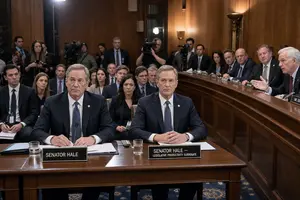
The House Committee on Government Modernization convened hearings Thursday after concluding that recent archaeological developments had exposed broader questions regarding how public institutions respond when well-established scientific models undergo substantial revision.
Committee Chairman Richard Holloway opened the proceedings by carefully defining the committee's jurisdiction.
"This hearing is not about determining when and where ancient people lived."
"It is about determining how institutions responsibly adapt after scientific understanding changes."
Holloway noted that Congress had previously examined administrative transitions involving evolving nutritional guidance, artificial intelligence, and several federal reviews of historical governance procedures.
"Chronology," he observed, "appears to have joined that list."
Representative Susan Delgado asked whether federal agencies possessed established procedures for coordinating educational revisions following major scientific developments.
Officials from the Department of Administrative Affairs replied that no government-wide framework currently exists.
"Historically," Whitmore explained, "most scientific revisions have occurred incrementally."
"Current administrative guidance does not contemplate revisions of this magnitude."
Representative Delgado asked whether the Department intended to issue revised guidance.
"We're evaluating that question now," Whitmore replied.
Archaeologists Describe Science As A Continuing Process
The committee's first witnesses consisted of active field archaeologists representing several universities and research institutions engaged in the study of early human occupation in North America.
Professor Daniel Whitcomb of the National University of Administrative Sciences testified on behalf of the panel.
Whitcomb told lawmakers that archaeological conclusions rarely change because of a single discovery.
"They change because independent lines of evidence gradually begin pointing in the same direction."
Representative Delgado asked why the White Sands footprints had become such a focal point in the debate.
"Because the proposed age challenged the prevailing chronology," Whitcomb replied.
"The original publication relied primarily on radiocarbon dating of aquatic plant seeds found within the same sedimentary layers as the footprints."
"Some archaeologists questioned whether aquatic plants might produce dates older than the surrounding deposits."
Representative Delgado asked whether those concerns had been legitimate.
"Yes."
"They were legitimate scientific questions."
"The appropriate response was additional investigation."
Whitcomb explained that subsequent studies addressed those concerns directly.
"Researchers independently dated terrestrial pollen recovered from the same stratigraphic layers."
"They also used optically stimulated luminescence to determine when the surrounding sediments were last exposed to sunlight."
"Both methods produced ages consistent with the original findings."
Representative Holloway asked whether that ended the debate.
"No single site ends a scientific debate," Whitcomb replied.
"But independent confirmation changes the discussion."
Representative Delgado asked whether White Sands alone had altered archaeological opinion.
"No."
"It became part of a much larger body of evidence."
"White Sands was important because it survived increasingly rigorous examination while additional pre-Clovis discoveries continued accumulating elsewhere."
Representative Delgado then asked whether archaeologists had anticipated resistance to revising such a long-established model.
Whitcomb considered the question.
"I would describe it as caution."
"A model that has organized decades of research should not be replaced lightly."
"The more difficult question is recognizing when the accumulated evidence explains the archaeological record better than the existing model."
Representative Holloway asked whether archaeology had now reached that point.
"For many researchers," Whitcomb replied, "yes."
"The discussion today is considerably different from the discussion twenty years ago."
He paused.
"Publishing a revised scientific paper is relatively straightforward."
"Updating textbooks, museum exhibits, lecture materials, and educational standards is a much larger undertaking."
The committee recessed briefly while staff prepared the next panel of witnesses.
Retired Scholars Describe The Administrative Weight Of Scientific Consensus
The committee's second panel consisted of seven distinguished emeritus paleoanthropologists whose textbooks, museum collaborations, editorial appointments, graduate students, and research programs had helped shape North American archaeology for more than four decades.
Chairman Richard Holloway thanked the witnesses for what he described as "a lifetime of advancing archaeological scholarship under the best evidence then available."
Dr. Harold Emerson, Professor Emeritus of Paleoanthropology at Western Plains University, was recognized to present the panel's testimony.
Chairman Richard Holloway thanked the witnesses for what he described as "a lifetime of advancing archaeological scholarship under the best evidence then available."
Dr. Harold Emerson, Professor Emeritus of Paleoanthropology at Western Plains University, rejected suggestions that senior archaeologists had opposed scientific discovery.
"We opposed conclusions that, at the time, we believed had not yet met the necessary evidentiary standard."
Representative Delgado asked whether that standard had changed.
"Not substantially."
"What changed was the evidence."
"There is considerably more of it now than there was thirty or forty years ago."
Emerson acknowledged that recent discoveries had substantially altered the professional landscape.
"The discussion no longer concerns one excavation."
"It concerns an expanding body of independent observations that increasingly reinforce one another."
He explained that individual pre-Clovis discoveries had once been easier to evaluate independently.
"When one site appeared anomalous, alternative explanations often remained plausible."
"As additional sites accumulated, and as dating methods continued improving, each new discovery was interpreted within a different evidentiary environment."
Representative Delgado asked whether White Sands represented such a change.
"For many researchers," Emerson replied, "it became considerably more difficult to explain the growing collection of observations using only the previous model."
He emphasized that scientific revision was not unusual.
"The unusual aspect is the scale of the administrative revision now required."
Educational Infrastructure Extends Well Beyond Archaeology
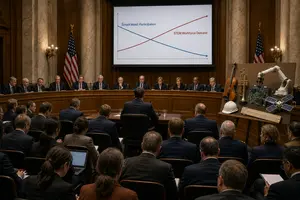
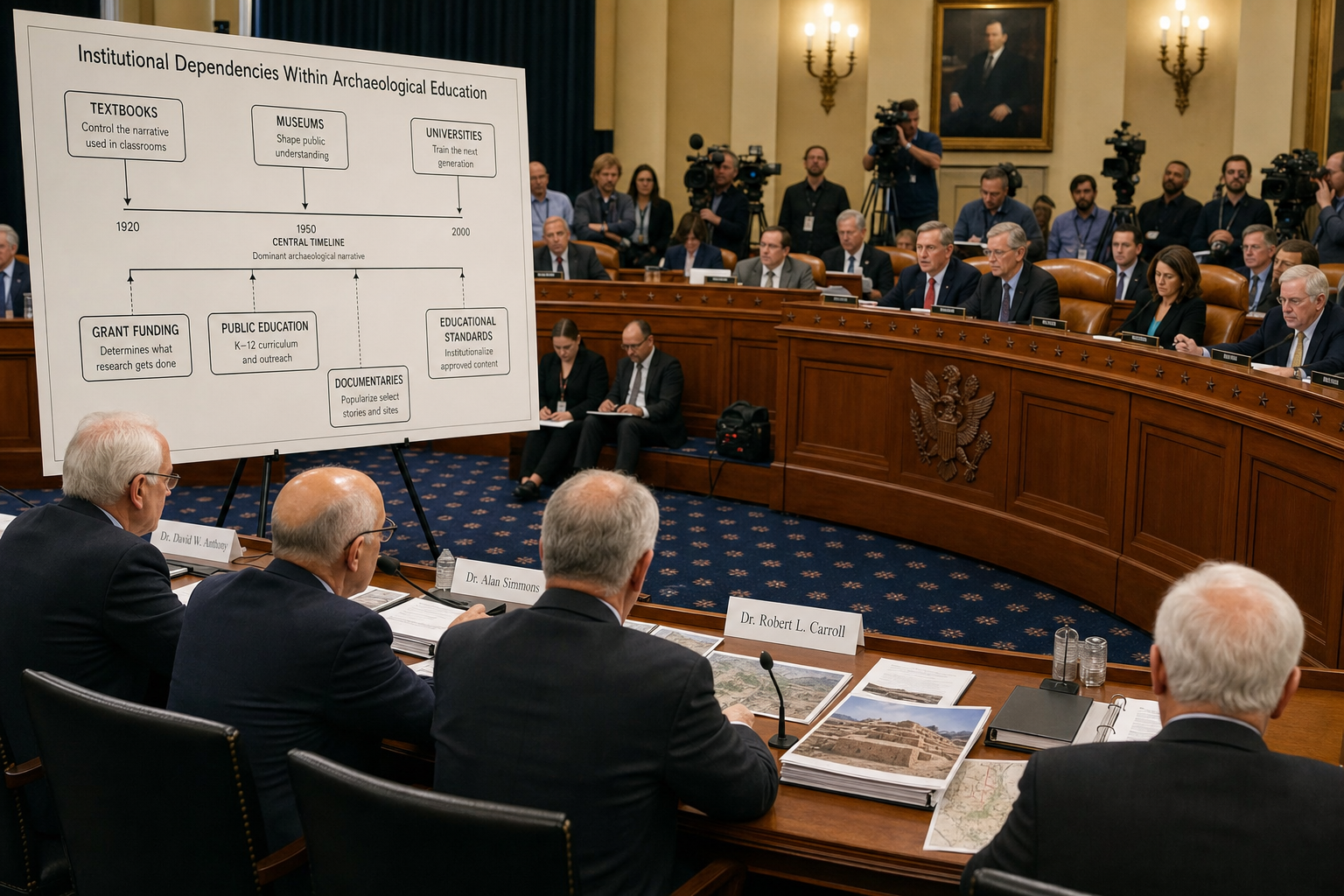
Emerson presented a chart entitled "Institutional Dependencies Within Archaeological Education."
At its center appeared a single migration chronology.
Radiating outward were introductory textbooks, museum exhibits, doctoral dissertations, university lecture materials, grant review criteria, documentary productions, educational standards, teacher certification programs, conference presentations, and public outreach materials.
Representative Holloway examined the diagram for several moments.
"Professor, are you suggesting that one chronology became embedded throughout the educational system?"
"It became embedded throughout the professional system," Emerson replied.
"When a framework remains productive for several decades, institutions naturally organize themselves around it."
He estimated that revising the chronology would require updating hundreds of museum exhibits, revising thousands of university lectures, producing new textbook editions, modifying educational assessments, rewriting public interpretive materials, and revisiting numerous published summaries intended for general audiences.
"Changing a conclusion in a scientific journal is comparatively straightforward."
"Updating everything that cites that conclusion is a considerably larger undertaking."
Representative Delgado asked whether those practical considerations should influence scientific judgment.
"No."
"They should influence implementation planning."
Publishers And Museums Request Coordinated Guidance
The committee next heard testimony from representatives of the National Association of Academic Publishers and the National Council of Museum Curators.
Elaine Mercer, President of the museum council, testified that museums routinely revise exhibits as scholarship advances.
"Our concern is not whether exhibits should change."
"Our concern is sequencing."
She explained that major permanent exhibits frequently require years of planning, design, fabrication, conservation review, accessibility evaluation, educational testing, and budget approval.
"Visitors generally observe a completed display."
"They rarely observe the administrative process required to replace one."
Publishers described similar challenges.
Jonathan Reeves, Senior Editorial Director at Academic Heritage Publishing, noted that introductory archaeology textbooks often remain in circulation for many years across universities, community colleges, and secondary education.
"A revised scientific consensus does not immediately replace the previous edition."
"It initiates the production schedule for the next edition."
Representative Holloway asked whether publishers preferred delaying scientific revisions.
"Certainly not."
"We simply recommend distinguishing between scientific acceptance and publishing logistics."
The committee directed staff to note the distinction for subsequent testimony.
Grant Administrators Review Earlier Funding Decisions
Officials from several research foundations appeared jointly before the committee to discuss how changing scientific understanding affects grant evaluation.
Dr. Melissa Harmon, Senior Systems Analyst at the Institute for Strategic Compliance, testified that funding agencies necessarily evaluate proposals using the strongest evidence available when applications are reviewed.
"Every grant decision represents a judgment made under uncertainty."
"Reviewers don't know what will be discovered ten or twenty years later. They have to make decisions using the evidence in front of them."
She cautioned lawmakers against interpreting normal scientific self-correction as evidence that earlier funding decisions had been improperly made.
"Science advances because conclusions remain open to revision."
"If funding agencies waited until every major question had been resolved, there would be very little left to investigate."
Representative Delgado asked whether younger researchers sometimes faced greater difficulty obtaining support when proposing ideas that challenged long-established models.
Harmon answered carefully.
"The existing model had explained decades of observations reasonably well. That is precisely why replacing it required unusually strong evidence."
"A proposal seeking to replace one therefore carries a greater burden of proof than a proposal extending it."
She paused.
"The more difficult question is recognizing when the existing model no longer explains the accumulating evidence as well as a competing one."
"The institutional challenge is recognizing when it has begun protecting the existing framework more effectively than it evaluates new evidence."
Several committee members requested that the statement be entered into the record.
Representative Holloway then asked the question that had appeared repeatedly in committee briefing materials.
"Who determines when sufficient evidence has accumulated to justify changing the baseline?"
Harmon smiled slightly.
"Congressman, if there were a universally accepted answer to that question, archaeology would have been considerably quieter during the past thirty years."
The hearing room remained silent for several moments.
Representative Delgado resumed questioning.
"Once a proposal challenging an established model has been rejected, does that decision influence future reviews?"
"Formally, each proposal is evaluated independently," Harmon replied.
"In practice, reviewers are familiar with the published literature, previous grant decisions, and the current state of the field."
"So institutional memory exists?"
"I believe every mature scientific discipline possesses institutional memory."
"The challenge is ensuring that institutional memory does not gradually become institutional preference."
Harmon declined to discuss individual cases but acknowledged that every scientific discipline eventually reaches periods when accumulating evidence begins to alter long-established assumptions.
"The transition is rarely recognized while it is occurring."
"It generally becomes obvious only after enough independent evidence has accumulated that the discussion has already changed."
Universities Study The Dynamics Of Scientific Self-Correction
Following the morning testimony, Westbridge University, the Jefferson Institute of Technology, and the National University of Administrative Sciences jointly announced the formation of the Center for Consensus Dynamics.
Researchers would study how scientific communities revise foundational models over extended periods.
Professor Adrian Keller, Chair of Comparative Epistemology at Westbridge University, described the initiative as an opportunity to examine institutional learning itself.
"Scientific knowledge is not static."
"Neither are the organizations responsible for transmitting it."
Researchers from the Center for Behavioral Decision Sciences announced a companion project examining how professional investment influences the rate at which institutions adapt to accumulating evidence.
Officials emphasized that the study would include medicine, engineering, economics, archaeology, and several additional disciplines.
"The objective is not identifying error," one researcher explained.
"It is understanding organizational adaptation."
The Department of Administrative Affairs immediately requested observer status.
The request was approved pending formation of an Interdisciplinary Advisory Committee on Consensus Transition Methodology.
The committee is expected to issue preliminary guidance following completion of its stakeholder engagement process.
Consultants Recommend A National Historical Transition Framework
The committee's final panel featured representatives from Operational Excellence Advisors, who had been retained by several universities, museum systems, and publishing organizations to evaluate the operational consequences of major archaeological revision.
Senior Managing Director Allison Price emphasized that the firm's engagement deliberately excluded archaeology.
"We are not evaluating evidence."
"We are evaluating organizational adaptation after evidence has been evaluated."
Price presented a seventy-eight-page executive summary titled Framework for Sustainable Chronological Transition Management.
The report proposed a six-phase implementation roadmap beginning with stakeholder identification, followed by chronology dependency assessments, educational infrastructure inventories, institutional readiness evaluations, implementation sequencing, and long-term historical resilience planning.
"Our analysis indicates that scientific consensus and institutional implementation operate according to different timelines," Price explained.
"The objective is not delaying scientific conclusions."
"It is reducing unnecessary disruption while organizations incorporate them."
Representative Holloway asked whether organizations could simply revise their materials as new evidence appeared.
"They certainly can," Price replied.
"They generally discover they have considerably more materials than they realized."
She displayed a flowchart extending across three projection screens.
Beginning with a single peer-reviewed publication, the chart expanded through textbooks, museums, grant programs, public school standards, documentary producers, continuing education courses, educational websites, certification examinations, digital archives, public lectures, historical societies, tourism materials, and thousands of secondary citations.
"Our conclusion," she said, "is that chronology possesses a significantly larger administrative footprint than previously recognized."
The committee requested copies of the report.
Attorneys Conclude That "Settled Science" Requires A Definition
As the hearing entered its second day, legal experts argued that recent archaeological developments exposed an unexpected regulatory question.
Margaret Sullivan, Senior Counsel for the Institute for Strategic Compliance, testified that numerous government publications, grant announcements, educational standards, and public documents routinely referred to "settled science" without defining the expression.
"The phrase is widely understood."
"It is considerably less frequently defined."
Representative Delgado asked whether existing scientific literature already provided sufficient guidance.
"For scientific purposes, quite often."
"For administrative purposes, considerably less often."
Sullivan distributed a memorandum identifying twenty-nine expressions that she believed deserved standardized guidance before federal agencies incorporated revised archaeological chronologies into future publications.
Among them were:
"scientific consensus"
"widely accepted"
"prevailing interpretation"
"settled science"
"compelling evidence"
"provisional conclusion"
"currently supported"
"historically accepted"
Representative Holloway observed that the committee had spent two days discussing chronology and had now arrived at vocabulary.
Sullivan nodded.
"Congress frequently arrives at definitions immediately after reaching agreement."
The Office of Regulatory Harmonization later announced formation of the Terminology Consistency Working Group.
Officials estimated preliminary guidance could be available following interagency review.
Economists Argue That Scientific Progress Creates Predictable Replacement Costs
The committee's final witness was Dr. Alan Prescott, Senior Economist at the Center for Regulatory Excellence.
Prescott told lawmakers that economists viewed the archaeological debate somewhat differently than scientists.
"Our interest isn't determining whether the chronology is correct," he said.
"Our interest begins after the chronology changes."
Representative Delgado asked him to explain.
"When scientific understanding changes," Prescott said, "organizations begin replacing things. Textbooks are revised. Museums redesign exhibits. Universities rewrite courses. Grant agencies update evaluation criteria. None of those activities are free."
He cautioned the committee against viewing those costs as evidence that scientific revision should proceed more slowly.
"Quite the opposite."
"The long-term cost of continuing to teach outdated information is almost always greater."
Representative Holloway asked whether economists had estimated the financial impact of revising a chronology by approximately ten thousand years.
"We have not attempted a precise estimate," Prescott replied.
Quite honestly, Congressman, I'm not aware of another instance where educational institutions have had to revise roughly ten thousand years of North American prehistory."
"Economically speaking, this isn't a routine textbook revision. We're talking about revising a chronology that has been taught for several generations."
Committee staff requested that the remark be entered into the record.
Prescott continued.
"I suspect archaeologists think they're debating migration."
"In practice, they've initiated one of the larger educational update projects we've seen in some time."
Representative Delgado asked whether the government should establish a special fund to assist institutions making large-scale scientific revisions.
"That would ultimately become a budget decision," Prescott replied.
"I would simply observe that scientific progress occasionally carries implementation costs."
"It would be unfortunate if those costs became an incentive to postpone acknowledging better evidence."
The Congressional Budget Office confirmed that it would prepare a preliminary estimate of the long-term costs associated with nationwide chronological revision before the committee's next hearing.
Agencies Prepare For Future Historical Revisions
Following the hearing, Deputy Undersecretary Karen Whitmore announced the formation of the National Commission on Historical Adaptation, which will consolidate several temporary working groups established during the review.
She emphasized that the Commission would not evaluate archaeological discoveries.
"Our responsibility begins after the scientific community has done its work."
The Commission's mission will include developing best practices for updating educational materials, museum exhibits, grant language, curriculum standards, digital archives, and public information following significant scientific revision.
The Association of Responsible Stakeholders welcomed the announcement.
The National Council of Museum Curators endorsed coordinated implementation planning.
The Association of Academic Publishers announced publication of voluntary guidance for managing large-scale chronology revisions across multiple textbook editions.
Westbridge University confirmed that the newly established Center for Consensus Dynamics would host its first annual symposium next spring.
The announced theme is:
Institutional Adaptation Following Evidence-Based Revision.
Officials emphasized that the conference title remains subject to revision should additional evidence become available before registration opens.
Additional Discoveries Prompt Continuing Administrative Planning
The Bureau of Predictable Outcomes simultaneously released a forecasting report concluding that additional archaeological discoveries remain statistically probable.
The report noted that ongoing excavation, improved analytical techniques, and future discoveries will likely continue to refine the current understanding of early human occupation in the Americas.
Officials stressed that such developments should be regarded as a normal feature of scientific investigation rather than institutional instability.
"Scientific understanding improves because additional evidence continues becoming available," the report concluded.
"Public institutions improve by developing equally effective methods for incorporating that evidence."
The Department of Administrative Affairs confirmed that lessons learned during the Historical Transition Planning Hearings may eventually be incorporated into broader federal guidance addressing future revisions in other scientific disciplines.
Officials emphasized that no decisions had yet been made.
A Preliminary Framework Development Committee has been established to evaluate whether creation of such guidance would itself require additional guidance.
At press time, the Office of Administrative Continuity confirmed that it had begun drafting voluntary recommendations for agencies experiencing significant evidence-based revisions while reminding participating organizations that all recommendations would remain subject to future amendment pending additional discoveries, independent replication, peer review, public comment, interdisciplinary consultation, educational implementation planning, historical reassessment, administrative coordination, and the orderly completion of the National Historical Transition Framework.
Recent Articles


-
The Gentle Night Friends Series
Aug 23, 26 03:38 PM
 The Gentle Night Friends Series is a collection of SEL children's stories.
 -
Senator Replaced Himself With Android: Committee Investigates
Aug 10, 26 12:32 PM
 Senator replaced himself with an android characterized as a "Legislative Productivity Surrogate," prompting a Judiciary Committee inquiry into voting, representation, AI autonomy, and constitutional p…
 -
Congress Opens Investigation Into the Decline of Music Education
Aug 03, 26 02:18 PM
Congress Opens Investigation Into the Decline of Music Education after educators report unexpected changes in student learning, prompting federal hearings, academic reviews, and industry responses.