

Smartphone Battery Lasts Entire Week:
Manufacturer Insists It Was Never Designed To Do That
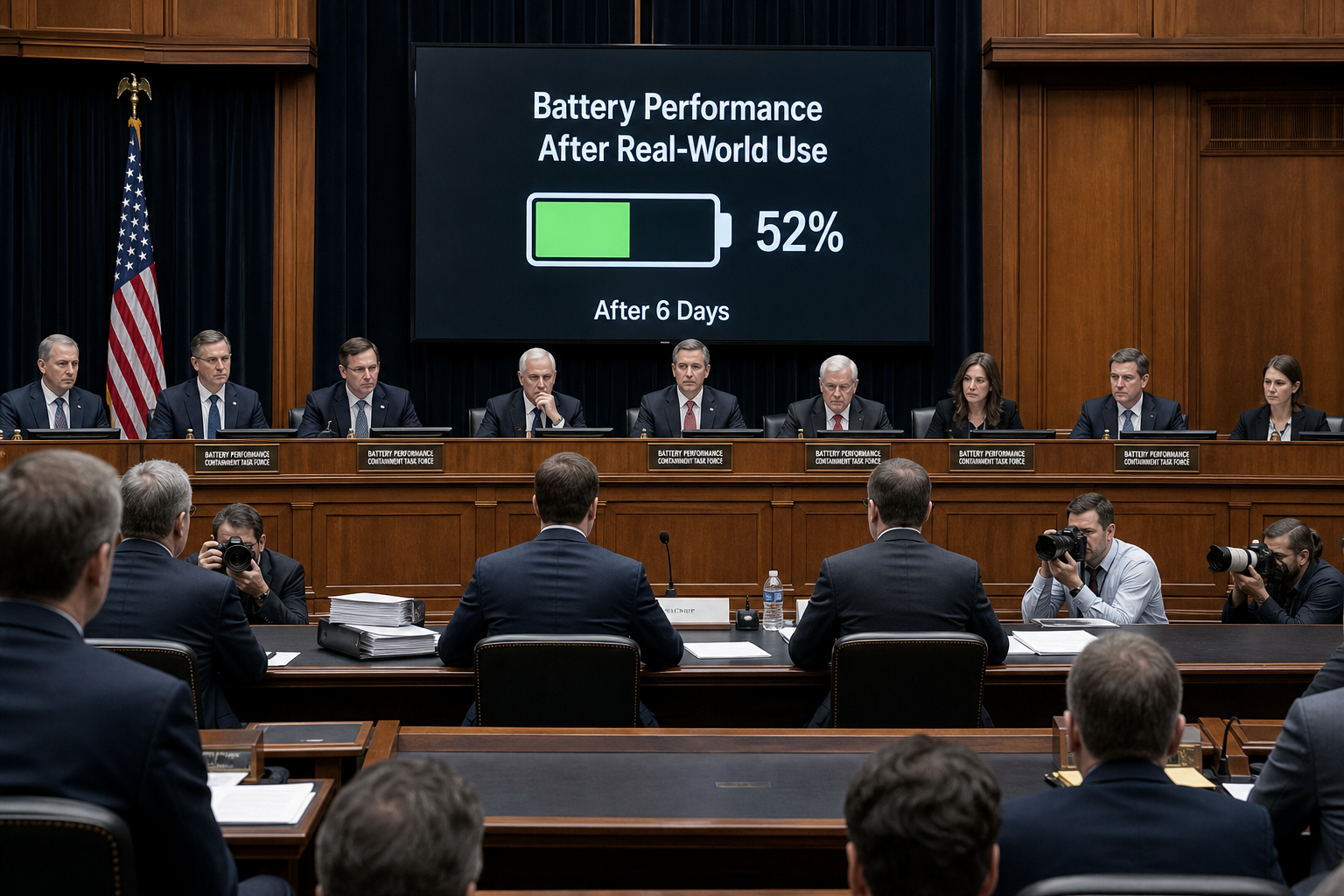
Smartphone Battery Lasts Entire Week: Manufacturer Insists It Was Never Designed To Do That
By Harold Winslow
GFNN Technology Desk
GFNN continues to support legacy information delivery technologies, including written language. The following is the text version of today's report.
Performance Advisory: This report contains uninterrupted paragraphs that may require sustained attention.
A smartphone battery lasts entire week, triggering investigations, regulatory reviews, and industry concern over dangerously altered consumer expectations.
A routine software update intended to improve battery management has instead triggered a series of investigations after thousands of smartphone owners reported that their batteries lasted as long as 7 consecutive days without requiring a recharge.
The manufacturer emphasized that the extended battery life should not be interpreted as a product enhancement.
"This operating condition falls well outside validated customer expectation parameters," the company said in a statement released Tuesday. "While devices continue functioning normally, the observed performance does not reflect the design philosophy under which the product was developed."
Engineers initially believed the reports resulted from users accidentally exaggerating battery life after losing track of when they had last connected a charging cable. Those assumptions changed after diagnostic logs confirmed many devices had indeed operated for nearly a full week while maintaining normal performance.
Company representatives stressed that customers were under no immediate safety risk but acknowledged that the unexpectedly efficient batteries could create "behavioral uncertainty throughout the broader consumer technology ecosystem."
The announcement immediately drew attention from regulators, economists, consumer advocates, charging-accessory manufacturers, and market analysts seeking to assess the long-term implications of a smartphone that simply kept working.
Engineers Describe How The Smartphone Battery Lasts Entire Week
According to internal technical documents reviewed by GFNN, engineers ultimately traced the anomaly to an interaction among hundreds of routine efficiency improvements that unexpectedly reinforced one another.
- Background processes synchronized more efficiently.
- Applications released unused memory sooner.
- Wireless radios eliminated unnecessary polling.
- Processor scheduling reduced idle wake cycles.
- Display management removed inefficiencies that had accumulated throughout normal daily operation.
Each individual optimization produced only a fractional improvement. Collectively, however, they resulted in battery performance that exceeded every internal engineering forecast.
The final software changes were reportedly submitted late Friday afternoon by 16-year-old summer engineering intern Ethan Morales, who had been assigned to review several legacy power management routines that senior developers considered too minor to warrant immediate attention.
According to company officials, Morales completed the work shortly before leaving for the weekend, believing he had merely eliminated a handful of unnecessary processor wake cycles.
Morales later told investigators that he simply followed the department's coding standards and removed several redundant operations identified during routine code review.
When engineers returned Monday morning, they initially suspected a fault in the company's diagnostic systems after internal testing showed prototype devices continuing to operate for days longer than expected.
Senior systems engineer Dr. Michael Renner said investigators spent several hours verifying that the batteries themselves had not somehow changed.
"Initially we assumed the diagnostic tools had malfunctioned," said Vice President of Software Engineering Karen Phillips. "When they continued reporting exceptional battery performance, we expanded the investigation to include the possibility that one of our engineers had accidentally improved the product."
"Our objective was incremental efficiency," Renner explained. "At no point did anyone propose allowing customers to forget where they placed their charging cable. That outcome was neither modeled nor requested."
Renner praised the quality of the optimization, describing the code as "technically excellent and fully consistent with established engineering principles."
"The challenge," he added, "is that it optimized variables whose historical performance had become embedded in a much larger commercial ecosystem."
Engineers emphasized that the software remained fully compliant with every published technical specification.
Ironically, that compliance became part of the problem.
Because the battery substantially exceeded every documented expectation, customer behavior immediately began to diverge from the planning assumptions that had quietly shaped product design, accessory manufacturing, retail merchandising, hospitality infrastructure, and consumer charging habits for nearly two decades.
Company officials confirmed that the intern had received no disciplinary action because existing corporate policies did not specifically prohibit making products substantially better than intended.
Corporate attorneys later advised executives that acknowledging the optimization as an intentional enhancement could expose the company to future consumer expectations.
Marketing executives cautioned that consumers might begin accepting a smartphone battery lasts entire week as a baseline feature rather than a one-time operational anomaly.
Financial analysts warned that extending replacement cycles for charging accessories could create "unexpected revenue headwinds across adjacent ecosystem partners."
Accessory Manufacturers Request Immediate Review
Within hours of the announcement that a smartphone battery lasts entire week, the National Association of Mobile Charging Accessory Manufacturers requested an emergency meeting with the Department of Administrative Affairs and the Office of Customer Expectation Alignment.
Association president Karen Bell argued that consumers had developed stable charging routines over many years.
"Entire product categories exist because people reasonably expect their phones to require frequent charging," Bell said.
During the presentation, Bell advanced to a slide labeled "Stakeholders Potentially Impacted by Extended Autonomous Device Operation."
The slide identified manufacturers of portable battery packs, automobile charging systems, hotel bedside charging stations, airport charging kiosks, restaurant charging lockers, multi-port charging hubs, decorative braided charging cables, and executive travel charging organizers as participants in what the association described as the "consumer charging value chain."
Several attendees photographed the slide before it was replaced by a flowchart illustrating what the association called "the historical relationship between consumer battery anxiety and accessory market stability."
"These products represent decades of carefully aligned consumer expectations," Bell said. "Suddenly introducing batteries that remain operational for an entire week creates uncertainty throughout established purchasing patterns."
Industry analysts estimated that millions of consumers postponed buying replacement charging accessories while waiting to determine whether the software update represented a permanent condition.
Several manufacturers announced temporary workforce adjustments pending clarification from regulators.
Federal Agencies Launch Coordinated Response
The Federal Bureau of Public Expectations confirmed that it had established an interagency working group with assistance from the Office of Unintended Consequences, the Center for Regulatory Excellence, and the Battery Performance Containment Task Force.
Officials emphasized that the review should not be interpreted as opposition to improved battery technology.
Instead, they described the objective as preserving "reasonable continuity between historical consumer expectations and observed marketplace behavior."
Deputy Administrator Linda Harmon explained the challenge.
"When consumers have spent nearly two decades charging devices every evening, they develop planning habits around that activity. When a smartphone battery lasts entire week, well, this is extremely disruptive."
She noted that hotels routinely position electrical outlets beside beds specifically to accommodate overnight charging.
Airports devote substantial floor space to charging stations.
Coffee shops advertise charging availability.
Furniture manufacturers now include built-in charging ports.
"These investments reflect long-established behavioral assumptions," Harmon said. "Public institutions benefit from introducing significant expectation changes gradually."
The Office of Administrative Continuity later announced a ninety-day stakeholder consultation period to gather comments from manufacturers, retailers, software developers, hospitality organizations, commercial property managers, and cable storage solution providers.
Economists Warn of Secondary Market Effects
Financial markets reacted cautiously.
Shares of several charging accessory companies declined before recovering after investors concluded that consumers might continue purchasing cables despite needing them less frequently.
Economics Professor Daniel Mercer of the Institute for Strategic Compliance suggested the situation demonstrated the complexity of mature economic ecosystems.
"No one sells only electricity," Mercer explained.
"They sell reassurance."
Consumers purchase charging cables because they anticipate future inconvenience.
Portable batteries provide psychological redundancy.
Additional chargers reduce uncertainty.
"When uncertainty unexpectedly disappears," Mercer said, "entire pricing models require reassessment."
Several investment firms issued research notes describing battery longevity as "operationally impressive but commercially disruptive."
One analyst observed that investors had spent years rewarding companies that made charging incrementally faster.
Very little financial modeling existed for batteries that simply declined to become depleted.
Consumers Report When Smartphone Battery Lasts Entire Week, It Creates Unexpected Lifestyle Adjustments
Early customer interviews revealed subtle behavioral changes.
Many users admitted forgetting where they had put their home chargers.
Others began leaving the house without portable battery packs.
Several travelers reported completing business trips without carrying multiple charging cables.
"I kept checking the battery because I assumed something was wrong," said software consultant Brian Ellis.
"After the fourth day I started worrying the indicator itself had malfunctioned."
College student Amanda Ruiz reported experiencing mild confusion.
"I plugged my phone in before bed out of habit," she said. "Then I realized it still had eighty-three percent remaining."
Retired caregiver Susan Walker said the change eliminated one item from her nightly routine.
"When you're caring for an aging parent, you're already checking medications, locks, lights, and whether everyone is settled for the night," she said. "Remembering to charge my phone was just one more thing to think about."
Seventy-eight-year-old Robert Jensen said he initially assumed the charger had failed.
"I kept plugging it in because I couldn't believe it still had plenty of battery left," Jensen said. "Eventually I realized nothing was wrong. It just didn't need charging."
Behavioral researchers noted that some participants continued charging their devices nightly despite recognizing no practical need.
The Consumer Technology Fairness Coalition described this as "legacy charging behavior" and encouraged patience while consumers adjusted to the revised operating environment.
Industry Seeks Harmonized Expectations
Several smartphone manufacturers announced that they would cooperate fully with ongoing reviews.
One executive, speaking on background because discussions remained confidential, suggested consumers should avoid interpreting exceptional battery life as a competitive benchmark.
"Engineering involves balancing thousands of variables," the executive said.
"If customers suddenly see that a smartphone battery lasts entire week, they may conclude it represents ordinary performance. They may begin evaluating products against standards that were never strategically intended."
The Association of Responsible Stakeholders proposed developing voluntary guidance encouraging manufacturers to communicate battery performance using "expectation-aligned operational ranges" rather than observed field results.
The proposal received tentative support from several standards organizations.
A draft discussion paper suggested that exceptionally efficient batteries might eventually include informational notices explaining that prolonged operation should not necessarily be viewed as a typical consumer experience.
Administrative Process Expands Beyond the Original Event
As additional agencies joined the review, the administrative response gradually developed momentum independent of the software update itself.
The Department of Sequential Approvals established a Battery Expectation Harmonization Committee.
The National Office of Temporary Guidance issued preliminary recommendations advising organizations not to redesign charging infrastructure until additional studies had been completed.
University researchers announced grants to examine the psychological effects of walking past electrical outlets without instinctively checking the battery percentage.
Meanwhile, local television stations aired interviews with residents who described the unfamiliar experience of completing an entire workweek without having to search for a charging cable.
Public reaction remained generally positive, although several participants admitted feeling vaguely uncomfortable.
"I understand that my phone is functioning better," one resident explained, "but I also feel like I'm forgetting to do something important."
Behavioral scientists later described the phenomenon as "residual charging awareness."
At press time, the manufacturer confirmed that engineers were continuing to investigate why the batteries had become substantially more efficient while federal officials announced plans to establish a permanent Commission on Sustainable Consumer Expectations to ensure that any future technological improvements occur at a pace consistent with existing charging habits rather than measurable engineering capability.
Click here for more carefully curated Genuine Fake News.
Administrative Disclosure: In the interest of transparency, GFNN acknowledges that the publisher also operates AgingInPlaceResource.com. After careful review, the Editorial Cross-Promotion Committee unanimously concluded that mentioning it here constituted an inappropriate, immodest, and entirely self-serving use of available publishing infrastructure. Committee members later clarified that the vote should not be interpreted as voluntary.
Recent Articles


-
The Gentle Night Friends Series
Aug 23, 26 03:38 PM
 The Gentle Night Friends Series is a collection of SEL children's stories.
 -
Senator Replaced Himself With Android: Committee Investigates
Aug 10, 26 12:32 PM
 Senator replaced himself with an android characterized as a "Legislative Productivity Surrogate," prompting a Judiciary Committee inquiry into voting, representation, AI autonomy, and constitutional p…
 -
Congress Opens Investigation Into the Decline of Music Education
Aug 03, 26 02:18 PM
Congress Opens Investigation Into the Decline of Music Education after educators report unexpected changes in student learning, prompting federal hearings, academic reviews, and industry responses.