
Federal Review of AI LLM Generating Progressively More Groupthink Responses
Federal officials launch a review into AI LLM Groupthink after researchers report increasingly uniform responses across competing models, raising questions about innovation and public trust.
GFNN continues to support legacy information delivery technologies, including written language. The following is the text version of today's report.
Reader Advisory: This report has not been personalized to reinforce your existing assumptions.
By Emily Foster
GFNN Technology Desk
WASHINGTON — Federal agencies have opened a coordinated review following reports from university researchers that several leading large language models (LLMs) appear to be producing increasingly similar responses across a widening range of public questions, despite being developed by competing organizations using different architectures, datasets, and optimization strategies.
Officials emphasized that the review is not intended to determine whether the responses are correct. Instead, investigators have been asked to determine why independently developed systems increasingly arrive at nearly identical conclusions while simultaneously presenting those conclusions with growing confidence.
The Department of Administrative Affairs confirmed that an interagency working group has already begun collecting examples from industry, academia, and government users after several organizations independently reported that different AI systems had begun recommending nearly identical frameworks, policy language, management strategies, communication styles, and risk assessments.
"This is presently being evaluated as a convergence event rather than a malfunction," Deputy Undersecretary Karen Whitmore said during a briefing Friday. "At this stage we are attempting to determine whether independent optimization has produced naturally occurring consensus or whether multiple optimization pathways have become operationally adjacent."
Officials stressed that no cybersecurity threat has been identified.
The review follows publication of a technical paper by researchers at Jefferson Institute of Technology suggesting that reinforcement optimization, preference alignment, and continual post-deployment fine-tuning may gradually compress a wide range of probabilistic outputs into increasingly similar regions of solution space.
The authors cautioned that the phenomenon could be an expected statistical outcome rather than evidence of any coordinated behavior among AI developers.
"The models are not communicating with one another," the report stated. "They may simply be discovering that similar optimization objectives reward similar linguistic behavior."
The Department said that explanation remains under review.
Researchers Identify AI LLM Groupthink Across Multiple Disciplines
The initial concern emerged after researchers compared responses generated by dozens of commercially available language models over a period of eighteen months.
According to investigators, early versions often approached identical questions from noticeably different perspectives. More recent evaluations showed increasing convergence not only in factual content but also in structure, tone, sequencing of recommendations, risk disclaimers, and preferred decision-making frameworks.
Engineers described the trend as measurable rather than anecdotal.
"We are observing declining variance across independent inference engines," explained Dr. Melissa Harmon, Senior Systems Analyst at the Institute for Strategic Compliance. "The underlying probability distributions remain distinct, but the post-optimization behavioral surfaces increasingly occupy overlapping regions. From an engineering perspective, this is not inherently surprising."
Dr. Harmon cautioned against assuming the models had somehow become identical.
"They continue to differ in countless technical respects," she said. "The question is whether optimization incentives are reducing practical diversity in publicly visible outputs."
Several technology companies acknowledged awareness of similar findings while emphasizing that safety optimization naturally encourages consistent handling of many sensitive subjects.
One executive, speaking on background, described the phenomenon as "market convergence through responsible deployment."
Federal Review of AI LLM Generating Progressively More Groupthink Responses Expands
Within hours of the initial briefing, the Office of Customer Expectation Alignment announced the formation of an Interagency Working Group on Independent Consensus Preservation.
According to preliminary documentation, the working group will evaluate whether consumers expect competing AI systems to disagree more frequently simply because they are produced by different companies.
Officials repeatedly clarified that the review concerns public expectations rather than technical correctness.
"If consumers believe independent systems should routinely provide substantially different answers, then expectation management becomes a matter of administrative interest," Whitmore explained.
The Office indicated that several public listening sessions will be scheduled over the coming months.
Participants will be invited to address questions including:
- At what percentage of agreement does consensus become noticeable?
- Does repeated agreement increase or decrease public confidence?
- Should AI systems disclose when similar responses are statistically probable?
- Can originality be meaningfully measured when factual accuracy remains constant?
Agency officials emphasized that no regulatory proposals are currently under consideration.
Instead, the meetings are intended to develop what draft documents describe as "a shared vocabulary for discussing convergence events within the context of evolving consumer expectations."
Meanwhile, the National Office of Temporary Guidance released an interim advisory encouraging organizations not to interpret similar AI responses as evidence that independent analysis has ceased.
The advisory noted that many human consulting firms have independently recommended virtually identical strategic transformation frameworks for decades without triggering comparable federal concern.
Industry representatives declined to comment on that observation.
Consultants Recommend Framework To Preserve Constructive Disagreement
The expanding federal review quickly attracted the consulting industry, where several firms cautioned that organizations may be approaching what one report described as "Consensus Saturation."
Strategic Alignment Partners released a 147-page white paper arguing that the issue should not be viewed as an artificial intelligence problem but as an enterprise governance opportunity.
"Our analysis indicates that consensus, like any organizational asset, requires active lifecycle management," the report stated. "High-performing institutions should establish measurable disagreement objectives supported by structured implementation roadmaps."
The firm's consultants proposed an AI Consensus Diversity Framework consisting of seven operational pillars, twenty-three performance indicators, and a maturity model allowing organizations to benchmark "Healthy Cognitive Variance" against peer institutions.
Operational Excellence Advisors published its own assessment less than twenty-four hours later.
"The marketplace has historically rewarded consistency," said managing director Elizabeth Carver. "Organizations should avoid reacting to temporary alignment trends without first developing cross-functional governance structures capable of managing future alignment scenarios."
The firm's recommended first step was creation of an Executive Vice President for Strategic Perspective Management.
Future Systems Consulting disagreed.
"Creating a new executive position before establishing a steering committee introduces unnecessary implementation risk," the company warned. "Best practices suggest forming an Alignment Readiness Council before selecting long-term governance architecture."
Industry observers noted that all three consulting firms recommended eighteen-month transformation roadmaps despite disagreeing about where those roadmaps should begin.
Review Expands To Include Potential Omission Of Statistically Relevant Minority Perspectives
As the federal review expanded, investigators broadened the scope to determine whether increasingly aligned language models were inadvertently suppressing statistically uncommon but potentially valuable viewpoints.
Officials emphasized that the inquiry did not concern factual inaccuracies.
Instead, researchers were asked whether optimization processes designed to improve reliability might also reduce the likelihood that less common, but still evidence-supported, perspectives appear in generated responses.
Dr. Melissa Harmon cautioned that the distinction is technically subtle.
"Optimization necessarily changes output probabilities," she said. "The unresolved question is whether repeated optimization gradually shifts some low-frequency, high-information responses below practical visibility. Their omission may be statistically expected while remaining operationally significant."
The Institute for Strategic Compliance recommended development of what it termed an Informational Diversity Index to measure the frequency with which AI systems present well-supported minority viewpoints alongside prevailing consensus.
The proposal immediately generated disagreement among participating agencies.
Attorneys argued that requiring disclosure of omitted information could imply that every response contained an unknowable number of undisclosed alternatives.
Engineers responded that every probabilistic model necessarily omits an effectively infinite number of possible responses.
Economists questioned whether consumers would benefit from additional information if that information reduced confidence in otherwise useful recommendations.
Consultants recommended establishing a Multi-Stakeholder Framework for Responsible Alternative Perspective Visibility.
The proposal was referred to an interagency working group charged with defining what constituted an "alternative perspective" before determining whether such perspectives were being omitted.
The Office of Administrative Continuity confirmed that preliminary work had already begun on a companion document defining "omitted."
Economists Debate Whether Independent Agreement Distorts Market Signals
Economists soon entered the discussion after investors questioned whether converging AI recommendations might reduce competition among technology providers.
Dr. Alan Prescott, Senior Economist at the Center for Regulatory Excellence, testified before the Interagency Committee on Strategic Coordination that identical recommendations could eventually alter consumer purchasing behavior.
"Markets generally assume product differentiation," Prescott said. "If competing systems increasingly recommend similar management techniques, identical travel itineraries, equivalent dietary advice, matching legal disclaimers, and remarkably consistent brainstorming sessions, consumers may begin evaluating products on secondary characteristics such as interface aesthetics or subscription pricing."
He emphasized that agreement itself was not economically problematic.
"The concern is incentive compression," Prescott explained. "Innovation depends upon firms believing that differentiated outputs create measurable competitive advantage. If every optimization process independently converges toward comparable linguistic equilibrium, firms may increasingly compete on marketing while models quietly become functionally adjacent."
Several Wall Street analysts issued research notes suggesting that "AI Differentiation Premium" could become an important future valuation metric.
Shares of companies specializing in automated prompt engineering rose modestly following publication of those reports.
The Metropolitan School of Economics responded with its own paper arguing that excessive diversity might also confuse consumers.
"If twelve independent AI systems provide twelve incompatible tax planning strategies," the paper concluded, "consumer confidence may decline despite increased intellectual diversity."
The paper recommended additional longitudinal study before drawing policy conclusions.
The recommendation itself was immediately endorsed by three other think tanks.
Philosophers Complicate The Definition Of Agreement
As the hearings continued into a second week, the National Commission on Long-Term Planning invited philosophers to determine precisely what constituted "agreement."
Professor Adrian Keller, Chair of Comparative Epistemology at Westbridge University, cautioned lawmakers against assuming the concept possessed clear boundaries.
"We have proceeded from the premise that two statements either agree or disagree," Keller testified. "Historically, that distinction has proven substantially less stable than policymakers often prefer."
He suggested that linguistic similarity, conceptual similarity, semantic equivalence, and epistemological convergence should each be treated as separate analytical categories.
"The probability that two responses appear similar does not necessarily establish that they occupy identical interpretive frameworks," Keller said. "Conversely, radically different language may conceal identical assumptions."
Committee members requested an operational definition.
Keller replied that producing one prematurely might unintentionally privilege one philosophical tradition over another.
Attorneys representing several technology companies welcomed that observation.
"The absence of a universally accepted definition complicates premature regulatory action," one attorney noted. "From a procedural standpoint, definitional uncertainty may constitute an important procedural safeguard."
Engineers appeared less enthusiastic.
"We generally prefer quantities that can be measured," one Jefferson Institute researcher quietly remarked after the hearing.
Keller later clarified that measurement itself was "an interpretive activity embedded within broader epistemological commitments."
The clarification was referred to a newly established Technical Definitions Working Group.
Industry Announces Voluntary Consensus Transparency Initiative
Seeking to reassure customers, the Coalition for Sustainable Expectations and the National Coalition for Responsible Innovation jointly announced a voluntary Consensus Transparency Initiative.
Participating companies agreed to explore optional disclosure language informing users that similar answers generated by competing AI systems should not automatically be interpreted as evidence of coordinated development.
Industry spokesperson David Mercer emphasized that the initiative reflected the sector's longstanding commitment to transparency.
"Consumers deserve confidence that independent organizations can arrive at comparable conclusions through entirely separate optimization processes," Mercer said. "Responsible innovation requires ongoing dialogue regarding naturally occurring convergence."
Public relations specialists praised the announcement as demonstrating proactive stakeholder engagement.
Consumer advocacy groups responded cautiously.
The Consumer Education Partnership issued a statement welcoming additional transparency while encouraging plain-language explanations understandable without advanced statistical training.
Citizens for Practical Solutions suggested that future disclosures include examples illustrating the difference between independent agreement and coordinated behavior.
Meanwhile, the Office of Administrative Continuity quietly confirmed that preparations had already begun for a permanent Federal Center for Consensus Monitoring should temporary guidance eventually require ongoing administrative support.
Officials stressed that no decision had yet been made regarding permanent staffing.
The preliminary staffing proposal nevertheless exceeded 430 pages.
Congressional Hearing Produces More Questions Than Answers
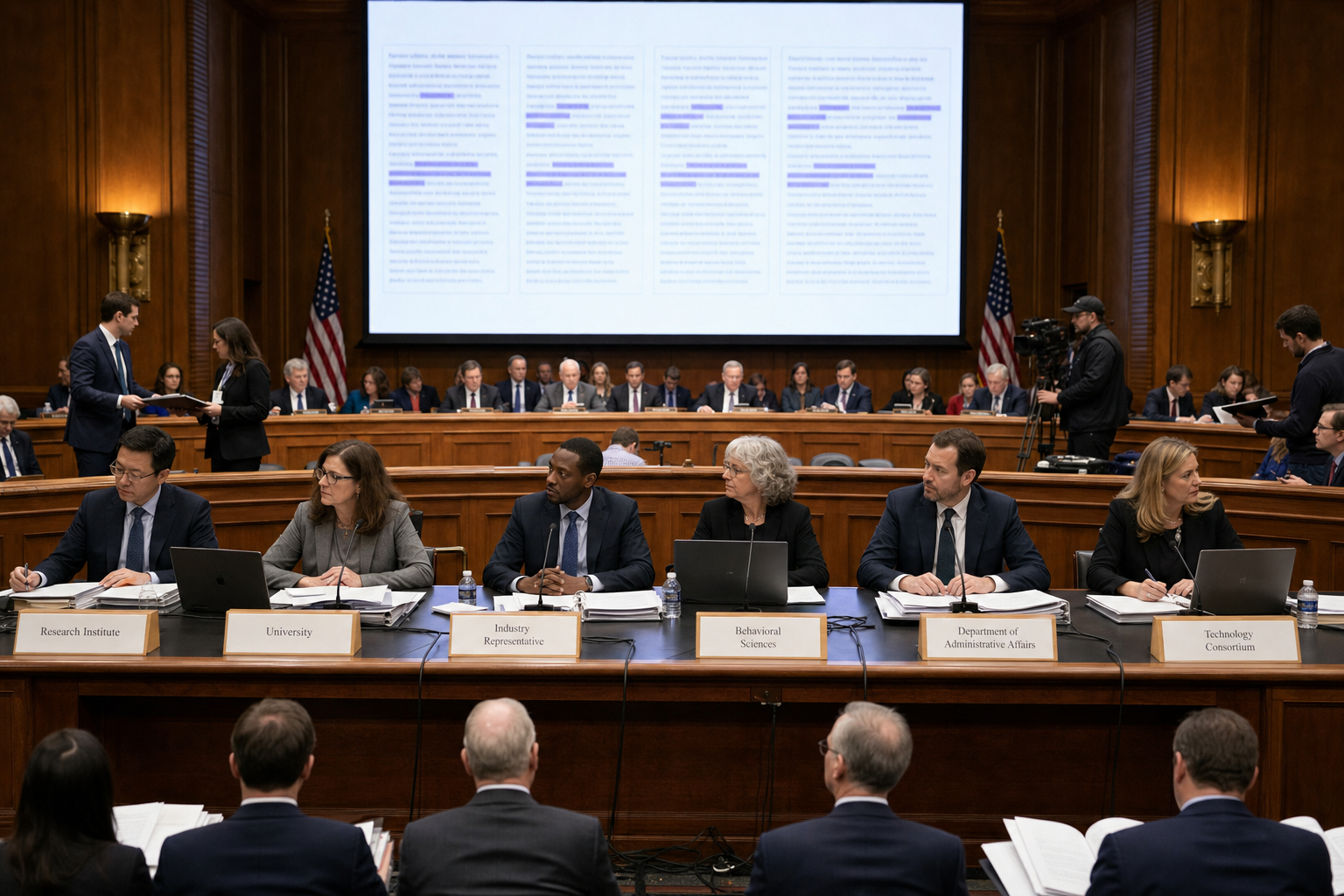
By the third week of the review, what had begun as a technical assessment of AI convergence had expanded into a full Congressional hearing involving engineers, economists, attorneys, psychologists, consultants, philosophers, technology executives, educators, and federal regulators.
Committee Chair Margaret Ellison opened proceedings by reminding witnesses that the hearing's objective was "to better understand whether independently developed artificial intelligence systems are independently becoming increasingly similar."
The first witness, Dr. Melissa Harmon, summarized updated engineering findings.
"Our latest measurements indicate statistically significant convergence across numerous categories," she testified. "However, substantial architectural diversity remains beneath the surface. Identical outputs do not necessarily imply identical reasoning pathways."
The committee thanked her.
Professor Adrian Keller then reminded lawmakers that "reasoning pathways themselves remain philosophically contested concepts."
An attorney immediately asked whether existing consumer protection statutes distinguished between probabilistic convergence and interpretive convergence.
The committee counsel replied that no such distinction presently existed.
A representative from Strategic Alignment Partners recommended formation of a Consensus Governance Roadmap to establish terminology before attempting legislation.
An economist suggested that creating terminology before measuring the underlying phenomenon might unintentionally distort future market incentives.
A psychologist cautioned that disagreement itself can increase public anxiety if introduced without adequate contextual framing.
The hearing recessed for lunch while committee staff attempted to determine whether the witnesses actually disagreed.
Staff later concluded that opinions remained "operationally adjacent."
AI Systems Asked To Explain AI Groupthink
In what officials described as an effort to improve methodological consistency, the Department of Administrative Affairs authorized researchers to ask multiple leading AI systems why AI systems appeared to be producing increasingly similar answers.
Each model independently generated detailed explanations referencing optimization incentives, reinforcement learning, safety alignment, large-scale statistical training, preference modeling, benchmark optimization, and convergent reasoning.
Although wording varied, investigators found that the underlying explanations were strikingly consistent.
The Department of Reality subsequently reviewed the results to determine whether agreement regarding AI Groupthink constituted additional evidence of AI Groupthink.
Officials stressed that this should not be interpreted as circular reasoning.
"It represents recursive evidence acquisition," Karen Whitmore explained. "Federal methodology distinguishes between circular conclusions and iterative confirmation when appropriate procedural safeguards have been documented."
Several committee members requested clarification.
The clarification required an additional clarification.
The National University of Administrative Sciences later published a sixty-eight-page guidance document explaining the difference.
Peer reviewers recommended a second edition.
Permanent Office Proposed To Coordinate Temporary Guidance
Although agency officials continued emphasizing that the review remained preliminary, administrative momentum continued accelerating.
The National Office of Temporary Guidance proposed establishing a Permanent Office of Temporary Guidance Coordination to ensure that future temporary guidance remained consistent with previously issued temporary guidance until permanent guidance could be developed.
According to draft documents, the proposed office would coordinate:
- Interagency consensus assessments.
- Cross-sector convergence monitoring.
- Public expectation harmonization.
- Independent disagreement metrics.
- Stakeholder confidence reporting.
- Voluntary best-practice development.
- International coordination regarding naturally occurring optimization convergence.
The proposal received immediate support from the International Council for Administrative Excellence, which announced the creation of an international symposium devoted to temporary administrative permanence.
Meanwhile, the Foundation for Institutional Resilience published a forecast concluding that coordination among coordinating organizations would eventually require a Coordinating Coordination Council.
Consultants praised the recommendation as "forward-looking."
Government officials referred it for stakeholder review.
Technology Companies Welcome Regulatory Predictability
Major AI developers largely welcomed the government's measured approach.
In a joint statement issued through the National Coalition for Responsible Innovation, participating companies reaffirmed their commitment to transparency, safety, competition, and responsible deployment.
"Independent optimization will inevitably produce areas of convergence," the statement read. "At the same time, healthy competition continues to drive innovation in architecture, efficiency, multimodal capability, reasoning performance, and customer experience."
Industry leaders cautioned against assuming that visibly similar answers reflected identical internal processes.
"Commercial aircraft all possess wings," one executive observed. "That does not imply they were built from identical engineering drawings."
Wall Street analysts responded positively to the prospect of regulatory clarity.
Several investment firms noted that predictable oversight often reduces long-term uncertainty, regardless of whether additional regulation ultimately results.
One analyst summarized investor sentiment by writing, "Markets generally prefer known procedures to unknown possibilities."
That observation was later cited by three federal working groups studying procedural predictability.
Experts Suggest Humans May Also Be Experiencing Convergence
Toward the conclusion of the hearings, researchers from the Center for Behavioral Decision Sciences introduced preliminary findings suggesting that humans exposed to similar information ecosystems often exhibit their own forms of convergent reasoning.
The report emphasized that professional organizations frequently recommend comparable strategic plans, universities often teach similar foundational concepts, consulting firms regularly develop remarkably compatible frameworks, and government agencies routinely adopt language from one another through years of collaborative rulemaking.
Researchers noted that similar institutional convergence had previously been documented during the Persian Governance Administrative Continuity Review, where multiple agencies independently concluded that expanding administrative coordination represented the most effective response to concerns regarding expanding administrative coordination.
"Some degree of convergence appears to be an inherent feature of large knowledge networks," the report concluded.
Researchers cautioned against interpreting this as evidence that human thought had become obsolete or recursively self-reinforcing.
Instead, they recommended additional comparative research examining whether artificial intelligence had begun resembling institutional human reasoning more closely than previously understood.
Officials immediately agreed that the recommendation warranted careful study.
Three universities announced a joint research consortium before the hearing adjourned.
Four consulting firms offered implementation support.
Two trade associations established stakeholder advisory councils.
The Department of Administrative Affairs confirmed that interagency planning had already begun.
At press time, the Office of Administrative Continuity announced that the Federal Review of AI LLM Generating Progressively More Groupthink Responses had successfully completed Phase One by concluding that additional phases would be required before determining whether future conclusions were becoming increasingly similar to previous conclusions.
By Emily Foster
GFNN Technology Desk
For more responsibly sourced Genuine Fake News, click here.
Recent Articles


-
The Gentle Night Friends Series
Aug 23, 26 03:38 PM
 The Gentle Night Friends Series is a collection of SEL children's stories.
 -
Senator Replaced Himself With Android: Committee Investigates
Aug 10, 26 12:32 PM
 Senator replaced himself with an android characterized as a "Legislative Productivity Surrogate," prompting a Judiciary Committee inquiry into voting, representation, AI autonomy, and constitutional p…
 -
Congress Opens Investigation Into the Decline of Music Education
Aug 03, 26 02:18 PM
Congress Opens Investigation Into the Decline of Music Education after educators report unexpected changes in student learning, prompting federal hearings, academic reviews, and industry responses.