
Anthony Honkins and the Goose Who Stayed
Anthony Honkins and the Goose Who Stayed is a Gentle Night Friends story about resilience and the possibility of an unexpected future.
Anthony is a Canada goose who came to Woodmere Estate and Rescue Farm after being shot by a hunter. His life was saved, but his injured wing could not be. When spring arrives and migrating geese begin flying north, Anthony can only watch them go.
Then one goose stays behind.
Through Professor Pondo's careful observations, the story follows Anthony and Harriet through a spring of courtship, bonding, nesting, and new life. Anthony cannot change what happened to him, but his future becomes something he could never have imagined when things looked darkest.
Like all Gentle Night Friends stories, the lesson emerges naturally from the characters' experiences rather than being taught directly. The story offers children a gentle way to explore resilience after loss or change, while reminding readers of all ages that a difficult moment does not tell us what the future will become.
The free printable PDF is provided so parents and caregivers can read and review the complete story before deciding whether to purchase the printed book. For bedtime reading, a physical book can also help preserve the quiet, screen-free routine that makes reading together such a special part of the evening. Book versions of Gentle Night Friends stories will be available soon.
If you'd like, you can read the entire story here. Simply scroll down and enjoy.
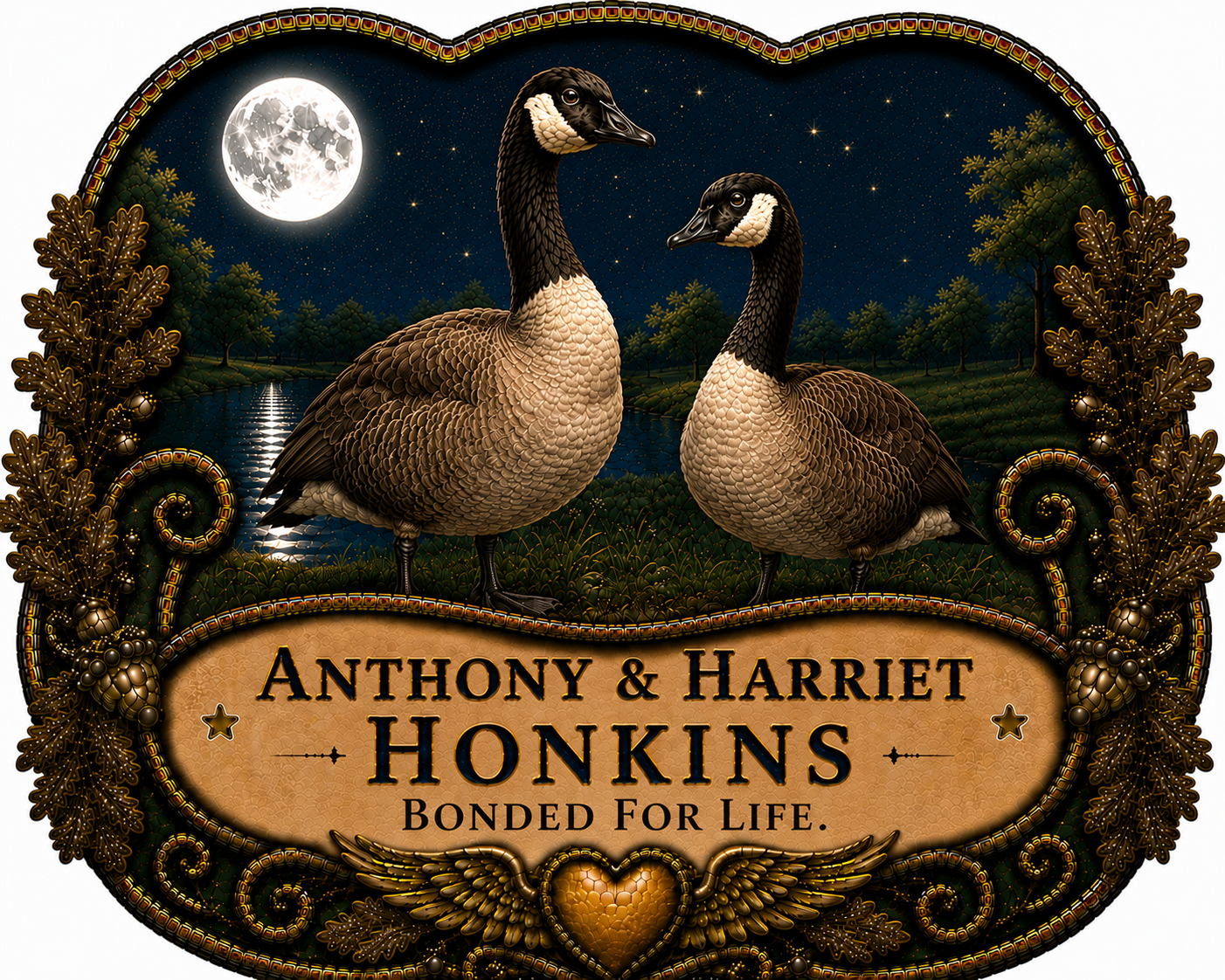
Woodmere Estate and Rescue Farm

The Cast of Characters

Anthony Honkins and the Goose Who Stayed
A Gentle Night Friends Story
From the notebook of Professor Pondo
Every spring, the geese return to Woodmere.
I usually hear them before I see them.
Their calls come down through the cool spring air. Then long lines of Canada geese appear above the trees.
Some continue north.
Others circle the lake and descend.
And every year, a remarkable number of them come to Woodmere.
I know that many belong to one very large family.
They spread across the lake and pasture until it becomes difficult to remember that there was once a spring when none of them were here.
Sometimes I stand beside the lake and wonder how one family can contain quite so many geese.
Then I remember how it began.
With one goose.
His name was Anthony Honkins.
Anthony had only one wing.
Animals do not speak to me in human words. I watch them closely, and then I imagine the words that might belong to what I see.
I watched Anthony very closely during his first spring at Woodmere.
Much of that watching was done from the walkway around the observatory at the top of the mansion.
During the day, Woodmere can be a busy place. Visitors come to see the estate and the rescue farm, and I have found that an unexpected Sasquatch can distract people from whatever they came to see.
The observatory solves this problem nicely.
From its walkway, I can see across the pasture and most of the lake. With my handheld telescope, I can observe the animals without disturbing them.
Or the visitors.
So I opened my notebook.
And this is what I imagined.
Anthony came to Woodmere after being shot by a hunter.
The people who rescued him saved his life, but they could not save his injured wing.
By the time I knew Anthony, the wound had healed.
He could walk through the pasture.
He could graze.
He could swim strongly across the lake.
He could also honk loudly enough to interrupt my reading in the conservatory.
This happened regularly.
I eventually learned that closing the window did not help very much, and decided to like the sound.
But Anthony could never fly again.
During the winter, there were few reminders of this.
Anthony had the lake.
He had the pasture.
He had plenty of grass and food from human caretakers.
He had sheltered places when the weather turned cold.
He had settled into the ordinary routines of Woodmere.
Then spring came.
One cool morning, I was on the observatory walkway when Anthony suddenly stopped grazing.
His head rose.
His neck stretched upward.
He stood very still.
Then I heard them too.
Honk.
Honk-honk.
The calls grew louder.
I looked toward the southern sky.
A line of Canada geese appeared above the trees.
They were flying north.
Anthony watched them cross the sky.
I could see the flock above me and Anthony far below.
He called.
A few calls came back from high above.
Then the flock continued on.
Anthony remained where he was until the last goose disappeared.
Afterward, he lowered his head and returned to the grass.
A few days later, another flock passed.
Anthony watched that one too.
Then another.
And another.
Some flew high over Woodmere.
Others circled the lake and came down to rest.
Those were the days when Anthony hurried toward the water.
From the observatory walkway, I could watch the lake fill with geese.
For a few hours, sometimes for a day or two, Anthony swam among them.
He called.
They called back.
He grazed with them along the shore.
For a while, there was nothing unusual about a goose with one wing among all those geese with two.
They were simply geese together on a lake.
Then the visitors gathered again.
They called more often.
They moved out onto open water.
Soon one goose began running across the surface.
Then another.
Then many.
Their feet struck the water.
Their wings beat harder and harder.
One after another, they lifted into the air.
Anthony followed through the water.
He paddled quickly.
Then he stopped.
From high above, I could see Anthony on the lake and the flock climbing into the sky.
The geese passed the mansion and continued north.
Anthony watched until they disappeared.
He always watched them go.
That became part of the spring.
Geese arrived.
Anthony joined them.
Geese left.
Anthony remained.
A week passed.
Then another.
The days grew longer.
More flocks came.
More flocks went.
Anthony watched every departure.
One afternoon, another group descended onto the lake.
They stayed through the evening.
That night, after Woodmere had grown quiet, I sat outside the conservatory and listened to their soft calls carrying across the water.
By morning, some were gone.
The others spent much of the day grazing.
Late that afternoon, I was back on the observatory walkway when they began gathering on the lake.
They called to one another.
They ran.
Wings beat against the air.
The geese rose from the water, circled once above Woodmere, and headed north.
Anthony stood at the shore.
He watched them leave.
But this time, one goose remained.
I raised my telescope.
She floated near the reeds.
She was a Canada goose with a dark head, a white patch beneath her chin, and a watchful way of carrying herself.
Anthony looked at her.
She looked at Anthony.
I began calling her Harriet.
At first, Harriet kept her distance.
Anthony did not chase her.
They occupied the same lake without appearing particularly concerned about one another.
Harriet fed along one shore.
Anthony fed along another.
Sometimes they passed each other on the water.
Sometimes they rested far apart.
The next morning, Harriet was still there.
That afternoon another flock passed overhead.
Harriet raised her head.
Anthony did too.
They watched the geese fly north.
Harriet stayed.
The following day, Anthony and Harriet grazed within a few yards of each other.
The day after that, I saw them swimming in the same part of the lake.
Then they separated again.
For several days, very little seemed to happen.
This is one of the difficulties with watching animals.
Humans are inclined to think that if nothing dramatic happens, nothing important is happening.
Animals have never shown much concern for this opinion.
So I kept watching.
Some observations I made from the roof.
Others I made in the evening, when the visitors were gone and I could walk quietly around Woodmere without attracting attention.
Anthony and Harriet continued spending time near each other.
Not always.
Sometimes Harriet disappeared around the far side of the lake.
Sometimes Anthony grazed alone.
But the distance between them gradually became smaller.
One morning, through my telescope, I noticed them swimming together.
Not merely near one another.
Together.
Anthony moved across the water and Harriet moved with him.
Harriet changed direction and Anthony followed.
They fed near each other.
They rested near each other.
When one moved away, the other often followed later.
And if enough distance opened between them, they called.
Then one morning, I saw something different.
Anthony and Harriet were facing one another on the water.
I steadied the telescope.
Anthony lowered his head and neck into the lake.
Harriet lowered hers.
Anthony raised his head.
Harriet raised hers.
Then they did it again.
Down.
Up.
Down.
Up.
They continued for some time.
I had seen Canada geese do this before.
I knew what I was watching.
Anthony Honkins was courting Harriet.
And Harriet was courting Anthony.
That mattered.
Anthony's missing wing had been obvious to me from the first day I saw him.
It was obvious when he walked.
It was obvious when he stretched.
It was most obvious when the migrating geese lifted from the lake and Anthony remained behind.
But Harriet did not fly away.
The next morning, they were together again.
Their courtship continued as spring moved across Woodmere.
Anthony stretched his neck and called.
He bobbed his head.
Harriet answered.
They dipped their heads and necks into the water together.
Sometimes their quiet swimming became a great commotion of calling and splashing.
Then, almost as suddenly, they settled.
They preened their feathers.
They rested near each other.
The displays happened again the next day.
And days after that.
I found myself spending more time on the observatory walkway than usual.
This occasionally interfered with my work.
I decided that observing Canada geese was work.
This solved the problem.
Meanwhile, the bare branches around the lake began to change.
At first there was only a faint green haze.
Then tiny leaves appeared.
The leaves opened.
Fresh grass spread across the pasture.
Tree frogs were peeping in the forest.
Bull frogs began calling from the wet places in the evening.
Insects appeared above the water.
Warm afternoons became more common.
Still the migrating geese came through Woodmere.
And still Harriet stayed.
By then, Anthony and Harriet had begun to behave differently around the other geese.
They no longer simply joined whatever flock happened to be visiting.
They had begun to claim a part of the lake.
They patrolled it together.
If another goose came too close, Anthony stretched his neck forward and moved rapidly across the water.
Sometimes Harriet joined him.
The visitor usually reconsidered its plans.
Anthony had always been a determined goose.
Having one wing had not changed that.
He could not chase another goose into the sky.
He did not need to.
On the water and along the shore, Anthony was entirely capable of making his opinions clear.
More geese left for the north.
Harriet did not go with them.
The departures that had filled Anthony's early spring gradually became less important.
There was something else to watch now.
Anthony and Harriet had become a pair.
As the days grew warmer, Harriet spent a great deal of time feeding.
She grazed for long periods in the fresh spring grass.
Anthony was usually nearby.
They moved through the pasture together.
They returned to the lake together.
And then Harriet began paying particular attention to a quiet place near the water.
From the observatory, I could see that it was partly hidden by vegetation.
Harriet went there.
She came out again.
She returned.
Soon I saw her carrying grasses and other plant material.
Anthony remained nearby, alert to anything approaching their part of the lake.
A nest was taking shape.
Then there were eggs.
And the rhythm of Anthony and Harriet's spring changed again.
Harriet sat.
Anthony watched.
And from high above them, I watched too.
The change was remarkable.
I had grown accustomed to seeing Harriet swimming with Anthony, grazing beside him, dipping her neck into the water with him, and moving around their part of the lake.
Now she remained on the nest for astonishing stretches of time.
Morning after morning, I brought my telescope to the walkway.
Harriet was there.
Afternoon after afternoon, I checked again.
She was still there.
She occasionally left for a short time.
But never for long.
Harriet had prepared for this.
She had fed heavily before laying her eggs.
Now she seemed to live on patience and whatever she had stored within herself.
Anthony's role was different.
He did not sit on the eggs.
He stayed near them.
He watched.
He patrolled.
He grazed nearby.
If another goose approached too closely, Anthony moved toward it.
If something unfamiliar crossed the pasture, his head rose immediately.
If Harriet briefly left the nest, Anthony remained attentive to the nesting area.
Then Harriet returned.
Days passed.
Rain came to Woodmere.
From the walkway around the observatory, I watched it move across the estate.
Harriet sat through it.
Water gathered on the leaves.
Drops fell from the branches.
Anthony stood nearby, wet and watchful.
The rain passed.
Sunlight returned.
The grass grew taller.
Harriet remained.
The evenings grew warmer.
The frogs became louder.
The trees became thick with leaves.
The great northward movement of geese began to diminish.
There were fewer calls overhead.
Fewer flocks came down to the lake.
The sky that had seemed full of geese at the beginning of spring became quieter.
Still Harriet sat.
Still Anthony watched.
And every day, I climbed to the observatory walkway and looked toward their quiet corner of the lake.
The telescope allowed me to see without approaching.
That seemed particularly important now.
Harriet needed peace.
Anthony strongly agreed.
Sometimes Harriet was so well hidden that even using the telescope, I had to be very observant to see her through the vegetation.
Anthony was easier to find.
He moved around the nesting area.
He grazed.
He rested.
He watched.
Day after day.
Week after week.
Nearly a month passed.
Then one morning, I stepped onto the observatory walkway and immediately noticed that Anthony was different.
He was standing close to the nest.
He was not grazing.
He was not watching the pasture.
His attention was fixed on Harriet.
I raised my telescope.
Something moved beneath her.
A tiny head appeared.
Then disappeared.
I adjusted the focus.
A moment later, it appeared again.
A gosling.
Another small head appeared beside it.
Then another.
After weeks in which the nest had seemed almost unchanged from one day to the next, everything was changing at once.
The eggs were hatching.
I remained on the walkway for a very long time that day.
By afternoon, tiny yellow-and-brown goslings were moving beneath and around Harriet.
Some were still damp.
Others were beginning to fluff as they dried.
One appeared from beneath Harriet and stood on uncertain legs.
It took a few steps.
Anthony lowered his head.
The gosling moved toward him.
Another appeared.
Then another.
For nearly a month, Anthony had guarded eggs he could barely see beneath Harriet.
Now those eggs had become little geese.
They moved.
They stumbled.
They disappeared beneath Harriet and appeared again somewhere else.
Anthony stayed close.
The following day, I was watching when Harriet stood.
The goslings gathered around her.
Anthony was beside them.
Harriet began walking toward the lake.
The goslings followed.
Or attempted to.
They hurried.
They stopped.
They changed direction.
They hurried again.
One became interested in a piece of grass.
Another walked directly into the first one.
For a moment, both seemed to forget that everyone else was leaving.
Then they noticed.
They hurried after Harriet.
Anthony stayed with them.
At the edge of the lake, Harriet stepped into the water.
The first gosling followed.
Then another.
Then another.
Tiny bodies that had been inside eggs only a short time before were suddenly swimming.
Anthony entered the lake beside them.
Harriet swam on one side.
Anthony swam on the other.
Their goslings paddled between them.
From the observatory walkway, I lowered my telescope for a moment and simply looked across Woodmere.
Then I heard geese.
Anthony heard them too.
A small flock appeared high above the estate.
They were still traveling north.
At the beginning of spring, that sound had stopped Anthony wherever he was.
He had raised his head.
He had watched until the last goose disappeared.
This time, Anthony looked up.
Only for a moment.
One of the goslings had drifted away from the others.
Anthony turned.
He paddled toward the little goose and remained beside it as it returned to Harriet and the rest of the family.
Above them, the migrating flock continued north.
Its calls became faint.
Then they were gone.
Anthony did not watch them disappear.
He was watching his goslings.
Nothing had given Anthony back his missing wing.
Nothing ever would.
The geese in the sky could still go somewhere Anthony could not follow.
That had not changed.
But the Anthony I had watched at the beginning of spring could not have known what else the season would bring.
He could not have known that one goose would remain when the others flew north.
He could not have known that she would swim beside him.
Or that they would dip their heads together in the cold spring water.
Or patrol the lake together.
Or choose a quiet place near its shore.
He could not have known that one morning there would be tiny heads appearing beneath Harriet.
And he certainly could not have known that he would one day swim across Woodmere's lake with Harriet beside him and their goslings between them.
That was many springs ago.
Tonight, the lake is crowded with geese again.
Some are resting on the water.
Others have settled in the grass.
I cannot tell you exactly how every one of them is related.
I have learned not to attempt this.
But I know where this family began.
Anthony is resting near the lake.
Harriet is beside him.
The calling across the water has grown softer.
One by one, the geese are becoming still.
The lake reflects the evening sky.
And tonight, the family that began with Anthony and Harriet has come home to Woodmere for another reunion.
Good night then.
Professor Pondo
Anthony Honkins and the Goose Who Stayed
A Gentle Night Friends Story
Copyright © 2026 Marcus Goodman LLC
All rights reserved.
Recent Articles


-
The Gentle Night Friends Series
Aug 23, 26 03:38 PM
 The Gentle Night Friends Series is a collection of SEL children's stories.
 -
Senator Replaced Himself With Android: Committee Investigates
Aug 10, 26 12:32 PM
 Senator replaced himself with an android characterized as a "Legislative Productivity Surrogate," prompting a Judiciary Committee inquiry into voting, representation, AI autonomy, and constitutional p…
 -
Congress Opens Investigation Into the Decline of Music Education
Aug 03, 26 02:18 PM
Congress Opens Investigation Into the Decline of Music Education after educators report unexpected changes in student learning, prompting federal hearings, academic reviews, and industry responses.