
The Goslings Learn to Fly
Learning something new rarely happens the same way for everyone.
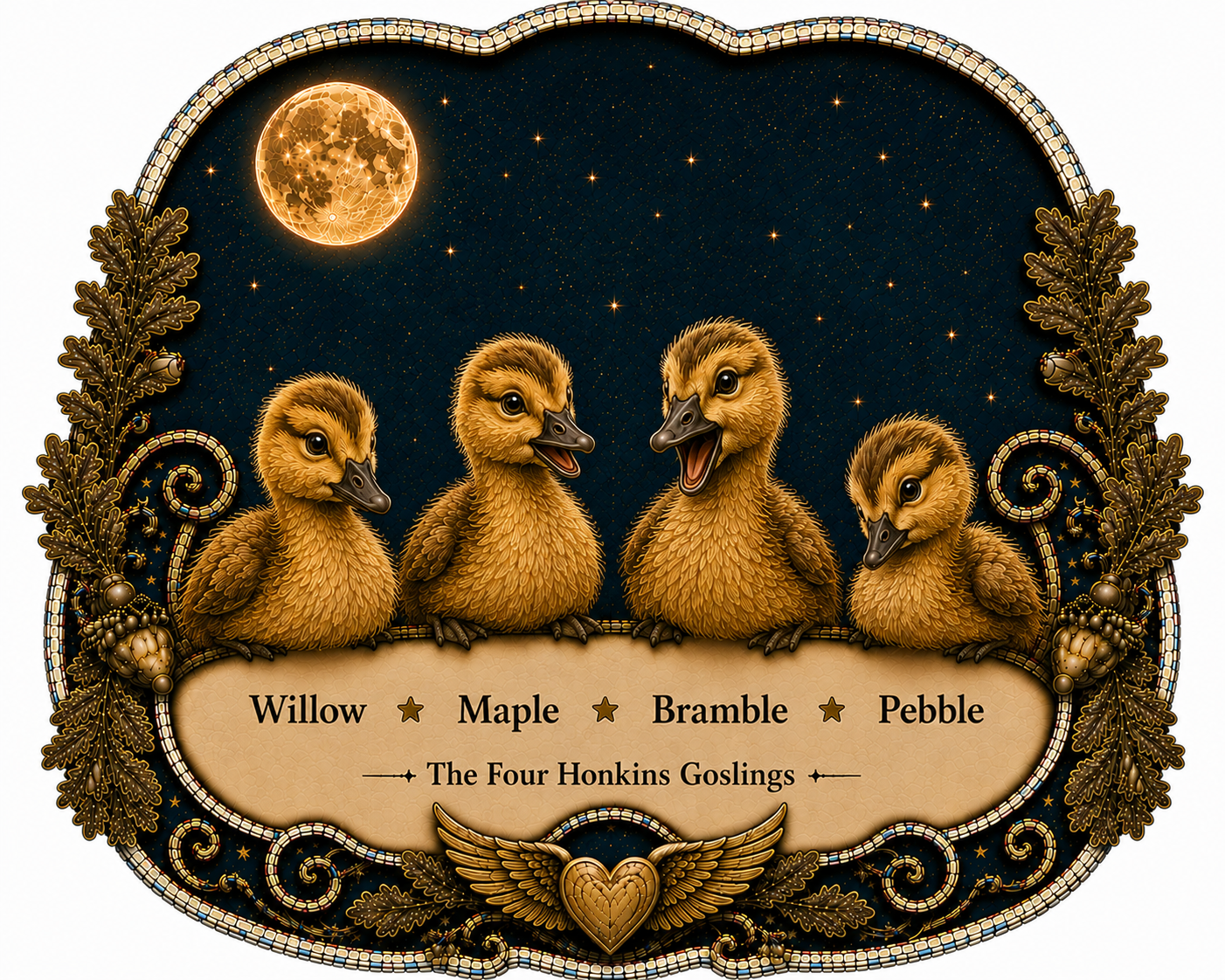
In The Goslings Learn to Fly, four young Canada geese named Willow, Maple, Bramble, and Pebble begin the difficult business of learning to use their wings. Willow watches carefully before she tries. Maple learns through small adjustments. Bramble relies heavily on enthusiasm. Pebble needs more time than the others.
Professor Pondo watches as each gosling finds a different path toward the same goal. Some attempts work. Others end in wobbles, tumbles, unexpected turns, and, in Bramble's case, an occasional bush. Progress is not always obvious, and it does not always happen in a straight line.
The Goslings Learn to Fly is a Gentle Night Friends story about persistence and different ways to learn. It offers children a gentle reminder that taking longer does not mean failing, that mistakes are part of learning, and that someone else's way of learning does not have to be your own.
Like all Gentle Night Friends stories, the free printable PDF is available here, along with the full story, so parents, grandparents, caregivers, and educators can read it before deciding whether they want a printed copy.
For bedtime reading, I recommend the printed book rather than reading from a phone, tablet, or computer. The quiet routine of sharing a physical book can become part of the experience itself, and for many families, those ordinary bedtime reading moments become treasured memories.
Woodmere Estate and Rescue Farm

The Cast of Characters

The
Goslings Learn to Fly
A
Gentle Night Friends Story
From
the notebook of Professor Pondo
The geese had returned to Woodmere.
I noticed them early one morning from the walkway around the observatory, where I often go when I want to see what is happening across the estate.
There were geese on the lake.
Geese in the pasture.
Geese walking importantly across the grass as though they owned Woodmere and had merely allowed the rest of us to use it while they were away.
On my predawn walk, there were even three geese standing directly in the middle of one of the paths.
They appeared to be holding a meeting.
I waited.
The meeting continued.
Eventually I went around them.
One must choose one's battles.
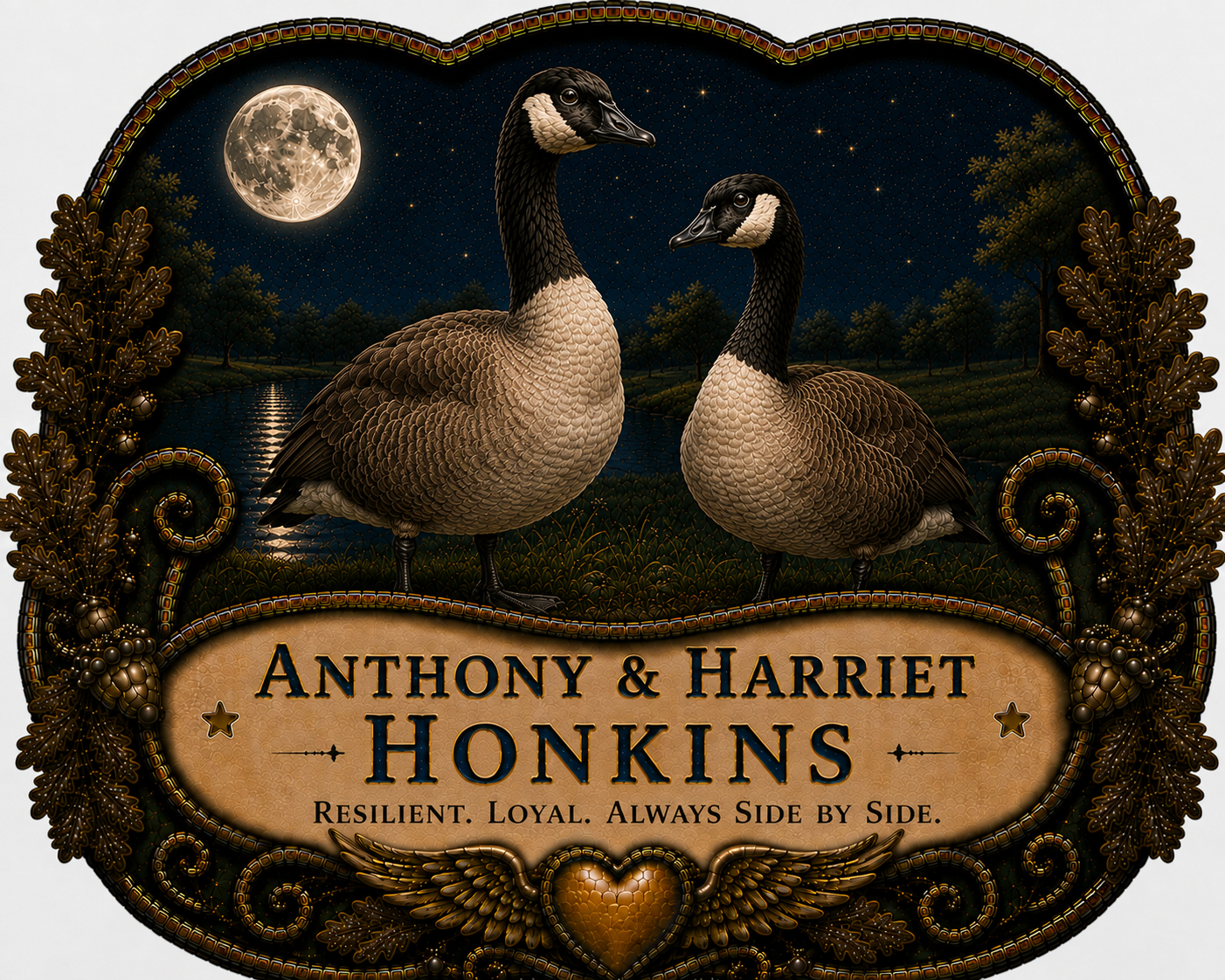
And among all those geese were Anthony and Harriet Honkins.
Anthony was easy to recognize. Years ago, before he came to Woodmere, a hunter had shot him. His injured wing could not be saved. He would never fly again.
That had not prevented him from building a life here.
And it certainly had not prevented him from building a family.
Some of the geese on the lake that morning were part of that family.
Watching them reminded me of a spring many years earlier, when four small goslings were discovering that having wings and knowing what to do with them were two very different things.
Their names were Willow, Maple, Bramble, and Pebble.
Animals do not speak to me in human words. I watch them closely, and then I imagine the words that might belong to what I see.
So I opened my notebook.
And this is what I imagined.
Willow was the careful one.
When the four goslings explored something new, Willow usually stood back for a moment.
She watched.
She considered.
Then she moved.
Sometimes she considered for quite a while.
Maple was different. Maple seemed comfortable trying things a little at a time. If something did not work, she tried it again with some small adjustment that was almost too slight to notice.
Bramble did not believe in small adjustments.
Bramble believed in enthusiasm.
If a little flapping was useful, Bramble seemed certain that a great deal of flapping must be better.
Pebble was the smallest.
He followed the others everywhere, but he often arrived a few steps behind them.
This did not appear to bother him.
At first, flying was not important to any of them.
There were much more interesting things to do.
There were young dandelions and clover shoots to nibble.
There were insects to hunt and eat.
There were shallow places along the lake where four goslings could eat algae and paddle together.
There was Harriet to follow.
And there was Anthony.
Anthony could not fly with them, but he could swim.
He could walk.
He could stand watch while they rested.
And he was exceptionally good at noticing when one of his children had wandered somewhere a young goose should probably not be.
Bramble gave him considerable practice.
If there was a patch of mud, Bramble inspected it.
If there was a hole, Bramble looked into it.
If there was a clump of tall grass, Bramble disappeared into it.
Usually his head appeared again a moment later.
Anthony would look at him.
Bramble would look at Anthony.
I often imagined their conversations.
Where were you?
Over there.
Why?
I hadn't been over there yet.
As the goslings grew, their soft yellow down gradually gave way to feathers.
Their legs became stronger.
Their necks became longer.
And their wings began to look less like little feathery paddles and more like something that might someday carry them into the air.
They began exercising them.
Willow stretched hers carefully.
Maple flapped hers several times and stopped.
Pebble copied Maple.
Bramble flapped his with such determination that his whole body rocked from side to side.
He stopped.
He looked around.
Then he did it again.
A small cloud of dry grass and bits of leaves rose behind him.
Willow moved away.
Bramble flapped harder.
Willow moved farther away.
This seemed sensible.
One afternoon, Harriet walked away from the lake and onto a broad stretch of grass.
The four goslings followed.
Anthony followed too.
Harriet began to run.
Then her wings opened.
A few powerful strokes carried her above the grass.
She flew low across the field, circled, and came back down.
Four young geese watched her.
Willow stretched her neck.
Maple opened her wings.
Pebble looked from Harriet to the field ahead.
Bramble ran.
Apparently, Bramble had seen enough.
His feet pounded across the grass.
His wings beat furiously.
For several strides, nothing happened.
Then something did.
Bramble left the ground.
It was not what I would describe as controlled flight.
It was closer to an unexpected disagreement with gravity.
He rose perhaps a foot.
One wing dipped.
His body turned.
His feet came down again at an angle, and Bramble bounced through the grass before stopping in a heap.
For a few seconds, he remained there.
Then his head came up.
He stood.
He shook his feathers.
And he ran back toward the others.
If I were putting words to his expression, they might have been:
That almost worked.
If I were putting words to Willow's expression, they might have been:
Did it?
Maple went next.
She ran more slowly.
Her wings opened.
She flapped.
Her feet left the ground for two or three strides.
Then they touched down again.
Maple stopped.
She looked back at the patch of grass she had crossed.
Then she returned to where she had started.
She tried again.
This time she went slightly farther.
Maple stopped again.
She looked back again.
I began to suspect Maple was measuring.
Willow watched both of them.
She opened her wings.
She folded them.
She watched Harriet.
She watched Maple.
She watched Bramble make another spectacular attempt and land considerably better than he had the first time.
Willow did not run.
Pebble did not run either.
Instead, he flapped his wings while standing beside Anthony.
Bramble tried a third time.
He ran.
He flapped.
He lifted.
He turned unexpectedly.
And he landed facing the direction from which he had started.
Bramble stood there for a moment.
I imagined him thinking:
Excellent.
I am not certain what he believed he had accomplished.
Perhaps he wasn't either.
The next morning, they practiced again.
Bramble ran first.
Of course.
This time he got higher.
He also discovered that getting into the air was not the same as knowing what to do once he was there.
His left wing dipped.
He corrected too much.
His right wing dipped.
He corrected that.
For several remarkable seconds, Bramble traveled across the field in a series of airborne wobbles.
Then he landed.
He remained upright.
That seemed to surprise him more than anyone.
He looked back toward Harriet.
Then toward Anthony.
Then he stretched himself as tall as he could.
There are moments when it is possible to know exactly what a young goose is thinking without understanding a single word of goose.
This was one of those moments.
Maple ran next.
She lifted.
Her flight was shorter than the one she had managed the day before.
She landed, stood quietly for a moment, and tried again.
The second attempt was better.
The third was not.
Maple rested.
She seemed entirely unconcerned that improvement had failed to proceed in a straight line.
I admired this.
Humans are often less reasonable.
Willow walked to the place where Harriet had begun her run.
She stood there for a long time.
Bramble waited behind her.
Then he stopped waiting.
He wandered away.
He found something in the grass.
He investigated it.
He returned.
Willow was still considering.
Then she ran.
Her wings opened.
Her feet moved faster.
For a moment, it seemed she might stop.
She did not.
Willow lifted cleanly from the grass.
She flew perhaps twenty feet.
Then she landed on both feet, took several hurried steps, and stopped.
She stood very still.
Bramble hurried toward her with his wings partly open.
Maple followed.
Pebble followed Maple.
Willow looked back toward Harriet.
Then she walked to the starting place and did it again.
Her second flight was not as good.
That appeared to offend her.
She tried a third time.
Pebble continued practicing his wings.
He ran a few times.
But when the moment came when the others opened their wings and pushed hard against the air, Pebble slowed down.
Sometimes he stopped completely.
Nothing chased him.
No one pushed him.
Harriet waited.
Anthony remained nearby.
Once Pebble ran halfway across the field, stopped, and began eating grass.
I have occasionally used the same technique when avoiding work. Eating is more entertaining than working most of the time.
It is surprisingly effective.
The next day, Pebble tried again.
And the next.
So did the others.
Flying did not arrive all at once for everyone.
Bramble could get into the air quite easily now, but landing remained an adventure.
Once, he came down too quickly, ran several steps, stumbled, recovered, stumbled again, and finally stopped beside Anthony.
Anthony turned his head and looked at him.
Bramble settled his feathers.
I imagined Anthony saying nothing at all.
Sometimes nothing is exactly the right thing to say.
Another time, Bramble made an excellent takeoff, flew farther than he ever had before, and landed neatly.
I was impressed.
Bramble seemed impressed.
Everyone seemed impressed.
On his very next attempt, he landed in a bush.
Learning is like that.
The bush survived.
So did Bramble.
Willow became very good at short, controlled flights.
But when the wind was stronger, she hesitated.
She would stand with her wings partly open, feeling the moving air.
Sometimes she flew.
Sometimes she waited.
Bramble rarely waited.
This gave Willow more opportunities to observe what happened to a goose who did not.
On one particularly breezy afternoon, Bramble opened his wings at exactly the wrong moment.
The wind caught him.
For a second, he went sideways.
He landed safely several feet from where he had intended.
Willow watched.
Then she folded her wings and waited for the gust to pass.
I imagined Bramble saying:
I meant to do that.
I imagined Willow replying:
No, you didn't.
Maple kept practicing.
Her flights became longer so gradually that I could not have said exactly when the change happened.
One day she crossed part of the field.
A few days later she crossed most of it.
Then she reached the lake.
The next afternoon she did not.
She landed well short of the water.
Maple simply walked the remaining distance.
The following morning, she tried again.
Pebble was still making short hops.
He could leave the ground now.
But only briefly.
His feet would rise.
His wings would beat.
Then his feet would come down again.
Sometimes he looked toward his siblings after they flew.
Sometimes he looked at Harriet.
And sometimes he stayed close to Anthony.
One afternoon, Willow, Maple, and Bramble followed Harriet across the field.
Harriet rose first.
Maple followed.
Then Willow.
Bramble charged after them, lifted too steeply, corrected himself, and continued.
For the first time, all three stayed in the air.
They crossed the grass.
They reached the lake.
Maple landed first with a splash.
Willow came down beside her.
Bramble arrived last and struck the water with enough enthusiasm to send a spray into the air.
He surfaced immediately.
I believe Bramble considered this a landing.
I am willing to allow the term.
Pebble had stopped halfway across the field.
He stood alone on the grass.
His wings were still slightly open.
Across the water, his siblings gathered near Harriet.
Pebble folded his wings.
Anthony walked toward him.
Pebble looked at the lake.
Then he looked at Anthony.
Anthony could not fly across it either.
The two of them walked.
They did not hurry.
When they reached the shore, they entered the water together.
Pebble paddled out to his family.
Bramble was still splashing.
The next morning, Pebble returned to the field.
He ran.
He flapped.
He lifted.
And he came down.
He tried again.
The second attempt was shorter.
He tried again anyway.
The third was longer.
The fourth ended almost immediately.
Pebble rested.
Then he tried a fifth time.
For several days, that was how it went.
Up.
Down.
Run.
Flap.
Land.
Rest.
Again.
Meanwhile, Bramble discovered turning.
His first turns were much like his first flights.
There was considerable enthusiasm and very little agreement among the different parts of Bramble about where they were going.
His first deliberate left turn became something closer to a large circle.
He landed almost where he had started.
Bramble looked around.
I imagined him thinking:
I have returned.
Maple learned to use the breeze.
Willow learned that she could wait for a gust to pass and then take off when the air felt right.
Pebble kept running.
I watched his flights grow by distances so small that I doubt Pebble noticed them.
One more body length.
Then another.
A few more wingbeats.
A little more height.
A slightly better landing.
There was no single morning when he suddenly became a different goose.
There were simply mornings.
And attempts.
Then, one quiet morning, Harriet crossed the field again.
Willow followed her into the air.
Maple rose beside Willow.
Bramble followed Maple.
Pebble ran behind them.
His wings beat.
His feet left the ground.
I expected them to come down again.
They did not.
Pebble was flying.
He stayed low.
His wingbeats were quick.
There was nothing graceful about them.
But the space beneath his feet grew.
He crossed the place where he usually landed.
Then the next place.
And the next.
Anthony stood below.
Pebble passed over him.
For one moment, the small goose seemed to hang in the morning air.
Then he continued toward the lake.
He did not reach it.
His feet touched the grass several yards from shore.
He ran.
He stumbled.
He caught himself.
And stopped.
Pebble stood with his wings open.
Behind him was the field.
Ahead of him was the lake.
He folded his wings.
Then he turned around.
He walked back to the other end of the field.
He tried again.
That second flight was shorter.
Pebble landed.
He returned.
The third was shorter still.
He returned again.
Bramble watched him.
Then Bramble ran down the field and launched himself into the air.
He climbed.
He turned.
He came down.
His feet touched the grass.
For once, everything appeared to happen exactly as Bramble intended.
Then he tripped over his own foot.
Willow walked past him.
Maple walked past him.
Pebble walked past him.
Bramble stood up and followed.
A few mornings later, I watched five geese rise from the grass.
Harriet went first.
Then Willow.
Maple.
Bramble.
And Pebble.
They flew together toward the lake.
Willow was careful and steady.
Maple held an easy line beside her.
Bramble climbed higher than necessary, corrected himself, and came back down.
Pebble flew lowest.
But he flew.
All four reached the water.
They circled once before landing.
Bramble splashed.
Maple barely did.
Willow landed neatly.
Pebble touched the surface, bounced once, and settled onto the water.
Anthony was already there.
The four young geese paddled toward him.
Soon the Honkins family was together again.
Bramble climbed onto the bank, stretched his wings, and flapped hard enough to spray Anthony with water.
Anthony moved away.
I imagined him saying:
You can fly now. Perhaps you could fly somewhere else while you do that.
That evening, I sat beside the lake with my notebook.
The goslings were resting near the shore.
Bramble had finally stopped practicing.
This improved the quiet considerably.
It was difficult to believe that the awkward little creatures I had watched tumbling through the grass would one day become the great birds I now see returning to Woodmere.
But perhaps I should not have been surprised.
Bramble had learned something from every wild landing.
Willow had learned something each time she watched before trying.
Maple had learned through all those ordinary attempts that seemed hardly different from the ones before.
And Pebble had learned during all those little flights that ended before he wanted them to.
None of them had learned in quite the same way.
None of them had learned at quite the same speed.
They had simply kept going.
I wrote one sentence in my notebook that evening.
Their flight was made from every attempt that came before it.
This morning, many years later, I watched the flock from the observatory walkway.
Geese rose from the lake one after another.
Their wings caught the morning light as they climbed over Woodmere.
Somewhere among them were birds whose first flights I had watched years ago.
They did not wobble anymore.
But once they had.
Good night then.
Professor Pondo
Copyright © 2026 Marcus Goodman LLC
All rights reserved.
No part of this book may be reproduced, distributed, or transmitted in any form or by any means without the prior written permission of the copyright holder, except for brief quotations used in reviews, articles, or other uses permitted by copyright law.
Gentle Night Friends and its characters, stories, and related creative elements are the property of Marcus Goodman LLC.
Published by Marcus Goodman LLC
United States of America
Recent Articles


-
The Gentle Night Friends Series
Aug 23, 26 03:38 PM
 The Gentle Night Friends Series is a collection of SEL children's stories.
 -
Senator Replaced Himself With Android: Committee Investigates
Aug 10, 26 12:32 PM
 Senator replaced himself with an android characterized as a "Legislative Productivity Surrogate," prompting a Judiciary Committee inquiry into voting, representation, AI autonomy, and constitutional p…
 -
Congress Opens Investigation Into the Decline of Music Education
Aug 03, 26 02:18 PM
Congress Opens Investigation Into the Decline of Music Education after educators report unexpected changes in student learning, prompting federal hearings, academic reviews, and industry responses.