
The Winter of Waiting
The Winter of Waiting is a Gentle Night Friends story about constancy, family bonds, and remaining connected when circumstances require us to be apart.
Autumn has come to Woodmere Estate, and Anthony and Harriet Honkins’ four offspring are finally strong enough to migrate. Harriet can show them the long journey south, but Anthony cannot follow. His missing wing means he must remain at Woodmere.
After Harriet and the young geese disappear into the southern sky, Anthony returns to the familiar routines of his life. He grazes beside the lake. He swims. He rests. He watches the migrating flocks overhead.
And sometimes, after Woodmere has grown quiet, he calls into the night.
Through Professor Pondo’s observations, The Winter of Waiting explores a quiet kind of constancy: the bonds that remain even when those we care about cannot always be beside us.
Like all Gentle Night Friends stories, The Winter of Waiting is intended to be read slowly and shared together. The free printable PDF is available so parents and caregivers can review the complete story before deciding whether to add the printed book to their bedtime reading collection.
The full text is also included here. Scroll down and enjoy.
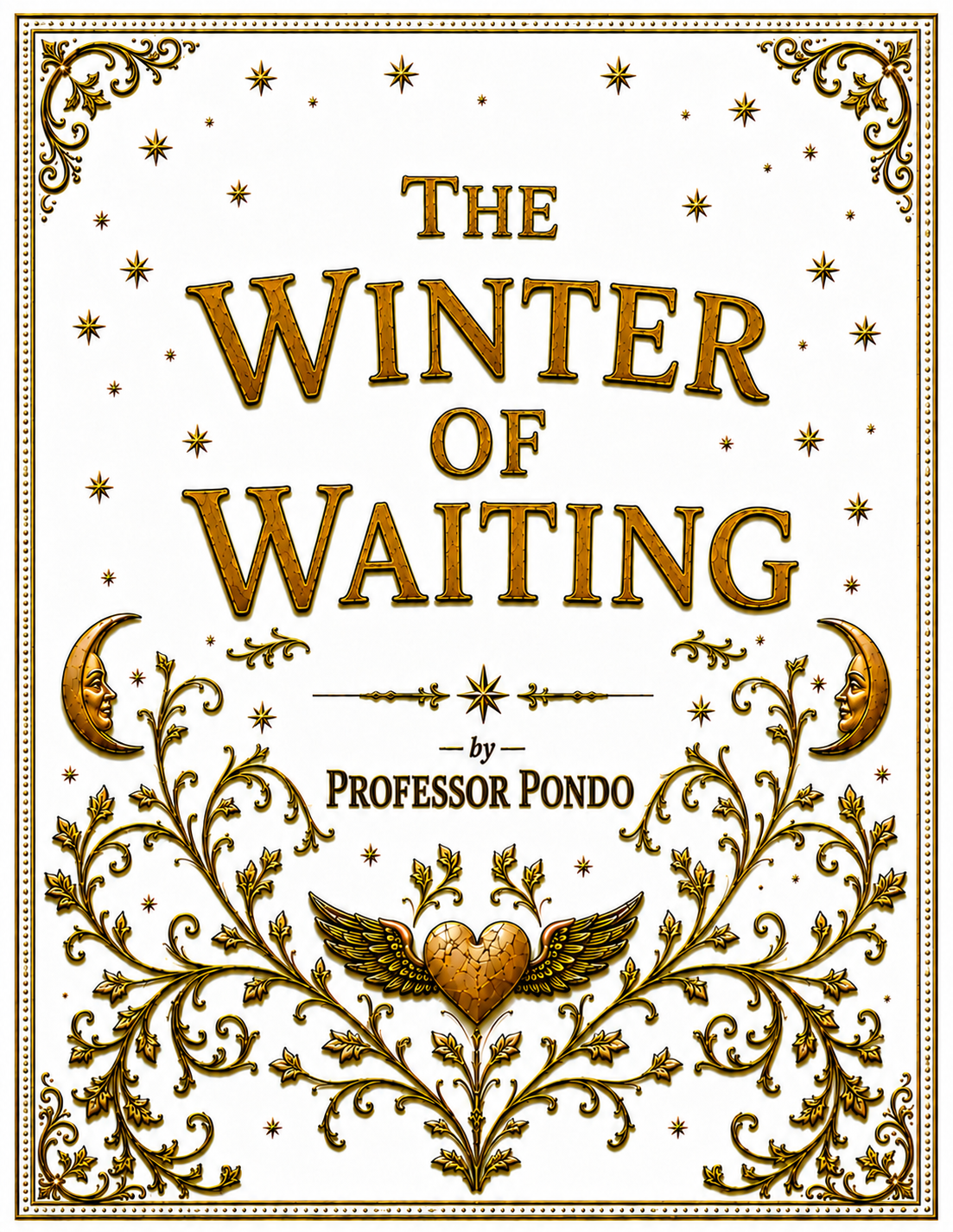
Woodmere Estate and Rescue Farm


The Winter of Waiting
A Gentle Night Friends Story
From the notebook of Professor Pondo
I keep many notebooks.
Some are new.
Some have been sitting on my shelves for a very long time.
One evening, I opened an old notebook and found some of my notes about Anthony Honkins.
The notes were from a late autumn many years ago, when the last great flocks of Canada geese were passing over Woodmere on their way south.
I had written about Anthony standing beside the lake.
He was looking at the sky.
According to my notes, he had been doing that quite often.
He would graze for a while.
Then he would stop.
He would raise his head.
And he would look south.
I decided this might make a good story for you.
So I opened my notebook.
And this is what I imagined.
A few days earlier, there had been five geese on the lake.
Harriet Honkins and the four young geese she and Anthony had raised through spring and summer.
The young geese were nearly grown.
They had learned to swim.
They had learned to find the insects they needed to grow strong when they were very young.
They had learned where to graze.
And, after considerable practice, they had learned to fly.
Each had learned in a slightly different way.
One seemed to understand almost immediately.
One worked at it steadily.
One appeared to believe that enthusiasm could substitute for technique.
And one had taken somewhat longer to become convinced that leaving the ground was a sensible activity.
Eventually, all four could fly very well.
Autumn had been coming.
The days grew shorter.
Flocks of geese began passing over Woodmere.
Then one cold morning, Harriet led the four young geese onto the lake.
Anthony followed them to the water.
He swam beside them for a while.
Then Harriet climbed onto the shore.
The young geese followed.
Anthony followed too.
Harriet stretched her wings.
Four young geese stretched theirs.
Anthony watched.
Years before, a hunter had shot Anthony.
He survived, but his injured wing could not be saved.
He could swim.
He could walk.
He could graze in the pasture and wander around Woodmere.
He could honk with such determination that I had occasionally lost my place while reading several hundred yards away.
But Anthony could not fly.
Harriet could.
Their children could.
And now it was time for the young geese to learn something Anthony could not teach them.
The journey south.
Harriet ran.
The four young geese ran behind her.
Their wings beat hard.
Harriet rose first.
Then one young goose.
Then another.
Then the other two.
They circled the lake.
Anthony stood below them.
His neck was stretched high.
Harriet called.
Anthony answered.
The young geese called too.
They circled once more.
Then Harriet turned south.
The four young geese followed her.
Anthony watched them go.
Five geese became five smaller geese.
Then five tiny shapes.
Then five specks against the sky.
Then they were gone.
Anthony remained beside the lake.
The next morning, Anthony followed his usual path.
He grazed near the pasture.
He drank from the lake.
He preened.
He rested in one of his familiar places.
Almost everything was the same.
Almost.
A flock passed high over Woodmere.
Anthony stopped grazing and watched.
He called once.
Several geese answered from above.
Anthony remained where he was as the flock continued south.
After they disappeared, he lowered his head and returned to munching the grass.
Later that afternoon, another flock appeared.
Again, Anthony watched.
The following morning there were more.
Every time geese passed over Woodmere, Anthony seemed to notice them.
Then night came.
Long after Woodmere had grown quiet, I heard Anthony calling from the lake.
One long honk carried through the darkness.
Then another.
He waited.
Nothing answered.
A few minutes later, he called again.
There was still no answer.
In daylight, Anthony could search the sky.
At night, there was only darkness above him.
So he called into it.
And listened.
The days continued.
Anthony ate.
Anthony swam.
Anthony rested.
Anthony looked at the sky.
And Anthony called into the night.
There are dramatic ways to wait.
Humans pace across rooms.
They look at clocks.
They check telephones.
They look out windows.
Then they check their telephones again, apparently in case something important has happened during the six seconds they spent looking out the window.
Anthony had no telephone.
This may have been an advantage.
He simply went about his days.
But I began to recognize the moments when his attention changed.
A distant honk.
His head came up.
When a flock appeared beyond the trees.
He stopped what he was doing.
He watched.
Then the geese passed on.
The weather grew colder.
More leaves fell.
Frost appeared in the mornings.
Thin ice sometimes formed in the shallowest water along the lake and disappeared again by afternoon.
The great movement of geese through the autumn sky began to slow.
There were fewer flocks now.
Then fewer still.
Anthony kept his routines.
He knew where food would be available.
He knew the safest places near the water.
He knew where to shelter when the wind came across the lake.
Woodmere was his home.
He had lived here before Harriet.
He knew how to live here without her.
That did not mean he did not notice that she was gone.
Near the lake, workers had built a winter shelter for Anthony years before.
It was low and sturdy, with a protected entrance, clean bedding, and a section of the floor gently heated from underneath.
Anthony had never shown any interest in understanding how the floor became warm.
He had shown considerable interest in sleeping on it.
As the nights had grown colder, Harriet and their offspring had begun sleeping there with him.
Now Anthony went inside alone.
Sometimes, after Woodmere had grown quiet, I noticed that he had come back outside.
Then a long honk would carry across the lake.
Anthony waited.
And listened.
The days continued.
Anthony ate.
Anthony swam.
Anthony rested.
Anthony looked at the sky.
And Anthony called into the night.
I often watched Anthony from the walkway surrounding the observatory at the highest point of the mansion.
It is a good place for observing Woodmere during the day.
Visitors rarely look up.
This is useful when one is a Sasquatch.
From there I could see the lake, the pastures, the barns, the paths winding through the estate, and much of the rescue farm.
I could also see Anthony.
One afternoon, a flock of geese appeared far to the west.
Anthony noticed them before I did.
His head came up.
I raised my telescope.
The flock crossed the sky in a loose V formation.
Anthony watched.
He called once.
Several distant voices answered.
For a moment, Anthony stood very still.
Then the flock continued south.
Anthony watched until it disappeared.
He lowered his head.
I had watched this happen many times by then.
A flock appeared.
Anthony stopped.
Anthony watched.
The flock disappeared.
Anthony continued with his day.
Sometimes the wisest thing a professor can do is stop explaining and continue watching.
So I did.
The following days were quiet.
The last large flocks passed over Woodmere.
Then there were days when no geese passed at all.
A cold rain came.
Anthony sheltered from it.
The rain stopped.
The sky cleared.
Another morning arrived.
Anthony grazed.
Another afternoon.
Anthony swam.
Another evening.
Anthony went into his shelter alone.
At night, I sometimes heard him come outside and call.
There would be one honk from the darkness.
A pause.
Another.
Then silence.
Anthony no longer looked up at every sound during the day.
Perhaps there were fewer sounds worth noticing.
Perhaps waiting changes after a while.
At first, every moment seems as though it might be the moment.
Then waiting becomes part of the day.
You eat while waiting.
You sleep while waiting.
You notice the weather.
You find a good patch of grass.
You continue being yourself.
Anthony continued being Anthony.
He even interrupted my reading one evening.
I was sitting in the conservatory with a book when a tremendous series of honks came from outside.
I stopped.
There was silence.
I found my place again.
Anthony honked.
I stopped.
Silence.
I began again.
Anthony honked.
I closed the book.
Some traditions survive every change of season.
Two mornings later, a few snowflakes drifted over Woodmere.
They did not amount to much.
A few landed on the pasture.
A few touched the lake and disappeared.
Anthony continued grazing.
By afternoon, the clouds had broken apart.
The western sky was pale.
I was on the observatory walkway again.
Anthony was near the lake.
He grazed for a while.
Then he stopped.
His head came up.
He turned.
I heard it a moment later.
A distant call.
Anthony answered.
I looked toward the sky.
Nothing.
Another call.
Anthony answered again.
This time he began moving.
He walked quickly away from the lake.
Then faster.
Then he ran.
Anthony was not an elegant runner.
His body rocked from side to side.
His good wing opened partly.
His feet struck the ground with great determination.
He ran across the pasture.
I raised my telescope.
There.
One goose.
Flying alone.
She was still far away.
The goose called.
Anthony answered.
She came closer.
Anthony kept running.
The goose crossed over the trees at the edge of Woodmere.
She circled once.
Anthony stopped.
He stood in the open pasture with his neck stretched upward.
The goose circled lower.
Then lower still.
Her feet came forward.
Her wings spread wide.
She landed.
Harriet.
For several seconds, Anthony did not move.
Neither did Harriet.
They stood facing one another.
Then Anthony walked toward her.
Harriet walked toward him.
Their heads moved.
Their necks dipped.
Anthony called softly.
Harriet answered.
They came together.
Not dramatically.
Not with any great display.
They simply stood very close.
Then Harriet turned toward the lake.
Anthony went with her.
From the observatory, I watched them walk away side by side.
I did not know exactly where Harriet had been.
I did not know how far she had traveled with the young geese.
I did not know when she had left them.
I could only see what was in front of me.
Harriet had flown south with four young geese.
Now she had returned alone.
She had taken their children where they needed to go.
Then she had come back to Anthony.
From the observatory, I continued to watch.
Nothing remarkable happened.
Anthony ate.
Harriet ate.
Anthony moved a few steps.
Harriet remained nearby.
Harriet wandered toward another patch of grass.
Anthony eventually joined her.
After a while, I realized Anthony was no longer looking at the sky.
He had spent days doing it.
A sound would come.
He would look.
A flock would pass.
He would watch until it disappeared.
At night, he had called into the darkness.
Now Harriet was beside him.
A late flock crossed high over the western edge of Woodmere.
Anthony heard them.
His head came up briefly.
Harriet looked too.
The flock continued.
Anthony lowered his head and went back to grazing.
So did Harriet.
There was no need to search the sky for the goose who was standing beside him.
That evening, Anthony walked toward the winter shelter.
Harriet followed.
Anthony went inside.
Harriet went in after him.
For the first time since she had left with the young geese, there were two geese inside.
Much later, I walked past the lake.
Anthony did not come outside.
There were no calls into the darkness.
The lake was quiet.
The next morning, Harriet was still there.
Anthony came out of the shelter.
Harriet followed.
They went to the lake together.
The morning after that, she was there again.
And the morning after that.
Soon their ordinary routines joined together again.
They grazed.
They swam.
They rested.
Sometimes Anthony went one way and Harriet another.
Later I would see them together again.
Winter arrived slowly.
The grass became duller.
Frost covered the pasture.
Cold winds crossed the lake.
On some mornings, thin ice formed near the shore.
Anthony and Harriet spent the warmer parts of the day outside.
When the wind became sharp, they returned to the shelter.
At night, they rested there together.
Sometimes, after dark, I heard Anthony call.
Now another voice answered.
One call.
One answer.
Then quiet.
One evening, a small flock passed overhead.
Anthony noticed.
Harriet noticed too.
Both geese raised their heads.
They watched the flock crossing the sky.
In my notebook, I imagined Anthony saying, "Do you think they know the way?"
Harriet continued watching the distant geese.
"They know."
Their four young geese were somewhere far to the south.
Anthony and Harriet could not see them.
They could not know which lake they were on.
They could not know what they had eaten that morning.
They could not know whether the one who had always been slightly awkward was still making landings more complicated than necessary.
They had done what parents could do.
The young geese had learned to fly.
Harriet had shown them the way south.
Now the rest belonged to them.
Anthony and Harriet could only wait.
But Anthony was not waiting alone anymore.
The first real snow came that night.
I stood on the observatory walkway as the flakes began to fall.
Below me, the lights of the mansion glowed warmly.
The barns were quiet.
The pasture slowly turned white.
The lake became difficult to see through the falling snow.
Anthony and Harriet had already gone into their shelter.
A soft layer of snow gathered on its roof.
Their tracks crossed the whitening ground from the lake to the entrance.
Two sets.
Then no more.
Inside, the clean bedding was dry.
The floor beneath part of it was gently warm.
I imagined Anthony settling into his familiar place.
Harriet settled beside him.
Outside, the snow continued falling.
Inside, there was nothing they needed to do.
Their children were far to the south.
Spring was still a long way away.
They could not hurry either one.
For now, there was only winter.
And each other.
As winter settled over Woodmere, I began seeing Anthony and Harriet in familiar places.
Two sets of tracks near the lake.
Two geese grazing in the pale winter grass.
Two dark shapes swimming together when the water was open.
On cold days, two sets of tracks led back to the shelter.
Sometimes they were close together.
Sometimes they were separated by several yards.
Sometimes one rested while the other watched.
They did not need to be side by side every moment.
Harriet had already shown that.
She had flown away.
She had gone where Anthony could not follow.
She had done what their children needed her to do.
And when that was done, she had returned.
Anthony had done something quieter.
He had stayed.
He had continued through the days.
He had watched the sky.
He had called into the night.
And when Harriet appeared over Woodmere, he had been there.
Now they waited for spring together.
One snowy night, I walked down to the lake and refilled their feeder with a cracked grain mixture.
The estate was very quiet.
Snow covered the pasture and lay thick on the bare branches.
The winter shelter stood near the shore with a soft white cap on its roof.
Two trails of goose tracks led to the entrance.
None led away.
I stopped at a respectful distance.
There was no honking.
No calling into the darkness.
Only the faint sounds of winter around the lake.
There are some things animals show us without doing very much at all.
Harriet had gone because her children needed her.
Anthony had remained because he could not follow.
Then Harriet came back.
The seasons changed.
The distance between them changed.
What each of them needed to do changed.
But something else had remained steady through all of it.
Somewhere far to the south were four young geese who now knew the way home.
And when spring came, perhaps four familiar shapes would appear in the southern sky.
Here at Woodmere, beneath a snow-covered roof, Anthony and Harriet rested together on the warm floor.
There was nothing to search for in the darkness tonight.
There was nothing to call after.
For now, they were together.
And together, they could wait for spring.
Good night then.
Professor Pondo
Copyright © 2026 Marcus Goodman LLC
All rights reserved.
No part of this book may be reproduced, distributed, or transmitted in any form or by any means without the prior written permission of the copyright holder, except for brief quotations used in reviews, articles, or other uses permitted by copyright law.
Gentle Night Friends and its characters, stories, and related creative elements are the property of Marcus Goodman LLC.
Published by Marcus Goodman LLC
United States of America
Recent Articles


-
The Gentle Night Friends Series
Aug 23, 26 03:38 PM
 The Gentle Night Friends Series is a collection of SEL children's stories.
 -
Senator Replaced Himself With Android: Committee Investigates
Aug 10, 26 12:32 PM
 Senator replaced himself with an android characterized as a "Legislative Productivity Surrogate," prompting a Judiciary Committee inquiry into voting, representation, AI autonomy, and constitutional p…
 -
Congress Opens Investigation Into the Decline of Music Education
Aug 03, 26 02:18 PM
Congress Opens Investigation Into the Decline of Music Education after educators report unexpected changes in student learning, prompting federal hearings, academic reviews, and industry responses.